When Clarissa arrived unexpectedly at the family’s country house, she discovered her seven-year-old son sitting alone with a plain boiled potato while everyone else enjoyed a table full of food. What she uncovered next would change her family forever.
Sometimes, the cruelest betrayals come from the people who claim to love us the most.
Clarissa had spent the entire week working extra shifts, determined to provide a comfortable life for her son, Dustin. She believed that leaving him at the country house with her mother-in-law, Alana, and her sister-in-law, Ellie, would give him a few carefree days with his cousin, Mason.
Instead, she returned to discover that her little boy had been deliberately excluded, humiliated, and made to question whether he truly belonged in his own family.
What began as a disturbing scene at the dinner table soon revealed something far more calculated: a plan to turn a child against his own sense of belonging and use his mother’s reaction to destroy the family she had worked so hard to build.
But Alana and Ellie had underestimated one important thing.
Clarissa was not going to stand by and watch her son suffer just to keep the peace.
AN UNEXPECTED ARRIVAL AT THE COUNTRY HOUSE
That Friday afternoon, Clarissa pulled into the driveway of the country house carrying several bags of groceries.
She had worked extra shifts throughout the week and was looking forward to surprising her seven-year-old son, Dustin, with an unexpected visit. He had been staying at the property with her mother-in-law, Alana, her sister-in-law, Ellie, and Ellie’s son, Mason.
Nobody knew Clarissa was coming.
As she approached the front door, she heard Alana’s sharp voice coming from the dining room.
“That boy is not sitting at this table until he learns his place.”
Clarissa stopped.
For a moment, she wondered whether she had misunderstood what she had heard. But as she stepped inside and walked toward the dining room, the scene in front of her left little room for doubt.
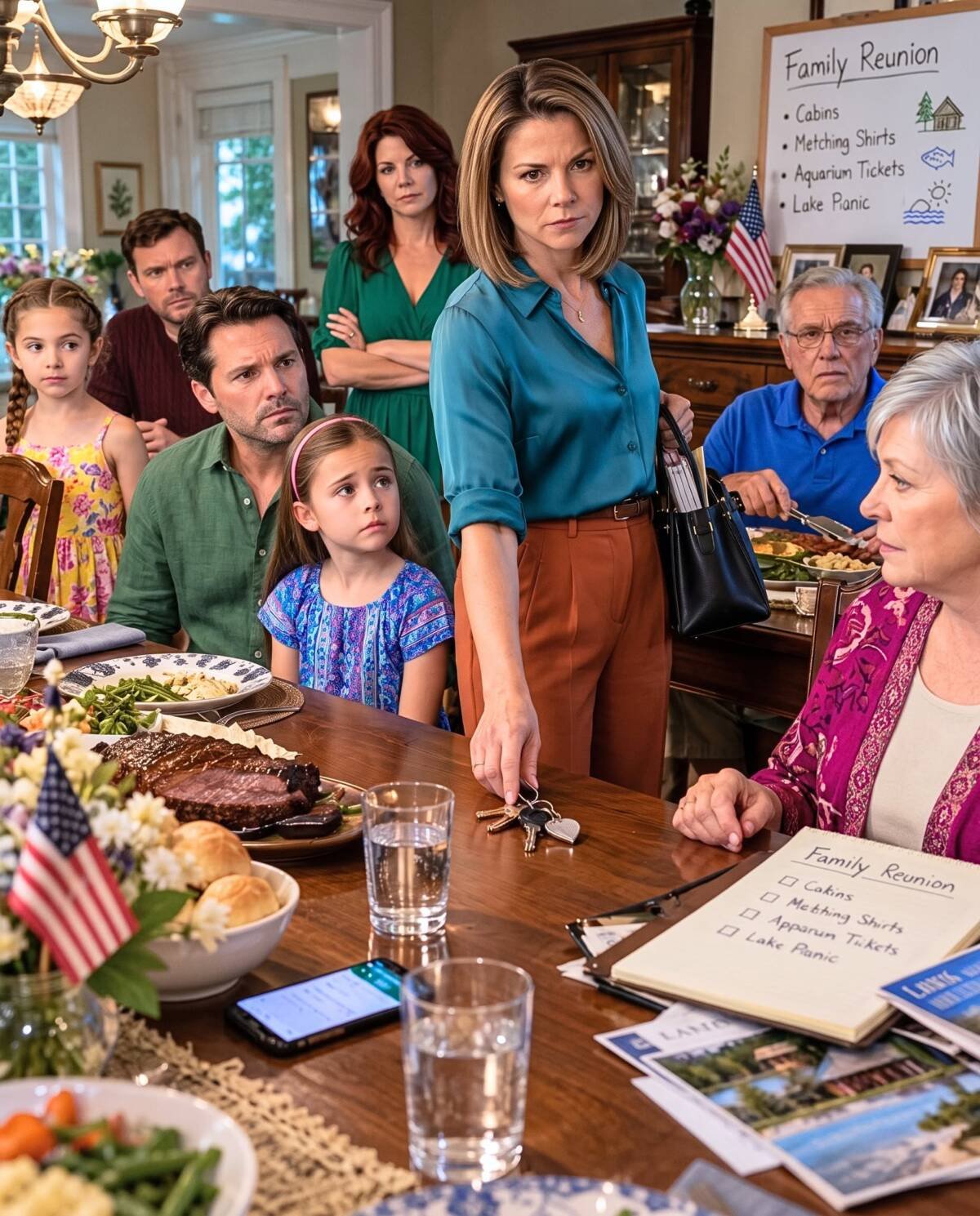
Alana was seated at the table beside Ellie and Mason. The table was covered with fried chicken, rice, bread, cheese, snacks, and chocolates Clarissa had purchased specifically for the children.
Mason was eating comfortably.
Dustin was not at the table.
Instead, he sat alone in an old armchair across the room. His head was lowered, and he held a small plastic plate containing nothing but a plain boiled potato.
When he noticed his mother, he quickly tried to hide the plate.
That tiny movement hurt Clarissa more than she expected.
Her son looked embarrassed, almost ashamed, as though he had done something wrong simply by being treated differently.
Alana stood abruptly.
“Clarissa! Why didn’t you tell us you were coming?”
Clarissa placed the grocery bags on the floor without answering. She walked straight to Dustin and knelt beside his chair.
“Sweetheart, why aren’t you eating at the table?”
Dustin glanced nervously toward his grandmother.
“Grandma said I couldn’t eat with them.”
Clarissa looked up.
“Why?”
Alana crossed her arms.
“He’s being disciplined.”
“For what?”
According to Alana, Dustin had been running around the garden, making noise, touching things, and bothering Mason. She claimed he needed stricter discipline because his behavior was becoming difficult to manage.
Dustin shook his head.
“My ball rolled near the flowers, Mom. I didn’t break anything.”
Then he lowered his voice.
“Grandma said I was making everyone uncomfortable.”
Alana sighed impatiently.
“There. He always has an excuse.”
Clarissa looked at Mason’s full plate, then at the lonely child sitting across the room.
Both boys had spent the day together. Both were children. Yet only one had been singled out and humiliated.
“Was Mason disciplined today?” Clarissa asked.
Ellie laughed.
“My son knows how to behave.”
She leaned back in her chair and reminded Clarissa that Alana had been helping care for Dustin for weeks. Rather than questioning them, Ellie suggested, Clarissa should be grateful that someone was willing to manage her son while she worked.
Clarissa could hardly believe what she was hearing.
Just two weeks earlier, Alana had practically begged her to let Dustin spend part of the summer at the country house. Before leaving him there, Clarissa had stocked both refrigerators, filled the pantry, left grocery money, purchased games and outdoor toys, and made sure there was enough food for everyone.
She had trusted them to care for her child.
Instead, the food she had provided was being enjoyed by everyone except him.
Clarissa slowly stood up and took Dustin’s hand.
“You have two hours,” she said.
Alana frowned.
“For what?”
“To pack.”
Ellie pushed her chair back.
“You’re throwing us out?”
“The train to Columbus leaves at 3:10. I suggest you be on it.”
Ellie’s expression changed immediately.
“You can’t throw us out of Parker’s house!”
Clarissa met her gaze.
“This isn’t Parker’s house. I bought it five years before I married him, and my name is the only one on the deed.”
For the first time since Clarissa had walked through the door, nobody had an answer.
But the confrontation had only just begun.
THE FIRST DECISION: HER SON WOULD NOT STAY ANOTHER MINUTE
Ellie was the first to recover.
Rather than acknowledging what had happened to Dustin, she tried to make Clarissa’s reaction seem unreasonable.
“You’re really creating a family crisis because a child didn’t get fried chicken?”
Clarissa tightened her grip on her son’s hand.
“No. This became a family crisis when you decided a seven-year-old should feel unwelcome around his own family.”
Alana rolled her eyes and accused her daughter-in-law of being dramatic.
Clarissa refused to argue.
She had no intention of debating whether humiliating a child counted as acceptable discipline. She had already made her decision, and she was not going to change it because the adults responsible for the situation were uncomfortable with the consequences.
She checked her phone.
“One hour and fifty-eight minutes.”
Ellie immediately threatened to call Parker, Clarissa’s husband.
“He’s going to hear exactly what you’ve done!”
Clarissa stopped on the stairs and turned toward her.
“Please call him.”
Parker loved his mother, and he had spent years trying to avoid arguments with her and Ellie. Clarissa knew that his instinct was often to calm everyone down rather than confront the people causing the problem.
But she also knew something else.
She would not teach her son that protecting adults from uncomfortable consequences mattered more than protecting his dignity.
Upstairs, Clarissa helped Dustin gather his clothes and toys.
For several minutes, he remained unusually quiet. Then he stopped folding a shirt and stared at his shoes.
“Mom?”
“Yes, sweetheart?”
“Was I bad?”
Clarissa immediately sat beside him.
“No. You did absolutely nothing wrong.”
He continued looking down.
His grandmother had made him feel that he deserved less than another child. Now he was beginning to wonder whether the treatment was his fault.
Clarissa gently pulled him closer.
“You are not bad. You are not a problem. And you never have to earn the right to be treated with kindness.”
Dustin nodded, but he still seemed afraid to say something.
Finally, he whispered the words that would change Clarissa’s understanding of the entire situation.
“Grandma said Mason gets more because he’s real family.”
Clarissa felt her hands go still.
“What do you mean, sweetheart?”
Dustin hesitated.
“She said Parker isn’t really my dad.”
For a moment, Clarissa could barely speak.
Parker had been raising Dustin since he was three years old. He had taught him to ride a bicycle, taken him to soccer practice, attended school performances, read him bedtime stories, and stayed beside him whenever he was sick.
Dustin had never questioned whether Parker was his father.
To him, Parker was simply Dad.
Now Alana had deliberately introduced a painful doubt into the mind of a seven-year-old child who had never had a reason to question where he belonged.
Clarissa wrapped her arms around him.
“Listen to me, sweetheart. Parker is your dad because he chose to be your dad every single day. He loves you, he takes care of you, and he is your family. Nothing Grandma says can change that.”
Dustin rested his head against her shoulder.
Clarissa held him for a long moment, trying to keep her anger from overwhelming the reassurance he needed.
She had arrived expecting to spend a peaceful weekend with her son.
Instead, she was discovering that the people entrusted with his care had been undermining his confidence and making him question the security of his own family.
Then her phone buzzed.
A new audio file had appeared to come from Ellie’s device.
Clarissa initially assumed it was an accidental recording of the argument downstairs. Still, something about the timing made her curious.
She pressed play.
And what she heard next turned a disturbing family incident into something much more serious.
WHAT THE RECORDING REVEALED
The recording began with Ellie’s voice.
“Do you think she believed it?”
Alana answered without hesitation.
“She reacted exactly the way we wanted.”
Clarissa stopped moving.
She replayed the beginning, making sure she had heard the words correctly.
Then Ellie continued.
“Keep making Dustin uncomfortable. Eventually, he’ll refuse to come here.”
Alana responded with a plan that made Clarissa’s stomach tighten.
“Once he stops coming, Parker can visit without them.”
Clarissa stared at the phone.
The separate meals. The comparisons with Mason. The comments about “real family.” The criticism of Dustin’s behavior.
Suddenly, the incidents that had seemed like individual acts of cruelty began to form a disturbing pattern.
The recording continued.
Ellie explained that they wanted Clarissa to become angry. If she reacted emotionally, they could portray her as the source of the family’s problems and use the confrontation as evidence against her.
“Clarissa will get angry. We’ll have proof of her making another scene, and Parker will finally understand that she’s the problem.”
Clarissa listened to the conversation in disbelief.
They had not simply decided that Dustin was difficult to manage. They had discussed making him feel unwanted until he stopped wanting to visit the country house.
They had not merely criticized Clarissa behind her back. They had planned to provoke her and use her response to influence Parker.
And the child caught in the middle was only seven years old.
Clarissa saved the recording immediately.
She listened to the final section again, then checked that the file had been stored securely.
She could have stormed downstairs and confronted them with what she had heard. She could have shouted, demanded explanations, and given them the dramatic confrontation they apparently expected.
But she realized that would accomplish very little.
They already knew how to turn a disagreement into an argument about Clarissa’s behavior. What they could not easily explain away was their own recorded conversation.
So she made another decision.
Parker would hear the truth directly from them.
Clarissa forwarded him the audio file without adding a lengthy explanation.
Then she waited.
Within a minute, her phone rang.
It was Parker.
His voice sounded different from the moment she answered. There was none of the hesitation or careful diplomacy he normally used when dealing with his mother and sister.
“I’m coming home.”
Clarissa remained quiet.
Then Parker added something she had rarely heard him say so firmly.
“Don’t let Mom or Ellie speak to Dustin again until I get there.”
There was a pause.
“Clarissa?”
“Yes?”
“When I get there, I’m going to tell my mother something I should have told her a long time ago.”
The call ended.
Clarissa looked at her son, who was sitting quietly on the bed beside his packed clothes.
Dustin’s face was calmer than it had been downstairs, but his uncertainty had not disappeared.
“Is Dad mad at me?” he asked.
Clarissa shook her head.
“No. He’s not mad at you.”
Dustin looked down at his hands.
“Is Grandma leaving because of me?”
Clarissa took both his hands in hers.
“She’s leaving because of the choices she made. None of this is your fault.”
She knew that reassurance would not instantly erase what he had heard and experienced. But she wanted him to understand one thing before another adult entered the room and began discussing the situation.
He was not responsible for the choices of the people who had hurt him.
The responsibility belonged to them.
PARKER HEARS THE TRUTH
Downstairs, suitcases were being dragged across the floor.
Ellie was still complaining loudly about Clarissa’s decision. Alana, meanwhile, sounded confident that Parker would arrive and put everything back the way she wanted.
Clarissa did not correct them.
She stayed with Dustin until she heard a car pull into the driveway.
Parker arrived about forty minutes later.
From upstairs, Clarissa heard Ellie greet him with obvious relief.
“Finally. You need to talk some sense into her.”
Parker did not immediately respond.
When Clarissa and Dustin came downstairs, Alana was standing beside her suitcase with her arms folded. She looked as though she expected her son to reverse the situation and send Clarissa away with an apology.
But Parker did not approach his mother first.
He walked directly to Dustin.
Then he knelt in front of the boy and placed both hands gently on his shoulders.
“I need you to hear something from me.”
Dustin looked nervous.
Parker kept his voice steady.
“You are my son. You have been my son since the day I chose to be your dad, and nobody gets to tell you otherwise.”
Dustin stared at him.
For the first time that afternoon, Clarissa saw the boy’s expression soften.
Parker continued.
“I love you. That will never change because of anything Grandma says or anything anybody else thinks.”
Dustin moved closer to him.
Clarissa turned away for a moment, struggling to contain her emotions. Parker’s words were exactly what her son needed to hear, but she also knew they were only the beginning of what it would take to repair the damage.
Parker remained beside Dustin until the boy seemed reassured.
Then he stood and turned toward his mother.
Alana’s confidence began to fade.
“What exactly did Clarissa tell you?” she asked.
Parker reached into his pocket, took out his phone, and placed it on the table.
“She didn’t have to tell me anything.”
He pressed play.
The recording filled the room.
Everyone heard Ellie’s question, Alana’s response, and their discussion about making Dustin uncomfortable until he no longer wanted to visit.
Then came the part about provoking Clarissa and using her anger to convince Parker that she was the problem.
By the time the recording ended, nobody was speaking.
There was no longer any need for Clarissa to explain why she had made them leave. The people involved had described their intentions in their own words.
Parker picked up his phone and looked at his mother.
“You deliberately made a seven-year-old child feel unwanted so you could push him away from me.”
Alana immediately tried to defend herself.
“I was protecting the family.”
Parker’s expression remained firm.
“Protecting the family from what? A little boy who loves you?”
Alana shifted her gaze toward Dustin.
“He isn’t your blood, Parker. You can care about him, but that doesn’t make him the same as real family.”
The room fell silent again.
For years, Parker had avoided confronting his mother directly. He had often convinced himself that staying quiet was the best way to prevent family disagreements from becoming worse.
But this time, he did not retreat.
“You don’t get to decide who my son is.”
Ellie interrupted, accusing Clarissa of manipulating him and turning him against his own family.
Parker stopped her.
“This isn’t Clarissa turning me against you. This is me hearing exactly what you said when you thought nobody else was listening.”
He looked at his sister.
“You planned to make my son feel unwanted. You planned to push my wife into an argument so you could use her reaction against her. And you expected me to believe you were the victims.”
Ellie opened her mouth, but Parker continued before she could respond.
“You didn’t just insult Clarissa. You used a child to get what you wanted.”
For the first time, Alana appeared unable to find an answer.
She tried to argue that she and Ellie had simply wanted more time with Parker without what she described as constant family tension.
Parker shook his head.
“If spending time with me requires humiliating my wife and making my child question whether he belongs, then you’ve misunderstood what family means to me.”
He turned toward Dustin and placed an arm around his shoulders.
“This is my son. Clarissa is my wife. They are my family. If you cannot respect both of them, you do not get access to me.”
The words were simple, but their meaning was unmistakable.
For years, Alana had expected Parker to prioritize her feelings, even when doing so meant ignoring the consequences of her behavior.
Now she was hearing a boundary she could no longer dismiss.
Parker told his mother and sister that they would leave the country house as Clarissa had instructed. He also made it clear that there would be no visits with Dustin and no phone calls to him while they continued to deny responsibility for what they had done.
“You wanted him to feel like he wasn’t family,” Parker said. “Until you understand why that was wrong, you won’t be part of his life.”
Ellie protested that Clarissa had already thrown them out and that Parker was taking things too far.
Parker reminded her that the house belonged to Clarissa and that neither of them had the right to treat it as their private family property.
Alana turned toward Clarissa.
Her expression suggested that she still expected her daughter-in-law to soften the decision now that Parker had taken her side.
Clarissa said nothing.
She did not need to.
The boundary had been set, and for once, the adults responsible for the conflict would have to live with the consequences.
THE QUESTION THAT BROKE PARKER’S HEART
Less than an hour later, Alana and Ellie loaded their suitcases into a taxi headed toward the train station.
Clarissa stood in the doorway beside Parker and Dustin, watching the vehicle disappear down the road.
Nobody celebrated.
There were no triumphant speeches or expressions of victory.
There was simply the quiet realization that a relationship had changed in a way that could not be undone by pretending the afternoon had never happened.
Parker knelt beside Dustin again.
“I should have protected you from this sooner.”
Dustin studied his face.
Then he asked a question that made Clarissa’s heart ache.
“Are you still my dad?”
Parker’s expression changed.
He immediately pulled the boy into his arms.
“Always. Nothing will ever change that.”
Dustin wrapped his arms around his father and held on tightly.
For the first time since Clarissa had arrived, he smiled.
It was a small smile, and it did not erase what had happened. But it was a reminder that the child who had been made to feel unwanted still had adults willing to stand beside him and make sure he understood that he belonged.
Clarissa watched them embrace and realized that the most painful part of the day had never really been about the food.
It was about the fact that someone had deliberately tried to damage a child’s sense of security to influence the adults around him.
Alana and Ellie had wanted to control the family dynamic.
Instead, their own actions had exposed the problem that Parker could no longer ignore.
THE CONVERSATION THAT CHANGED THEIR MARRIAGE
That evening, after Dustin finally fell asleep, Clarissa and Parker sat together in the kitchen.
The country house felt unusually quiet.
For a while, neither of them spoke.
Parker looked exhausted. The confrontation with his mother and sister had forced him to face something he had spent years trying to avoid: his desire to keep the peace had sometimes come at the expense of the people he was supposed to protect.
Finally, he broke the silence.
“I kept telling myself I was protecting everyone by staying out of it.”
Clarissa looked at him.
“But staying out of it didn’t protect everyone.”
Parker nodded slowly.
She continued, explaining that silence had never actually prevented conflict. It had simply allowed Alana and Ellie to believe they could cross boundaries without being challenged.
Every time Parker had avoided an uncomfortable conversation, the underlying problem had remained unresolved.
And every time he had asked Clarissa to be patient, the responsibility for maintaining peace had fallen on her.
“I didn’t want you to feel like you were competing with my family,” Parker said.
“I’m not competing with your family,” Clarissa replied. “I’m asking you to protect the family we’ve built.”
Parker looked down at the table.
For the first time, he seemed to understand the difference.
Clarissa had never asked him to stop loving his mother. She had never demanded that he abandon his sister or reject his relatives simply because they disagreed with her.
What she needed was much simpler.
She needed him to recognize that loving his relatives did not mean allowing them to mistreat his wife or child.
Parker finally spoke again.
“Dustin isn’t someone I tolerate because I married you. He’s my son because I chose to become his father.”
Clarissa listened carefully.
Those words mattered, but she also knew they needed to become more than a promise made after a crisis.
Parker seemed to understand that, too.
Over the following weeks, he became more deliberate about setting boundaries. He stopped allowing conversations about Dustin to turn into comparisons with Mason. He refused to let his mother frame the situation as a disagreement between adults when the person most affected was a child.
He also stopped expecting Clarissa to be the one who managed every difficult interaction with his relatives.
If Alana wanted to discuss the situation, she would have to speak with Parker directly and acknowledge what had happened.
If Ellie wanted to rebuild their relationship, she would have to accept that her behavior had consequences.
Neither woman would be permitted to use Dustin as leverage again.
THE MONTHS THAT FOLLOWED
Alana called several times after leaving the country house.
At first, she tried to argue that Clarissa had overreacted. She suggested that the recording had been taken out of context and insisted that she had only wanted to teach Dustin discipline.
Parker refused to engage in another argument about whether his wife’s reaction had been justified.
“The issue isn’t whether Clarissa was upset,” he told her. “The issue is what you deliberately did to a child.”
Alana continued to insist that she had been protecting the family.
Parker asked her to explain how making a seven-year-old feel inferior to his cousin could possibly protect anyone.
She had no convincing answer.
Ellie tried a different approach.
She sent messages claiming that the situation had been exaggerated and that everyone had made mistakes. She suggested that the family should move forward rather than continue discussing something that had already happened.
Parker responded only once.
He reminded her that the recording existed and that no amount of rewriting the story could change what she and Alana had said.
Then he stopped debating the issue.
For a while, Dustin refused to talk about the country house.
Whenever Mason’s name came up, he became quiet. Sometimes he asked whether his cousin had been told what happened. Other times, he simply changed the subject.
Clarissa and Parker did not force him to discuss it.
They understood that a child who had been made to question his place in the family needed time to feel secure again.
Instead, they focused on the everyday moments that had always mattered to him.
They attended his soccer games. They cooked dinner together. They spent weekends doing activities he enjoyed. Parker made a point of being present, not only during difficult conversations but also during the ordinary moments that helped Dustin feel loved.
They did not repeatedly remind him of what Alana had said.
They showed him, through their actions, that he was valued.
Slowly, Dustin became more comfortable.
He stopped asking whether he had done something wrong. He began talking about school and soccer again without the same hesitation. He laughed more easily and seemed less worried about whether the adults around him were disappointed in him.
The family did not pretend that nothing had happened.
Instead, they worked to ensure that the experience did not define how Dustin understood himself.
“DO YOU THINK GRANDMA WILL EVER LIKE ME AGAIN?”
Several months later, Parker was helping Dustin repair his bicycle in the garage when the boy asked a question that neither parent had forgotten.
“Do you think Grandma will ever like me again?”
Parker set down the wrench.
He did not dismiss the question or tell Dustin that he was too young to worry about such things.
Instead, he looked at his son carefully.
“This was never about whether you were good enough for Grandma,” he said. “You were always good enough. She was the one who made a bad choice.”
Dustin considered the answer for a moment.
Then he returned his attention to the bicycle.
Parker watched him quietly, understanding that he could not control whether his mother eventually accepted responsibility for her actions.
What he could control was how he treated his own son.
He could make sure Dustin never again had to wonder whether love depended on biology, whether family members were allowed to humiliate him, or whether his place in the household could be taken away whenever someone became angry.
That was the responsibility Parker had finally accepted.
And it mattered far more than winning an argument with his mother.
AN APOLOGY DID NOT ERASE WHAT HAD HAPPENED
Eventually, Alana sent a written apology.
It acknowledged some of the harm she had caused, but the family did not immediately return to the way things had been.
Parker made it clear that forgiveness and reconciliation were not the same thing.
He was willing to consider rebuilding the relationship if his mother demonstrated genuine accountability and stopped making excuses for her behavior.
But Dustin’s emotional well-being would come first.
There would be no pressure on him to visit the country house, speak on the phone, or pretend he felt comfortable around someone who had deliberately made him question whether he belonged.
Any future contact would depend on whether Dustin felt ready and whether Alana could respect the boundaries his parents had established.
Ellie, too, would have to accept that rebuilding trust required more than insisting everyone move on.
Clarissa did not view these boundaries as punishment.
She saw them as necessary protection.
Children should not have to tolerate humiliation simply because the people responsible are relatives. Nor should they be expected to repair relationships that adults damaged through their own choices.
If Alana and Ellie wanted to become part of Dustin’s life again, they would have to demonstrate that they understood what had gone wrong.
Until then, distance was the healthier choice.
THE COUNTRY HOUSE BECAME A DIFFERENT PLACE
Over time, the country house changed in meaning for Clarissa and her family.
Before that Friday afternoon, it had been a place where relatives gathered, children played, and everyone was expected to get along.
Clarissa had assumed that shared family history would be enough to ensure that Dustin was treated with kindness.
She had been wrong.
The house had also become a place where some relatives believed they could decide who belonged, who deserved attention, and whose feelings mattered.
After the confrontation, those assumptions were no longer accepted.
The property remained Clarissa’s, but its importance had little to do with ownership. What mattered was that she had refused to let her child remain in an environment where he was being deliberately made to feel inferior.
She had drawn a boundary that afternoon, and Parker had finally stood beside her.
Together, they made it clear that no family member would be allowed to use access to a home, a holiday, or a relationship as a way to control their child.
Dustin would not be required to prove his worth to earn a place at the table.
He already had one.
WHAT CLARISSA NEVER FORGOT
Even months later, Clarissa could still picture the moment she had first entered the dining room.
She remembered the full plates on the table.
She remembered the chocolates she had bought for both boys.
Most of all, she remembered Dustin sitting alone in the old armchair, trying to hide a plate containing nothing but a plain boiled potato.
At first, she had thought the cruelest part of the experience was that adults had excluded a seven-year-old from a family meal.
But as the truth emerged, she realized the food had only been the beginning.
The deeper cruelty was the deliberate attempt to convince Dustin that he mattered less than another child because he was not biologically related to Parker.
They had taken something he had never questioned—his place in his family—and tried to turn it into a source of insecurity.
They had hoped that by making him uncomfortable, they could influence Parker’s relationship with his wife and eventually gain the freedom to see him without Clarissa and Dustin.
They had treated a child’s feelings as a tool in an adult conflict.
And they had expected nobody to challenge them.
What they had failed to understand was that family loyalty does not require silence in the face of cruelty.
It does not require parents to overlook harmful behavior simply because the person responsible is a relative.
And it certainly does not require a child to accept humiliation to keep the adults around him happy.
Clarissa had not arrived at the country house planning to confront anyone.
She had brought groceries, hoping to surprise her son.
But when she saw how he was being treated, she made a decision that changed the course of their family’s life.
She chose her child over appearances.
She chose his dignity over a convenient peace.
And she refused to let anyone convince him that he was less deserving of love.
THE TRUE MEANING OF FAMILY
Parker also learned something that Friday afternoon.
For years, he had believed that avoiding confrontation was a way to preserve his relationships. He had tried to keep his mother happy, prevent arguments with his sister, and avoid forcing the people he loved to choose sides.
But silence had not solved the underlying problems.
It had allowed them to continue.
When he finally heard the recording, he understood that protecting his family sometimes meant disappointing people he loved.
He could love his mother without agreeing with her.
He could care about his sister without allowing her to mistreat his wife.
And he could respect his family’s history without permitting anyone to use that history as an excuse to hurt his child.
Most importantly, he understood that fatherhood was not a title his mother could grant or withdraw.
It was a commitment he had made to Dustin, and one he intended to keep.
Clarissa never needed Parker to prove that he was willing to argue with his relatives.
She needed him to show their son that he was safe, loved, and wanted.
By the time the country house became a place of happy memories again, that lesson had become part of the foundation of their family.
Real family was never about whose blood matched whose.
It was about who stayed when things became difficult.
It was about who protected a child when standing up for him came at a personal cost.
It was about who made sure he never had to earn the right to belong.
And sometimes, it was about having the courage to say no to people who believed that sharing a last name gave them permission to hurt you.
Clarissa had walked into the country house expecting an ordinary weekend.
She left that afternoon knowing something she would never forget.
A child should never have to sit across the room wondering why everyone else deserves a place at the table except him.
And no parent should ever be asked to sacrifice a child’s dignity for the sake of keeping the family peace.
Because in the end, the people who truly belong in your life are not the ones who demand loyalty while causing harm.
They are the ones who show you, through their actions, that your well-being matters.
They are the ones who stand beside you when it would be easier to look away.
And they are the ones who remind you, especially when the world tries to make you feel otherwise, that you were always worthy of love.
What would you have done if you had walked into that dining room and found your child sitting alone with a plain potato while everyone else enjoyed a feast?
Would you have given the family another chance, or would you have drawn the same boundary Clarissa did?
Share your thoughts in the comments, and if you believe every child deserves to feel loved, protected, and included, share this story with someone who needs that reminder.