When my sister humiliated me in front of nearly 200 wedding guests, she thought she was reminding everyone that I was the family disappointment. She had no idea that the man standing beside her at the altar was about to expose a secret that could destroy everything she had spent years pretending to own.
The laughter reached me before the pain did.
One moment, I was reaching for my chair at the family table. The next, my sister yanked it backward, and I crashed onto the polished ballroom floor in front of nearly 200 wedding guests.
A champagne flute shattered beside my elbow. Someone gasped. Several people laughed.
And my sister, Vanessa, stood over me in her expensive white wedding gown, smiling as though she had just delivered the evening’s best entertainment.
“Careful, Claire,” she said. “You don’t belong at the family table.”
For a moment, I couldn’t move. My elbow throbbed, my dress had twisted beneath me, and the faces surrounding the table seemed to blur beneath the ballroom lights.
Then I noticed my mother.
She had covered her mouth with one hand, pretending to be horrified. But I knew that expression. Beneath the performance was the same familiar amusement I had seen on her face throughout my childhood whenever Vanessa found a new way to make me feel small.
One of my uncles actually applauded.
A waiter hurried over to collect the broken glass, but no one offered me a hand.
I pushed myself upright, brushed the dust from my dress, and looked at my sister.
Vanessa had spent nearly fifteen years making sure I understood exactly where she believed I belonged.
She was the beautiful daughter. The charming daughter. The one whose photographs filled our parents’ living room and whose accomplishments were announced at every family gathering.
I was Claire, the quiet accountant who wore practical shoes, avoided arguments, and rarely gave anyone a reason to notice her.
At least, that was the version of me my family preferred.
What almost nobody in that ballroom knew was that I had spent twelve years helping rebuild our late grandfather’s real estate company after my father nearly drove it into bankruptcy.
I was the chief financial officer of Hawthorne Properties. I had helped restructure its debt, renegotiate contracts, restore investor confidence, and protect the family’s most valuable assets.
My position was earned, not inherited out of pity.
But Vanessa had never accepted that distinction.
She preferred to tell people that our grandfather had given me a senior title because he felt sorry for me.
That evening, as I stood beside the overturned chair, I realized she had not changed at all.
She was simply performing for a larger audience.
“Go sit near the kitchen,” she continued, adjusting the delicate bracelet on her wrist. “That’s where staff belongs.”
A few guests laughed again.
I opened my mouth to respond, but another sound interrupted me.
A chair scraped sharply against the floor.
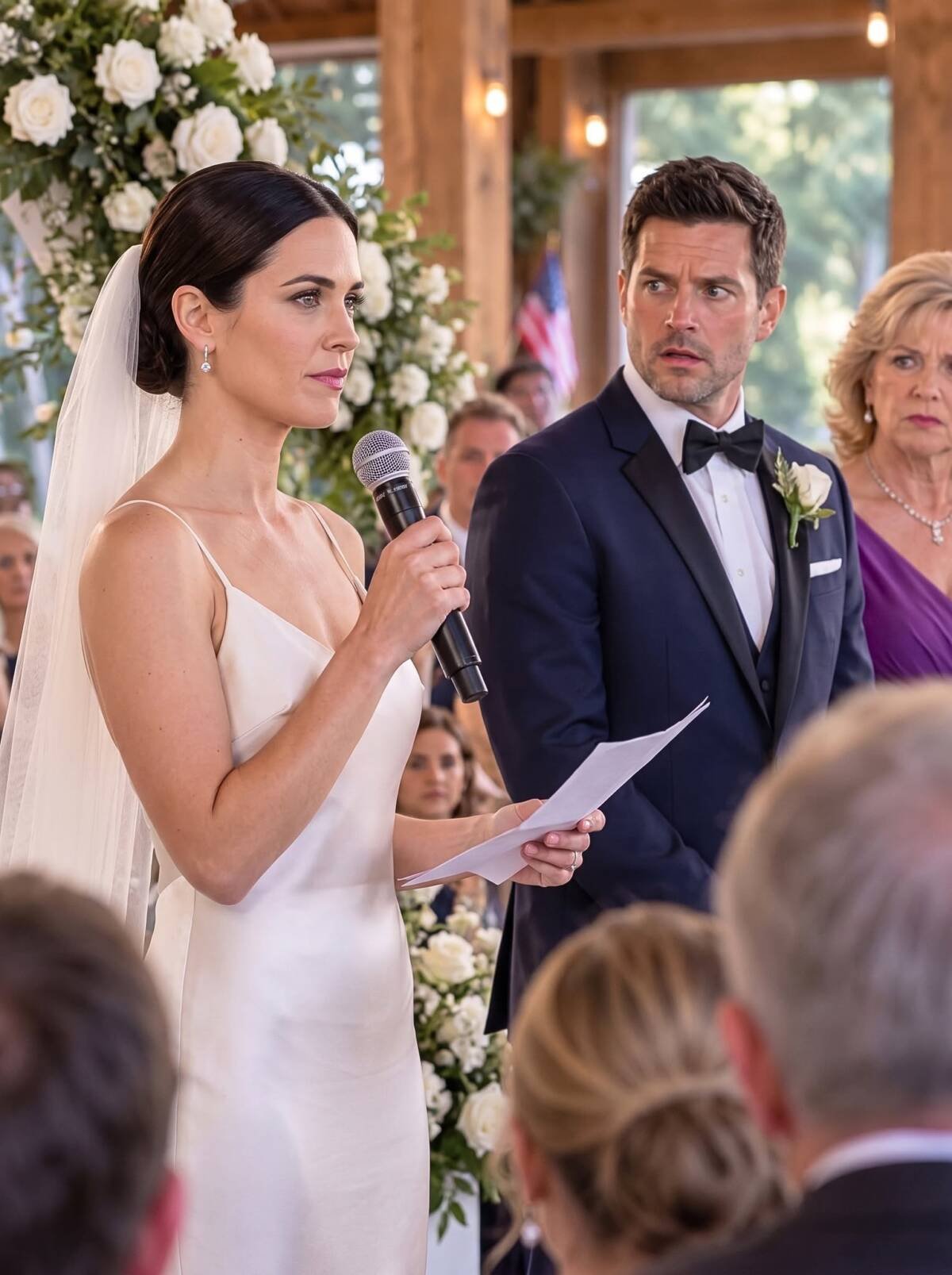
Daniel, Vanessa’s groom, had stood up.
His expression was so furious that the laughter began to fade before he even spoke.
“That’s enough!”
The words carried across the ballroom.
Vanessa turned toward him, her smile faltering.
“Daniel, sit down.”
He ignored her.
Instead, he stared at his new bride as though he were seeing someone entirely different from the woman he had promised to marry that morning.
“Do you really want me to tell everyone the truth?”
Vanessa went completely still.
For the first time that evening, I saw genuine fear in her eyes.
She reached for his wrist as he moved toward the microphone, but he pulled away.
My mother rose quickly from her chair.
“This is a wedding,” she announced, forcing a nervous laugh. “Everyone is emotional. Let’s not turn a small misunderstanding into something it isn’t.”
A small misunderstanding.
That was what she called it when Vanessa humiliated me.
That was what she called it when my father dismissed my work, when relatives repeated lies about me, and when I was expected to apologize simply because I had finally defended myself.
I looked at Daniel, then at Vanessa.
Suddenly, I understood why he seemed so angry.
Three nights earlier, he had called me with an unusual question.
He wanted to know whether Vanessa had any legal authority over Hawthorne House, the historic family estate where they planned to live after their honeymoon.
I had answered honestly.
“No.”
There had been a long silence.
Then Daniel had asked whether I was absolutely certain.
I told him that I was the registered owner under our grandfather’s estate plan and that the property was protected by the relevant trust documents.
When I asked why he needed to know, he hesitated.
“I just need to understand something,” he finally said.
He ended the call without explaining further.
Now, watching him move toward the microphone while Vanessa desperately tried to stop him, I realized that whatever she had told him about Hawthorne House was beginning to unravel.
I brushed the dust from my dress and stepped forward.
“Daniel, wait.”
Nearly every face in the ballroom turned toward me.
Vanessa let out a short, mocking laugh.
“See? Claire knows her place.”
I met her eyes.
“No,” I said quietly. “I’m giving you one last chance to tell the truth yourself.”
Her face lost its color.
Because there was one fact she had spent months pretending did not exist.
Hawthorne House did not belong to our parents.
It did not belong to Vanessa.
It belonged to me.
And before the night was over, nearly 200 wedding guests would learn why my sister had been so desperate to keep that fact hidden.
The Family Secret Behind Hawthorne House
To understand why Vanessa reacted so strongly to the mention of Hawthorne House, it helps to understand the family she and I grew up in.
Our grandfather, Arthur Hawthorne, had built his real estate business over several decades. He began with a handful of rental properties and gradually expanded into commercial buildings, residential developments, and historic estates.
He was a demanding businessman, but he believed that responsibility mattered more than appearances.
He also believed that family members should earn positions rather than expect them.
My father, Richard, never quite accepted that philosophy.
He wanted the prestige of running a successful company, but he was less comfortable with the discipline required to maintain one. Several risky investments and poorly negotiated agreements eventually placed Hawthorne Properties under severe financial pressure.
By the time I joined the company full-time, the situation was worse than most relatives understood.
Bills were accumulating. Contracts needed renegotiation. Investors were losing confidence, and the company was dangerously close to losing control of several important properties.
I had trained as an accountant, and numbers had always made more sense to me than family politics.
I understood cash flow, debt obligations, operating expenses, and the importance of keeping accurate records. More importantly, I understood that a company could appear wealthy on paper while quietly running out of money.
I began working with our financial advisers and legal team to identify the biggest risks.
The process took years.
I worked late nights, attended difficult meetings, and spent weekends reviewing contracts that my father had neglected. I helped negotiate repayment schedules, sell underperforming assets, and rebuild the company’s financial reporting systems.
Grandfather watched the process closely.
He rarely offered praise, but he began asking for my opinion before making major decisions.
When he died, his estate plan reflected the responsibilities he believed I had earned.
Hawthorne House and the controlling shares of Hawthorne Properties were transferred to me under the applicable estate documents. My parents received substantial financial trusts, while Vanessa inherited cash, jewelry, and an investment account.
Nobody had been left without an inheritance.
Vanessa simply believed she deserved mine as well.
She had always imagined herself living at Hawthorne House. She liked its sweeping staircase, manicured gardens, and tall windows overlooking the grounds. She liked the idea of hosting charity events there and introducing herself as the woman who had inherited the Hawthorne legacy.
She rarely discussed the responsibilities that came with owning such a property.
To her, the estate was a symbol.
To me, it was an asset that required maintenance, insurance, financial planning, and careful legal protection.
The difference between those perspectives had caused years of resentment.
Whenever I reminded Vanessa that she did not own the property, she accused me of being petty.
Whenever I explained the company’s finances, she told people I was trying to make myself sound important.
And whenever Grandfather praised my work, she claimed he was being manipulated.
After his death, those accusations became more frequent.
My father occasionally suggested that I should consider transferring the estate to Vanessa because she was better suited to entertaining guests and representing the family socially.
I refused.
The refusal changed the atmosphere at home.
My mother became distant. My father accused me of putting business ahead of family. Vanessa began telling relatives that I had stolen the inheritance that should have been hers.
I tried to ignore the gossip.
I had a company to run, employees who depended on it, and financial obligations that could not be solved by arguing over family pride.
But I underestimated how far Vanessa was willing to go to get what she wanted.
The Document That Changed Everything
Six months before the wedding, an internal compliance alert brought a suspicious transaction to my attention.
Someone had submitted documents to a private lender suggesting that Hawthorne House could be used as collateral for a business loan.
The proposed amount was three million dollars.
At first, I assumed it was an administrative mistake.
The paperwork included copies of trust records and an authorization supposedly signed by me. According to the document, I had agreed to let Vanessa use the property to secure the loan.
I had signed no such authorization.
I examined the paperwork carefully.
The signature looked convincing at a glance. Vanessa had copied the broad, decorative version of my signature that I sometimes used on personal cards and informal correspondence.
My legal signature was different.
It was shorter, more compact, and used consistently on official documents.
That difference alone did not establish who had created the document, but it gave our legal team a clear reason to investigate.
I contacted the company’s attorney and provided the original records for review. We also notified the lender that the authorization was disputed.
A forensic document examiner was engaged to assess the signature, and the lender’s fraud department began preserving relevant correspondence and verification records.
I did not confront Vanessa immediately.
There was a reason for that decision.
If I accused her without understanding the full transaction, she could deny everything, destroy relevant records, or persuade our relatives that I was simply trying to sabotage her wedding.
I wanted the facts established before the family turned the matter into another emotional argument.
Over the following weeks, the investigation uncovered a troubling pattern.
The lender had received repeated communications presenting Vanessa as someone entitled to arrange financing against Hawthorne House. The disputed authorization was accompanied by confidential trust information that should not have been shared without proper authority.
Our legal team continued communicating with the lender while its fraud department reviewed the proposed transaction.
The loan was never funded.
That fact was important. Although the paperwork had progressed far enough to require serious investigation, no three-million-dollar loan had been issued against the estate.
Vanessa, however, appeared to believe that the transaction was close to completion.
She had already told Daniel that money from the proposed loan would help finance a new medical clinic he hoped to establish.
To him, she described the arrangement as a legitimate financial opportunity supported by her family’s estate.
He believed she was telling the truth.
I later learned that he had begun questioning the story after discovering inconsistencies in the documents.
That explained his call three nights before the wedding.
He had not been asking about Hawthorne House out of curiosity.
He had been trying to determine whether his future wife had misrepresented her ownership rights.
And the answer had changed everything.
Vanessa Tries to Take Control of the Room
Back in the ballroom, Vanessa seemed determined to prevent the truth from becoming public.
She turned toward the guests, lifted her chin, and forced a smile onto her face.
“Claire is confused,” she announced. “Grief did strange things to her after Grandpa died.”
Several relatives exchanged sympathetic looks.
It was a familiar tactic. Whenever Vanessa could not answer a question, she tried to make the person asking it appear unreliable.
She had used the same strategy for years.
If I corrected one of her financial claims, I was jealous. If I challenged her version of a family event, I was bitter. If I refused to give her something she wanted, I was selfish.
She had learned that people were often more comfortable believing a simple accusation than examining a complicated truth.
Then she turned back toward me.
“You handle paperwork, Claire. Don’t confuse that with ownership.”
I could have listed every relevant document.
I could have explained the estate transfer, the company records, and the legal basis for my ownership. I could have described the years I spent helping rebuild the business.
But I knew that arguing with Vanessa would only give her another opportunity to redirect the conversation.
Instead, I looked at Daniel.
“Ask her what she told you about the property,” I said.
He did not hesitate.
“Tell her what you told me.”
Vanessa’s jaw tightened.
“We can discuss this privately.”
“No,” Daniel replied. “You told me Claire stole your inheritance. You said Hawthorne House belonged to you and that she refused to transfer it unless you paid her.”
A wave of whispers moved across the ballroom.
My mother stepped between them.
“This is a family matter. There is no reason to involve everyone.”
Daniel looked at her.
“Your daughter involved everyone when she told me she owned a house she doesn’t own.”
My father, Richard, finally spoke.
“Daniel, you don’t understand the history of this family.”
“Then explain it,” Daniel replied. “Explain why the documents say one thing and Vanessa told me another.”
My father opened his mouth, then closed it.
I recognized that silence.
It was the same silence I had heard during difficult board meetings when he knew the numbers did not support his argument.....