When Hannah’s mother excluded her young stepdaughter from a family reunion, she expected her daughter to accept the decision quietly. Instead, Hannah made one choice that exposed years of favoritism, emotional manipulation, and a painful truth about what her family really valued.
Introduction: The Moment Everything Changed
“There’s no room for her at the reunion. She isn’t really family.”
My mother said those words while standing in the middle of a Sunday dinner, surrounded by relatives who suddenly seemed more interested in their plates than in the eight-year-old girl sitting nearby.
My stepdaughter, Sophie, had been talking excitedly about the family reunion for nearly an hour. She wanted to know whether the children would be allowed to touch the stingrays at the aquarium, whether there would be games by the lake, and whether she could wear the matching family T-shirt everyone had been discussing.
She had no idea that the adults around her had already decided she did not belong.
My mother expected me to accept her decision. My sister appeared to agree with her. My father remained silent, and my brother avoided looking at me.
For a moment, I could hardly believe what I was hearing.
Sophie was eight years old. She lived in my home, shared our everyday routines, and was one of the most important people in my life. I helped raise her, cared for her when she was sick, packed her lunches, listened to her worries, and made sure she knew she was loved.
Yet my own family was treating her as though she were an unwanted guest.
I could have argued. I could have raised my voice, demanded an explanation, or tried to convince my mother that her words were cruel.
Instead, I reached into my purse, took out the keys my parents had given me years earlier, and placed them on the dining table.
“If Sophie isn’t family,” I said quietly, “then neither am I.”
The room went silent.
What happened next would change my relationship with my parents, expose a pattern of behavior I had spent years overlooking, and force me to reconsider everything I had believed about loyalty, obligation, and the meaning of family.
But the most important consequence was not what happened to the adults who rejected Sophie.
It was what happened to an eight-year-old girl who had begun to wonder whether she deserved to belong.
Part 1: The Sunday Dinner That Exposed the Truth
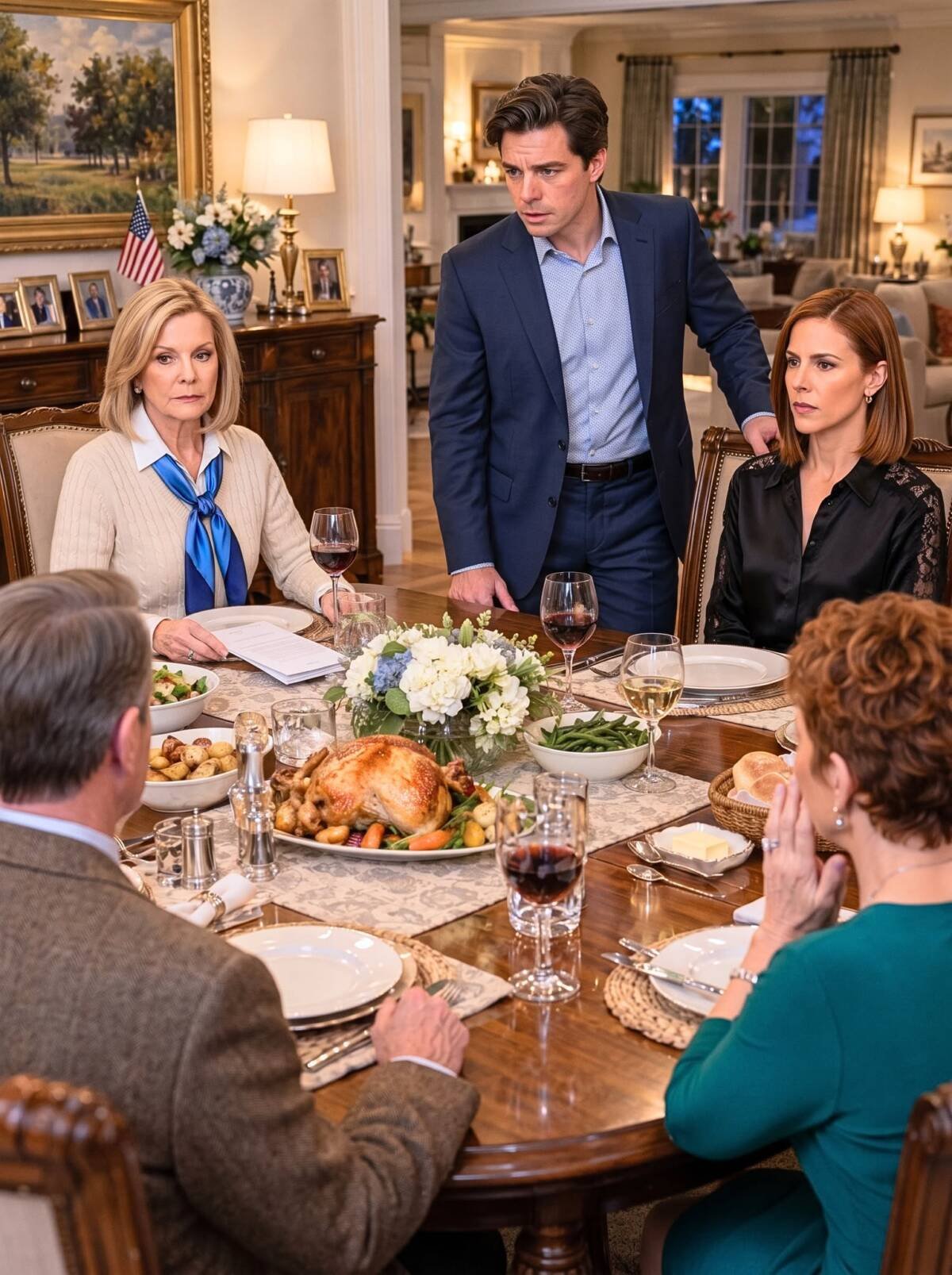
Sunday dinner at my parents’ house had always followed a familiar routine.
My father carved the meat, my mother moved between the kitchen and dining room, and my siblings discussed work, children, and the latest developments in our extended family. The younger children ran between the adults, occasionally being reminded to sit down or finish their food.
That Sunday was no different.
My husband, Michael, sat beside Sophie, carefully cutting her chicken into smaller pieces. When Sophie became excited, she tended to talk faster than she ate, and Michael had learned to help her without interrupting the stories she loved telling.
I watched her explain something to one of her cousins while she built a small tower from crackers.
She looked happy. Comfortable. Included.
Then my mother appeared with a legal pad in one hand and a coffee pot in the other.
She had been organizing the family reunion scheduled for the following weekend. The arrangements included rented cabins, matching T-shirts, aquarium tickets, and a lakeside picnic for the children.
Everyone had been discussing the plans for days.
Sophie was especially excited about the aquarium.
“Are we really going to see the stingrays?” she asked.
“If the touch tank is open, we should be able to,” I told her.
She smiled and returned to her dessert.
A few minutes later, I noticed my mother exchanging a glance with my sister, Lauren. It was brief, but something about it made me uneasy.
Then my mother approached me.
“There isn’t room for her at the reunion,” she said.
I looked up.
“For whom?”
“Sophie. The numbers have already been finalized.”
At first, I assumed there had been a misunderstanding. Perhaps the cabins had reached their capacity, or perhaps the tickets had been purchased before Sophie’s attendance was confirmed.
Those problems could have been solved.
“Then call and add one more person,” I said. “We still have a week.”
My mother tightened her expression.
“It’s too late.”
Before I could respond, Lauren put down her glass.
“Hannah, she isn’t really family.”
The words seemed to stop the conversation around us.
I looked at my sister, waiting for her to clarify what she meant. She did not.
Instead, she explained that the reunion had been planned for the family’s children and that Sophie was Michael’s daughter, not one of the biological cousins.
My father continued looking at his plate.
My brother, Kevin, rubbed the back of his neck but said nothing.
I glanced toward Sophie.
She was sitting only a few feet away. Her hands had stopped moving, and the crackers she had been arranging were scattered across the table.
She had heard them.
That realization hurt more than anything my mother had said to me.
“Sophie is family,” I replied. “She is my stepdaughter. She lives in my home, and I help raise her. She is eight years old, and she can hear you talking about her as if she is someone nobody wants around.”
My mother sighed.
“Please don’t make this dramatic. Everything has already been arranged.”
Lauren crossed her arms.
“She’s Michael’s daughter. She isn’t actually one of the cousins.”
I wanted to ask my sister how she could look at a child and decide that her place in our family was conditional. I wanted to ask my father why he was allowing his granddaughter, at least in every meaningful sense of the word, to be humiliated in front of everyone.
But I did not need to ask.
Their silence had already told me something important.
They knew what was being said. They had an opportunity to challenge it. They chose not to.
Then Sophie looked at me.
She did not ask her grandmother to reconsider. She did not argue that she belonged.
She simply looked at me with the quiet, uncertain expression of a child waiting to see whether the adult she trusted would stand up for her.
That was the moment I understood that my response would matter long after the reunion was over.
I reached into my purse and took out the key ring my parents had given each of their adult children years earlier.
The keys had once represented trust, belonging, and the understanding that their home would always be open to me.
I placed them on the table.
“If Sophie isn’t family, then neither am I,” I said.
Nobody moved.
“And if I’m not family, you cannot continue expecting me to fulfill every family obligation while excluding the child I consider mine.”
Michael had turned toward us. He noticed Sophie’s expression and immediately understood that something serious had happened.
He did not shout or threaten anyone.
He simply told Sophie to get her coat.
I picked up my purse, and we left.
Behind us, the keys remained on the table.
I did not know then how much my decision would change our lives. I only knew that I could no longer ask Sophie to trust me while allowing other adults to treat her as though she were disposable.
For years, I had tried to keep the peace in my family.
That evening, I finally decided that peace was not worth the price of her self-respect.
Part 2: The Question Sophie Asked When We Got Home
The drive home took about twenty minutes.
Sophie sat quietly in the back seat, looking out the window. Michael kept his eyes on the road, and I struggled to find words that would make sense of what had happened.
When we arrived home, I expected Sophie to return to her usual routine. Instead, she went to her room and began arranging her stuffed animals on the bed.
She lined them up, moved them around, and started again.
I recognized the behavior as a way of keeping herself occupied while she tried to process something she did not fully understand.
I sat beside her.
“Do you want to talk about dinner?”
She shook her head.
I waited.
A few minutes later, she asked a question that broke my heart.
“Did I do something bad?”
I immediately turned toward her.
“No, sweetheart. You did absolutely nothing wrong.”
She looked down at her hands.
“Then why doesn’t Grandma want me at the reunion?”
I took her hand.
“Your grandmother made a hurtful decision. That decision was not your fault.”
Sophie was quiet for a moment.
Then she asked the question I had been dreading.
“Is it because I’m not really yours?”
I felt the words settle heavily in my chest.
“No,” I told her. “You are my family. I love you, and I am here for you. Nobody gets to decide that you do not belong in our home or in our lives.”
She studied my face as if she were trying to determine whether I truly meant it.
“Even though I had another mom first?”
I moved closer and wrapped an arm around her.
“Your first mother will always be your mother. Loving you does not mean replacing her or pretending she never existed. You can love and remember her, and you can love me too. There is room for all of that.”
Sophie leaned against me.
I held her until she felt ready to return to her stuffed animals.
Later, after she had gone to bed, I thought about how easily adults can underestimate the impact of their words on children.
My mother and sister might have regarded the reunion as a private family arrangement. They might even have convinced themselves that they were simply managing logistics.
But Sophie had not heard a discussion about capacity.
She had heard a discussion about whether she belonged.
And because she was eight, she had begun by wondering what she had done wrong.
That was the part I could not forgive myself for overlooking.
How Sophie Became Part of My Life
I first met Sophie when she was four years old, while I was working as a pediatric nurse.
Her mother had died, and Sophie was struggling with the kind of grief that can be difficult for a young child to express. Sometimes it appeared through sleepless nights. Sometimes it showed up as stomachaches or sudden questions about death, separation, and whether the people she loved would leave her too.
Michael was doing everything he could to support her.
He was tired, frightened by the responsibility of raising a grieving child, and still learning how to navigate conversations for which there were no easy answers. But he was patient with Sophie. He listened when she spoke, answered her questions honestly, and sought guidance when he needed it.
Over time, Michael and I became friends.
Our conversations gradually extended beyond the clinic. Coffee turned into walks, and walks eventually became dates.
When I first spent time with Sophie outside work, there was no expectation that I would become her mother or replace the woman she had lost.
We simply spent a Saturday together at a park.
There were muddy shoes, juice boxes, playground equipment, and a little girl who had an endless supply of questions.
I learned that she liked her sandwiches cut a certain way. She loved bedtime stories and wanted to hear the same ones repeatedly. When she was nervous, she asked questions. When she was comfortable, she talked enough for three people.
Our relationship grew naturally.
I helped with school pickups, prepared meals, read bedtime stories, and sat beside her when she needed reassurance. I learned how to recognize the difference between an ordinary childhood worry and a moment when she needed extra patience.
I also made sure she understood that loving me did not require her to forget her first mother.
There was never a competition between those relationships.
I was not trying to erase the past. I was trying to help Sophie feel secure in the present.
Eventually, Michael and I built a life together.
Sophie became part of our everyday decisions, our traditions, our holidays, and our plans for the future.
I did not think of her as a responsibility I had agreed to take on.
I thought of her as a child I loved.
That was why my family’s rejection was so painful. They were not merely excluding a child from a weekend outing. They were dismissing a relationship that had developed through years of care, patience, and trust.
Worse, it was not the first time they had treated her differently.
It was simply the first time they had explained their reasoning so openly.
Part 3: The Small Exclusions That Had Been Happening for Years
After that Sunday dinner, I began reconsidering memories I had previously dismissed as misunderstandings.
At Thanksgiving, the other grandchildren had received personalized gift bags. Sophie received leftover items that had not been assigned to anyone else.
At Christmas, the children had ornaments with their names printed on them. Sophie’s ornament was missing, and she was eventually given a generic tin of chocolates with her name misspelled.
At family birthday gatherings, the other children posed together for photographs. More than once, Sophie was left standing outside the group until I stepped forward and brought her into the frame.
Each incident had seemed small enough to explain away.
Perhaps my mother had forgotten to order something. Perhaps the ornaments had been mixed up. Perhaps everyone had been distracted during the photographs.
I had offered those explanations because I wanted to believe my family would eventually accept Sophie without being asked.
But the incidents were no longer isolated.
They formed a pattern.
The biological grandchildren were included automatically. Sophie had to be remembered, accommodated, or specifically defended.
I had been asking for basic consideration while telling myself that patience would eventually solve the problem.
It had not.
And there was another contradiction I could no longer ignore.
My parents had always relied on me.
I visited them regularly, helped organize their medications, checked my father’s blood pressure, ran errands, and took care of household tasks whenever they needed assistance.
I also sent them $300 each month to help with expenses because their retirement income was limited.
I did those things because I loved them and believed family members should help one another when they could.
I had never considered those contributions a transaction.
I did not help my parents because I expected to receive something in return. I helped because I wanted them to be comfortable and safe.
But sitting beside Sophie that evening, I finally recognized the imbalance in our relationship.
My family considered me dependable when they needed something.
They expected me to show up, provide assistance, contribute money, and organize the details that made their lives easier.
Yet when it came to the child I loved, they were unwilling to extend even the basic courtesy of inclusion.
I had spent years assuming that my commitment to my parents would eventually encourage them to respect my household.
Instead, I had allowed the responsibilities I carried to become so routine that nobody seemed to question whether the arrangement was fair.
The realization was painful, but it was also clarifying.
I could continue being a loving daughter without accepting every demand placed on me.
I could care about my parents without allowing them to determine whether Sophie deserved a place in my life.
And I could establish boundaries without becoming the person they would inevitably accuse me of being.
I did not need to stop loving my family to stop participating in a pattern that hurt my child.....