When an eight-year-old boy was wheeled into the emergency room with a dangerously high fever and a failing pulse, his mother stood calmly in the corner holding a coffee cup, insisting it was nothing more than a seasonal bug. She only asked for a quick prescription so they could go home.
But the moment the attending physician saw the boy’s swollen, blue fingertips protruding from a filthy, month-old fiberglass cast, she knew this was not the flu. When she ordered the cast to be cut off immediately, the mother’s calm demeanor shattered. She didn’t just object—she panicked, lunged toward the stretcher, and begged the doctors not to open it.
What the medical team discovered beneath that sealed shell left even veteran emergency nurses frozen in shock—and led to a heartbreaking confession that revealed just how long the boy had been trying to warn her.
The Warning Signs in Trauma Room 2
The smell reached the main hallway before the stretcher even cleared the emergency-room doors. It was a heavy, sickening blend of sweetness, metal, and decay that cut effortlessly through the sharp scent of hospital disinfectant. At the nurses’ station, heads turned immediately. Anyone who had spent more than a week in emergency medicine knew that odor meant one thing: this was not a routine pediatric visit.
My name is Dr. Sarah Jenkins. After eight years working in a high-volume emergency department, I had learned a hard truth about the job. The most dangerous cases rarely arrive with screaming relatives or dramatic, visible trauma. More often, a critically ill child arrives beside an adult who speaks so calmly, so reasonably, that for a brief, perilous moment, everyone in the room is tempted to believe nothing serious has happened.
Marcus, one of our most reliable trauma nurses, hurried toward me with one hand pressed firmly over his surgical mask. His eyes were wide above the blue fabric.
“Trauma Two,” he said quickly. “Eight-year-old male. Temp is 103.8, heart rate is pushing 140, and his blood pressure is bottoming out. He’s barely responsive to verbal cues.”
“What’s the chief complaint?” I asked, already moving down the corridor.
“His mother says it’s a mild flu,” Marcus replied, lowering his voice as we approached the sliding glass doors. “But you need to see his arm.”
The moment I stepped inside Trauma Room 2, the odor hit me like a wall. On the stretcher lay a boy who looked far smaller than his eight years. His lips were dry and cracked, his cheeks hollow, and his skin had taken on that pale, waxy sheen that tells a physician a child’s body has been fighting a losing battle for far longer than a few hours.
My eyes dropped immediately to his right arm. It was encased in a fiberglass cast stretching from his knuckles to above his elbow. The exterior was grimy and mottled with dark, dried stains. Worse, the rigid edge near his palm had bitten deeply into severely swollen flesh, and the fingertips peeking out from the end had turned an unmistakable shade of blue.
I stepped to the bedside and gently pressed the tip of his index finger to check his capillary refill.
The skin stayed pale. The color did not return.
“How long has this cast been on?” I asked, keeping my eyes on the boy’s hand.
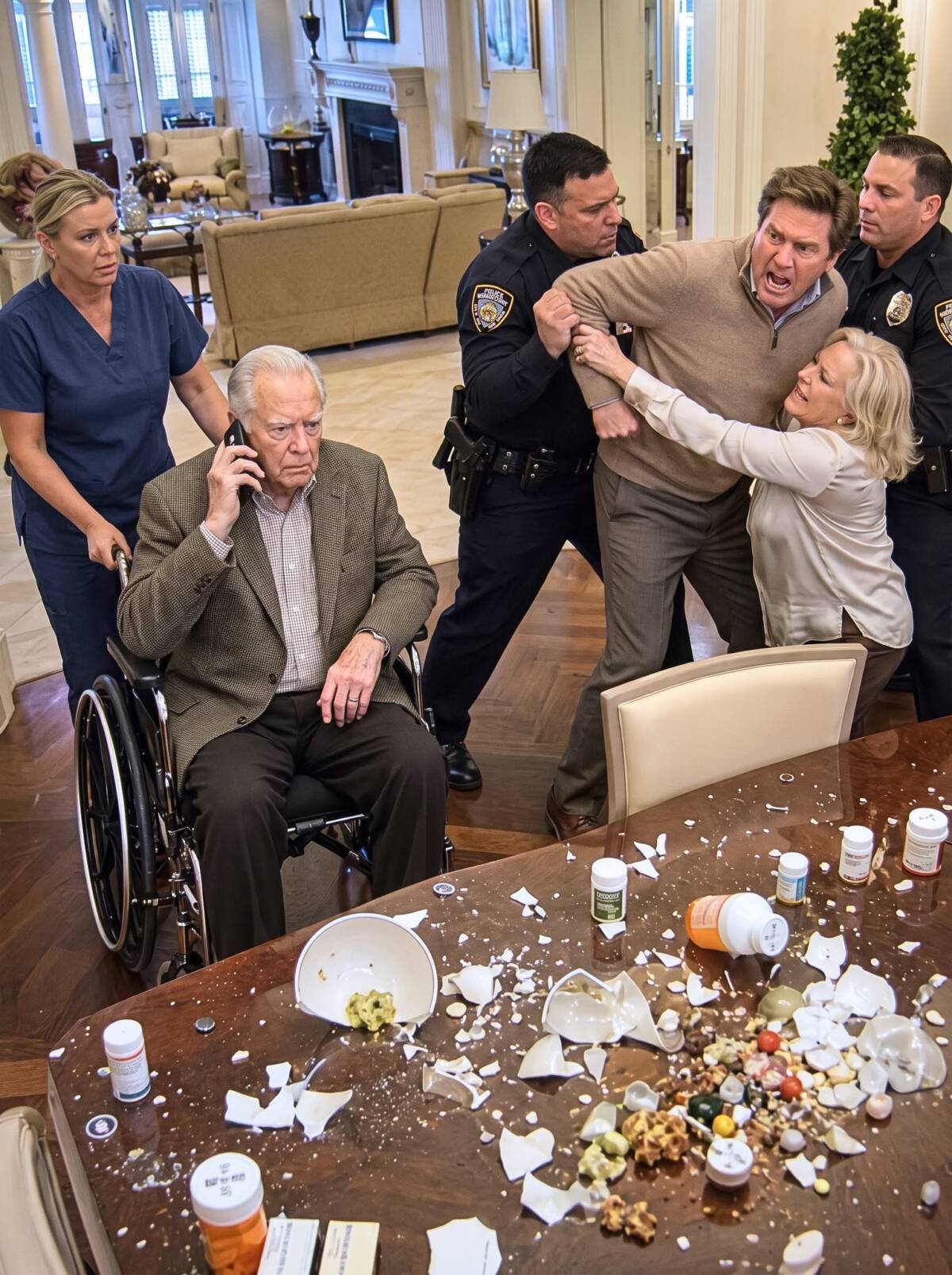
Across the room, his mother, Martha Harris, stood near the counter holding a Starbucks cup as though she were waiting through an inconvenient oil change. Dressed in a spotless cream sweater, a strand of pearls, and a neatly styled blonde bob, she looked entirely detached from the medical crisis unfolding six feet away.
“Oh, about a month,” she said with a casual shrug. “He’s clumsy. Always falling out of trees in the backyard. We really only came in because he felt warm this morning. I’m sure it’s just whatever seasonal bug is going around school.”
Nothing she was saying aligned with the monitors behind her. Her son’s vitals pointed directly toward septic shock—a life-threatening systemic response to severe infection. Combined with the blue discoloration and lack of circulation in his fingers, whatever was trapped inside that fiberglass was actively destroying tissue and poisoning his bloodstream.
“Mrs. Harris,” I said, turning to face her. I kept my voice level, but there was no room left for polite negotiation. “Your son is critically ill. That cast needs to come off right now. He is at immediate risk of losing his hand—and if this infection has spread as far as his vitals suggest, he could lose his life.”
When Anger Turned to Panic
I expected fear. I expected tears, or a frantic rush to the bedside. Instead, Martha looked annoyed.
“No,” she said flatly, shifting her coffee cup to her other hand. “His orthopedic surgeon told us that cast is not to be touched for another two weeks. Just give him some antibiotics for the fever and we’ll be on our way.”
Behind me, Clara—one of our most seasoned emergency nurses—had already doubled up on her masks and dabbed peppermint oil beneath her nose to combat the overwhelming stench. Marcus was moving fast, prepping pediatric IV lines and initiating our hospital’s sepsis protocol.
As I watched Martha cross her arms, a cold, familiar memory surfaced in the back of my mind. Three years earlier, I had treated another young child whose caregiver offered smooth, polished explanations for injuries that didn’t quite add up. Back then, I had noted my concerns in the chart, but I had hesitated. I had given the adult the benefit of the doubt for just a little too long. When that child returned to our ER weeks later in far worse condition, I made a silent vow: I would never again let a confident adult talk me out of trusting the evidence right in front of me.
“Clara, call security,” I ordered, turning toward the supply cart. “And bring me the cast saw.”
The shift in Martha was instantaneous. Her calm composure evaporated. She dropped her coffee onto the counter and lunged toward the stretcher, her voice rising into a sharp shout.
“You can’t touch him!” she yelled. “I’m his mother! I do not consent to this! I will sue this hospital into the ground!”
Clara stepped smoothly between Martha and the boy, shielding him without raising her voice. Seconds later, two hospital security officers entered the room and gently but firmly guided Martha back toward the corner. She pulled against them, still threatening lawsuits, until Clara set the electric cast saw down on the sterile drape beside the boy’s arm.
Then, something strange happened.
The fight drained out of her. Her shoulders sagged, her face went pale, and her anger collapsed into something much quieter and far more telling.
“Don’t open it,” she whispered.
I froze and looked straight at her. “Why?”
Martha couldn’t meet my eyes. She stared fixedly at the stained fiberglass. “Please,” she said, her voice trembling. “Just don’t open it.”
In that single second, everything clicked into place. Martha wasn’t an uninformed parent who had simply missed the signs of an infection. She knew something was inside that cast—and she was terrified of what we were about to see.
What Lay Beneath the Cast
While Marcus pushed IV fluids and broad-spectrum antibiotics, Clara stabilized the boy’s arm. I leaned down close to his ear so he could hear me over the steady beeping of the heart monitor.
“Hey, buddy,” I said softly. “My name is Dr. Sarah. Your arm is very sick, and I need to take this cast off so we can help you. It’s going to make a loud buzzing sound, okay? It won’t cut your skin.”
His cracked lips parted, as if he wanted to answer, but he didn’t have the strength.
I switched on the saw.
Across the room, Martha repeatedly pleaded for me to stop, her voice rising and falling behind the security guards. The fiberglass was dense and stubborn, resisting the blade at first. As I worked carefully down the length of the cast and finally pried the two halves apart, the odor surged outward so intensely that even Marcus had to turn his head away behind his mask.
The cotton padding underneath was completely ruined—soaked through, compressed, and darkened by moisture and contamination that had clearly been trapped against the boy’s skin for a long time.
When Clara carefully lifted the top layer of sodden gauze away, several pale larvae fell from the decaying padding and hit the sterile linoleum floor.
For two full seconds, nobody in Trauma Room 2 moved. Even professionals who had seen the worst the world had to offer were momentarily stunned into silence.
Then, training took over.
Beneath the padding, the boy’s forearm was grotesquely swollen, red, and severely infected, with areas of compromised skin that had been sealed away in a dark, damp environment without air or medical care. This had not started that morning. It had not even started yesterday.
“Get pediatric surgery on the phone—stat,” I called out.
Marcus was already on the wall phone while Clara and I worked swiftly to clear away the remaining contaminated debris and flush the area. Across the room, Martha suddenly found her voice again, launching into a frantic stream of excuses.
“He’s always playing outside,” she said rapidly. “He gets filthy. He must have shoved dirt or sticks down inside it himself. I swear, he never even said it hurt that badly!”
I stopped what I was doing and looked up at her.....