When a medical emergency strikes in the delivery room, every second counts—and the last thing any expectant mother should have to do is stare at an empty chair while doctors fight to save her babies. At 2:17 p.m., with alarms blaring and three tiny heartbeats faltering on the monitor, Emily Carter signed the emergency C-section consent forms alone.
Miles away, her husband, Mark, saw her name light up his phone screen—and deliberately powered it off so he wouldn’t interrupt a private celebration with his first love. Four days later, Mark finally walked back into the maternity ward expecting to find his wife waiting to forgive him. Instead, one calm sentence from a passing nurse stopped him cold and forced him to realize that the life he had taken for granted was already gone.
The Empty Chair at 2:17 p.m.
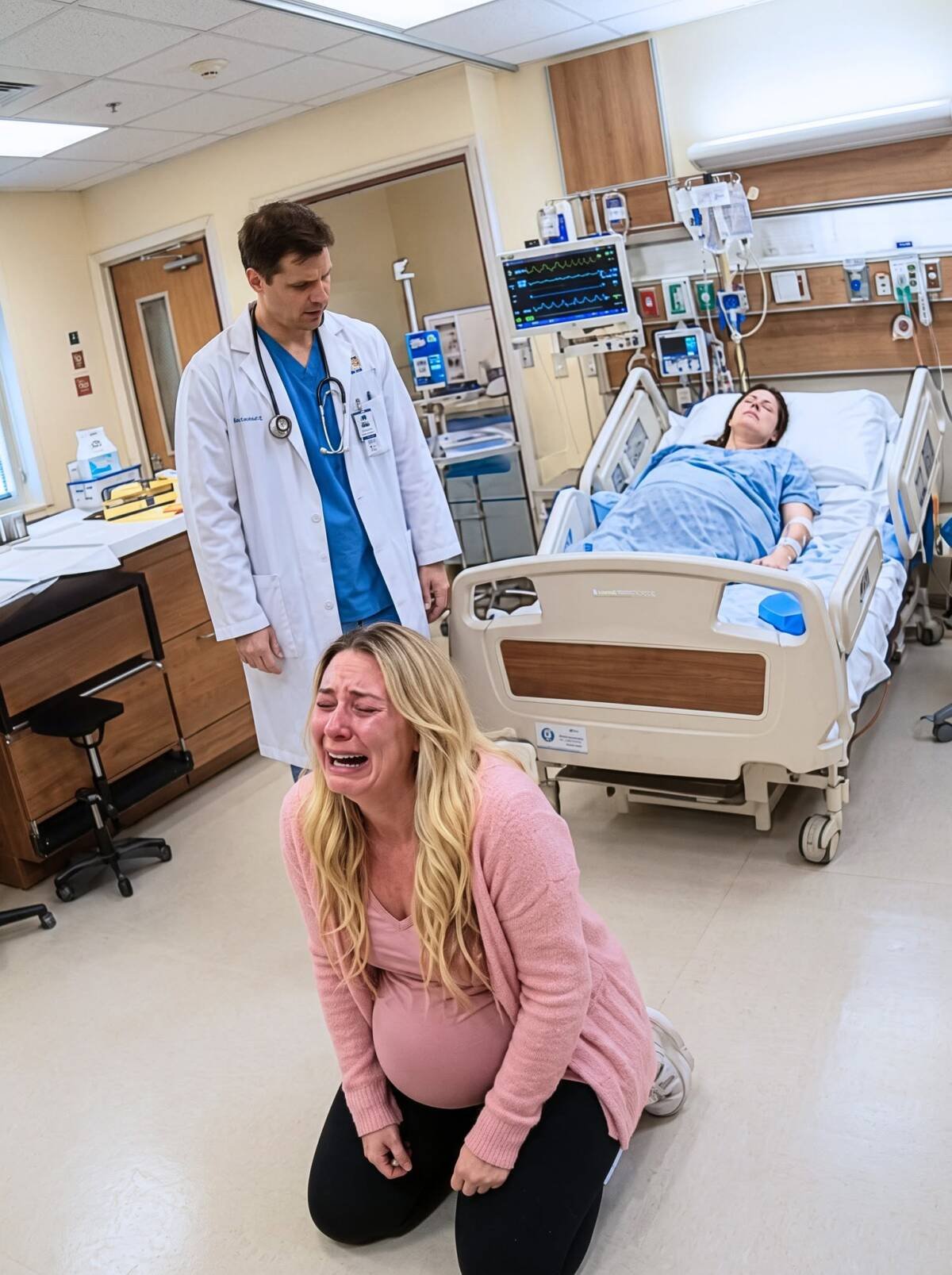
The emergency surgical consent form rested against my trembling stomach because the rolling bedside tray was already crowded with IV lines, blood pressure cuffs, and medical equipment. Around me, the maternity suite had transformed from a quiet waiting room into a high-stakes crisis zone. The fetal monitors were sounding sharp, rhythmic alarms as three tiny heartbeats jumped unevenly across the glowing screen, each one struggling as the medical team raced to calculate how much time we had left.
Dr. Naomi Patel studied the jagged lines on the monitor for only a few seconds before turning to face me. She didn’t need to raise her voice; the quiet urgency in her eyes told me the truth before she even spoke.
“Mrs. Carter, we have to perform an emergency C-section immediately,” Dr. Patel said, her voice steady but firm. “Baby B is showing severe distress, and Baby C’s umbilical cord is compressed. If we wait any longer, we could lose all three.”
My lips were parched, and a cold wave of terror made it nearly impossible to draw a full breath. Instinctively, I turned my head toward the padded vinyl chair beside my bed—the exact spot where my husband was supposed to be sitting.
It was empty.
Less than an hour earlier, Mark had squeezed my hand, kissed my forehead, and promised he would only be gone for a few minutes.
“I’m just stepping out to make one quick call,” he had said, already glancing at his watch. “I’ll be right back.”
Forty minutes had passed since he walked out the door. As the alarms continued to pierce the air, I swallowed against the panic tightening my throat and looked up at Charge Nurse Lauren.
“Please,” I whispered, my voice cracking. “Call my husband again.”
Lauren didn’t hesitate. She picked up the bedside phone and dialed his number. I watched her face as the seconds ticked by. The first call went straight to voicemail. She hung up and tried a second time. Still nothing. When she dialed a third time, the line didn’t even ring.
What I didn’t know, lying under the harsh fluorescent lights of the hospital, was that Mark was nowhere near the building.
A Private Celebration Miles Away
Miles across town, Mark was standing inside an elegant private dining room at an exclusive country club. Crystal chandeliers cast a warm, golden glow over white linen tables, and soft instrumental music drifted through the air. Across from him stood Madison Vale—his first love, and the woman he had spent months assuring me was nothing more than an old friend from his past.
Between them sat a tiered white chocolate raspberry cake decorated with fresh, blush-colored roses. Mark and Madison were standing shoulder to shoulder, their hands resting together on the handle of a silver cake knife as they prepared to cut the first slice.
Just as they leaned in, Mark’s phone began to vibrate inside his suit jacket.
He pulled it out and glanced at the screen. My name was glowing in bold letters.
Emily.
Mark stared at the screen long enough to know exactly who was calling—and to remember where he had left me. His jaw tightened for a fraction of a second. Instead of swiping to answer, he pressed and held the side power button until the screen faded to complete black.
He slipped the dead phone back into his pocket.
Madison looked up at him with a soft, knowing smile. “Today is about us.”
Mark let out a breath and returned her smile. Together, they pressed the silver knife through the frosting.
Three Names in the Operating Room
Back at the hospital, I took the pen from Nurse Lauren with fingers so cold and shaky I could barely grip the plastic. I looked up at Dr. Patel, terrified that signing my name on that dotted line might be the final decision I ever made for my daughters.
“If I sign this,” I asked, tears spilling over my lashes, “will they live?”
Dr. Patel held my gaze without blinking. “We are going to do everything humanly possible.”
It was the only promise anyone in that room could give me. I pressed the pen to the paper and signed my name.
Within moments, the hallway blurred past me as the medical team wheeled my bed into the operating room. The air was freezing, and the controlled urgency of the nurses and anesthesiologist moved around me like a choreographed storm. As the medication began to numb my lower half, I fought to stay conscious, silently repeating the three names I had chosen during the quiet, lonely nights at home when I folded miniature onesies and imagined holding my girls.
Grace. Lily. Hope.
Minutes stretched into what felt like hours. Then, suddenly, a sharp, fierce little cry cut through the sterile silence of the operating room. Relief hit me so hard I gasped, fresh tears pooling in my ears. A second cry followed just moments later—stronger, insistent, alive.
I held my breath and waited for the third.
Seconds passed. Then more. The silence where the third cry should have been felt heavier than anything I had ever experienced.
“What about Baby C?” I cried out, trying to lift my head over the blue surgical drape. “Why isn’t she crying?”
A voice answered quickly from somewhere beyond my line of sight. “We’re still working on her, Emily. Stay with us.”
The bright overhead lights began to swim and blur as severe blood loss and sheer exhaustion pulled at the edges of my consciousness. For one desperate, impossible second, I pictured Mark bursting through the double doors—breathless, terrified by what he had almost missed, finally realizing that his wife and newborn daughters mattered more than anything else in the world.
But the doors never opened. Mark never came.
When my eyes finally fluttered shut, the only hand holding mine belonged to a nurse.
Four Days Too Late
When Mark finally decided it was time to return to the hospital, he walked through the sliding glass doors carrying an overnight bag as if he were merely arriving a few hours behind schedule. The faint scent of expensive vanilla frosting still lingered on his jacket, subtly mixed with traces of Madison’s perfume.
During the elevator ride up to the maternity floor, he silently rehearsed the explanation he fully expected me to accept. He would tell me his battery had died. He would reassure himself that hospitals always exaggerated routine complications. Most of all, he assumed that once he apologized and calmed me down, I would forgive him—just as I always had before.
When the elevator doors chimed open, he walked confidently down the corridor toward my room.
Then he stopped dead in his tracks.
The door was wide open. The hospital bed had been stripped bare and remade with crisp, empty sheets. The only sign that I had ever been there was the generic bouquet his office had sent, still sitting untouched on the windowsill with the card dangling from its ribbon. There was no wife waiting to confront him. No bassinets. Only a hollow, echoing silence.
Mark spun around and stepped into the hallway, stopping a passing nurse.
“Excuse me,” he said, his voice tight. “My wife—Emily Carter. She delivered triplets. Where did you move her?”
The nurse paused, studying his face for a moment before a flicker of recognition crossed her eyes. “Emily Carter?”
“Yes. My wife.”
Her expression shifted from recognition to quiet confusion. “She was discharged four days ago.”
Mark froze, the words refusing to register.
The nurse glanced into the empty room, then looked back at him and asked the one calm question that completely shattered his composure.
“Isn’t she home?”
For the first time since he had powered off his phone at the country club, Mark was completely speechless. He stood there holding his overnight bag, realizing with sickening clarity that reality had not paused to wait for his excuses. Four full days had passed.
“What do you mean, discharged?” Mark demanded, his voice rising. “She was admitted here. She was having complications. I stepped out, and now you’re telling me she just left?”
“Sir, I need you to lower your voice,” the nurse said firmly, her expression shifting into something Mark found far harder to stomach than anger: pity. She glanced down at his empty wrists—no visitor band, no NICU clearance badge, nothing to suggest he had been present for a single hour of the last four days. “I can’t discuss patient details without proper authorization. You’ll need to speak with the attending physician or patient services.”
Panic finally overtook his confidence. Mark pulled his phone from his pocket and looked at the screen he had deliberately ignored. There were twenty-six missed calls, fourteen voicemails, nine urgent text messages from the hospital, three from his mother, and one from an unfamiliar number.
There was not a single message from me after the surgery.
He hit dial on my number. It went straight to voicemail. He hung up and tried twice more, receiving the exact same automated greeting. Lowering the phone, he caught sight of Charge Nurse Lauren watching him steadily from behind the nurses’ station.
“You,” Mark said, striding over. “Where is my wife?”
“Mr. Carter,” Lauren replied evenly. “Before she was discharged, Emily amended her contact and privacy permissions. She requested that no personal information be released to you beyond what hospital policy legally requires.”
Mark stared at her in disbelief. “That’s impossible. She was barely conscious.”
“She was fully conscious when she signed the paperwork,” Lauren said, her tone cool and deliberate.
The word signed hit him like a physical blow, instantly reminding him of the emergency consent form I had signed alone while his phone sat dark inside his jacket.
“I need to see my children,” he said, his voice shaking. “They’re my kids.”
“They are also patients,” Lauren replied. “There are protocols.”
Mark went quiet. The last of his bravado crumbled, leaving behind the one terrifying question he had been too afraid to ask.
“Are they alive?”
Lauren didn’t answer right away. Those few seconds of silence were enough to make his knees weaken. “You need to speak with Dr. Patel.”
The Truth Behind Closed Doors
Twenty minutes later, Dr. Naomi Patel met Mark inside a small, windowless consultation room. Two boxes of tissues sat in the center of the table, making his stomach drop before she even closed the door.
“Where are they?” he asked immediately.
Dr. Patel sat across from him, folding her hands. “Before we discuss anything, I had to verify your legal status, Mr. Carter, because your wife restricted access to her records.”
“She was angry,” Mark said quickly, grasping for a familiar narrative. “She overreacted because I wasn’t here.”
“She was recovering from major abdominal surgery, severe blood loss, and the premature delivery of three infants,” Dr. Patel corrected calmly.
Each phrase landed like a weight on his chest.
“I didn’t know it was that serious,” he muttered.
“We called you repeatedly.”
“My phone died.”
Even Mark heard how hollow the lie sounded the moment it left his lips. Dr. Patel didn’t argue; she simply noted that the calls had gone directly to voicemail after ringing initially, leaving no room for his story to hold up.
“How is Emily?” he asked, his voice barely above a whisper.
“She survived.”
Two words. Not she’s doing fine, not she’s resting. She survived.
“And the babies?”
“Grace and Lily are stable,” Dr. Patel said.
Mark gripped the edge of the table. He was hearing the names of his own daughters for the very first time from a doctor, not their mother.
“And Baby C?”
“Hope required more intensive intervention because her oxygen flow was compromised longer,” Dr. Patel explained. “She is alive, and she is fighting, but she requires specialized monitoring.”
Mark let out a shaky breath, leaning forward as relief collided with the devastating realization of everything he had missed—their first cries, their first fight for life, even the moment they were named.
“Where are they now?” he asked.
“Grace and Lily were transferred yesterday to a private neonatal recovery facility arranged through Emily’s family physician,” Dr. Patel said. “Hope was moved under specialized care as well. They are no longer at this hospital.”
“Arranged? Without me? I’m their father!” Mark stood up abruptly, his chair scraping loudly against the linoleum. “She can’t just take my children and disappear.”
“She didn’t disappear, Mr. Carter,” Dr. Patel said, remaining completely composed. “She left with a full discharge plan, medical supervision, and proper documentation. She was the parent who was present, who signed the consent forms, and who made every critical decision when no other contact could be reached. If you have legal questions, you will need to speak with an attorney.”
The Phone Call That Left No Excuses
Shaken and desperate, Mark retreated to the hospital parking garage and dialed his mother, Diane.
“Mom, have you heard from Emily?” he asked the second she picked up.
There was a heavy pause on the other end of the line. “Where have you been, Mark?”
“I asked if you’ve heard from Emily!”
“Do not raise your voice at me,” Diane snapped.
Mark squeezed his eyes shut, forcing himself to breathe. “Please. Just tell me if she called you.”
“The nurse called me first,” Diane said, her voice thick with disappointment. “Emily called me the next morning. She told me she was alive, the girls were alive, and not to come to the hospital unless I was coming for her—not for you.”
“You went to the hospital?” Mark gripped the roof of his car. “You saw her and didn’t tell me?”
“I called you three times, Mark! Your phone was off!” Diane’s voice trembled with anger. “I walked into that room and saw your wife lying there pale as paper, with surgical staples across her stomach and three tiny babies in incubators. She was terrified Hope wouldn’t make it through the night, and she was trying so hard not to fall apart because there was nobody there to hold her.”
“I didn’t know,” Mark pleaded.
“You chose not to know,” Diane replied quietly. “And Mark? Madison called the house yesterday.”
Mark’s blood ran cold. “What?”
“She said she was worried because you seemed ‘distracted after the luncheon,’” Diane said with a bitter, disgusted laugh. “She actually asked if Emily had calmed down yet. Your wife nearly died giving birth to your daughters, and that woman thought Emily needed to calm down.”
“It was a mistake,” Mark whispered.
“No, Mark,” his mother said, her voice final. “Forgetting to buy milk is a mistake. Turning off your phone while your pregnant wife is in the hospital is a decision.”
The line went dead.
The Notebook in the Nursery
That evening, Mark drove back to a house that felt like a museum of a life that had already ended. My sandals were still lined up neatly by the front bench. My pregnancy books sat stacked on the hallway console.
Slowly, he walked down the hall and pushed open the door to the nursery.
Three white cribs stood against the soft gray wall beneath three wooden name plaques I had painted myself: Grace, Lily, and Hope. Beside the rocking chair sat my spiral-bound notebook. Mark picked it up and flipped through the first pages—feeding schedules, lists of premature infant supplies, questions for Dr. Patel.
Then he reached the letters I had written to our daughters.
“Dear Grace, today you kicked so hard I spilled my tea. Your father said you’re already dramatic. I think you’re strong.”
“Dear Lily, you’re the quiet one on the monitor, but I know you’re listening. I feel you move whenever I sing.”
“Dear Hope, your sisters always start the party first. You wait. Maybe you’ll be the thoughtful one. Maybe you’ll surprise us all.”
Mark sank into the rocking chair, his eyes burning. There was not a single note in his handwriting anywhere in the book.
He turned to the final page, where my handwriting was noticeably rushed and uneven.
“If something happens and Mark isn’t here, I need someone to know: I tried. I tried to keep asking. I tried to explain that I was scared. I tried to make him understand that being alone in a marriage is sometimes worse than being alone outside one.”
Beneath that paragraph was one final sentence that made it impossible for him to pretend I had left on impulse:
“After they’re born, I can’t keep teaching him how to choose us.”
The Photograph He Never Expected Me to See
While Mark sat alone in that quiet nursery, I was several hours away at a private recovery residence connected to a specialized neonatal program. Grace and Lily were resting peacefully beside me, and Hope was gaining strength under round-the-clock care just down the hall.
Mark thought I had left solely because he missed the delivery. He didn’t know what I had found the night after my surgery.
When Nurse Lauren had brought me my personal belongings and plugged in my phone, dozens of notifications had flooded the screen. Buried beneath the hospital alerts was a text from an unknown number, sent less than an hour before my emergency C-section.
It was a photograph.
Mark and Madison were standing together at the country club beside a rose-covered cake, their hands layered over the same silver knife. The timestamp on the photo proved it had been taken at the exact moment Dr. Patel was telling me we might lose our babies.
Beneath the image were nine words: “You deserve to know where your husband really is.”
When I asked the anonymous sender what they were celebrating, the reply came back instantly: “The anniversary of the day they met.”
Everything I had spent months trying to rationalize—the late meetings, the vague excuses, the quiet distance—suddenly snapped into sharp, undeniable focus. When Diane visited me the next morning and admitted she had known Mark and Madison were talking again for months, something inside me went completely still.
I didn’t scream. I didn’t cry. I simply looked toward the NICU and realized that protecting my daughters meant ending the cycle right then and there.
With the help of my family physician and a recommended attorney, I changed my hospital permissions, documented the twenty-six unanswered calls, saved the photograph and timestamps, and arranged our transfer before Mark ever bothered to turn his phone back on.
Choosing Myself—and My Daughters
When my attorney served Mark with separation papers a few days later, my phone rang nonstop. I let it ring four times while Grace slept peacefully against my chest, before finally answering on the fifth.
“Emily,” Mark breathed, his voice frantic. “Where are you? Where are my daughters?”
“We’re safe,” I said calmly. “They’re receiving excellent medical care. You’ll receive all updates through their doctors and our attorneys.”
“Stop talking to me like I’m a stranger!” he snapped.
“You turned yourself into one,” I replied quietly.
“I thought I had more time,” he pleaded. “My battery was dying—”
“I have the photograph, Mark.”
The silence on the other end of the line was deafening.
“The country club,” I continued, my voice steady. “The rose cake. Madison. Both of you holding the knife together. While Hope was fighting to breathe and the hospital called you twenty-six times, you were celebrating an anniversary with another woman.”
“I made a terrible mistake,” he whispered, his voice breaking. “Emily, I love you. Please don’t do this.”
I looked through the window toward the bassinet where Lily was sleeping. For years, those three words had been enough to make me shrink my own needs just to keep the peace. Now, they felt impossibly small.
“You didn’t love me, Mark,” I said softly. “You loved knowing I would always wait for you. And I’m not doing this to you—I’m finally stopping you from doing it to me.”
I ended the call.
A New Beginning
The divorce moved forward swiftly, backed by hospital logs, phone records, and undeniable proof. Mark was eventually granted structured, supervised visitation once the girls’ doctors cleared them. I never tried to erase him as their father, but I refused to let his title as a parent excuse his betrayal as a husband.
Unsurprisingly, Madison vanished from his life almost as quickly as she had reappeared. Once the secrecy was gone and the real-world consequences set in, the fantasy lost its appeal.
Months later, during one of his scheduled visits, Mark held Hope carefully against his chest. When she wrapped her tiny fingers around his thumb, tears spilled down his face.
“I missed everything,” he whispered, looking up at me. “Is there really no way back?”
I looked at my three healthy, thriving daughters, then back at the man I had once begged to simply show up.
“No,” I said, without a trace of anger—only clarity.
A year after that terrifying afternoon in the operating room, we celebrated Grace, Lily, and Hope’s first birthday surrounded by the people who had actually shown up when it mattered most. Grace plunged both hands straight into her frosting, Lily carefully tasted hers before demanding more, and Hope—our smallest fighter—laughed louder than anyone in the room.
Later that night, after tucking all three girls into their cribs beneath their wooden name plaques, I stood in the doorway and smiled. Back in that hospital room, I had believed Mark’s absence meant I was facing the worst moment of my life alone.
I wasn’t. I had three daughters depending on me, and a strength I didn’t know I possessed until the person I expected to lean on chose to walk away. On the day my girls were born, I lost the marriage I thought I had—and built a life where none of us will ever have to beg anyone to choose us again.
What would you have done if you were in Emily’s shoes? Do you think she made the right decision by leaving without looking back, or should Mark have been given a second chance? Share your thoughts in the comments below—and pass this story along to someone who needs a reminder of their own strength today.