Introduction: The Scent of Antiseptic and Betrayal
The hospital room still carried that sterile, unforgiving scent—a suffocating mix of clinical antiseptic and something faintly sweet, lingering like an uninvited ghost, probably the residue of baby formula warming under a fluorescent light. I was lying in a narrow, mechanical bed that felt far too cold, staring blankly at the empty bassinet sitting beside me. Its vacant frame mocked my grief, a cruel reminder of arms that should have been full but were now agonizingly, terrifyingly empty.
Footsteps echoed softly on the linoleum floor. The doctor stepped near the foot of my bed, his face pale and drawn, carrying the heavy burden of words no mother on earth should ever have to hear.
“I’m sorry,” he said, his voice barely above a whisper. “We did everything we could.”
My newborn son, Evan, was gone. Just like that, hours after he had taken his first breath into a world he barely had time to experience, he was taken away. My body felt hollow, echoing with a numbness that defied physics, while my arms physically ached, desperate for the weight of a child who should have been resting safely against my chest. The world outside the window kept moving, cars passing by on the highway, indifferent to the fact that my universe had just collapsed into absolute nothingness.
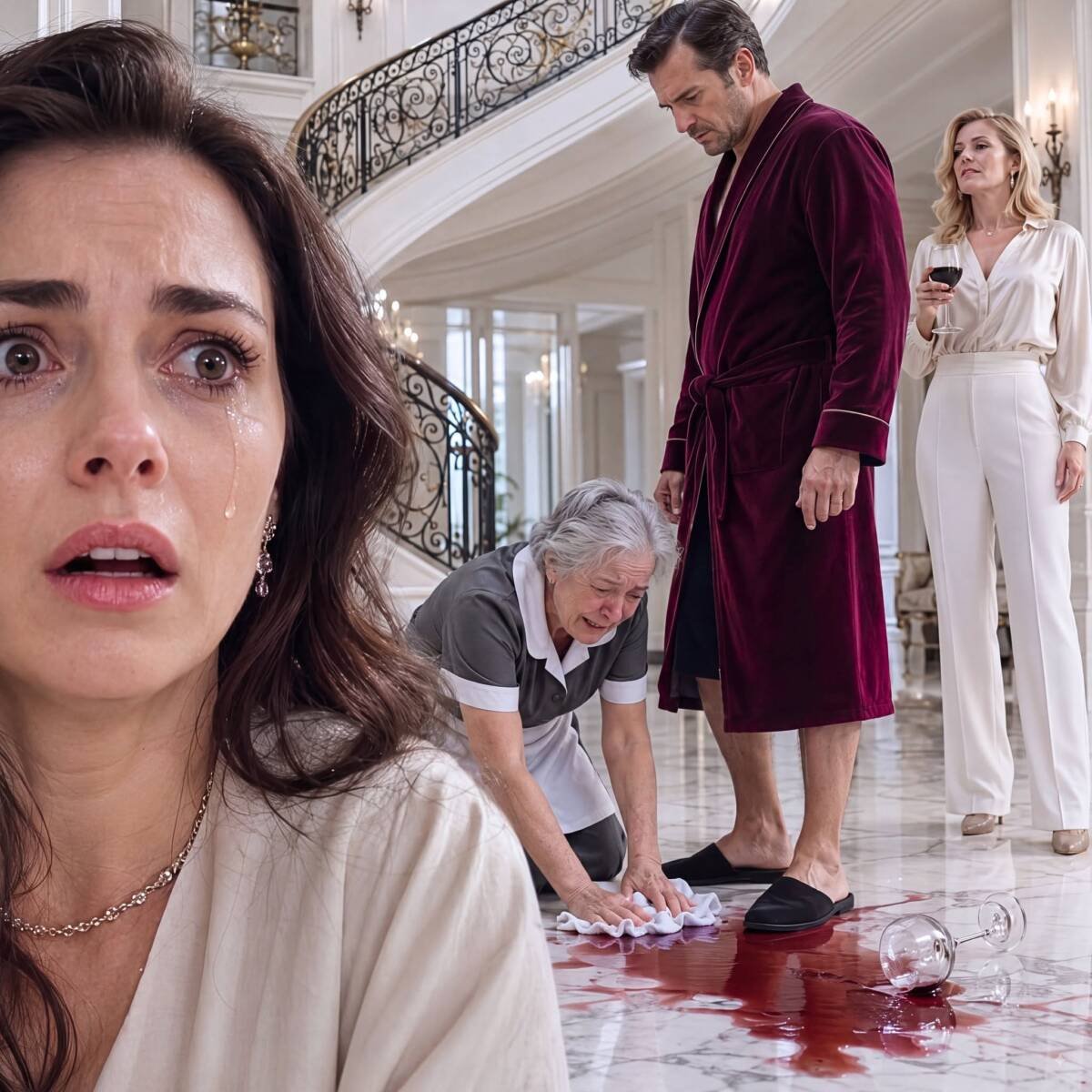
Across the room stood my mother-in-law, Margaret Collins.
While everyone else seemed paralyzed by the shock and tragedy of the moment, Margaret’s expression was disturbingly alien. There was no grief in her eyes, no sorrow, no empathy. Instead, her face held something that looked sickeningly close to profound relief—the look of a person watching a difficult task finally reach its conclusion.
She leaned slightly toward her daughter, Claire, whispering—though she pitched her voice just loud enough to cut straight through my numbness and echo in the silent room.
“God saved this world from your bloodline.”
The words struck me like physical blows. Claire didn’t recoil. She didn’t gasp, nor did she tell her mother to have a shred of decency. She simply tightened her lips into a hard line and gave a cold, small nod of agreement.
Instantly, my head snapped toward my husband, Daniel. In that moment of absolute devastation, my soul cried out for him to defend me, to stand between me and the cruel venom of his family, to prove that our vows meant something.
Instead, Daniel avoided my eyes. He turned his head slowly toward the window, fixing his gaze on the parking lot below, standing completely silent and motionless.
That silence hurt almost as much as Margaret’s vile words. Our child had just been declared dead, yet I was standing—and falling—entirely alone inside my own grief.
Then, from the corner of the room, a small movement broke the agonizing stillness.
My eight-year-old son, Noah, quietly climbed down from the plastic chair where he had been sitting, clutching a box of crayons. He walked slowly toward the nurse’s cart parked near the door, his curious eyes inspecting the medical trays and the small bottles sitting neatly upon the surface.
He turned around, holding a tiny, clear bottle in his small hand.
“Mom?” he asked, his innocent voice piercing the heavy, suffocating air of the room.
I turned my head toward him, my heart fracturing all over again.
“Should I give the doctor what Grandma hid in my baby brother’s milk?”
The entire room went dead, absolute silent. Little did any of us know in that precise second, an eight-year-old boy had just pulled the first thread on a tapestry of lies, murder, and calculated deceit that would unravel a family forever.
Part 1: The Night Everything Changed
Margaret’s face instantly lost every drop of color, turning a chalky, sickly grey. Claire gasped, clapping her hands over her mouth, while Daniel spun around from the window so quickly he nearly knocked over a metal chair behind him.
The doctor crossed the room in two long strides, stopping right in front of Noah. His voice was urgent, laced with sudden panic.
“What did you say, son?”
Noah looked up, completely confused by the sudden shift in the room’s energy. To him, he wasn’t exposing a crime; he was simply reporting something an adult had instructed him to keep secret, treating it like a harmless game or a whispered rule.
“Grandma said it was medicine,” Noah explained, tilting his head with innocent confusion. “She told me not to tell anyone. She put it in the bottle when the nurse wasn’t looking. She said it would help Evan sleep.”
“He’s lying!” Margaret shrieked, her voice suddenly losing its composed veneer, replaced by the sharp, hysterical pitch of absolute terror. “The boy is confused! He’s making things up in his grief!”
A nurse, reacting on sheer instinct, darted forward and pulled the nurse’s cart away, securing the trays. She looked directly at Noah.
“Which bottle was it, sweetie?”
Noah pointed a small, steady finger toward a specific glass bottle sitting near the back of the tray.
Within minutes, the sterile environment of the hospital transformed into a scene of absolute chaos. Hospital security guards appeared at the doorway, blocking entry and exit. Staff members began making urgent, frantic phone calls, and within half an hour, two local police officers arrived.
Margaret was escorted out into the hallway, protesting loudly, screaming that everyone had misunderstood her, that she was a respected woman, that her family was being torn apart by lies. Claire followed close behind her, weeping hysterically, insisting over and over that there had been some terrible, catastrophic mistake.
Daniel remained inside the room. His hands were shaking violently as he stared at me, repeating my name like a broken record, but his voice sounded distant, hollow, and utterly foreign. I couldn’t look at him. I couldn’t breathe.
The hospital administration immediately sealed the room, secured the nurse’s cart, and confiscated the bottle Noah had pointed out. Toxicology testing was ordered on an emergency basis. Within hours, the preliminary results identified a heavy dose of a potent prescription medication mixed into Evan’s milk—a drug that hospital records quickly confirmed Margaret Collins had been prescribed and taking for years.
For an adult, that dosage might have caused severe lethargy or dizziness. For a newborn infant, weighing barely six pounds and only hours old, investigators told us it would be catastrophic, shutting down developing organs within minutes.
It hadn’t gotten into the bottle by accident. There was no cross-contamination, no mix-up in the pharmacy. Someone had deliberately poured it in.
When interrogated by detectives that very night, Margaret dropped all pretenses of polite society. She admitted to her actions, but instead of showing remorse, she offered a chilling, twisted justification. She claimed she had been acting to “protect the family.” She pointed to my past struggles with postpartum depression from years prior—issues I had long since overcome—and weaponized them, arguing that my “tainted bloodline” meant I was unfit to raise a child, and that she had merely stepped in to prevent a disaster.
The police arrested her before dawn.
Claire was questioned separately for hours. Under pressure from investigators, she eventually admitted that she had witnessed Margaret standing by the nurse’s cart and had realized what was happening, yet she had chosen to remain entirely silent. Her silence wasn’t fear; it was complicity.
Daniel’s questioning revealed an even darker, more agonizing truth. Under intense cross-examination by detectives, Daniel broke down and confessed something that shattered whatever fragile remnants of our marriage were left.
His mother had opposed our marriage from the very first day. She had spent years whispering in his ear about my family history, warning him about “tainted genetics” and weak bloodlines. And Daniel? Daniel admitted he had known how extreme, how unhinged his mother’s beliefs had become. He had seen the warning signs mounting for months, yet he had never warned me, never protected me, and never stood up to her—hoping, cowardly, that the problem would simply manage itself.
That was when the horrifying reality set in with brutal clarity.
Evan hadn’t been lost to a tragic, unexplained medical anomaly. He had been murdered.
Someone inside our own family—someone who sat at our dinner table, smiled at our celebrations, and pretended to share in our joy—had made a calculated, deliberate choice to steal my son’s life.
And my eight-year-old son, sitting quietly with his crayons, had been the only one with the courage to expose the secret they thought would disappear forever into the silence of a hospital room.
Part 2: The Aftermath and the Trial
The days and weeks following Margaret’s arrest passed in a blur of police interviews, social workers, legal forms, and media frenzy. News vans materialized outside our home and the hospital, turning our private agony into public entertainment. Strangers online debated our family history, treating our grief as a true-crime podcast script they could dissect from the safety of their living rooms.
I spent every waking moment shielding Noah. We sat with hospital social workers who gently debriefed him, praising his quick thinking, though Noah remained mostly quiet, trying to process why adults could be so cruel.
One afternoon, while a social worker was checking on us, Noah looked up with those big, solemn eyes and asked a question that broke my heart into a million irreparable pieces.
“Is Evan cold?” he asked softly.
He wasn’t thinking about criminal charges, prison sentences, or courtrooms. He was simply an eight-year-old boy wondering if his baby brother had a blanket in the dark.
Daniel moved out of our house within a week. I didn’t ask him to stay, and he didn’t have the courage to fight for it. Every time I looked at him, I didn’t see a grieving father; I saw the man who had turned his back and stared out a window while his mother spat venom at me over the body of our dead child.
The trial began several months later, stretching across eight grueling, emotionally draining months. Margaret showed zero remorse throughout the proceedings. She sat in the courtroom with a stiff posture, completely unbothered by the testimony detailing how a newborn’s organs had failed, but she flew into quiet rages whenever her social standing, her reputation, or her family name was dragged through the mud.
The evidence was overwhelming. The jury deliberated for less than four hours before returning a verdict of guilty on all counts. The judge didn’t hesitate: Margaret Collins was sentenced to life imprisonment without the possibility of parole.
Claire accepted a plea agreement midway through the legal proceedings, trading cooperation for a reduced sentence, which ultimately landed her five years behind bars for conspiracy and concealing a felony.
Before the final paperwork was signed, Daniel approached me outside the courthouse one brisk morning. His eyes were red-rimmed, his shoulders slumped under the weight of his own cowardice. He asked me a single question, his voice trembling:
“Do you think… could you ever forgive me?”....