“Dad… my little sister won’t wake up. We haven’t had anything to eat for three days,” the boy whispered.
Panic took over as the young father abandoned everything and rushed to save his children. But nothing could have prepared him for the terrifying truth that surfaced next—especially when he discovered where their mother had actually been. What began as a frantic medical emergency rapidly unraveled into a dark, sprawling conspiracy that would rewrite the history of his entire family.
Main Story
Part 1: The Phone Call That Stopped Time
The fluorescent lights of my Columbus architectural firm buzzed with a low, monotonous hum. I was halfway through a high-stakes planning meeting, surrounded by sprawling blueprints and half-empty coffee cups, when my phone vibrated against the mahogany table. An unfamiliar number flashed on the screen. Ordinarily, I ignored unknown callers during working hours, but a sudden, inexplicable sense of dread urged me to answer.
After several agonizing seconds of static and shaky, shallow breathing, I recognized the small, frightened voice of my seven-year-old son, Noah.
“Dad?”
I immediately pushed away from the conference table, the heavy wooden chair scraping loudly against the floor. I demanded to know where he was. Noah’s voice trembled, fighting back tears as he explained that his six-year-old sister, Clara, wouldn’t wake up. Their mother, Meredith, was completely gone. They had not eaten a proper meal in days.
I grabbed my keys before he could even finish his sentence. I hurried out of the office, sprinting toward the parking garage while repeatedly dialing Meredith’s number. Every single call went directly to voicemail. It made absolutely no sense. She had explicitly told me she was taking the children to a rented cabin near Lake Erie for her custody week.
Meredith and I had endured a bitter, exhausting divorce, but the dust had finally started to settle. Things between us were becoming less hostile. I had zero reason to suspect she would abandon Noah and Clara inside a rented bungalow east of downtown Columbus, much less that something catastrophic had happened to her.
Twenty-five agonizing minutes later, I pulled into the bungalow’s driveway. My tires skidded against the pavement. The moment I stepped out of the car, my stomach plummeted. The curtains were drawn tight, and the porch light was still burning brightly in the middle of the afternoon. I pounded on the front door, shouting Noah’s name. Silence answered me.
I twisted the handle. It was unlocked.
Inside, the air felt stale, heavy, and unnaturally quiet. I found Noah sitting on the living-room floor, his small hands clutching a throw pillow to his chest. He was still dressed in wrinkled, stained pajamas. The hollow, terrified expression on his pale face frightened me more than anything he had said over the phone.
“I thought you weren’t coming,” he whispered.
I dropped to my knees beside him, pulling him into a tight embrace before asking where Clara was. He pointed a trembling finger toward the couch. My daughter lay beneath a thin, woven blanket. Her cheeks were deeply flushed, her breathing was terribly weak, and the intense heat radiating from her forehead told me she needed immediate medical intervention.
“Get your shoes, buddy,” I said, keeping my voice as steady as possible. “We’re going to the hospital.”
As Noah followed me through the cramped kitchen, the grim reality of their survival became clear. The sink was piled with dirty bowls. An empty cereal box sat on the counter. The refrigerator contained nothing but a bottle of water and a solitary jar of mustard. Whatever had happened to Meredith, my children had been fighting to survive on their own much longer than I had initially realized.
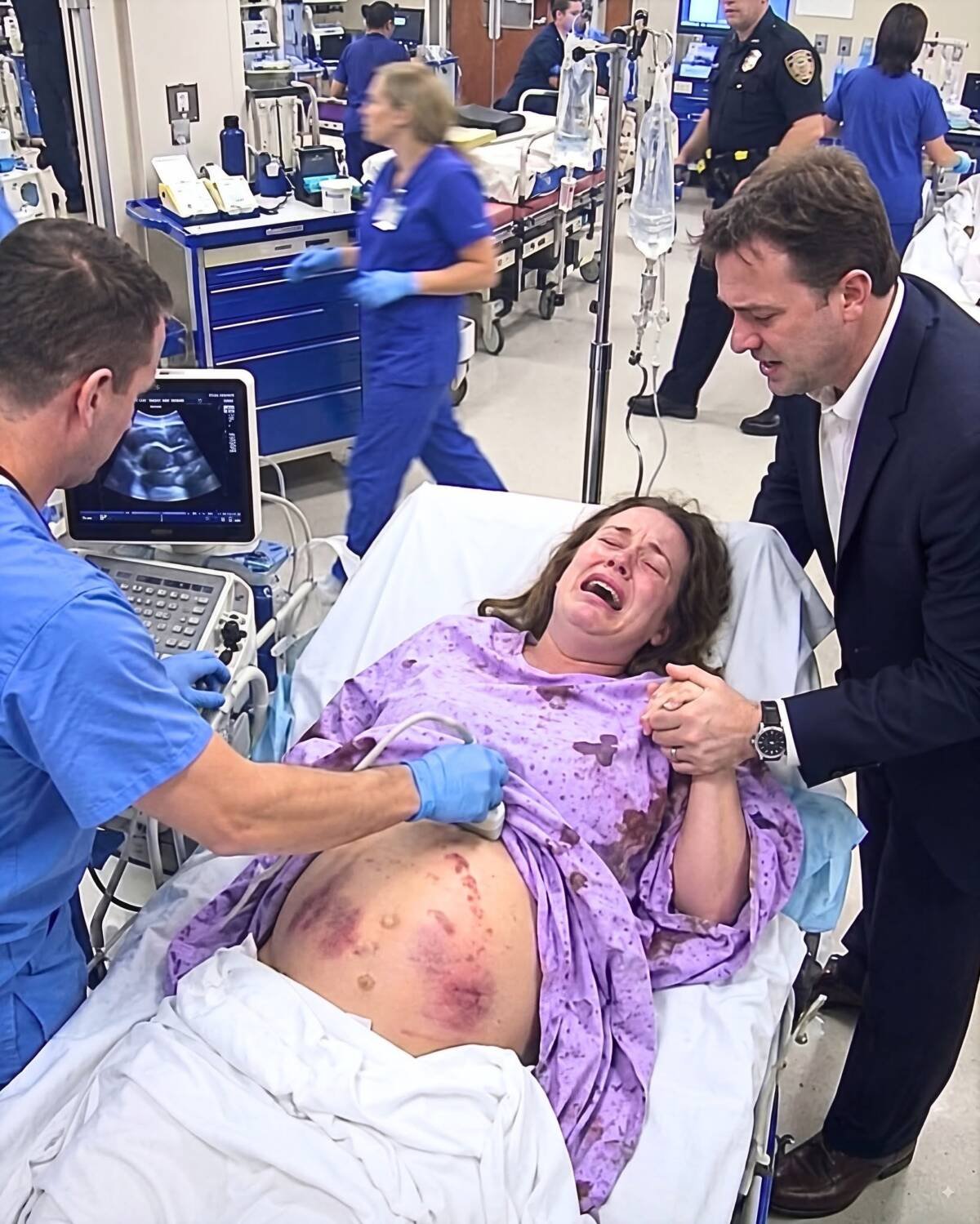
At Riverside Children’s Medical Center, the emergency room staff immediately sprang into action. Doctors began treating Clara for a severe infection and dangerous dehydration. Noah was provided with food, water, and a heated blanket, though he staunchly refused to take a single bite until a pediatric nurse looked him in the eye and promised that his sister was going to be okay.
That was when Detective Rebecca Sloan approached me in the waiting area. The information she carried turned my frantic confusion into something deeply disturbing.
Meredith hadn’t disappeared during a weekend getaway to Lake Erie. She had been inside this exact hospital for three nights.
“Have you found her?” I asked, my heart pounding.
“She was brought here three nights ago, Caleb,” Rebecca said gently.
The detective explained that a city maintenance worker had discovered Meredith lying unconscious near an unused, overgrown service road beside the Scioto River. She had arrived at the emergency room as a Jane Doe—without identification, her phone, or her purse. She had remained in a comatose state for most of the time since her admission.
Hours later, when Clara finally regained enough strength to speak, she provided a detail that chilled my blood. She told us that a man wearing “shiny shoes” had come to the bungalow before Meredith vanished. Clara remembered hiding and hearing the man aggressively argue with her mother about something Meredith had taken from him.
“She said she gave it to the one person he would never search,” Clara murmured weakly.
The statement triggered a memory I had entirely forgotten. Months earlier, Clara had accidentally left her favorite stuffed white rabbit at my condominium. Meredith had been strangely, wildly insistent that I return it immediately. Annoyed by the irrational demand at the time, I had tossed it inside a plastic storage container in my garage and forgotten all about it.
Before I could relay this to Detective Sloan, Noah reached deep into his pajama pocket. He pulled out his closed fist and slowly opened his fingers. Resting on his small palm was a tiny silver charm shaped like an antique key. He explained that it had fallen out of Clara’s rabbit, and Meredith had specifically instructed him to hide it if the man with the shiny shoes ever returned.
“She said to tell you she wasn’t trying to keep us away from you,” Noah said, wiping his tear-streaked eyes. “She was trying to protect you, too.”
For two long years, I had firmly believed Meredith’s erratic secrecy was a calculated strategy to push me out of our children’s lives. Standing under the harsh hospital lights, I suddenly realized that everything I thought I understood about our broken marriage might be a lie.
Rebecca and I rushed back to my condominium. I tore through the garage until I found the plastic storage bin. Buried at the bottom was the battered white rabbit. Beneath an uneven, recently restitched seam in its fabric belly, the detective pulled out a heavy-duty flash drive and a folded, glossy photograph. The image showed Meredith standing beside an older, silver-haired man. In front of them stood six children, all wearing identical blue hospital-style wristbands.
On the back of the photograph, Meredith had hastily scribbled a warning in black ink:“These are not ordinary placements. The records have been changed.”
Suddenly, my cell phone rang. It was an unknown number.
I answered, and a calm, chillingly smooth male voice introduced himself as Harrison Creed. He firmly demanded that I return the property Meredith had stolen from an organization known as the Havenbridge Family Alliance. He instructed me to bring the flash drive to a local pedestrian bridge before midnight if I wanted this delicate situation to remain a “private misunderstanding.”
I didn’t go to the bridge. Instead, I handed the phone to the police. Within the hour, cyber investigators decrypted the flash drive. The files they uncovered were staggering: falsified guardianship documents, heavily altered medical histories, offshore payment ledgers, and dossiers involving dozens of children who had been transferred between private institutions under highly misleading, legally murky circumstances.
Only then did the gravity of the situation hit me. Meredith hadn’t taken money. She had stolen the master evidence. And whatever secrets were locked inside that drive were about to prove that the shadows looming over our divorce were far more dangerous than I had ever dared to imagine.
Part 2: The Secret She Carried Alone
The encrypted flash drive shattered every preconceived notion I held about the last two years of my life. I had interpreted Meredith’s unexplained absences, her secretive financial habits, her sudden and illogical job changes, and her infuriating custody decisions as vindictive attempts to control me. But the digital paper trail hidden inside Clara’s toy painted a different picture. Meredith had been waging a silent, terrifying war to keep our family entirely off the radar of a very dangerous enterprise.
Detective Sloan’s task force worked through the night. The records continuously pointed back to Havenbridge Family Alliance. On paper, Havenbridge was a saintly philanthropic organization designed to help struggling families arrange temporary foster care during financial or medical crises. In reality, it was a highly lucrative trafficking pipeline disguised by layers of impenetrable bureaucracy.
But how had Meredith become involved? And why was Harrison Creed willing to threaten my children to get the files back?
Before investigators could piece together the answers, a nurse rushed into the hallway. Meredith had finally woken up.
I stood outside the door of her hospital room, my hand hovering over the handle. I didn’t know if I wanted an apology, an explanation, or if I just needed to see her breathing. She looked incredibly frail against the white sheets, dark bruises coloring her jaw and cheekbone. Yet, the moment her eyes locked onto mine, she didn’t ask about her own injuries or the police presence.
“Are Noah and Clara safe?” she asked, her voice cracking.
“They’re both here,” I replied, stepping closer. “Clara is getting medical care. Noah is the reason I found them.”
Tears spilled over her bruised cheeks as the dam finally broke. She confessed that she had never intended to abandon the kids. Three years ago, she had accepted a high-level records administration position at Havenbridge, genuinely believing she was helping vulnerable families. But as the months passed, she began noticing alarming discrepancies. Children’s names changed between preliminary documents and final court filings. Medical histories were rewritten. Guardianship approvals were moving through the legal system with impossible, suspicious speed.
Initially, she thought they were administrative errors. But when she began comparing original intake files with the finalized transfer documents, the pattern became undeniable. Healthy children with living relatives were being legally reclassified as orphans with severe medical needs, funneling them into highly profitable, closed-system private placements.
“Why didn’t you just go to the police?” I asked, the frustration bleeding into my voice.
“I was going to, Caleb. I had a meeting set up. But then Harrison Creed found out I was digging into the archives.”
Meredith’s voice dropped to a terrified whisper. She told me Creed had summoned her to his private office. Without a word, he had slid three photographs across his mahogany desk. One showed Noah walking out of his elementary school. Another showed Clara swinging at our neighborhood playground. The third showed me, carrying my briefcase, walking out of my architectural firm.
That was the exact moment the erratic, hostile behavior I had resented for years finally made sense. Meredith had deliberately engineered a chasm between us. She had hidden her finances, changed her routines, and intentionally allowed our co-parenting relationship to devolve into a bitter feud. She reasoned that if Creed believed she despised me—and that I was completely cut off from her life—he wouldn’t view me or the children as collateral damage.
“I thought if you hated me enough, you’d stop trying to talk to me,” she sobbed. “If Creed believed you knew absolutely nothing, maybe he would leave you and the kids alone.”
I sank into the chair beside her bed. I had spent twenty-four months believing she was trying to erase me. Now, I realized she had weaponized our divorce to build a firewall around us.
Rebecca Sloan entered the room shortly after, carrying a heavy tablet. She had a major problem. While the flash drive proved records were being manipulated, the victims on the drive were only identified by numerical codes. To bring down Havenbridge, the police needed the master physical archive to connect the digital codes to the real identities of the missing children.
Meredith had overheard executives whispering about an off-site archive but had never uncovered its location. The room fell silent until I remembered the bizarre clue Noah had given me. He had quoted a specific line from a lullaby Meredith used to sing—a line about a place “beyond the willow door.”
The phrase hit me like a physical blow.
“Willow Door Archives,” I said aloud, the memory rushing back.
Years prior, my architectural firm had been contracted to evaluate the structural integrity of a massive, abandoned records warehouse on the industrial outskirts of Columbus. The facility was named Willow Door. I had taken Meredith there once to show her the historic architecture. Investigators quickly ran the property deeds and discovered that a shell company loosely tied to Havenbridge’s board of directors currently held the lease.
A tactical police unit breached the warehouse at dawn. Upstairs, they found nothing but dust and empty desks. But in the subterranean basement, they navigated a labyrinth of narrow, concrete corridors that dead-ended at a heavy, vintage green door. It was secured by a unique, custom-cast lock surrounded by an ornate iron carving of willow branches.
When Rebecca sent me a secure photo of the lock, the final puzzle piece snapped into place.
“The charm Noah had,” I told her over the phone. “It isn’t a charm. It’s the key.”
Detectives retrieved the silver key from the evidence locker and returned to Willow Door. It turned the tumblers perfectly. The heavy door swung open, revealing thousands of square feet of climate-controlled filing cabinets, physical hard drives, medical binders, and payment ledgers. It was the Holy Grail of the investigation, directly identifying the children listed on Meredith’s drive.
But the victory was short-lived. Later that afternoon, Rebecca pulled me into a private conference room at the precinct. She placed a single, physical photograph on the table. It had been pulled from a highly secured cabinet in the archive.
It was Clara.
She was a newborn in the photo. I recognized the blanket she was wrapped in; Meredith and I had taken that exact picture in the hospital shortly after she was born. But it was the black marker written across the bottom of the photo that made my lungs seize.
Reserved placement.
Clara had never been in the foster system. She had never been touched by Havenbridge. She was our biological child.
“Why do they have a file on my daughter?” I demanded, my vision blurring with rage.
Rebecca looked at me with deep, unsettling sympathy. The photograph proved something infinitely more sinister than corporate fraud. Havenbridge’s interest in our family hadn’t started when Meredith accidentally stumbled onto their secrets.
Harrison Creed’s organization had been watching Clara since the day she was born.
Part 3: The Blueprint of Betrayal
The photograph of Clara upended the entire timeline of the investigation. Rebecca Sloan immediately redeployed her forensic accountants and digital analysts, ordering a deep dive into the Willow Door archives for any mention of the names Caleb, Meredith, Noah, or Clara.
Hours later, they presented us with a horrifyingly thick dossier. It contained our previous home addresses, our combined financial histories, credit reports, and extensive notes documenting the various neighborhoods we had lived in during the early years of our marriage.
“Someone was actively tracking us?” I asked, staring at the neatly typed surveillance logs.
“It appears someone was specifically tracking Clara,” Rebecca corrected, pointing to the date stamps on the documents.
Meredith, looking over my shoulder, suddenly went pale. She pointed to a series of alphanumeric codes scribbled in the margins of our financial reports. She recognized the classification system from her time inside the Havenbridge database.
“I’ve seen this exact code,” Meredith whispered, her hand trembling. “They used it for minors they considered ‘future viable placements.’”
The implications were nauseating. Havenbridge wasn’t just processing children who naturally fell into the foster system. They were running a sophisticated predictive algorithm. They maintained covert profiles on middle-class families experiencing financial distress, severe medical debt, or volatile marital conflict. They were essentially scouting families whose circumstances might eventually cause their children to slip into temporary state care.
The timeline perfectly aligned with the darkest era of our marriage. My architectural firm had nearly gone bankrupt, we were drowning in debt, and the stress had caused Meredith and me to fight relentlessly. Someone at Havenbridge had been watching our house of cards wobble, waiting for it to collapse.
Rebecca’s team soon confirmed this wasn’t an isolated incident. They found dozens of similar dossiers. Families who had experienced sudden, unexplainable legal disputes, anonymous calls to Child Protective Services, or targeted financial ruin shortly before their children were funneled into Havenbridge’s network.
“Are you saying Havenbridge deliberately engineered these family crises?” I asked.
“We can’t prove that in court yet,” Rebecca said tightly. “But we are actively investigating whether this organization benefited from pushing vulnerable families over the edge.”
A sickening realization washed over me. During the most toxic phase of our divorce, an anonymous caller had reported my home as “unsafe” to social services. I was subjected to weeks of humiliating interviews and home inspections before the allegations were dismissed as baseless. For years, I had harbored a deep, burning resentment, entirely convinced Meredith had made the call to secure full custody.
I looked at Meredith from across the table. “You thought it was me, didn’t you?” I asked softly.
“Yes,” she admitted, tears welling in her eyes. “I thought you called them on me first. I never reported you, Caleb.”
Investigators pulled the original CPS transcripts and compared them with Havenbridge case files. The specific legal verbiage used in the anonymous complaint against me was identical to the bureaucratic language Creed’s lawyers used in their internal memos. Havenbridge had deliberately thrown a match onto our already volatile divorce, ensuring that we trusted no one—especially not each other.
Our marriage had genuine flaws, but Havenbridge had weaponized them.
Then, an investigator handed Rebecca another folder. This one bore Noah’s name. Inside was his school schedule, medical records, and a handwritten note dated just six months prior:Secondary placement if household separation becomes permanent.
I stared at the ink until the letters blurred. They hadn’t just been preparing to take Clara. They had been planning to take both of my children.
The discovery escalated the case to the federal level. Armed protection was immediately stationed outside Clara’s hospital room. Meanwhile, federal agents began tracing Havenbridge’s money, untangling a web of corrupt consultants, paid-off attorneys, and shadow foundations. Harrison Creed was the spider in the center of the web.
But when a SWAT team raided Creed’s sprawling suburban estate, they found the front door wide open and the house completely sanitized. His company cell phone was sitting on the kitchen island. His luxury SUV was later found abandoned in the long-term parking structure of John Glenn Columbus International Airport.
Flight manifests showed no record of him boarding a plane. Rebecca suspected the car was a calculated decoy. Creed hadn’t run.
That evening, I sat in the hospital room with Meredith. Clara was breathing easily, recovering rapidly from the infection. Noah was fast asleep in a chair beside her bed, his small hand wrapped fiercely around his sister’s fingers. He had refused to leave her side for a single second.
Meredith looked at me, exhaustion etched deep into her features. “I’m so sorry, Caleb.”
“For what?”
“For arrogant thinking. For believing I could protect all of you by carrying this alone in the dark.”
I looked through the glass window, watching my children breathe. “We can argue about our mistakes when this is over. When they are safe.”
Suddenly, my cell phone vibrated. A text message from an unknown, blocked number.
I opened it. There was no text. It was a high-resolution photograph of the main entrance to Riverside Children’s Medical Center. The angle indicated it had been taken from the roof of the parking garage directly across the street.
A second later, a text bubble appeared.You opened the wrong door, Caleb.
I shoved the phone into Rebecca’s hands. Harrison Creed hadn’t fled the state. He hadn’t abandoned his empire. He was standing less than a hundred yards away, watching my family.
Part 4: The Man in the Shadows
The photograph triggered an immediate, full-scale hospital lockdown. Security sealed the pediatric ward, heavily armed officers stationed themselves at every exit, and a tactical team swept the adjacent parking garage. But by the time they reached the roof, the photographer was gone.
Meredith began hyperventilating when she saw the image. Her carefully constructed illusion that I was an ignorant, uninvolved ex-husband had shattered. Creed now knew that I possessed the flash drive, that the police had breached the Willow Door archive, and that his empire was crumbling.
“He won’t stop,” Meredith warned, her voice shaking. “The files in that archive aren’t just about him.”
Rebecca nodded in agreement. A trafficking ring of this magnitude required a vast, coordinated network. Doctors had signed fraudulent psychiatric evaluations. Family court attorneys had expedited illegal custody transfers. City administrators had looked the other way. Creed had spent a decade building a syndicate, and if he went down, he was taking highly influential people with him.
The photograph sent to my phone eventually proved to be Creed’s first critical mistake. Analysts pulled the traffic camera footage surrounding the hospital and identified a dark, unmarked sedan speeding out of the parking structure precisely two minutes after the text message was sent. The license plate traced back to a corporate fleet rental company owned by one of Havenbridge’s shell corporations.
Police located the vehicle abandoned in a suburban alleyway three hours later. Creed was gone, but he had left behind a burner phone and a leather briefcase. Inside were printed surveillance photos of my family, alongside a terrifyingly detailed handwritten ledger of our daily routines. He had the address of Noah’s elementary school, my architectural firm, and Meredith’s new apartment.
Seeing the photos spread out on a police table finally broke through the remaining anger I held toward my ex-wife. Looking at images of myself buying coffee, entirely oblivious to the predator watching me from a parked car, I finally understood the suffocating, paralyzing terror Meredith had lived with every single day.
The burner phone yielded a massive break in the case. Cyber technicians recovered a string of hastily deleted text messages. Creed had been ordering an associate to quickly transport specific, highly sensitive ledgers from a location referred to as “North House” before the authorities could connect it to the Willow Door raid.
Meredith immediately recognized the name. “Havenbridge used to run a remote residential processing center in the woods north of the city. They claimed it shut down years ago due to funding issues.”
By nightfall, tactical units had surrounded the heavily wooded property. Official county tax records listed the sprawling, institutional brick building as vacant, but thermal imaging drones detected massive heat signatures radiating from the basement. The electricity was fully active.
When the SWAT team breached the doors, they found the facility entirely devoid of children—but it was far from empty. Industrial paper shredders were running hot. Rows of commercial servers were actively wiping hard drives. Fortunately, the police arrived fast enough to interrupt the purge, securing locked filing cabinets packed with the financial ledgers Creed had been desperate to destroy.
More importantly, they recovered the internal security camera footage. It showed Harrison Creed frantically pacing the hallways less than 24 hours earlier. He had used North House as his operational command center.
While searching his temporary office, detectives found a handwritten schedule detailing a meeting set to take place at North House the very next night. Creed had written down initials instead of full names. Rather than publicly announcing the raid, Rebecca ordered her team to leave the building exactly as they found it and set up a covert stakeout. They were going to let the meeting happen.
That evening, the hospital finally discharged Meredith. Clara’s fever had broken, and the doctors cleared her to go home the following morning. For the first time since this nightmare began, I allowed myself to envision the four of us walking out of those sliding glass doors, alive and together.
Then, my phone rang. It was Detective Sloan.
Her forensic team had run the initials from Creed’s schedule against the financial ledgers recovered from the servers. They had positively identified one of the key co-conspirators.
It wasn’t a Havenbridge executive. It wasn’t a corrupt judge.
It was the private family-law mediator who had overseen Meredith’s and my divorce.
Part 5: The Masterpiece of Manipulation
The revelation felt like a physical blow to the chest. The man who had sat at the head of the conference table, calmly handing us tissues while we tore our family to shreds, had been on Harrison Creed’s payroll the entire time.
Rebecca’s financial analysts discovered that the mediator had received massive, structured payouts routed through offshore consulting firms just days before our most critical custody hearings, with a final lump-sum payment clearing the week our divorce was finalized.
“He was paid to ensure we didn’t survive as a couple,” I said, the words tasting like ash in my mouth.
Meredith looked physically ill. She recalled how the mediator had continuously pulled her into private sessions, explicitly advising her to withhold financial information from me, warning her that I was secretly plotting to take full custody of Noah and Clara. I remembered the exact same private sessions, where he gently suggested that Meredith was exhibiting signs of severe mental instability and that I needed to aggressively document her flaws to protect myself.
We had walked into that mediation room deeply wounded, but willing to try. Instead of facilitating peace, a paid operative had systematically located our deepest insecurities and poured gasoline on them.
The next night, the trap at North House was sprung.
Under the cover of darkness, unmarked police cruisers surrounded the perimeter. The mediator arrived first, pulling his luxury sedan into the secluded driveway. He was followed by a prominent family court attorney. Finally, Harrison Creed arrived. He stepped out of his vehicle, completely unaware that his empire had already fallen.
The moment they unlocked the front doors, tactical teams swarmed them.
The arrests dominated the national news for months. The evidence recovered from North House, combined with the Willow Door archives and the flash drive Meredith had smuggled out, exposed a sprawling, multi-state corruption ring. Havenbridge was completely dismantled. The judges, attorneys, and administrators who had facilitated the nightmare were federally indicted. Hundreds of families whose cases had been manipulated were contacted, and an exhaustive legal review was launched to reunite stolen children with their rightful parents.
Meredith fully recovered from her injuries. Clara’s health returned to normal, and Noah transformed. The terrified little boy who had called me from a dark, empty house realized that his immense bravery had single-handedly brought down a criminal empire and saved his sister’s life. He carried that pride like armor.
One quiet Friday evening, several months after the arrests, the four of us sat together on the floor of my living room, eating delivery pizza. Meredith and I hadn’t magically erased the pain of our past, and neither of us knew exactly what the future held for our relationship. But the paranoia was gone. We had stopped allowing secrets and outside forces to dictate how we loved our children.
Clara suddenly scrambled up from the rug, disappearing down the hallway. She returned a moment later, clutching the repaired white stuffed rabbit to her chest.
“Can I keep her in my bed now?” Clara asked, looking up at me with wide eyes.
I smiled, reaching out to tap the rabbit’s velvet nose. “She’s all yours, sweetie.”
Meredith stared at the toy for a long, quiet moment. “That little rabbit saved all of us.”
Noah, sitting cross-legged with a slice of pizza, immediately objected. “I helped.”
I pulled him into my side, ruffling his hair. “You didn’t just help, Noah. You were the hero.”
Life gradually shifted back to ordinary, though my definition of ordinary had permanently changed. I learned the hard way that protecting your family doesn’t always mean fighting the monsters standing on your front porch. Sometimes, it means listening to your gut when something feels inherently wrong. It means refusing to let fear, pride, or anger isolate you from the people who need you the most.
I will never forget the sound of Noah’s voice breaking through the static on my phone.
“Dad?”
At the time, I thought that phone call was just about rushing to a house to save a sick little girl. I was wrong. That single, desperate phone call led me to Meredith, to the Willow Door, to the arrest of Harrison Creed, and to the terrifying truth that had nearly destroyed our family.
But when the dust settled, the detail I remembered most was the simplest one of all.
My seven-year-old son had been frightened, starving, and entirely alone in the dark. But when the whole world was falling apart, he knew exactly who to call.
👇 DO YOU WANT TO READ MORE THRILLING STORIES LIKE THIS? 👇
👉 𝐅𝐔𝐋𝐋 𝐒𝐓𝐎𝐑𝐘 𝐇𝐄𝐑𝐄 : [Link to your WordPress Blog/Website]
🔥 Don’t forget to LIKE and SHARE this story with your friends! Let us know what you would do if you received a phone call like this in the comments below! 💬✨