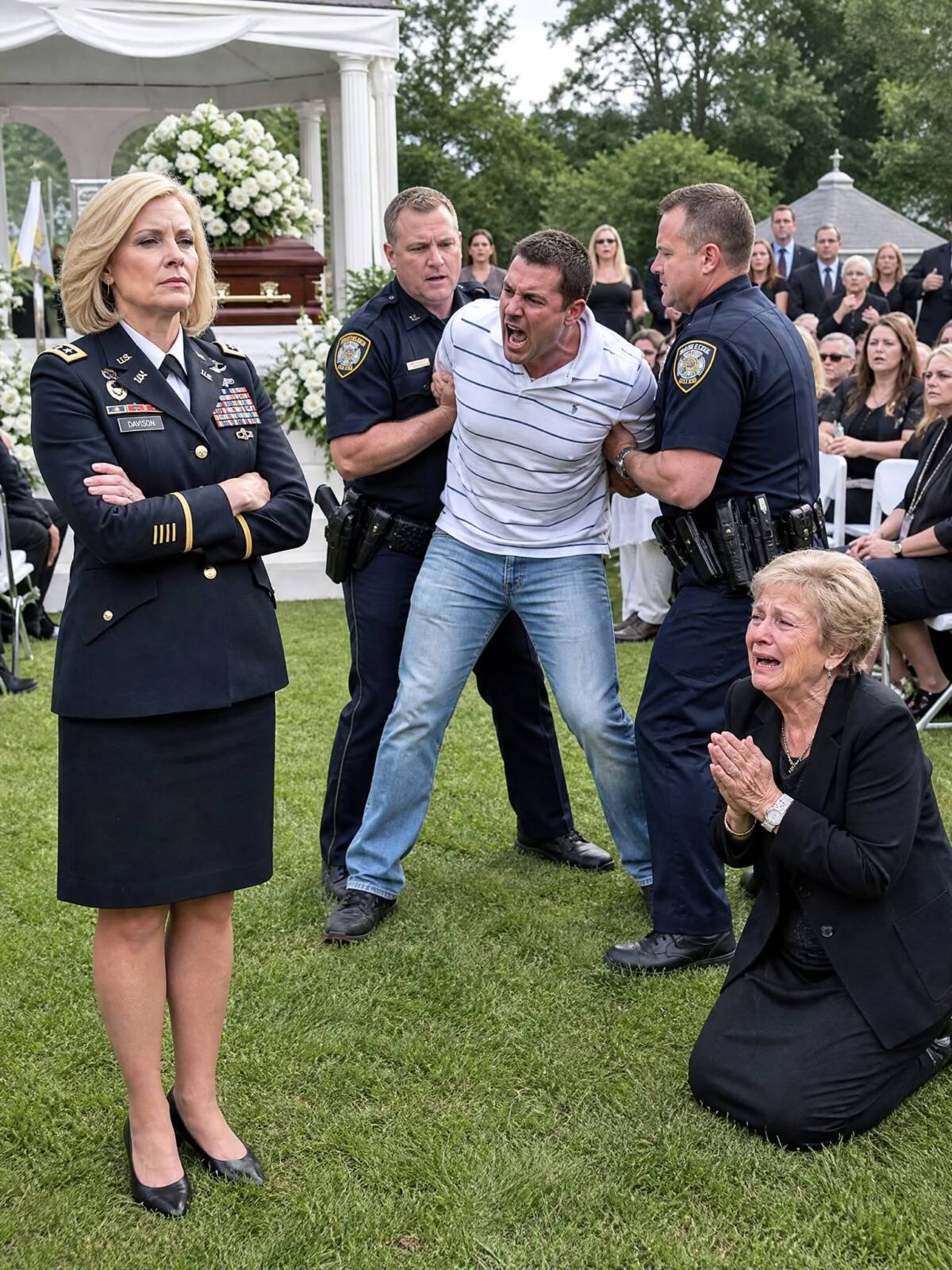
The courtroom was packed when my mother raised her hand, placed it on the Bible, and told the judge that twelve years of my life had been a lie.
“She was never a soldier,” Elaine Wright said confidently. “The scars, the medals, everything she claims is fake.”
The words seemed to hang in the air.
Reporters stopped typing. Spectators turned toward me. Even people who had never heard my name suddenly looked at me as if I were a fraud who had spent years pretending to be someone I was not.
My younger brother, Curtis, sat across the courtroom with his head slightly lowered and a barely concealed smile on his face.
My mother never looked at me.
She didn’t have to.
She believed she had already won.
What she did not know was that I had been waiting for one specific moment.
For weeks, my attorney, federal investigators, military counsel, and a former executive assistant to my father had been preparing for what would happen next.
My military records were classified.
My combat mission could not legally be discussed in open court.
And the people accusing me of lying had carefully built their entire case around that silence.
They thought the absence of public records proved I had fabricated my military career.
They thought my medals could be dismissed as decorations I had purchased.
They thought my scars were simply part of an elaborate story.
Most importantly, they thought they had found a way to take control of my late father’s defense company.
They were wrong.
But I could not tell them that yet.
I could only sit quietly and wait.
Because at 11:47 that morning, thirteen minutes remained before the evidence they believed could never exist was finally authorized for release.
And at exactly noon, the courtroom doors opened.
A decorated general walked in.
The smile disappeared from my mother’s face.
The Family Dispute That Became a Criminal Case
My father’s death was supposed to be a time for our family to grieve.
Instead, it became the beginning of a legal battle that would eventually expose a much larger scheme.
My father, Richard Wright, had built Titan Tactical Systems into a successful defense company over several decades. He had always been demanding, disciplined, and intensely private about his work.
He had also been clear about his wishes.
When he died, I was named executor of his estate and received controlling shares in the company.
My younger brother Curtis was not happy about it.
At first, he claimed the arrangement was unfair.
Then he produced another will.
According to Curtis, my father had signed the document only months before his death and intended to leave control of the entire company to him.
The document looked convincing.
The signature appeared authentic.
The language sounded like something my father might have written.
But I knew something was wrong.
I challenged the document.
That was when the accusations began.
Curtis claimed I had manipulated my father during his final months.
Then he alleged that I had fabricated parts of my military history to gain my father’s trust and influence his estate decisions.
The accusations quickly became more serious.
Curtis claimed my military service was fictional.
He claimed I had forged government records.
He suggested my medals had been purchased.
And then my mother joined him.
The woman who had given birth to me was prepared to tell a courtroom that the person standing before the judge was a fraud.
I knew exactly what that meant.
If the court accepted their claims, I could lose my inheritance, my position at Titan Tactical Systems, and potentially my freedom.
But there was something Curtis and Elaine did not understand.
My silence was not evidence of guilt.
It was evidence of classified service.
“She Was Never a Soldier”
The first lie my mother told under oath erased twelve years of my life in a matter of seconds.
“She was never a soldier,” Elaine declared.
Her hand rested on the Bible.
Her voice was steady.
“She never served in the military. She never deployed overseas. The scars and medals are part of a story she created.”
A murmur moved through the courtroom.
I could hear people whispering behind me.
My attorney leaned toward me.
“Don’t react,” she said quietly.
I nodded.
Across the aisle, Curtis appeared increasingly confident.
The prosecution displayed a case containing my Silver Star, Purple Heart, and a scorched unit patch I had carried home after a deployment to Kandar Province.
My mother looked at the medals as if they were cheap souvenirs.
“She could have bought them online,” she said.
That statement hurt more than I expected.
Not because I needed her to believe me.
But because she knew how much those medals had cost.
She knew about the years I had spent away from home.
She knew there were things I could not discuss.
She knew about the injuries.
Yet she sat in a courtroom and told strangers that all of it was fake.
Several jurors looked at me suspiciously.
I could feel the old burn scar along my ribs beneath my blouse.
For a moment, memories came rushing back.
Smoke.
Helicopters.
Gunfire.
Burning metal.
The sound of men calling for help.
The confusion that followed an ambush.
And the people I had refused to leave behind.
I wanted to tell the courtroom everything.
I wanted to explain exactly where every scar had come from.
I wanted to tell the jury why my records were not available through ordinary federal searches.
But I couldn’t.
The mission remained classified.
My service records were restricted.
And Curtis knew it.
That was the foundation of his entire strategy.
The Records That Appeared to Prove I Was Lying
Curtis’s attorney presented federal database searches showing no deployments under my name.
There were no publicly accessible combat awards.
No evacuation records.
No ordinary military medical records documenting the injuries I had described.
The attorney turned toward me.
“You claim these records are sealed?”
“They are officially restricted,” I answered.
He smiled.
“So every federal database is wrong?”
“No,” I said. “The databases are accurate.”
He paused.
“Then explain why they don’t show your military service.”
I looked toward the judge.
“The problem is that you’re only authorized to see part of them.”
The courtroom became quiet.
Judge Halpern leaned forward.
“Ms. Wright, are you suggesting there are additional government records concerning your service that are not accessible to this court?”
“Yes, Your Honor.”
“Can you provide those records?”
“Not yet.”
The prosecutor immediately objected.
My mother sighed dramatically.
“There she goes again,” she said.
Several people in the gallery laughed.
“She always has an explanation,” Elaine added.
I looked at the clock.
11:47.
Thirteen minutes.
My attorney had told me not to say anything that could interfere with the government’s disclosure process.
So I waited.
The other side interpreted my silence as weakness.
They were making a serious mistake.
The Forged Statement From My Father
Curtis’s attorney then introduced what he described as the strongest piece of evidence against me.
It was a notarized statement allegedly signed by my father six months before his death.
According to the document, my father claimed I had fabricated my military career, manipulated him during his illness, and pressured him into changing his estate plan.
The document was devastating on its face.
The signature looked almost perfect.
The wording was convincing.
And the timing appeared plausible.
The courtroom reacted immediately.
My mother looked relieved.
Curtis sat back in his chair.
But there was one thing Curtis did not know.
The person who helped create that document had already warned me.
Her name was Delwyn Johnson.
She had worked for my father for years as an executive assistant and had access to many of his business records.
Curtis had approached her secretly.
He offered her $200,000 to help manufacture the statement.
He believed she had accepted the money because she needed it.
Instead, Delwyn contacted me.
She told me what Curtis was planning.
And she began secretly recording their conversations.
For six weeks, my attorney, Delwyn, military counsel, and federal investigators coordinated their response.
We could not expose everything immediately.
The investigation required Curtis to continue believing he was in control.
More importantly, we needed him to authenticate the forged document himself.
Every lie he told under oath could become evidence.
Every claim he made about how he obtained the document could be tested.
Every detail he provided could potentially expose the people behind the scheme.
We needed him to keep talking.
And he did.
Curtis Makes the Mistake We Were Waiting For
After the forged statement was admitted into evidence, Curtis volunteered to testify.
He believed appearing confident would strengthen his credibility.
He was wrong.
My attorney approached him during cross-examination.
“You personally discovered this document?”
“Yes.”
“No one gave it to you?”
“No.”
“You found it yourself?”
“Yes.”
“Where?”
“My father’s office.”
“When?”
“March ninth.”
My attorney paused.
“And where exactly was it?”
“In the safe.”
Curtis began describing the office.
He talked about the safe.
The combination dial.
A blue folder.
Even a coffee stain on the page.
The details were unusually specific.
That was exactly what my attorney wanted.
“You are absolutely certain?” she asked.
“I am.”
I looked at the clock.
11:56.
My attorney turned toward the courtroom display.
A large photograph appeared on the screen.
It showed my father’s office after a fire-suppression accident.
The safe was open.
Its contents had been destroyed.
The interior was filled with scorched paper and twisted metal.
My attorney pointed toward the date printed on the photograph.
“February 22.”
She looked back at Curtis.
“This photograph was taken more than two weeks before you claim you opened the safe and found the document.”
Curtis froze.
His attorney immediately objected.
But the damage had been done.
My attorney continued.
“If everything inside the safe was destroyed on February 22, how did you find an undamaged document inside it on March 9?”
Curtis struggled to answer.
“I—I don’t know.”
“You testified under oath that you found it there.”
“I must have remembered the date incorrectly.”
“You also described the folder.”
“I may have been mistaken.”
“The coffee stain?”
“I don’t remember.”
The confident man who had entered the witness chair only minutes earlier was suddenly searching for a way out.
Then my attorney asked the question that changed everything.
“Did you pay Delwyn Johnson $200,000 to help create this statement?”
“No.”
“Did your mother know about the arrangement?”
“No.”
“Did either of you ask her to testify that your sister never served in the military?”
“No.”
Each denial went into the official transcript.
Each denial would soon become another piece of evidence.
And then the clock reached noon.
The Courtroom Doors Open
At exactly 12:00 p.m., the heavy courtroom doors opened.
Every conversation stopped.
A tall officer in full dress uniform entered alongside two Department of Justice investigators.
He had a jagged scar across his temple.
I recognized him immediately.
Lieutenant General Duane Carney.
The man who had once commanded operations connected to my unit.
The man who knew exactly what happened during the mission my family claimed never existed.
My mother stared at him.
The color drained from her face.
Curtis stopped moving.
General Carney walked to the center of the courtroom.
“Your Honor,” he said, “the Department of Defense has authorized limited disclosure of Captain Mara Wright’s military records, effective at 11:59 this morning.”
The courtroom erupted in whispers.
“Captain?” Curtis whispered.
General Carney turned toward him.
“Former Captain. Special Activities Detachment.”
My mother stared at me.
For the first time that morning, she looked uncertain.
A Pentagon attorney approached the bench and handed Judge Halpern a sealed packet.
The judge opened it.
He began reading.
Page after page.
His expression changed.
The courtroom grew completely silent.
The Truth Behind the Scars and Medals
General Carney took the witness stand.
He did not reveal classified operational details.
He did not disclose information that remained protected.
But he confirmed what mattered.
I had served.
I had deployed.
I had been wounded.
And the medals displayed in the courtroom had been lawfully awarded.
He described the circumstances surrounding an ambush that nearly destroyed our unit.
Without discussing classified details, he explained that I had crossed open ground under enemy fire, pulled wounded soldiers from burning wreckage, organized a defensive perimeter, and refused evacuation until the remaining survivors had been accounted for.
“The scars are genuine,” General Carney told the jury.
“The medals were lawfully awarded.”
He paused.
“Captain Wright remained silent because her command ordered her to remain silent.”
The words landed heavily.
My mother finally broke.
“Duane,” she whispered. “Please don’t do this.”
General Carney turned toward her.
“You turned her obedience to classified orders into evidence against her.”
My mother looked away.
The woman who had confidently called me a liar only minutes earlier could no longer maintain the same certainty.
But the evidence was not finished.
The Recordings That Changed Everything
My attorney asked permission to introduce the recordings Delwyn had made while cooperating with investigators.
The judge approved.
The first recording began playing.
Curtis’s voice filled the courtroom.
“Make the statement sound like Dad hated her.”
The room became silent.
Then came another part of the conversation.
“Mom will handle the testimony.”
My mother closed her eyes.
Curtis immediately began shaking his head.
“No. That’s not what I said.”
The recording continued.
His voice was unmistakable.
Then came my mother’s voice.
“Once Mara is convicted, the shares become vulnerable. We’ll sell the company before she ever has the chance to appeal.”
A wave of shock moved through the courtroom.
The case was no longer simply about a disputed will.
It was no longer about whether my military history was authentic.
The recordings suggested a coordinated effort to remove me from control of my father’s company.
Then another recording played.
Curtis was heard offering Delwyn money to manipulate federal searches and plant fake records suggesting that I had purchased military medals.....