The Night Everything Changed
The night before my military commissioning, my father followed me up the stairs carrying a steel crowbar.
“Nobody leaves this house without my permission,” he said.
I had spent five years preparing to become a commissioned military officer. By the following morning, I was supposed to stand among my classmates, receive my rank, and begin the future I had worked so hard to build.
Instead, one violent moment left me lying on the floor, unable to feel my legs.
“Dad, please help me,” I begged.
My mother appeared at the top of the staircase. I expected her to call an ambulance or rush to my side. Instead, she looked down at me and laughed.
“Maybe now you’ll finally understand where you belong.”
At first, I believed my parents were trying to prevent me from leaving home. I thought my father’s anger came from his fear of losing control over my life.
I was wrong.
As I lay in a hospital bed, struggling to understand whether I would ever walk again, investigators began examining the circumstances surrounding the attack. What they uncovered was far more disturbing than a family argument that had turned violent.
My grandfather had left me a $2.3 million trust. My father was facing mounting financial problems, and the money was about to become legally mine.
The timing was no coincidence.
According to the evidence uncovered in the investigation, my father had a financial motive for preventing me from becoming independent. The attack that threatened to destroy my future had also been connected to a desperate attempt to gain control over the inheritance my grandfather had intended to protect.
My name is Elena Cross, and this is the story of how I lost the future I had planned, discovered the truth about my family, and eventually built a life my parents could never control.
Part 1: The Night My Future Was Taken From Me
The evening before my commissioning ceremony began like any other night before a major milestone.
My dress uniform had been freshly pressed. My belongings were packed, and I had spent hours checking every detail to make sure I would be ready for the following morning.
After five years of demanding training, academic work, physical challenges, and personal sacrifice, I was finally about to become a commissioned officer.
I had earned academic honors and received the Commandant’s Leadership Ribbon. I had pushed myself through difficult training exercises and countless exhausting days because I believed the work would lead to something meaningful.
For the first time in my life, I could see a future that belonged entirely to me.
My parents, Victor and Diane Cross, had never shared that excitement.
My father routinely dismissed my military ambitions. Whenever I achieved something worth celebrating, he found a way to diminish it.
“You haven’t done anything in the real world yet,” he would say.
My mother used a different approach. She rarely confronted me directly, but her comments were often designed to make me question myself.
She described my career choice as impractical and suggested that a military life was not appropriate for a woman. When I received recognition for my work, she frequently changed the subject or compared me unfavorably with someone else.
For years, I tried to interpret their behavior generously.
I told myself they were worried about me. I convinced myself that they were struggling to accept that their daughter was growing up and preparing to leave home.
I believed that once they saw me in uniform, they might finally understand how much the opportunity meant to me.
That evening, I returned home carrying boxes and my garment bag. As I entered the house, I heard my parents talking in the kitchen.
“Once she leaves this time, she’s gone for good,” my father said. “She has her own money now.”
My mother responded bitterly.
“She already acts like she’s better than us.”
I paused in the hallway.
Their words should have been enough to make me leave immediately, but years of explaining away their behavior had trained me to ignore warning signs.
I picked up my belongings and started toward the stairs.
Halfway to the second floor, my father followed me.
“You’re not going tomorrow.”
I turned toward him, thinking I had misunderstood.
“The Commandant is commissioning me in the morning,” I replied. “We’ve talked about this for years.”
“I don’t care.”
His voice was calm, but there was something in his expression I had never seen so clearly before. It was not disappointment. It was the certainty of someone who believed he had the right to make decisions for another adult.
“I’ve worked for this my entire life,” I said. “I’m leaving at dawn.”
My father stared at me without responding.
Then he turned and walked away.
For a moment, I thought the confrontation was over. I returned to my room and began arranging my uniform for the morning.
Less than a minute later, I heard the garage door open and close.
When my father returned, he was holding a heavy steel crowbar.
“Nobody leaves this house without my permission,” he said.
I stepped backward.
“Put that down.”
He kept coming.
I remember the staircase beneath my feet, the sudden fear that filled my chest, and the realization that the man standing in front of me was no longer interested in hearing anything I had to say.
Then he raised the crowbar.
The next moments changed my life.
I collapsed to the floor. I tried to move, but my legs would not respond. My hands trembled against the hardwood as I struggled to understand what had happened.
“Dad,” I whispered. “What did you do?”
He did not rush to help me.
Instead, he set the crowbar aside as though he had finished an ordinary household task.
“Now let’s see you leave us.”
My mother appeared at the top of the staircase.
I looked up at her, desperately hoping that she would recognize the seriousness of the situation.
“Mom, please. I can’t feel my legs.”
She looked down at me and laughed.
“Maybe now you’ll finally understand where you belong.”
In that moment, the last excuse I had made for my parents disappeared.
This was not simply a disagreement that had gone too far. I was lying injured on the floor, and the two people who should have protected me were treating my suffering as a victory.
I did not yet understand why they had done it.
But I knew I had to survive long enough to find out.
Part 2: The Hospital Room and the Lie My Parents Told
When I regained consciousness, harsh hospital lights filled my vision.
Machines beeped nearby, and a nurse stood beside my bed, telling me not to move while the medical team assessed my condition.
The pain in my back was overwhelming.
Then the memories returned.
The staircase. The crowbar. My father’s voice. My mother’s laughter.
I tried to move my legs beneath the blanket.
Nothing happened.
“My legs,” I whispered. “Why can’t I move my legs?”
The nurse reassured me that I was receiving treatment, but she could not answer the question I was most afraid to ask.
A doctor named Michael Hastings eventually explained that I had suffered severe trauma to the lower portion of my spine.
He spoke carefully, making sure I understood that the damage was serious.
“What does that mean for me?” I asked.
He paused before answering.
“It means your mobility may be permanently compromised. We’ll need to monitor your condition and see how you respond to treatment.”
I stared at him.
“Will I walk again?”
He could not promise that I would.
My mind immediately returned to the commissioning ceremony. I pictured my classmates preparing their uniforms and gathering with their families. I imagined the Commandant calling our names as we crossed the stage to receive our commissions.
I had spent five years preparing for that morning.
Now I did not know whether I would ever stand again.
“What about my commissioning?” I asked.
Dr. Hastings lowered his eyes.
“I’m very sorry, Elena.”
I understood what he was telling me.
The career I had worked toward was suddenly uncertain, and the future I had imagined had been replaced by questions I was not emotionally prepared to face.
Later, someone turned on the television in my hospital room. The academy commissioning ceremony was being broadcast, and I watched my classmates receive their ranks.
Their families applauded. Photographs were taken. Parents embraced their children.
I watched from a hospital bed, unable to feel my legs.
I wanted to be happy for them, but the grief was too immediate. It felt as though the life I had spent years building had continued without me.
Three days later, Detective Marcus Keller arrived to take my statement.
My parents had already provided their own explanation. According to them, I had tripped over my garment bag while climbing the stairs.
They described the incident as a tragic accident.
I looked at Detective Keller.
“I didn’t fall,” I said. “My father hit me in the back with a steel crowbar.”
He stopped writing.
“And your mother?”
“She watched me lying on the floor. She laughed.”
The detective asked additional questions and recorded my account. I understood that he needed evidence, but it was difficult to accept that my parents had already begun constructing a story designed to erase what I remembered.
The next day, they visited my hospital room.
My father wore an expression of concern that might have fooled someone who did not know him. My mother carried a small vase of yellow flowers.
For a brief moment, I wondered whether they had come to apologize.
Then my father approached the bed.
“How are you feeling, sweetheart?”
I recoiled.
“You know what you did.”
My mother placed the flowers beside the bed.
“You need to stop making things worse,” she said. “You’re upsetting the doctors and the police with these dramatic stories.”
I stared at her in disbelief.
“You watched him hit me.”
My father leaned closer.
“You fell, Elena. It was an accident.”
“No. You hit me.”
His expression hardened.
“Nobody is going to believe a hysterical girl over a respected businessman.”
The statement was not merely a denial. It was a warning.
My father believed his reputation would protect him. He expected the police to trust his public image more than my account of what had happened.
My mother continued speaking in a calm, almost reassuring voice. She suggested that I should accept my circumstances rather than make the situation more difficult for everyone.
Then Dr. Hastings entered the room.
The transformation was immediate.
My father stepped away from the bed and appeared visibly distressed. My mother adopted the expression of a devastated parent.
They were performing grief for an audience.
And they seemed convinced that it would work.
A week later, however, a different kind of visitor arrived.
Major Rebecca Sloan, an investigator with the military investigative division, introduced herself and took a seat beside my bed.
She had reviewed my medical records.
“The injuries documented here do not match the explanation your parents provided,” she told me.
For the first time since the attack, I felt a small sense of relief.
Major Sloan opened her notebook.
“Let’s go through what happened that night, Elena. Start at the beginning.”
I took a breath.
“My father followed me upstairs carrying a crowbar.”
She looked directly at me.
“We’re going to examine that carefully.”
I did not yet know how far the investigation would reach. But someone was finally willing to look beyond my parents’ version of events.
Part 3: The $2.3 Million Secret
Major Sloan approached the case differently from anyone I had spoken with before.
She did not assume that my parents were telling the truth simply because they appeared respectable. She examined the medical evidence, reviewed the timeline, and began investigating what had happened before the attack.
The first significant development came when investigators examined my father’s recent purchases.
Among the records was a credit-card transaction from a hardware store approximately three days before the incident.
The purchase was a 36-inch forged steel crowbar.
Major Sloan showed me the receipt.
“Your father purchased this shortly before the attack.”
I stared at the document.
Until then, part of me had wondered whether the incident had begun as an argument that escalated unpredictably. The purchase raised a much more troubling question: had my father prepared for the confrontation in advance?
Investigators also interviewed people who knew him professionally.
Several employees described his growing frustration over my plans to leave home. According to their statements, he had complained that I was ungrateful and repeatedly criticized my decision to become independent.
One statement was especially disturbing.
“If she can’t physically leave, she can’t forget who owns her.”
Reading those words made my stomach turn.
My father had spent years trying to convince me that independence was selfishness. Now the investigation suggested that he had been willing to use violence to prevent me from achieving it.
The evidence continued to accumulate.
A neighbor’s security camera had captured my father leaving the garage on the night of the attack while carrying a long object wrapped in a shop rag.
The timestamp helped investigators reconstruct the events leading up to the confrontation.
The footage did not, by itself, establish everything that had happened inside our house. But alongside the purchase record, my statement, and the medical evidence, it gave investigators additional reasons to question my father’s account.
Then another person entered the investigation.
Margaret Hensley, the attorney who had handled my late grandfather’s estate, contacted me at the rehabilitation center.
She carried a folder of legal documents.
“Elena, did your grandfather ever tell you about a trust he created for you?”
I shook my head.
“My father told me Grandpa died in debt.”
Margaret looked at me with visible concern.
“That isn’t what the estate documents show.”
She opened the folder and placed a document in front of me.
The amount listed on the paperwork was $2.3 million.
My grandfather had established an irrevocable trust for my benefit. He had structured it to protect the money from being controlled by other family members.
According to the estate documents, the funds were scheduled to become available to me when I received my military commission and reached the specified conditions for distribution.
I read the information several times.
Two point three million dollars.
Money I had never known existed was about to become mine at the exact moment I was preparing to begin an independent life.
“Did my father know about this?” I asked.
Margaret nodded.
“He was aware of the trust and its distribution terms.”
Suddenly, the conversations I had overheard before the attack took on a different meaning.
My father had not simply been upset that I was leaving home. He had known that my commissioning would coincide with a significant financial change.
Investigators began examining his business affairs.
What they found painted a troubling picture. My father was facing mounting debts, unsuccessful investments, business disputes, and financial obligations that appeared to be placing considerable pressure on him.
The investigation also raised concerns about money that had been taken from my mother’s retirement savings.
My inheritance represented a potential financial lifeline.
But the trust had been structured to prevent my father from freely accessing the funds. Once the distribution conditions were met, the money would be placed under my control rather than his.
That was the point at which the motive became clearer.
My father had spent years telling me that I was not ready to live independently. He had presented his control as protection and his demands as parental concern.
Now investigators were examining evidence suggesting that his financial circumstances gave him another reason to prevent me from leaving.
The attack had occurred on the eve of the event that would mark my independence and trigger the trust’s distribution.
According to the emerging theory, my father believed that if I became severely disabled and dependent on him, he might be able to seek legal authority over aspects of my life and finances.
Such authority would not automatically entitle him to my inheritance. Legal guardianship and control over an irrevocable trust are separate matters, governed by the trust’s terms and applicable law.
Nevertheless, the possibility that my father had hoped to exploit my vulnerability made the situation even more disturbing.
He had not merely tried to stop me from leaving the house.
The evidence suggested that he had wanted to prevent me from becoming financially independent at a moment when his own financial situation was deteriorating.
My grandfather had created the trust to protect my future.
My father had allegedly tried to destroy that future to save himself.
The amount was $2.3 million.
But the real cost of what happened could never be measured in money alone.
Part 4: The Messages That Changed Everything
As the investigation continued, my parents’ carefully maintained public image began to weaken.
People who had previously considered my father a successful businessman began asking questions about his financial problems and the allegations against him.
Former employees spoke with investigators about his behavior. Neighbors provided information about incidents they had previously been reluctant to discuss.
The investigation also examined electronic records and messages exchanged between my parents.
When Major Sloan returned to the rehabilitation center with the findings, she carried transcripts that would change my understanding of my mother’s role in the attack.
One exchange concerned my upcoming departure.
“She leaves tomorrow. It changes everything with the bank,” my father had written.
My mother responded:
“Then you know what needs to be done. We can’t lose the house.”
I read the exchange again.
For years, I had tried to believe that my mother was simply afraid of my father’s temper. I had wondered whether she had laughed because she was frightened, shocked, or incapable of responding appropriately.
The messages suggested something much more serious.
Another exchange contained a statement attributed to Diane:
“She’s been arrogant for years. Maybe a heavy lesson is exactly what she needs to remember who she belongs to.”
I put the papers down.
I had spent much of my life hoping that, somewhere beneath the criticism and manipulation, my mother genuinely wanted me to succeed.
Now I was confronting evidence that she may have encouraged the very behavior that had left me injured.
I could no longer explain her actions away as a moment of panic.
The investigation had begun with a disputed account of an injury. It was now examining a possible connection among violence, financial desperation, and my parents’ efforts to prevent me from becoming independent.
Meanwhile, I was learning how to live with the physical consequences.
Rehabilitation was exhausting.
Some days, I struggled to transfer from my wheelchair without assistance. Other days, the pain was so intense that I could barely concentrate on the exercises my therapist assigned.
I had once measured progress in miles run, academic achievements, and the completion of demanding military exercises.
Now progress could mean maintaining my balance for an additional minute or moving my leg slightly farther than I had the day before.
My physical therapist, Sarah, refused to let me dismiss those achievements.
One afternoon, after a particularly difficult session, I stared at the parallel bars beside my wheelchair.
“I used to run six-minute miles,” I told her. “Now I can barely sit up without help.”
She crouched beside me.
“Having a difficult day doesn’t mean you’re failing. It means you’re having a difficult day.”
I looked away.
“What if this is as good as it gets?”
“We’ll work with what you can do today. Then we’ll see what tomorrow brings.”
Her answer did not promise that I would recover completely. It offered something more realistic: a reason to keep trying.
I returned to therapy the next morning.
Then I returned again the day after that.
The legal case moved forward as my rehabilitation continued.
Investigators assembled the evidence they had gathered, including the hardware-store purchase, witness statements, security footage, medical records, financial documents, and electronic messages.
The prosecution’s case would depend on how that evidence was authenticated, interpreted, and presented in court. But for the first time, my parents’ version of events faced serious scrutiny from multiple directions.
The case attracted public attention.
Reporters began examining the allegations and my father’s business history. News crews gathered outside the family home, and people who had once viewed my parents as respectable members of the community began asking how much of their public image had been carefully constructed.
My father attempted to defend himself.
But the more questions he faced, the more difficult it became to reconcile his claims with the evidence investigators were presenting.
For me, the most painful part was not watching his reputation collapse.
It was realizing how much of my life I had spent protecting that reputation myself.
I had minimized his insults, excused his controlling behavior, and convinced myself that my mother’s cruelty was simply a different form of concern.
I had done so because admitting the truth would have meant accepting that the people I loved were capable of hurting me deliberately.
Now I had to accept it.
And I had to decide what I would do with that knowledge.
Part 5: The Courtroom and the Verdict
By the time the case reached trial, the prosecution had assembled a substantial body of evidence.
Medical specialists testified about the nature of my spinal injuries and explained why the documented trauma raised questions about the claim that I had simply fallen down the stairs.
Investigators presented the hardware-store purchase record and evidence related to the timeline of the attack.
The court also heard testimony about my father’s financial circumstances and the $2.3 million trust that was scheduled to become available to me.
The recovered messages between my parents became another important part of the case.
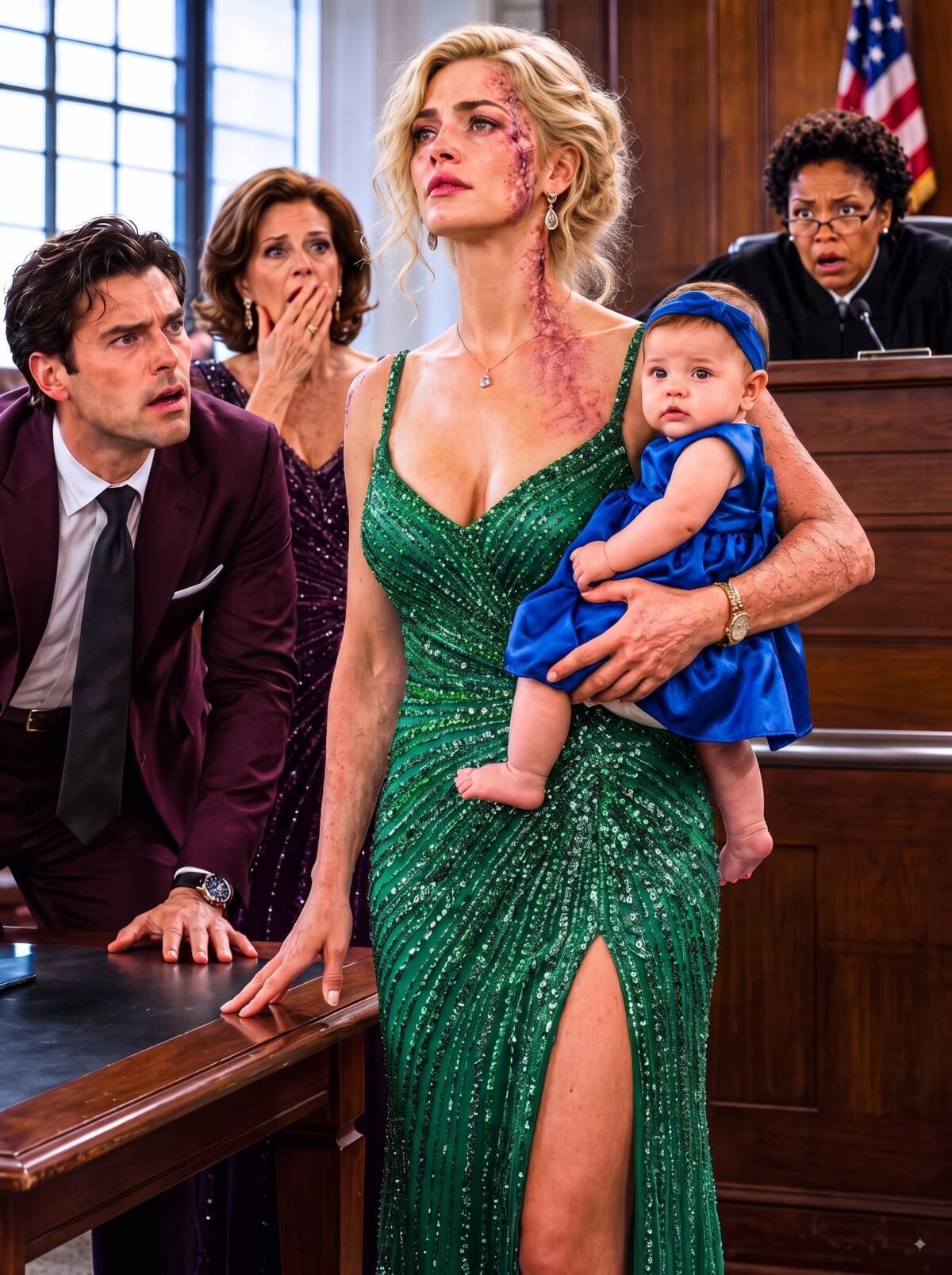
When one of my mother’s messages appeared on the courtroom screen, the room fell silent.
The statement about giving me a “heavy lesson” was difficult to read, even after everything I had learned.
My mother lowered her face into her hands.
For years, she had portrayed herself as a concerned parent trying to manage a difficult family situation. Now the jury was being asked to consider evidence suggesting that she had encouraged my father’s actions rather than intervening to protect me.
My father maintained his position that the incident had been an accident.
But the prosecution argued that the purchase record, witness accounts, medical findings, financial motive, and electronic communications told a different story.
The jury was left to evaluate the evidence and determine which account was supported beyond a reasonable doubt.
For me, sitting through the proceedings was emotionally exhausting.
I had to revisit the night of the attack repeatedly. I heard my own words read aloud and watched people discuss my injuries as evidence.
Sometimes, the details felt distant, as though the person being described were someone I had once known.
Then I would remember the staircase and the moment I realized I could not move my legs.
The memories were never entirely distant.
After the evidence and testimony concluded, the jury deliberated.
When the verdict was announced, I felt my hands tighten around the arms of my wheelchair.
Victor was found guilty on the major charges brought against him, including aggravated assault with a deadly weapon and conspiracy connected to the alleged financial scheme. The verdict represented the jury’s conclusion based on the evidence presented at trial.
The decision did not undo my injuries or restore the years I had spent preparing for a military career.
But it established that the attack could not simply be dismissed as an accident.
My father would face the consequences of his actions.
My mother’s legal outcome was different. Her cooperation with prosecutors affected her punishment, but it did not erase the evidence of her involvement or restore the relationship she had destroyed.
Their home was eventually sold, and the financial and public consequences of the case transformed their lives.
At sentencing, I was given an opportunity to address my father.
I rolled my wheelchair toward the podium.
For years, I had imagined what I would say if I ever had the chance to confront him in a place where he could not interrupt me, intimidate me, or dismiss my words.
I had written pages about everything he had taken from me.
But standing in front of the courtroom, I realized that I did not need to explain every detail to make my point.
“You shattered my spine,” I began. “You took the military career I had spent years building, and you changed the future I thought I would have.”
My father lowered his eyes.
I paused before continuing.
“But you failed at the one thing you wanted most.”
I steadied myself against the podium.
“You did not break me.”
Those words were not a declaration that I had overcome every consequence of the attack. I was still dealing with pain, physical limitations, and a future that looked nothing like the one I had planned.
I was not claiming that justice had made me whole.
I was telling him that he no longer had the authority to decide what my life would mean.
For the first time, I could look at my father without waiting for his approval or fearing his reaction.
The courtroom did not give me back my old life.
It gave me the opportunity to begin moving forward without pretending that what had happened was my fault.
Part 6: Building a Future Beyond the Inheritance
Three months after my father began serving his sentence, I received a phone call that changed the direction of my life again.
The executive director of a national veterans organization had followed my rehabilitation and learned about the work I had done to support other injured service members.
The organization was looking for someone who understood the challenges veterans face when their lives change suddenly and unexpectedly.
They offered me the position of National Outreach Coordinator.
I listened quietly as the director explained the responsibilities.
When the call ended, I sat alone for several minutes.
For months, I had believed that the future I wanted had disappeared. I had measured every day against the military career I had lost, comparing my present circumstances with the life I had imagined before the attack.
The job offer did not replace my commission.
It did, however, offer me a different way to serve.
I accepted.
A year later, the terms of my grandfather’s trust allowed the funds to be released into my control.
The $2.3 million inheritance was finally mine.
After everything that had happened, I could have used the money simply to rebuild my own life. Instead, I began thinking about the people I had met during rehabilitation.
Some had suffered catastrophic injuries while serving their country. Others had returned home to families who could not provide the support they needed.
Many faced practical challenges that were as overwhelming as the physical ones: inaccessible housing, expensive mobility equipment, financial uncertainty, and the emotional strain of adjusting to a life they had never expected.
I knew how frightening it could be to face an uncertain future without reliable support.
I also understood how devastating it was when the people who were supposed to help became part of the problem.
Working with the veterans organization, I established the CrossFreedom Foundation.
Its mission was to support catastrophically injured service members through adaptive mobility equipment, emergency housing grants, counseling, and assistance for veterans who lacked dependable family support.
The foundation was not created to erase what had happened to me.
It was created because I knew that other people were facing their own difficult circumstances, and I wanted them to have access to resources that could make a meaningful difference.
Some people questioned why I had kept the Cross name.
After everything my father had done, why continue using the same family name associated with the attack?
My answer was simple.
“Because Victor doesn’t own my name. I do.”
I refused to allow his actions to determine the meaning of my identity.
The foundation became a way to give the name a different purpose. Every veteran who received assistance represented another opportunity to turn something painful into something useful.
The work also changed the way I understood recovery.
For a long time, I had believed recovery meant returning to the person I had been before the attack.
I wanted my old body, my old career, and my old plans back.
Eventually, I began to understand that rebuilding a life did not require pretending that nothing had happened.
My future would always be shaped by the injury, but it did not have to be defined by it.
I began visiting rehabilitation centers and speaking with young service members who were adjusting to wheelchairs, braces, and unfamiliar limitations.
I never promised them that everything would return to normal.
I knew too well that no one could make that promise honestly.
Instead, I told them what I had learned.
“Your life may be different now, but different does not mean finished.”
Sometimes, people simply needed someone to sit beside them without trying to explain away their fear.
I could do that.
I could listen because I remembered what it felt like to wake up in a hospital bed and wonder whether the life I had imagined was gone forever.
And I could remind them that their worth had not disappeared simply because their circumstances had changed.
Part 7: Five Years Later, I Returned to the Military Academy
Five years after the attack, an envelope arrived at my office from the Military Academy.
Inside was an invitation from the Commandant asking me to deliver the keynote address at the upcoming commissioning ceremony.
I read the letter several times.
The ceremony had once represented the future I believed I had lost. I had imagined standing among my classmates, receiving my rank, and beginning a career that would take me far beyond the house where I had grown up.
Instead, I had spent the night before that ceremony fighting to survive.
Now the academy was inviting me back.
Not to receive the commission I had missed, but to speak to the next generation of officers about resilience, service, and the realities of rebuilding after profound loss.
I accepted.
On the morning of the ceremony, the auditorium was filled with cadets, officers, and families. The atmosphere reminded me of the life I had once expected to have.
I waited backstage as the ceremony progressed.
When my name was announced, I positioned my forearm crutches and carefully rose with the assistance of the motorized braces that supported my legs.
The movement required concentration.
Five years of rehabilitation had brought progress, but walking remained difficult, and I had learned not to mistake determination for the absence of physical limitations.
I took one step.
Then another.
The walk to the podium was slow, but I reached it standing upright.
I looked out at the young officers seated in front of me.
They were preparing to begin careers they had worked hard to earn. Many had families in the audience who were proud of what they had accomplished.
I wondered how many of them believed that the greatest challenges of their lives would arrive only after they left the academy.
I began speaking.
“Five years ago, I believed my greatest battles would happen somewhere far from home. Instead, the battle that changed my life began on the staircase inside my own house.”
The room became quiet.
I told them that life does not always follow the plans we make. Sometimes, circumstances change without warning, leaving us to confront questions we never expected to face.
I spoke about the difference between losing a particular future and losing every possible future.
“Life can change your direction without asking permission,” I said. “It can take away the future you carefully planned, but a changed future is not the same as having no future at all.”
I looked across the front rows.
“Other people can wound you. They can take opportunities away from you. But they do not get to decide when you surrender.”
The words reflected what I had learned through injury, rehabilitation, the investigation, and the slow work of building a new life.
I had not returned to the academy as the officer I once expected to become.
I had returned as someone who understood that service could take many forms.
My military career had been interrupted, but my commitment to helping others had not disappeared. Through the foundation, I had found a way to continue serving people who needed support during some of the most difficult periods of their lives.
After the ceremony, I stood near the parade field and watched the newly commissioned officers celebrate with their families.
My phone filled with messages from the foundation’s staff, including photographs of veterans receiving mobility equipment and assistance through our programs.
I thought about my grandfather and the trust he had created.
He had intended to give me financial security. He could not have known that the money would eventually help support injured service members whose lives had also taken unexpected turns.
The inheritance had been the motive behind a devastating betrayal.
But it had also become a resource I could use to help other people.
That did not make what my father had done acceptable, and it did not mean the money had been worth the suffering.
It meant that I had finally found a purpose for the circumstances I could not change.
For the first time in years, I could think about my parents without feeling that I needed to prove something to them.
I no longer needed my father to recognize my achievements.
I no longer needed my mother to approve of my choices.
Their opinions had once shaped the way I saw myself. Now they were simply part of a past I could acknowledge without allowing it to control my future.
They had changed the shape of my life.
They had not been given ownership of everything that came afterward.
Conclusion: They Tried to Take My Future, but They Couldn’t Decide What Came Next
I once believed that success meant reaching the exact destination I had spent years preparing for.
I thought I would become a commissioned officer, build a military career, and prove to my parents that I was capable of creating a life on my own terms.
The attack destroyed that plan in a single night.
It left me facing a serious spinal injury, an uncertain recovery, and the painful realization that my parents had not supported my independence in the way I had hoped.
The investigation revealed another dimension to their behavior: the $2.3 million trust, my father’s financial problems, and evidence suggesting that money had played a role in the events leading to the attack.
The legal process held my father accountable for the crimes established at trial. It also forced me to confront the truth about a family relationship I had spent years trying to repair.
But the most important change did not happen in the courtroom.
It happened gradually, through rehabilitation, work, and the decision to build a future that no longer depended on my parents’ approval.
I could not recover every opportunity I had lost. I could not return to the person I had been before the injury, and I could not erase the memories of that night.
What I could do was decide what happened next.
I used my inheritance to establish a foundation that supports injured service members. I returned to the academy to speak to future officers. I learned that a meaningful life does not have to resemble the one we originally imagined.
My parents had tried to make my world smaller.
Instead, I built a life that reached far beyond the house where they had attempted to keep me.
The future I had planned was taken from me.
The future I built afterward was my own.
And that was something neither of them could ever take away.
What Would You Have Done?
Imagine discovering that the people you trusted most had tried to control your future for their own financial benefit. Would you have been able to forgive them, or would you have walked away and never looked back?
Share your thoughts in the comments, and share this story with someone who needs a reminder that even after life changes in unimaginable ways, a new beginning is still possible.
Editorial note: This article is presented as a first-person narrative. Before publication as factual news, verify the identities, court records, trust documents, medical claims, and other material allegations. If the story is fictional or dramatized, label it accordingly.