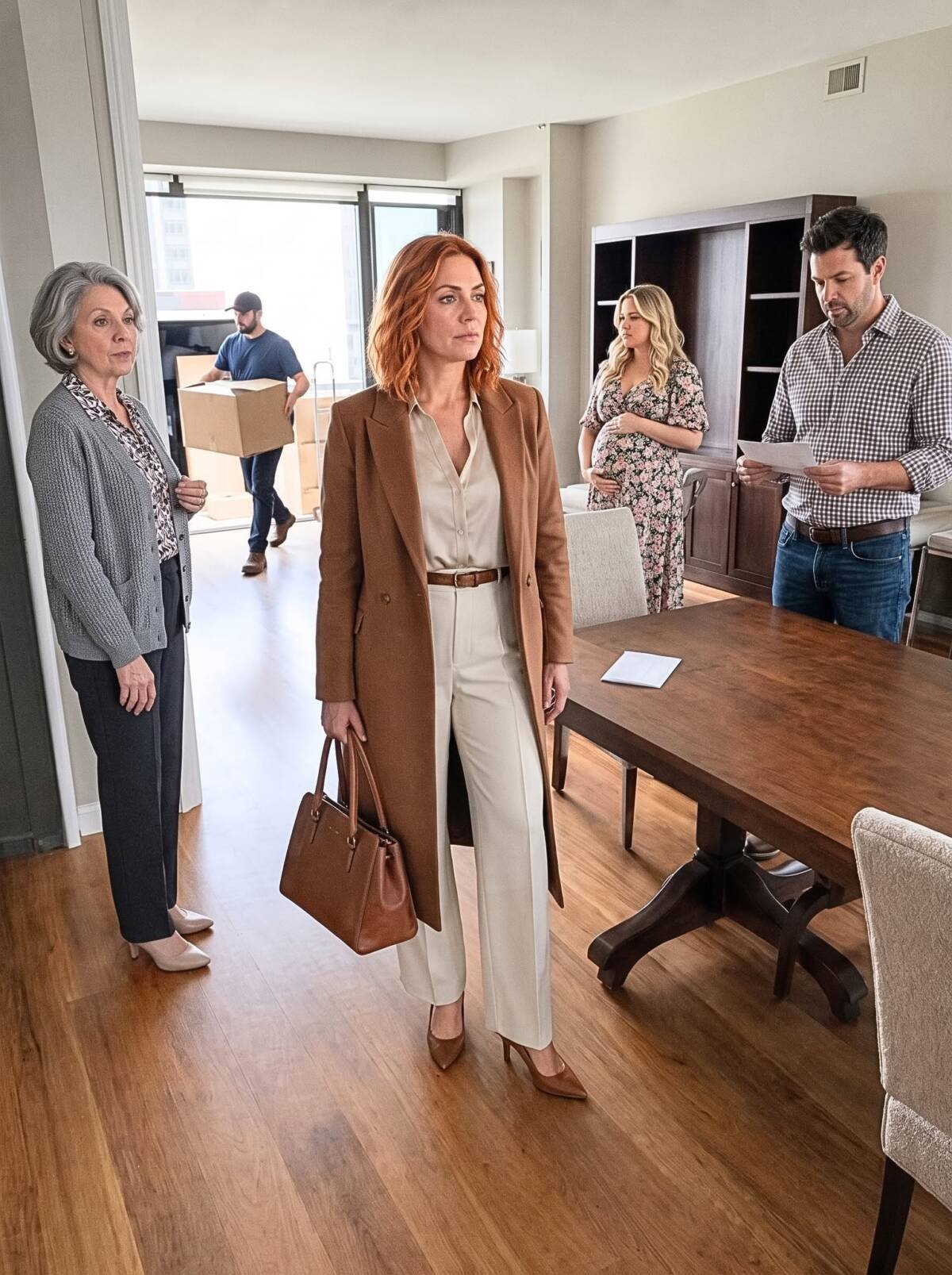
When Jenna Whitaker arrived at her dream home, she expected to collect her keys and begin a new chapter of her life. Instead, she found her brother, his wife, and her in-laws carrying furniture through the front door, convinced the million-dollar property belonged to them. What happened next exposed a family secret no one was prepared to face.
Introduction: The Day My Dream Home Became a Family Battlefield
I had spent years working toward a dream that once seemed almost impossible: buying a beautiful waterfront home in Annapolis, Maryland, with enough space to enjoy the peace and independence I had worked so hard to achieve.
At 34, I had finally done it.
No inheritance. No wealthy partner. No family handout. Just years of disciplined saving, careful investments, long hours at work, and a side business I had built quietly while everyone else assumed I was struggling to get by.
I had kept the purchase a secret because I wanted one achievement that belonged entirely to me.
I wanted to walk through my own front door without anyone asking for money, making demands, offering unsolicited opinions, or deciding how my success should benefit the family.
I thought I had earned that much.
But on the morning I planned to move in, I turned into my driveway and discovered a moving truck parked in front of the house.
At first, I assumed the movers had arrived at the wrong address.
Then I saw my sister-in-law, Kelsey, standing on the front porch with a clipboard in her hand, directing a group of workers as though she had been supervising the property for years.
Her mother was carrying decorative pillows inside. Her father was helping unload a heavy dining table. Several other relatives were moving boxes through the front door.
And my brother, Ryan, was nowhere to be seen.
I sat behind the steering wheel for several seconds, staring at the scene.
The house was mine.
I had purchased it legally. I had signed the closing documents. I had paid the required funds. My attorney had completed the transaction, and the keys were supposed to be waiting for me that morning.
Yet my family was moving into it as if I had never existed.
Then Kelsey noticed my car.
She waved enthusiastically and called out, “You’re finally here! Perfect timing. We could use another pair of hands.”
I looked at the house, then at the woman who had apparently decided she owned it.
Instead of screaming, I smiled.
“Of course,” I said, stepping out of my car.
And then I picked up a box.
What my family didn’t realize was that I had already seen enough to understand something important.
This wasn’t simply a misunderstanding about a house.
It was the result of years of entitlement, assumptions, and a family dynamic in which my silence had repeatedly been mistaken for permission.
And before that day was over, everyone would learn exactly who owned the million-dollar property they were so confidently claiming.
1. The Daughter Who Never Asked for Anything
My name is Jenna Whitaker, and for most of my adult life, I had been known as the responsible one.
I worked as a medical equipment supply-chain analyst, a position that required patience, precision, and the ability to solve complicated problems without losing control under pressure.
I was good at my job.
I knew how to manage deadlines, negotiate with vendors, analyze costs, and keep essential equipment moving through a complicated distribution system. When something went wrong, people called me because they knew I would find a solution.
Unfortunately, my family had developed the same expectations of me.
If someone needed help, they called Jenna.
If someone had a financial problem, they called Jenna.
If a family gathering became uncomfortable, I was expected to smooth things over.
And if I ever needed something myself, the response was usually a reminder that I was capable of handling my own problems.
My younger brother, Ryan, had always been treated differently.
He was charming, sociable, and good at convincing people that his latest setback was temporary. He had a talent for making poor decisions sound like unfortunate circumstances beyond his control.
My parents seemed to believe that he simply needed a little more time, a little more money, and a little more encouragement.
That encouragement often came at my expense.
When Ryan struggled with a car payment, my parents helped him.
When he fell behind on rent, they helped him again.
When he and his wife, Kelsey, decided they needed a better lifestyle than their income could comfortably support, my parents somehow found a way to justify the difference.
Nobody called it favoritism.
They called it family.
I learned early that arguing about fairness rarely changed anything. Instead, I focused on building a life that didn’t depend on anyone’s approval.
I drove an aging car long after I could have afforded a newer one. I packed lunches rather than buying expensive meals. I avoided unnecessary shopping and learned to distinguish between what I wanted and what I could reasonably justify spending.
My family interpreted those habits as evidence that I didn’t have much money.
They were wrong.
I wasn’t struggling.
I was preparing.
2. The Financial Secret Nobody Knew
Over the years, I had developed a financial strategy that combined disciplined saving, long-term investing, and a small side business that eventually became a meaningful source of income.
I also bought smaller properties, improved them where appropriate, and sold them when the numbers made sense.
None of it happened overnight.
There were months when I questioned whether the effort was worth it. There were unexpected expenses, difficult negotiations, and decisions that required more patience than I thought I possessed.
But I kept going.
I didn’t announce every accomplishment to my family because I had learned that sharing good news often came with an unspoken price.
A raise became an opportunity for someone to ask for help.
A successful investment prompted questions about whether I could lend money.
A new financial goal became a family discussion about what I should contribute.
Eventually, I stopped sharing details.
I didn’t lie about my circumstances. I simply stopped providing information that other people treated as an invitation to make demands.
By the time I reached my mid-thirties, my savings and investments had grown enough to make a major purchase possible.
I wanted a home near the water, somewhere in Annapolis where I could enjoy quiet mornings, open windows, and the feeling of finally having a place that reflected the life I had built.
When I found the property, I knew I wanted it.
The house had four bedrooms, spacious common areas, beautiful hardwood floors, and a setting that made it feel removed from the constant demands of everyday life.
It wasn’t merely an expensive purchase.
It represented years of work that nobody had witnessed.
I hired an attorney, Miranda Scott, to handle the legal details. She reviewed the transaction, coordinated the closing process, and helped ensure the purchase was completed properly.
The final price was $1 million.
For me, the most satisfying part wasn’t the number.
It was knowing that I had reached a goal through my own effort.
I imagined the first morning I would wake up there. I pictured making coffee in the kitchen, opening the curtains, and spending a few minutes enjoying the quiet before starting the day.
I wanted to furnish the rooms slowly, choosing things because I liked them rather than because someone else had an opinion.
Most of all, I wanted to enjoy the house before anyone began treating it as a family resource.
So I kept the purchase private.
I told myself I would share the news when I was ready.
I had no idea that my family would discover the property before I had even finished moving in.
3. How My Brother’s Family Decided the House Was Theirs
The misunderstanding began several weeks before moving day.
My parents had been discussing housing options with Ryan and Kelsey, who wanted a larger place in or near Annapolis.
Their current living arrangement had become inconvenient, and they were eager to find somewhere that offered more space.
My parents had talked about helping them explore rental options and possibly assisting with an initial deposit.
That was the extent of the arrangement as far as I knew.
But Kelsey apparently heard something that encouraged her to believe a much more generous promise had been made.
At some point, she saw a moving confirmation on my mother’s phone. She heard someone mention a house and assumed the conversation concerned a property that Ryan and she would be receiving.
Instead of asking for clarification, she filled in the missing details herself.
Her interpretation quickly became a family assumption.
Ryan believed my parents had arranged a new home for them.
Kelsey believed the house was theirs to furnish and occupy.
Her relatives were told enough to become involved in the move.
And my parents, rather than stopping the confusion immediately, allowed the situation to develop.
Nobody contacted the actual property owner.
Nobody verified the address against a purchase agreement.
Nobody asked to see the closing documents.
Most importantly, nobody asked whether I had any connection to the property.
The house was beautiful. The arrangement seemed convenient. Ryan and Kelsey wanted it.
Apparently, that was enough.
The problem wasn’t that my family had misunderstood a complicated legal transaction.
The problem was that they had accepted an extraordinary claim without checking a single fact because believing it suited them.
By moving day, Kelsey was apparently convinced that the property was her family’s new home.
And because no one had challenged her, she behaved accordingly.
4. I Walked Into My Own House and Was Handed a Box
When I stepped onto the porch, Kelsey greeted me with the confidence of someone welcoming a late arrival to a project she was managing.
“Finally!” she said. “Take that box to the back bedroom, would you?”
She pointed toward a stack of cardboard boxes near the entrance.
I looked at the label.
Kitchen supplies.
I picked it up.
Inside the house, several movers were carrying furniture across the hardwood floor. The living room was already filling with boxes, and someone had placed a collection of decorative items on the kitchen counter.
Kelsey’s mother was discussing curtains with another relative.
Her father was trying to decide where the dining table should go.
Everything was happening so quickly that I could barely process the audacity of it.
Then my mother approached me.
She looked genuinely pleased.
“Isn’t this wonderful?” she said. “Ryan and Kelsey finally have room to start over.”
I set the box down carefully.
“Start over where?”
She gave me a puzzled look.
“Here, obviously.”
I glanced around the kitchen.
“You bought this exact house?”
Before my mother could answer, Kelsey laughed.
“Technically, your parents helped us get it. It’s a family blessing.”
My father, who had been standing near the staircase, suddenly became very interested in his phone.
“We helped with the arrangements,” he said.
I turned toward him.
“What arrangements?”
He shifted uncomfortably.
“Jenna, let’s not get into all that right now. Everyone is busy.”
I studied his face.
“Whose name is on the closing documents?”
Kelsey let out an exaggerated sigh.
“Oh, please. Not everything has to become a legal interrogation with you.”
I almost laughed.
She was standing in a house I had purchased for $1 million, surrounded by her family’s belongings, explaining to me that asking who owned the property was somehow unreasonable.
I could have ended the entire situation with one sentence.
Instead, I decided to wait.
I wanted to understand exactly how far this had gone.
I wanted to hear what they believed.
And, if I was being honest with myself, I wanted to see whether anyone would show even the slightest curiosity about the woman who had arrived at the property with a key and every legal right to be there.
Nobody did.
For nearly two hours, I carried boxes, listened to conversations about bedroom assignments, and watched people arrange furniture in rooms they believed were theirs.
At one point, Kelsey’s mother announced that she wanted the bedroom overlooking the water.
Kelsey immediately agreed.
Ryan’s office would go in the smaller bedroom upstairs.
The largest bedroom would belong to Ryan and Kelsey.
A guest room would be reserved for visiting relatives.
I stood in the hallway listening to strangers divide up my home as though they were planning the layout of a hotel they had just purchased.
Every minute made the situation more absurd.
Every conversation reinforced the same uncomfortable truth.
They didn’t believe they needed my permission.
They didn’t even appear to realize they should ask.
5. My Father Told Me Not to Make Things Ugly
Eventually, my father pulled me aside near the kitchen.
“Jenna, don’t make this ugly,” he said quietly.
I looked at him.
For a moment, I genuinely couldn’t find a response.
They had arrived at my property without confirming ownership. They were moving their belongings into my rooms. My sister-in-law was assigning bedrooms to relatives.
And somehow, I was the person being warned not to create a problem.
“What exactly do you think I’m making ugly?” I asked.
He lowered his voice.
“Ryan and Kelsey have been through a lot. They need somewhere stable. We thought this would work out.”
“You thought what would work out?”
He hesitated.
“I thought everyone understood the arrangement.”
“What arrangement?”
He didn’t answer immediately.
That silence told me more than any explanation could have.
My parents had discussed helping Ryan and Kelsey find housing. Somewhere along the way, that discussion had become a promise in Kelsey’s mind.
Instead of correcting her, they had allowed the assumption to grow.
And now that the consequences were standing in front of them, they expected me to absorb the discomfort.
“Dad,” I said, keeping my voice level, “did you ever see a purchase agreement for this house?”
He looked away.
“No.”
“Did you ever speak to the seller?”
“No.”
“Did you ask whose name was on the deed?”
He rubbed his forehead.
“Jenna, we were trying to help your brother.”
“And I was trying to buy a house.”
He had no answer for that.
I returned to the kitchen, where Kelsey was explaining to her relatives how she planned to decorate the living room.
I decided I had waited long enough.
6. The Closing Folder Changed Everything
Ryan eventually opened a drawer beside the kitchen island while searching for the Wi-Fi equipment.
Inside was a folder containing copies of the closing documents my attorney had prepared.
He pulled it out and began flipping through the pages.
At first, he seemed distracted.
Then he stopped.
He looked at the first page, frowned, and read it again.
“Wait a minute.”
Kelsey turned toward him.
“What?”
He didn’t answer.
Instead, he looked at me.
“Jenna, why is your name on this?”
Kelsey crossed the kitchen and snatched the document from his hand.
“What are you talking about?”
She scanned the page.
Her expression changed.
The confidence disappeared from her face, replaced by confusion and then disbelief.
“Buyer: Jenna Marie Whitaker,” she read aloud. “Purchase price: $1,000,000.”
The kitchen became silent.
A mover standing near the doorway slowly lowered the box he was carrying.
Kelsey’s mother stared at the document.
My father closed his eyes.
My mother looked as though she had suddenly realized how serious the situation had become.
Kelsey lifted her head.
“Why is your name on our house?”
I met her gaze.
“Because it’s my house.”
For several seconds, nobody spoke.
Then Kelsey began shaking her head.
“No. That can’t be right.”
“It is.”
“You can’t afford a million-dollar house.”
I didn’t respond immediately.
She looked at my car through the front window, as though an aging vehicle somehow invalidated the paperwork in her hands.
“You drive that old car,” she continued. “You never buy anything expensive. You don’t live like someone who has that kind of money.”
I looked at her calmly.
“Not everyone who has money feels the need to advertise it.”
She turned toward my parents.
“You told us this house was arranged for us!”
My mother began crying.
“We never said Jenna’s house was yours.”
Kelsey stared at her.
“You let us move everything!”
“We thought you understood that we were discussing rental assistance.”
“You never corrected me!”
My father finally spoke.
“Kelsey, you should have checked before making arrangements.”
She looked at him with open disbelief.
Then she turned back toward me.
“You knew we thought this was ours. You stood there watching us move in!”
I nodded.
“Yes.”
“And you didn’t say anything?”
“No.”
Her voice rose.
“Why would you do that?”
I looked around the kitchen, at the boxes, the furniture, the strangers, and the relatives who had been assigning themselves bedrooms.
“Because I wanted to understand how everyone could walk into a house they hadn’t purchased and decide they had the right to occupy it without asking a single question.”
Ryan looked down at the documents.
For the first time, he seemed to understand that the problem was much larger than a mistaken address.
He had accepted a promise without verification.
Kelsey had treated an assumption as a legal entitlement.
And my parents had allowed the confusion to continue because they hoped it would somehow resolve itself.
I hadn’t created the situation.
But I was no longer willing to pretend it was harmless.
7. My Attorney Confirmed What the Documents Already Said
Kelsey continued arguing, insisting that there had to be some explanation.
She claimed my parents had promised them a home.
My father said he had only discussed helping them find a rental.
My mother repeatedly asked everyone to calm down.
Ryan remained quiet.
I took out my phone and called Miranda Scott.
She answered promptly.
“Jenna, is everything all right?”
“Not exactly,” I replied. “I have a house full of people who believe they own my property.”
There was a brief pause.
“Are you at the Annapolis house?”
“Yes.”
“Are they there with your permission?”
“No. I just arrived and found them moving in.”
Her tone became more formal.
“Put me on speaker, please.”
I did.
Miranda introduced herself and asked a few basic questions about what had happened. She then confirmed the essential facts.
I was the purchaser named in the closing documents.
The property had been acquired in my name.
My family had not been granted ownership rights.
And the presence of their belongings did not make them owners.
Kelsey interrupted.
“But her parents told us we could move in!”
Miranda remained calm.
“I cannot speak to what your family members told you. I can tell you that the purchase documents do not identify you as an owner.”
Kelsey opened her mouth, then closed it again.
Miranda continued.
“If you are occupying the property without the owner’s permission, the situation must be addressed promptly. The appropriate next steps depend on the circumstances and applicable law.”
My father tried to intervene.
“This is a family misunderstanding. Surely we don’t need attorneys involved.”
Miranda answered without hesitation.
“Clarifying ownership is precisely what legal documents are for.”
The room fell silent again.
Until that moment, everyone had treated the situation as a disagreement that could be resolved through emotional appeals.
Now they had to confront the difference between believing something and having a legal right to it.
I ended the call after Miranda agreed to help me document the situation and determine the appropriate process for regaining exclusive possession of the house.
Then I looked at Ryan and Kelsey.
“You need to arrange for your belongings to be removed.”
Kelsey stared at me.
“Where are we supposed to go?”
“That is something you need to figure out.”
My mother immediately stepped forward.
“Jenna, they cannot be left with nowhere to sleep.”
“I didn’t tell them to give up their apartment before confirming that they had another place to live.”
Ryan finally spoke.
“We already gave notice.”
“Then you should have verified the new arrangement before doing that.”
He lowered his head.
He knew I was right.
8. I Gave Them Time to Leave—and Set Clear Conditions
I had every reason to be furious.
Still, I didn’t want the situation to become more chaotic than it already was.
After speaking with Miranda, I agreed to allow Ryan and Kelsey a short period to organize their belongings and arrange temporary accommodation, provided the legal requirements for that arrangement were satisfied.
The deadline was Monday morning.
Miranda prepared written terms covering access to the property, the handling of belongings, and responsibility for any damage. We also made clear that no one was authorized to make further changes to the house.
There would be no changing the locks, no unauthorized visitors, no posting interior photographs online, and no entering my private bedroom or home office.
Everything had to be removed by the agreed deadline.
Any disputes about repairs or costs would be addressed separately through the appropriate process.
Kelsey read the agreement and looked up at me.
“This is humiliating.”
I held her gaze.
“Then you should understand how serious it is to move into someone else’s home without permission.”
She folded the papers.
“You’re acting like we’re criminals.”
“I’m acting like the owner of a house who needs to protect her property.”
My mother began pleading again.
“Can’t you just let them stay until they find something permanent?”
“No.”
“They’re your family.”
“And this is my home.”
She looked at me as though I had spoken in a language she didn’t recognize.
For years, I had been expected to treat family obligations as more important than my own boundaries.
Now that I was refusing, my decision seemed incomprehensible to her.
The movers eventually finished unloading the remaining furniture.
Ryan and Kelsey spent the evening arguing quietly in the living room while my parents tried to persuade me to reconsider.
I stayed in the guest room that night, surrounded by boxes that belonged to other people.
It was an uncomfortable experience, but it also clarified something I had struggled to understand for years.
My family wasn’t confused about whether I mattered.
They were accustomed to believing my needs could wait.
9. Sunday Morning Revealed How Little They Respected the Agreement
When Miranda and I returned on Sunday morning, we expected to find the house ready for the remaining move-out process.
Instead, we discovered several changes.
Kelsey had hung curtains in multiple rooms.
Ryan had installed a television mount directly into the living room wall.
A heavy table had been dragged across the hardwood floor, leaving a long scratch through the oak.
Several boxes had been stacked against freshly painted walls, leaving scuff marks.
I stood in the doorway and stared at the damage.
It wasn’t simply the cost that upset me.
I had spent months choosing the house, arranging the purchase, and imagining how I would care for it.
These were the first days of my ownership, and I was already dealing with unauthorized alterations and avoidable damage.
Miranda took out her phone and began photographing the affected areas.
She documented the walls, the flooring, the television mount, and the changes to the rooms.
My parents followed us from one space to another.
“They were stressed,” my mother said.
“The movers were in a hurry,” my father added.
“It’s only a scratch,” Kelsey called from the staircase.
I looked up at her.
“It’s a scratch in a house you were never authorized to alter.”
She folded her arms.
“Are you enjoying this?”
“No,” I replied. “I’m documenting it.”
She scoffed.
“You just want to make us look bad.”
I shook my head.
“I don’t need to make anyone look bad. I need to know what happened to my property.”
Miranda continued documenting the damage.
We avoided making assumptions about who was responsible for every mark until the facts could be reviewed. The photographs would allow us to establish the condition of the property and determine what repairs were actually necessary.
My parents continued offering explanations.
But explanations didn’t repair the floor.
And apologies didn’t make the television mount disappear.
By then, I understood that the only useful response was to remain calm, preserve the evidence, and follow the proper process.
10. Monday Morning: The House Was Finally Empty
On Monday morning, professional movers arrived to remove the remaining belongings.
This time, every box was accounted for.
Furniture was wrapped and loaded carefully. The movers worked through the rooms, carrying away the items that had filled my house only days earlier.
Ryan and Kelsey had arranged temporary accommodation at an extended-stay hotel.
When Ryan’s credit card was declined during the moving process, my parents quietly covered the immediate expense.
I didn’t comment.
Their financial arrangements were their responsibility, just as mine were mine.
By late morning, the house was finally empty.
I walked through the living room and looked at the marks on the floor.
The curtains were gone.
The boxes had disappeared.
The bedrooms were clear.
For the first time since I had arrived, the house looked like a property waiting for its owner rather than a family trying to claim it.
My mother stood near the entrance.
“I hope you’re proud of yourself,” she said.
I looked at her.
“I am.”
She seemed surprised.
“I protected something I worked years to earn.”
Her expression hardened.
“So that’s it? You’re choosing a house over your family?”
“No. I’m choosing not to let my family treat my home as something they can claim whenever they want.”
She shook her head and walked outside.
My father followed her.
Ryan lingered for a moment.
“I’m sorry,” he said quietly.
I believed that he regretted what had happened.
But regret and accountability were not the same thing, and neither could undo the choices that had brought us there.
He left without asking me for anything else.
The door closed behind him.
And for the first time since moving day, I could hear the house settling into silence.
11. The Internet Learned About the House Before I Was Ready
I thought the worst part of the situation was over.
Then I discovered Kelsey’s social media video.
Before the truth came out, she had uploaded a celebratory tour of the property, presenting it as the new home she and Ryan had finally secured.
She showed the spacious living room, the kitchen, and several bedrooms.
She spoke about fresh beginnings, family support, and finally having the space they deserved.
The video had attracted attention from relatives and acquaintances who congratulated her on the apparent purchase.
But once the ownership dispute became known, the comments changed.
People began asking questions.
Who had purchased the property?
Why was Jenna’s name on the closing documents?
Had Ryan and Kelsey actually bought the house?
Had anyone verified the arrangement?
Kelsey attempted to defend herself, but the basic facts were difficult to explain away.
The property had been purchased in my name.
I had not agreed to transfer ownership.
And a social media announcement could not replace a signed purchase agreement.
Soon, the family group chat was filled with arguments.
Some relatives accused Kelsey of being presumptuous.
Others blamed my parents for allowing the misunderstanding to develop.
A few people suggested that I should have prevented the entire situation by announcing my purchase earlier.
That last argument was particularly revealing.
According to some relatives, my decision to keep my financial life private had somehow contributed to their confusion.
I could have spent days responding to every accusation.
Instead, I posted one brief statement clarifying that I was the legal owner of the property and had not authorized the move.
I didn’t insult anyone.
I didn’t publish private financial information.
I didn’t try to turn the dispute into a public spectacle.
Then I left the conversation.....