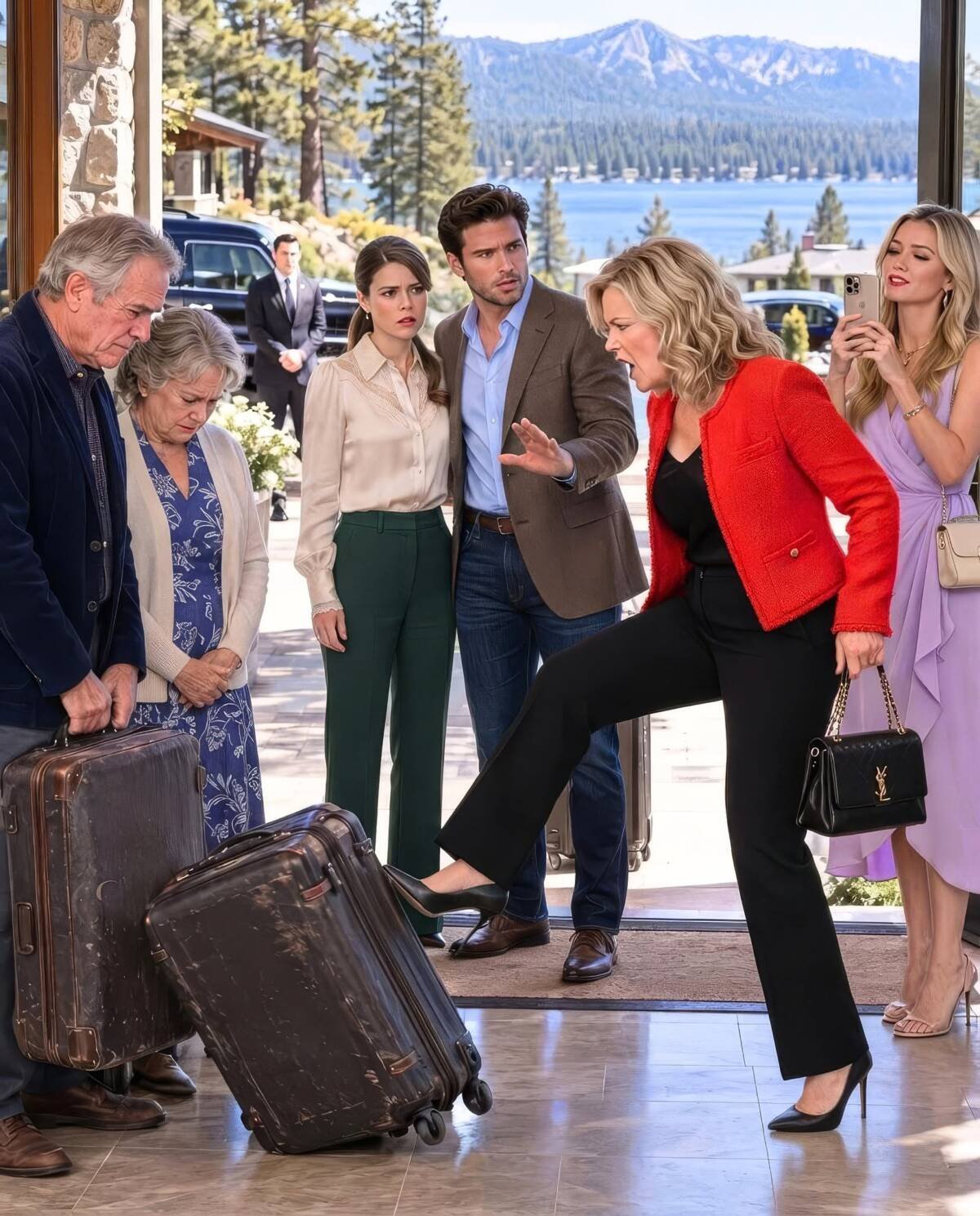
A birthday dinner turned into a calculated attempt at public humiliation when one wealthy socialite expected a quiet father to pay nearly $15,000 to prove his daughter deserved to marry into her family. She thought she knew exactly who he was. Then a waiter revealed a paper trail that changed everything.
The bill landed in front of Robert Hayes just as the last dessert plates were being cleared.
At the bottom of the page, beneath the restaurant’s elegant logo, was a total that made several people around the table glance at one another.
$14,870.
Thirty dinners. Premium wine. Champagne. An elaborate menu. A private dining room reserved for a celebration that had somehow become a test of Robert’s worth.
Across the table, Victoria Whitmore, the woman whose son was engaged to Robert’s daughter, leaned back in her chair and smiled.
“If you want your daughter accepted into this family,” she said, loud enough for all thirty guests to hear, “prove you can pay for it.”
The conversation stopped.
Robert’s daughter, Emily, turned pale. Her fiancé, Daniel, stared down at his plate. A few relatives exchanged uncomfortable glances, while others appeared almost entertained by the spectacle.
Victoria was not finished.
“Or is that too much for you?”
A nervous laugh traveled around the table.
Robert looked at the bill, then at his daughter. He could see the embarrassment in her eyes, and he understood that she was hoping he would somehow make the situation disappear without creating a scene.
He reached for his wallet.
Before he could remove a credit card, a waiter appeared beside his chair.
The young man looked unusually tense. He leaned toward Robert and lowered his voice.
“Mr. Hayes, please don’t pay this. You need to come with me. Right now.”
For the first time that evening, Robert looked genuinely surprised.
Behind him, Victoria laughed.
“Having trouble with your card already?”
More laughter followed.
Robert said nothing. He rose from his chair, excused himself with a brief glance toward Emily, and followed the waiter out of the private dining room.
He had no idea that the bill was only the beginning of the evening’s revelations.
And Victoria Whitmore had no idea that the man she was trying to humiliate had far more knowledge of her family’s financial affairs than she could imagine.
A Birthday Dinner With an Unexpected Price Tag
Robert Hayes was fifty-eight, widowed, and accustomed to keeping his private life out of public view.
He preferred simple clothes, drove an ordinary car, and rarely discussed his professional life at social gatherings. He had spent more than three decades building businesses, investing in commercial real estate, and developing a portfolio that allowed him to live comfortably without advertising his success.
He had never considered wealth something that needed to be displayed.
Victoria Whitmore saw things differently.
To her, money was not merely a means of buying comfort. It was a measure of importance, influence, and social standing. The clothes people wore, the cars they drove, the restaurants they visited, and the people they knew all helped determine where she believed they belonged.
For months, she had made it clear that she considered the Hayes family beneath the Whitmores.
She rarely said it directly when Emily was alone with her fiancé. Instead, she delivered her judgments through carefully worded remarks.
Some families, she would explain, had standards that others simply did not understand.
Certain social circles required a particular level of sophistication.
Marriage, she liked to remind Emily, was about bringing two families together, and those families needed to be compatible.
The implication was always the same.
Emily might be a wonderful young woman, but Victoria did not believe her background was impressive enough.
Robert knew that these comments had hurt his daughter. He had also seen how carefully Emily tried to avoid conflict. She loved Daniel, and she wanted to believe that his family would eventually accept her.
Robert had therefore chosen not to engage in a competition over money or status.
He had no desire to prove himself to Victoria. More importantly, he did not want his daughter’s future marriage to become a contest between two families.
Unfortunately, his restraint appeared to have convinced Victoria that he was an easy target.
The Dinner Victoria Planned
Victoria described the evening as a celebration of her sixtieth birthday.
The restaurant was among the city’s most exclusive dining establishments, known for its private rooms, carefully selected wine list, and expensive tasting menus. The dining room featured polished wood, crystal glassware, soft lighting, and chandeliers that reflected across the long table.
Victoria had personally arranged the reservation.
She selected the private room, requested a premium menu, and invited thirty guests, including relatives, close friends, and several business acquaintances.
As the evening progressed, additional wine was ordered. Champagne appeared at the table. Expensive dishes were added, and the staff accommodated requests for substitutions and upgrades.
Robert noticed the growing extravagance, but he assumed Victoria had arranged to cover the costs of her own birthday celebration.
Nobody had told him otherwise.
He had received no advance request to contribute to the dinner. He had not agreed to sponsor the event. No one had discussed a shared bill, a fixed contribution, or any expectation that he would pay for the entire gathering.
That changed only after dessert.
When the waiter placed the invoice beside Robert’s plate, Victoria behaved as though the arrangement had been obvious from the beginning.
“Marriage joins families,” she announced. “Your daughter is going to be part of ours. It seems only reasonable that you demonstrate your commitment.”
Emily looked at her in disbelief.
“You’re serious?”
Victoria gave her a patient, almost condescending smile.
“Of course, darling.”
Daniel finally lifted his head.
“Mom, maybe we should talk about this privately.”
“Stay out of it, Daniel.”
The words came so quickly that he immediately fell silent.
Robert watched the exchange without interrupting. He was less troubled by the money than by the message Victoria was sending his daughter.
She was presenting the marriage as a privilege that Emily’s family needed to purchase.
And she was doing it in front of thirty people.
Robert reached toward his wallet, not because he accepted Victoria’s demand, but because he wanted a moment to assess the situation without escalating the humiliation Emily was already experiencing.
Then the waiter intervened.
“Mr. Hayes, please don’t pay this.”
Something in the young man’s expression made Robert take the warning seriously.
“What’s going on?” Robert asked quietly.
“Please, sir. The manager is waiting for you.”
Robert followed him into the hallway.
For the first time all evening, he was no longer reacting to Victoria’s performance. He was about to learn what had happened behind the scenes.
The Waiter’s Warning
The waiter led Robert past the kitchen entrance and down a short corridor to the restaurant’s management office.
Inside, the general manager, Marcus Bell, stood beside a desk covered with printed documents.
Marcus closed the door.
“Mr. Hayes, I apologize for bringing you away from your guests like this, but I thought you needed to see something before you made any payment.”
Robert glanced at the papers.
“What is it?”
Marcus placed a reservation record in front of him.
“I believe there may be a serious misunderstanding about who agreed to pay for tonight.”
Robert began reading.
The document contained internal notes attached to the reservation. Several entries described changes made to the guest list, menu upgrades, and special requests. Other notes referred directly to the final invoice.
One instruction stood out.
Place the final bill beside Mr. Hayes after dessert. Do not discuss the payment arrangement with him beforehand.
Robert read the line again.
Below it was another note.
If guest objects, Mrs. Whitmore will handle publicly.
For several seconds, he did not speak.
“Who wrote this?” he asked.
“The instructions came through Mrs. Whitmore’s assistant,” Marcus explained. “We also have the related emails.”
Marcus turned his computer screen toward him.
The messages showed that the payment arrangement had been discussed weeks earlier. Victoria’s assistant had specifically instructed the restaurant to present the invoice to Robert at the end of the evening, without first confirming that he had agreed to cover the expenses.
There were also records of changes to the reservation.
The original guest count had increased. The wine package had been upgraded. Additional premium selections had been approved.
The total had climbed toward $15,000, yet Robert had not been informed that he was expected to pay.
The humiliation was not an unfortunate misunderstanding.
It appeared to have been planned.
Robert leaned back slightly.
“She intended to do this in front of everyone?”
Marcus hesitated before answering.
“The written instructions suggest that she wanted the payment issue addressed publicly if you objected.”
Robert looked down at the invoice.
Victoria had not merely presented him with an expensive dinner bill. She had arranged a situation in which refusing to pay would make him appear unable to support his daughter, while paying would reward her attempt to embarrass him.
Either response was supposed to reinforce her view of the Hayes family.
But there was another document on the desk.
And this one made the situation considerably more serious.
The Corporate Account That Changed Everything
Marcus opened the reservation’s backup payment information.
The restaurant had been provided with an account associated with Whitmore Development Group, the company connected to Victoria’s husband, Charles Whitmore.
Robert recognized the company immediately.
He had professional reasons to know it.
For nearly a year, Robert’s investment firm, Hayes Capital Partners, had held a financial interest in a major commercial property connected to Whitmore Development. The arrangement had been structured through a corporate investment vehicle, so Robert’s personal name was not widely associated with the financing.
The relationship was not something he discussed at dinner parties.
It was business, and he preferred to keep it that way.
He also knew that Whitmore Development had been experiencing financial difficulties.
The company had been working to stabilize its position after problems involving one of its major properties. Certain financial obligations had become more difficult to meet, and a covenant associated with the financing had been breached.
Robert’s firm had not immediately pursued the most aggressive remedies available. Charles had been attempting to refinance the property, and the existing arrangements allowed time for that process to continue.
Victoria, however, appeared unaware of just how complicated the company’s financial position had become.
Robert pointed to the account information.
“Did they tell you this was a corporate expense?”
Marcus nodded.
“Mrs. Whitmore’s assistant supplied it as a backup payment method. We were told that if you declined to pay, the corporate account could be used.”
Robert studied the document carefully.
“Was that authorization confirmed by someone responsible for the company’s finances?”
Marcus explained what the restaurant had been told and provided the available records.
Robert did not assume that the account had been charged improperly. The documents established that a corporate payment method had been supplied, but they did not, by themselves, answer every question about who had authorized it or whether the expense could lawfully be paid from company funds.
That distinction mattered.
A private birthday dinner was not automatically a legitimate corporate expense simply because the person arranging it was connected to the company.
If corporate funds had been committed without proper authorization, the issue could extend beyond an embarrassing dinner reservation.
Robert gathered the printed documents.
“Please preserve the original emails, reservation notes, and payment instructions,” he told Marcus. “I would also like copies of the records showing who requested the changes and when.”
“Of course.”
“Don’t alter anything. Just preserve what you have.”
Marcus agreed.
Robert then stepped into the hallway and called his attorney.
He explained the circumstances, described the corporate account information, and asked for advice on how to proceed.
The response was straightforward: preserve the evidence, avoid making accusations that had not yet been substantiated, and have the appropriate professionals review the documents before any further action was taken.
The conversation lasted only a few minutes.
When Robert returned to the dining room, the guests were still waiting.
Victoria was sitting at the head of the table with a champagne glass in her hand. She looked as though she had been enjoying the time it was taking him to return.
She had no idea that her carefully staged moment was about to become a very different conversation.
“So, Are You Paying or Not?”
Robert returned to his seat.
Victoria looked him up and down.
“Well?”
He folded the bill neatly and placed it beside his plate.
“Everything is fine.”
Her smile widened.
“So you’re paying?”
“Eventually.”
A few guests laughed.
Victoria leaned toward him, lowering her voice just enough to make the remark feel personal while ensuring that the people nearest her could hear it.
“I knew Emily had exaggerated your financial situation.”
Emily flinched.
Robert looked at his daughter. He could see the effort she was making to remain composed, even though the people around her had just witnessed an insult directed at her family.
He decided that the conversation needed to change.
“Victoria,” he said calmly, “how much do you know about your husband’s company?”
Her expression shifted.
“What an odd question.”
“Do you know who financed the Riverside Center acquisition?”
Charles Whitmore, who had been sitting farther down the table, immediately looked up.
Victoria waved a dismissive hand.
“Some investment group, I assume.”
Charles did not answer at first.
Then he said, “Hayes Capital Partners.”
The name seemed to interrupt the entire room.
Victoria turned toward him.
“What?”
Charles looked from his wife to Robert.
“Hayes Capital Partners,” he repeated. “They’re involved in the financing.”
Victoria gave a short, uncertain laugh.
“That proves nothing.”
Robert reached into his jacket and removed a business card.
He placed it on the table beside her champagne glass.
ROBERT HAYES
CHAIRMAN
HAYES CAPITAL PARTNERS
Charles stared at the card.
Then he looked directly at Robert.
“You’re Robert Hayes?”
“Yes.”
For the first time that evening, Charles appeared to be reconsidering everything he thought he knew about the man sitting across from him.
Victoria picked up the card.
Her eyes moved over the name and title, then returned to Robert’s face.
“I’ve never heard of you,” she said.
“You may not have,” Robert replied. “I generally don’t discuss my business arrangements at private dinners.”
The statement was calm, almost conversational.
It nevertheless made several guests look away.
Robert had not raised his voice. He had not boasted about his wealth or threatened anyone. He had simply corrected an assumption.
Then he continued.
“But I think we should discuss the emails your assistant sent to the restaurant.”
Victoria’s expression tightened.
“What emails?”
“The instructions about the bill.”
She looked toward Charles, who had already begun asking questions.
Robert explained that the restaurant had documented the payment arrangement, including the instruction to present the bill to him without prior notice.
He also explained that the corporate account had been supplied as a backup payment method.
He did not claim that the records proved fraud or that the company had necessarily suffered a financial loss. Those questions would require a proper review.
But he made one thing clear.
The documents needed to be examined.
Victoria stopped smiling.
And the room that had laughed at Robert only minutes earlier fell silent.
The Moment Emily Refused to Play Along
Charles reached for the printed emails that Robert had brought back from the manager’s office.
He read the first page, then the second.
His expression changed.
“Victoria, what did you do?”
She took the papers from him.
“It’s a birthday dinner.”
“You arranged for the company account to be used?”
“It was only a backup.”
Charles lowered his voice.
“That account has restrictions.”
Several guests suddenly found their plates more interesting than the conversation.
Victoria turned toward Robert.
“This is ridiculous. You were supposed to pay.”
“Why?” he asked.
“Because your daughter is marrying into our family.”
Emily pushed her chair back.
The sound of its legs against the floor cut through the silence.
“No,” she said.
Victoria turned toward her.
“Excuse me?”
Emily stood, her hands trembling slightly.
“I’m not buying my way into anything.”
For months, Emily had tried to preserve peace between the two families. She had ignored the comments, swallowed the insults, and hoped that Victoria’s attitude would eventually change.
But the dinner had made the underlying problem impossible to ignore.
Her future mother-in-law had deliberately placed her father in a humiliating position and presented the situation as a test of his worth.
Emily was no longer willing to pretend that it was acceptable.
Daniel reached for her hand.
“Emily’s right,” he said.
Victoria stared at her son.
“Daniel, sit down.”
This time, he did not obey.
“No, Mom. You’ve gone too far.”
The words were simple, but their effect on the room was immediate.
Victoria had spent the evening assuming that everyone would follow her lead. She expected the guests to laugh when she laughed, accept her judgments, and treat her demands as though they were reasonable.
Now her own son was refusing to support her.
Charles placed the documents on the table.
“We’re not discussing this further until I’ve spoken with the company’s advisers.”
Victoria looked at him in disbelief.
“You’re taking their side?”
“I’m trying to understand what happened.”
Robert allowed the family to speak among themselves for a moment.
He had no interest in turning the restaurant into a courtroom. The evidence needed to be reviewed, and any questions about corporate authorization belonged with the company’s appropriate decision-makers.
But he also had no intention of paying an invoice simply because Victoria had designed a public scene around it.
He picked up the bill and turned toward Charles.
“The restaurant’s records should be preserved. Your company can review the corporate account issue through the proper channels.”
Charles nodded slowly.
“And the bill?”
“Victoria arranged the dinner,” Robert replied. “I never agreed to cover the entire event. How the legitimate charges are settled is a matter for the people responsible for the reservation and the restaurant to resolve.”
Victoria stared at him.
“You said you could afford it.”
“I can.”
Robert stood.
“That doesn’t make it mine.”
Emily rose beside him.
Daniel hesitated for only a moment before standing with her.
Together, the three of them left the private dining room.
Behind them, Victoria remained at the table with the invoice she had intended to use as a weapon.
The guests who had laughed at Robert’s expense were no longer laughing.
And for the first time that evening, Victoria had no audience willing to applaud her.
Why Robert Refused to Pay
For Robert, walking away was not about proving that he was wealthier than Victoria.
He could have paid the bill without threatening his financial security. The amount was significant, but it was not beyond his means.
That was precisely why he refused to let the money become the central issue.
If he had paid simply to silence Victoria, the evening would have ended with her belief that public humiliation was an effective way to get what she wanted.
If he had shouted at her or threatened to destroy her husband’s business, she could have portrayed herself as the victim of an unreasonable man.
Instead, Robert made a distinction that Victoria had never considered.
Being able to pay for something does not mean you are obligated to accept someone else’s manipulation.
The restaurant had records of the reservation instructions. The corporate payment method raised questions that needed to be answered. The company’s financial arrangements were governed by existing agreements, not by the emotions of a birthday dinner.
Robert’s response was to preserve the evidence and allow the appropriate review to take place.
He would not use his business position to punish Victoria personally. He would not interfere with his daughter’s marriage. And he would not accept responsibility for expenses he had never agreed to cover.
Those boundaries were enough.
They also gave Emily and Daniel an opportunity to make their own decisions about the future of their relationship and the family they wanted to build.
For Robert, that mattered more than winning an argument.
The Review That Followed the Dinner
In the weeks after the dinner, Whitmore Development’s leadership began examining the available records.
The initial concern was the proposed use of a corporate payment method for a private birthday event. The company needed to determine who had supplied the account information, what authorization had been given, and whether any corporate funds had actually been used.
The review also examined other personal events that had reportedly involved company resources.
What began as a question about one restaurant invoice developed into a broader examination of how certain expenses had been handled.
The distinction between personal spending and legitimate corporate expenditure became central to the inquiry.
Victoria had been accustomed to organizing events through her husband’s professional connections. She had often treated the company’s resources as an extension of the family’s lifestyle.
But businesses operate under rules that do not disappear because a person is wealthy, socially connected, or married to an executive.
The review forced the Whitmores to confront those questions directly.
Victoria’s informal involvement with company accounts was subsequently restricted, and the company reassessed how personal expenses were approved. Charles also faced pressure to address the financial difficulties affecting the business.
The precise consequences of the review were matters for the company and its advisers, not for Robert to dictate.
He did not demand that Victoria lose her position. He did not insist that Charles sell a property. And he did not threaten to withdraw financing simply because he disliked the way his daughter had been treated.
His position remained consistent.
The company would be expected to follow its agreements, and the people responsible for its finances would have to address any problems identified by the review.
That was business.
The dinner, however, had revealed a different problem—one that could not be resolved through accounting procedures alone.
Victoria had treated Emily as though she needed to earn the right to marry Daniel.
And Daniel had allowed his mother to speak for him until the moment he finally chose to stand beside his fiancée.
That was the issue the young couple now had to confront.
A Wedding Without the Performance
In the months that followed, Emily and Daniel reconsidered their wedding plans.
The original proposal had included a grand ballroom, an elaborate guest list, professional society photography, and many of the expensive details Victoria had wanted.
The plans were designed to impress people.
After the dinner, Emily and Daniel began asking themselves a different question.
What kind of wedding would make them happy?
Their answer was simpler than either family had expected.
Six months later, they married at a lakeside venue with approximately forty guests. There was no elaborate display of social status and no attempt to impress a room full of acquaintances.
The people who attended were those the couple genuinely wanted beside them.
The ceremony was intimate. The reception was relaxed. Emily looked happy, and Daniel seemed more comfortable than he had during any of the formal family gatherings that preceded it.
Victoria attended the wedding.
She did not make a speech about family prestige. She did not comment on the cost of the arrangements. She did not attempt to turn the celebration into an occasion for evaluating Emily’s background.
She remained quiet.
Robert noticed the difference, but he did not mistake it for a complete transformation.
People can change their behavior when circumstances force them to reconsider their choices. Whether that change reflects deeper understanding becomes clear only over time.
Robert was willing to be civil.
He was not prepared to pretend that the dinner had never happened.
After the reception, Victoria approached him when they were briefly away from the other guests.
“I misjudged you,” she said.
Robert looked at her.
“Yes,” he replied.
She waited.
Perhaps she expected him to reassure her that the matter was forgotten. Perhaps she wanted him to say that the two families could now put everything behind them.
But Robert did not offer a quick absolution.
He had no desire to humiliate Victoria in return. He also understood that a single acknowledgment could not erase months of insults or undo the embarrassment Emily had experienced.
He simply allowed the statement to stand.
Victoria had misjudged him.
What happened next would depend on what she chose to do with that realization.
The Conversation That Stayed With Him
A year after the dinner, Robert was at home when Emily called him on a Sunday morning.
Her voice sounded relaxed.
“Dad?”
“Hey, sweetheart. Everything okay?”
“Yeah. I was thinking about that night at the restaurant.”
Robert smiled faintly.
“That’s a memorable dinner bill.”
Emily laughed.
Then she grew thoughtful.
“I finally understand why you didn’t yell at her.”
Robert leaned back in his chair.
“Why’s that?”
“Because people like Victoria expect anger. They know how to fight anger. They can turn it into an argument, make themselves look like the victim, and convince everyone that the other person is the problem.”
Robert listened without interrupting.
Emily continued.
“But you didn’t give her that. You stayed calm, and you kept the records. You let her own decisions become the issue.”
She paused.
“People can argue about what someone said. It’s harder to explain away what they put in writing.”
Robert looked out at the backyard.
He had never considered the evening a masterclass in handling difficult people. At the time, he had simply wanted to protect his daughter, understand the documents, and avoid making a difficult situation worse.
But Emily had identified something important.
Victoria had expected him to react emotionally because she believed the situation was under her control. She thought she could decide what the bill meant, what the guests would think, and how Robert would be remembered when the evening ended.
Instead, the records gave everyone a reason to look beyond her version of events.
Robert had not needed to shout.
He had not needed to reveal every detail of his professional life.
He had not needed to make a public display of his wealth.
He had only needed to refuse the terms of the humiliation and let the facts be examined.
The Lesson Behind the $14,870 Bill
Looking back, Robert understood that the dinner had never really been about the money.
The invoice was a prop in a carefully constructed performance. Victoria wanted to establish a hierarchy in front of her relatives and friends. She wanted Robert to demonstrate his supposed inferiority by paying a bill he had never agreed to cover—or by refusing and allowing her to present that refusal as proof that Emily came from the wrong family.
The plan depended on Robert accepting her definition of the situation.
He did not.
He also refused to turn the episode into a personal war.
His business dealings with Whitmore Development had to be handled professionally. His daughter’s relationship with Daniel had to remain her decision. Any questions about company funds had to be investigated through the appropriate channels.
Those boundaries prevented the situation from becoming the kind of spectacle Victoria had originally intended.
They also allowed Emily to see something she had struggled to recognize during the months of criticism.
She did not need to earn her place in a family by enduring humiliation.
And Daniel had to understand that loving someone sometimes requires setting boundaries with the people who raised you.
The couple’s smaller wedding was not a punishment for Victoria. It was a choice about how they wanted to begin their life together.
Their marriage belonged to them.
So did the decision about which family traditions they would keep, which expectations they would reject, and what kind of behavior they would accept from the people closest to them.
Robert was proud of his daughter for making that distinction.
He had built businesses over decades, negotiated complicated agreements, and learned that the most important decisions were not always the ones made in the largest rooms or in front of the most powerful people.
Sometimes, the most consequential moment came when someone quietly decided not to participate in a game designed to diminish them.
That was what happened at the restaurant.
Victoria had expected a public victory.
Instead, she was left with questions about her own decisions, a company review that needed to run its course, and a daughter-in-law who no longer felt obligated to win her approval.
Robert never needed to destroy her reputation or make her suffer the embarrassment she had tried to create for him.
He simply stopped allowing her behavior to dictate the terms of his family’s life.
And that was enough.
Conclusion: Silence Is Not Weakness
The $14,870 dinner bill was supposed to be Robert Hayes’s moment of humiliation. Victoria Whitmore believed that money could establish who deserved respect, and she expected a quiet father to pay whatever price she demanded to secure his daughter’s place in the family.
Instead, the restaurant’s records revealed that the payment arrangement had been planned in advance. The discovery raised questions that needed to be reviewed, while Robert’s refusal to turn the confrontation into a shouting match allowed his daughter to see the situation clearly.
He did not retaliate. He did not use his wealth to dictate the outcome of the marriage. And he did not confuse financial power with the right to control other people.
He preserved the evidence, maintained his boundaries, and let the relevant facts speak for themselves.
For Emily and Daniel, the lasting lesson was that a marriage should be built on mutual respect, not on one family’s demands for approval.
For Robert, it was a reminder that dignity does not depend on how loudly a person responds to an insult—or how much money they can spend to silence it.
Sometimes, the strongest answer is simply to refuse an unfair demand and allow the truth to emerge.
Victoria thought she was handing Robert a bill.
In reality, she was handing him the evidence that would expose the assumptions behind her own behavior.
And the most important thing he walked away with that night was not a financial victory. It was his daughter’s understanding that she never needed to buy anyone’s respect.
What do you think? Was Robert right to refuse to pay the bill, or should he have handled the situation differently to protect his daughter’s relationship? Share your thoughts in the comments, and pass this story along to someone who believes that respect should never come with a price tag.