They told me to take my little boy and never come back after he accidentally spilled cranberry juice at Thanksgiving dinner. My father thought he had the final word. My mother believed she had protected the family’s reputation. My sister was already planning to move into my childhood bedroom. None of them knew that I secretly owned the house they were living in—or that my father had signed a document that could change everything.
The deadbolt clicked behind me while my four-year-old son was still crying on the porch.
For a moment, I couldn’t move.
Snow drifted across the front steps, settling on Leo’s dark hair and collecting on his eyelashes. Behind the oak door, warm light spilled through the narrow glass panels beside the entrance. I could hear muffled voices from inside, the clinking of dishes, and the familiar sounds of a Thanksgiving dinner that had apparently continued without us.
My son squeezed my hand.
“Mommy, why did Grandpa lock the door?”
I looked down at him, struggling to find an answer that wouldn’t make a four-year-old feel responsible for something he could never have understood.
“Come on, sweetheart,” I whispered. “Let’s get you somewhere warm.”
I pulled his hat down over his ears, wrapped his scarf around his neck, and led him toward my SUV.
I didn’t knock again.
I didn’t beg my father to reconsider.
And I didn’t remind my mother that the roof over her head, the furnace keeping her warm, and the very house from which she had just watched her grandson being thrown out belonged to me.
Not yet.
My name is Nicole. I’m thirty-two years old, a single mother, and a digital marketing consultant. For years, my family had treated my career as an embarrassing little hobby, something I did on my laptop while my younger sister, Natalie, built the kind of life my parents loved showing off to their friends.
They praised her marriage, her clothes, her expensive vacations, and her husband’s impressive-sounding career in finance.
They rarely asked about my work.
They never asked how I managed to raise Leo on my own.
And they certainly never imagined that the daughter they dismissed as a disappointment had quietly purchased their family home after they came dangerously close to losing it.
Four years earlier, when my parents were drowning in debt, I had stepped in without telling them the truth about who was helping them. Through a company I owned, I bought the property after the bank took possession of it and allowed them to remain there under a lease.
They believed they had negotiated a favorable arrangement with an anonymous investment firm.
They believed their home was safe because of their own financial decisions.
And they believed I was simply the daughter who showed up when someone needed help.
On Thanksgiving night, those assumptions were about to collapse.
But first, I had to get my son out of the cold.
THE ACCIDENT THAT ENDED THANKSGIVING
Twenty minutes earlier, the dining room had been full of the familiar sounds of a family trying to look happier than it really was.
My father, Richard, sat at the head of the table, holding court as usual. He was telling everyone about the importance of discipline, financial responsibility, and making the right connections. He delivered these speeches with the confidence of a man who had never admitted how close his own decisions had brought him to financial ruin.
My mother, Patricia, moved between the kitchen and dining room, checking the food and making sure everything looked perfect.
Natalie sat beside her husband, Terrence, wearing a cream-colored sweater and a diamond bracelet that caught the light whenever she moved her hand.
Terrence was discussing a luxury vacation they were planning. He talked about hotels, restaurants, and destinations as if money were an unlimited resource.
My sister nodded along, occasionally adding details about the clothes she intended to buy before the trip.
Leo sat beside me in a chair that was a little too large for him. He had spent the afternoon excited about Thanksgiving, especially the cranberry sauce, which he had declared his favorite part of the meal.
He was trying very hard to behave.
He had been quiet during dinner, used his napkin when I reminded him, and asked politely before reaching for another roll.
Then his small hand slipped against the glass.
The cranberry juice tipped over.
Red liquid spread across the white tablecloth, ran toward the edge of the table, and splashed onto the floor near Terrence’s expensive loafers.
For one brief second, nobody spoke.
Then Natalie pushed her chair backward.
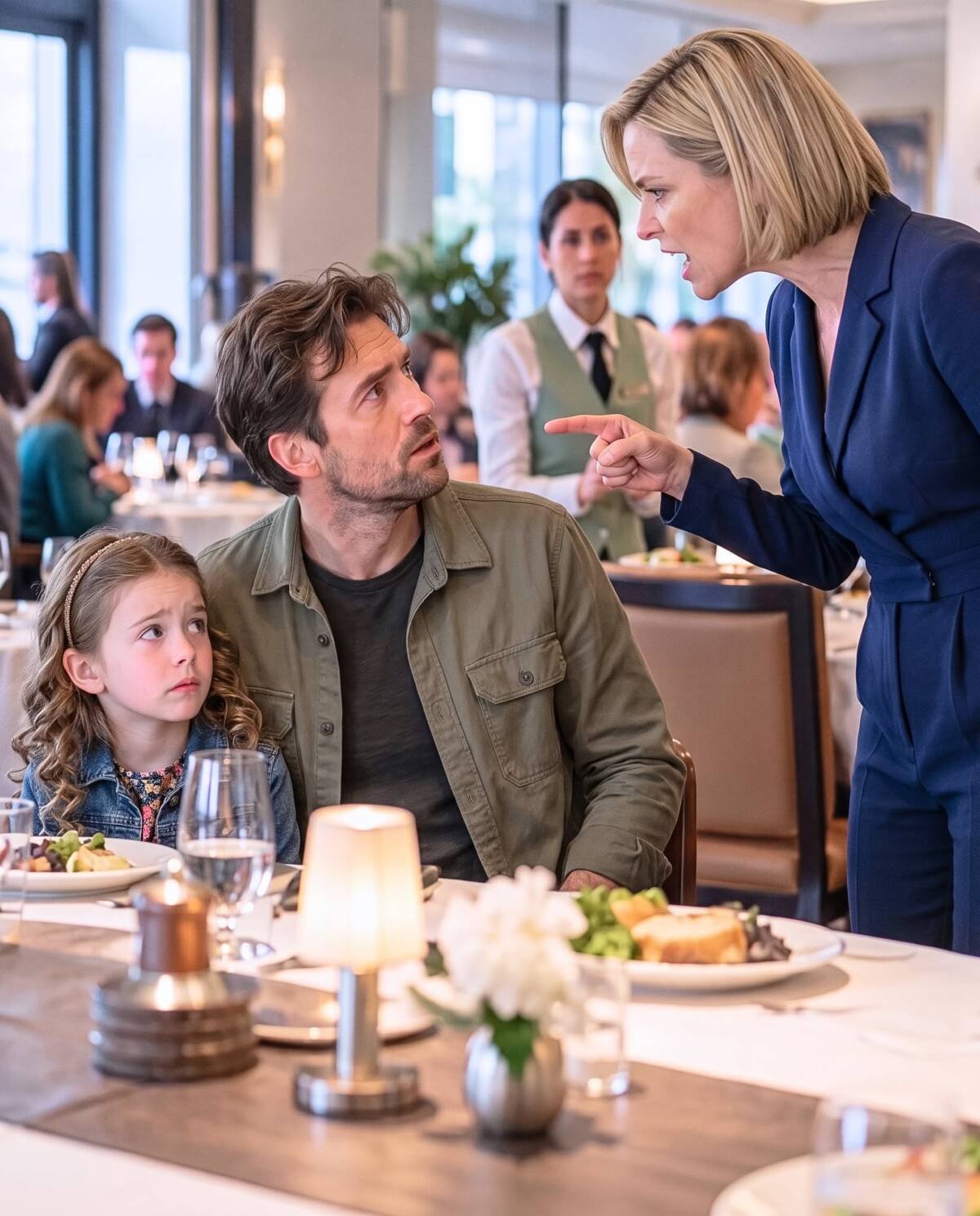
“Seriously, Nicole? Can’t you watch him for once?”
Leo froze.
His eyes moved from the spilled juice to my sister’s face, and then to me. I could see the embarrassment settling over him before he even understood what he had done.
“I’m sorry,” I said immediately, reaching for the napkins. “It was an accident.”
I began blotting the tablecloth while trying to keep the liquid from spreading.
Leo’s lower lip trembled.
“I’m sorry, Mommy.”
“It’s okay, sweetheart. You didn’t mean to.”
But Natalie wasn’t finished.
“Those shoes are expensive, and now the whole tablecloth is ruined.”
Terrence looked down at his shoes, then at the floor.
“It’s fine,” he said, although his tone suggested otherwise. “Let’s just clean it up.”
He could have ended the incident with those words.
He could have reassured Leo that accidents happened.
Instead, he leaned back in his chair and watched as my mother entered the room.
Patricia took one look at the table.
“What happened?”
“Leo spilled his drink,” Natalie answered. “Again, Nicole wasn’t watching him.”
Again.
The word landed harder than it should have.
Leo had spilled a drink. That was all. But my family had a way of turning small mistakes into evidence that I was somehow failing at life.
My mother picked up a stained napkin and sighed.
“He’s your responsibility, Nicole. We are tired of dealing with this.”
I looked at her.
“He’s four, Mom.”
“And you knew that when you brought him here.”
“I didn’t bring him here to cause problems. He was drinking juice.”
My father finally lowered his fork.
“That’s enough.”
He didn’t say it to Natalie.
He didn’t say it to Terrence.
He said it to me.
I took a breath, trying to keep the situation from escalating in front of Leo.
“I’ll clean everything up. It was an accident, and we’re all tired. There’s no reason to make this into something bigger.”
Richard stood.
“You always have an excuse.”
I stared at him, genuinely unsure whether he was still talking about the juice.
“An excuse for what?”
“For everything. Your decisions. Your circumstances. The way you live. You expect everyone to accommodate you.”
I felt Leo press closer against my side.
My father glanced at him, then looked away.
That was when I realized this was no longer about a stained tablecloth.
It was about years of resentment, expectations, and the role my family had assigned me long before Leo was born.
Natalie was the successful one.
I was the difficult one.
Natalie had made the right choices.
I had somehow disappointed everyone.
It didn’t matter that I had built a business from nothing, that I worked long hours to support my son, or that I had repeatedly stepped in when my parents needed help.
None of those things fit the story they preferred telling themselves.
My mother folded her arms.
“Perhaps it’s time you left.”
I looked at her.
“What?”
“You heard me.”
My father walked toward the hallway.
“Get your coat.”
I thought he was telling me to take Leo outside for a few minutes. I thought perhaps he wanted everyone to cool down before returning to dinner.
Then he returned holding my coat.
He threw it toward me.
“We’re finished dealing with your mistake. Leave, and don’t come back.”
The room went silent.
I looked at my father, waiting for the smallest sign that he didn’t mean what he had just said.
There was none.
“Richard,” my mother murmured, but her voice carried no real objection.
He pointed toward the front door.
“Now.”
I glanced at Natalie.
She didn’t look shocked. If anything, she looked relieved. Her husband had already begun wiping a spot on his shoe with a napkin.
I bent down and helped Leo put on his coat.
His little fingers struggled with the zipper, so I finished it for him.
“Mommy, are we going home?”
“Yes, sweetheart.”
“But we’re having Thanksgiving.”
“I know.”
He looked toward the dining room.
“Can I say goodbye?”
My throat tightened.
I didn’t trust myself to answer immediately.
My father opened the front door.
Cold air rushed inside.
“Go.”
I took Leo’s hand and stepped onto the porch.
Then I heard the deadbolt turn behind us.
THE DRIVEWAY WHERE I MADE MY DECISION
I didn’t start the engine immediately.
I sat in the driver’s seat, watching Leo stretch his hands toward the heater vents. His cheeks were pink from the cold, and his eyes were still wet.
Snow fell steadily across the driveway.
Through the windshield, I could see the upstairs windows glowing against the dark sky. One of those windows belonged to the bedroom where I had grown up.
A light had just switched on.
I knew whose room it was going to become.
Natalie had mentioned several times that she and Terrence needed more space. Their apartment lease was becoming a problem, although she had always avoided explaining exactly why. My parents had hinted that she might eventually move into the house.
Now, apparently, the decision had been made.
They had thrown me and my son outside, and my sister was already preparing to take over my old bedroom.
Leo looked at me.
“Mommy?”
“Yes?”
“Is Grandpa mad at me?”
I turned toward him.
“No, sweetheart. You didn’t do anything wrong.”
“But I spilled the juice.”
“That was an accident. Accidents happen.”
He thought about that for a moment.
“Will Grandma still love me?”
The question nearly broke me.
I reached across the console and took his small hand.
“You deserve to be loved, no matter what happens to a drink or a tablecloth. Do you understand?”
He nodded, although I wasn’t sure he fully understood what I meant.
I started the engine and turned the heat higher.
Then I reached for my phone.
For years, I had kept my parents’ financial arrangements separate from the rest of our relationship. I had never wanted them to feel humiliated. I had never wanted them to believe I was using money to control them.
More than anything, I had hoped they would eventually appreciate what I had done.
But as I watched my son staring out the window, trying to understand why his grandparents had sent him away, I finally accepted something I had avoided for years.
I couldn’t keep protecting people who were willing to hurt my child simply to protect their own pride.
I opened my contacts and called David Miller, my attorney.
He answered after two rings.
“Nicole? Is everything okay?”
“Do you still have the Westchester property file?”
“Of course.”
“The original lease?”
“Yes.”
“And the signed violation clause?”
There was a pause.
“Why are you asking about that tonight?”
I looked at Leo, who had begun rubbing his eyes.
“Because my father just threw us out of the house.”
David’s voice changed immediately.
“What happened? Are you and Leo safe?”
“We’re in the car. We’re going somewhere warm.”
“Good. Do that first.”
I could hear him moving papers on his desk.
“Nicole, tell me exactly what happened.”
I gave him the short version. I explained the spilled juice, the argument, my father’s demand that we leave, and the door locking behind us.
David listened without interrupting.
When I finished, he was quiet for several seconds.
“Did Richard explicitly tell you that you were no longer welcome on the property?”
“Yes.”
“And Leo?”
“He told us both to leave.”
David exhaled slowly.
“All right. I’m going to review the lease and the documentation. I want you to get Leo somewhere warm and comfortable. Don’t return to the house tonight.”
I hesitated.
“David?”
“Yes?”
“Use the clause.”
Another silence followed.
“Are you certain?”
I looked at the house one last time.
For years, I had made decisions based on what might preserve the family relationship. I had paid for repairs, covered shortfalls, and kept my ownership secret because I thought the truth might embarrass my parents.
Tonight, I had watched them humiliate my son over a spilled drink.
“Yes,” I said. “I’m certain.”
David promised to call me back.
I drove toward a hotel outside Manhattan, where I could give Leo a warm bed and a quiet place to sleep.
He fell asleep before we reached the highway.
I kept glancing at him in the rearview mirror, thinking about the promise I had made to myself when he was born: that I would always make him feel safe, even if I couldn’t give him everything he deserved.
I had thought safety meant keeping our family together.
Now I understood that sometimes it meant accepting that the family you wanted was not the family you had.
FOUR YEARS EARLIER, I HAD SAVED THEIR HOUSE
To understand why my father’s signature mattered, it helps to understand what had happened four years before that Thanksgiving.
At the time, my parents were living in a house they could no longer afford.
From the outside, everything looked fine. Richard still attended his club meetings. Patricia still hosted dinners. Their home still had the carefully maintained landscaping, polished furniture, and expensive decorations they considered essential to their social standing.
But behind the appearance of stability, their finances were deteriorating.
They had accumulated debt through years of overspending, questionable investments, and a determination to maintain a lifestyle that no longer matched their income.
Their mortgage payments fell behind.
Bills accumulated.
Creditors began calling.
My father responded by insisting that everything was under control.
My mother responded by avoiding the subject entirely.
Neither wanted to admit how serious the situation had become.
I learned the truth only after my father called me one evening and asked whether I could help him review some paperwork.
I was pregnant with Leo at the time, working from a small apartment and building my consulting business one client at a time.
I didn’t have a fortune.
I didn’t have a wealthy husband or parents who could help me when things went wrong.
What I had was a growing business, a willingness to work long hours, and some savings I had carefully set aside for the future.
When I reviewed the paperwork, I realized the situation was worse than my father had admitted.
The bank had already begun the process of taking possession of the house.
Richard was furious when I suggested selling some of their possessions and making more substantial changes to their lifestyle.
“We’re not selling the house,” he said.
“Then you need another plan.”
“I have a plan.”
“What is it?”
He didn’t answer.
My mother sat quietly at the kitchen table, staring at a cup of coffee.
For the first time, I saw fear beneath the carefully maintained image she presented to the world.
I knew that if the house disappeared, my parents would lose more than their property. They would lose the place where they had hosted birthdays, holidays, family celebrations, and decades of gatherings with friends.
I also knew that my father would struggle to accept help directly from me.
He had spent my entire life believing that parents were supposed to provide for their children, not the other way around. The idea of depending on his daughter would have wounded his pride.
So I spoke with an attorney.
His name was David Miller, and he specialized in property transactions and real estate agreements.
I explained my parents’ circumstances and asked whether there was a way to purchase the property through a separate company without turning the transaction into a public family discussion.
David warned me that the arrangement would carry substantial costs and responsibilities.
Buying the house would not be the end of the financial commitment.
There would be property taxes, insurance, maintenance, repairs, and the possibility of unexpected expenses. If the rental income failed to cover those costs, I would have to make up the difference.
He also warned me against confusing financial assistance with an obligation to preserve a relationship.
“Nicole,” he told me, “you need to decide whether you can afford this financially and emotionally. Those are two different questions.”
I told him I understood.
The truth was that I wasn’t completely sure I did.
I wanted to protect my parents from losing their home. I wanted Leo to grow up with grandparents he could visit during the holidays. And, if I was being honest with myself, I wanted to prove that I could become successful without becoming the kind of person my family had always assumed I would be.
I wanted them to see me differently.
I wanted them to respect me.
Most of all, I wanted to believe that if I helped them through their worst moment, they might eventually treat me and my child with the same kindness they offered Natalie.
After reviewing the numbers, I decided to proceed.
My company purchased the property after the bank acquired it. The transaction was completed through the appropriate legal process, and my parents entered into a lease with the company.
They believed the arrangement was the result of their own negotiations.
They never asked enough questions to discover who owned the business.
I didn’t volunteer the information.
At first, I thought I was doing the right thing by preserving their dignity. I told myself that the details didn’t matter as long as they could remain in their home.
For four years, I managed the property through the company.
When the roof needed repairs, I arranged them.
When the heating system required attention, I paid the bill.
When unexpected maintenance expenses appeared, I covered whatever the rental income didn’t.
I did not ask my parents to thank me.
I did not remind them that the arrangement existed because I had stepped in when no one else had.
And I never used the house as leverage in a family argument.
The lease was drafted to define the responsibilities of the parties, including the terms under which the property could be occupied and the procedures for addressing violations.
My father signed the documents.
He read enough to feel confident that he had secured a favorable arrangement.
He never imagined that the company behind the agreement belonged to the daughter he regularly criticized.
The clause David had drafted was designed to address serious breaches of the agreement, including circumstances involving the treatment and removal of authorized occupants.
I had never expected to rely on it against my own parents.
I had imagined a very different future.
I thought I might eventually tell them the truth over a family dinner. I imagined my mother crying with gratitude, my father admitting that I had done something remarkable, and Natalie finally recognizing that my life was not the failure she seemed to believe it was.
Perhaps that was naive.
But when you grow up trying to earn the approval of people who rarely offer it, you can spend years mistaking sacrifice for love.
Thanksgiving was the night I finally stopped.
TWO HOURS LATER, THE DOORBELL RANG
At the hotel, Leo slept beneath a thick white comforter while I sat beside the window watching snow collect along the parking lot.
I had ordered him a small dinner before he fell asleep, but he had been too exhausted to eat much. I left the food covered on the table and pulled a chair closer to the bed.
For the first time that evening, I allowed myself to cry.
Not because I regretted what I had done.
Because I was finally grieving what I had spent years hoping my family might become.
My phone buzzed.
David had sent a message.
We’re at the house.
I sat up.
A few months earlier, my company had installed a security system after a series of break-ins in the neighborhood. My parents knew the cameras were there, although they had never paid much attention to them.
I opened the security application on my laptop.
The front entrance appeared on the screen.
Richard stood inside the hallway with a cigar in one hand. Patricia was near the dining room, carrying a glass of wine. The Thanksgiving table was still set, and the stained tablecloth had been pushed toward one end.
Natalie and Terrence were upstairs.
Through another camera, I could see Natalie measuring the doorway of my childhood bedroom while Terrence stood nearby, checking something on his phone.
They had apparently decided that the evening’s argument had settled everything.
Then the doorbell rang.
Richard looked annoyed.
He placed his cigar in an ashtray and walked toward the entrance, apparently expecting another delivery or an inconvenient visitor.
When he opened the door, David was standing on the porch holding a thick manila folder.
Two county deputies stood several feet behind him.
They were not there to create a spectacle. David had requested their presence to help keep the situation calm while he delivered formal notice and explained the next steps.
My father looked from David to the deputies.
“What is this?”
“Good evening, Richard,” David said. “I’m David Miller, the attorney representing the owner of this property.”
Richard’s expression changed.
“The owner?”
“Yes.”
“I have a lease.”
“I know.”
“Then whatever this is, you can send it through the proper channels.”
David held up the folder.
“That’s precisely what I’m here to do.”
My father crossed his arms.
“You people can’t simply show up at my house and threaten me.”
David remained calm.
“This is not a threat. I have documents that need to be delivered and explained. I would appreciate a few minutes of your time.”
Patricia appeared behind Richard.
“Who is it?”
“Some attorney,” Richard replied irritably. “He says he’s representing the owner.”
She looked confused.
“The investment company?”
“That’s what I’m trying to establish.”
David opened the folder.
“The company that purchased this property four years ago has reviewed the events of this evening. The owner has instructed me to address a potential violation of the lease.”
Richard gave a short, dismissive laugh.
“What violation?”
“You ordered two authorized occupants to leave the property and expressly prohibited them from returning.”
“They were guests.”
“Nicole and her son were authorized to be here.”
“Nicole is my daughter.”
“That does not change the terms of your lease.”
Richard’s face darkened.
“Are you telling me I can’t tell my own daughter to leave my house?”
“I’m telling you that the legal ownership of the property and the terms of your occupancy are separate matters from your family relationships.”
For the first time, my father seemed unable to find an immediate response.
He looked down at the documents.
“Who owns this company?”
David turned to the relevant page.
“The owner has requested that I explain the situation before answering any further questions.”
Richard’s patience was running out.
“I want the owner on the phone. Right now.”
David glanced toward the security camera above the entrance.
“She’s watching.”
My father followed his gaze.
He looked directly into the camera.
For several seconds, he stood completely still.
Then he turned back to David.....