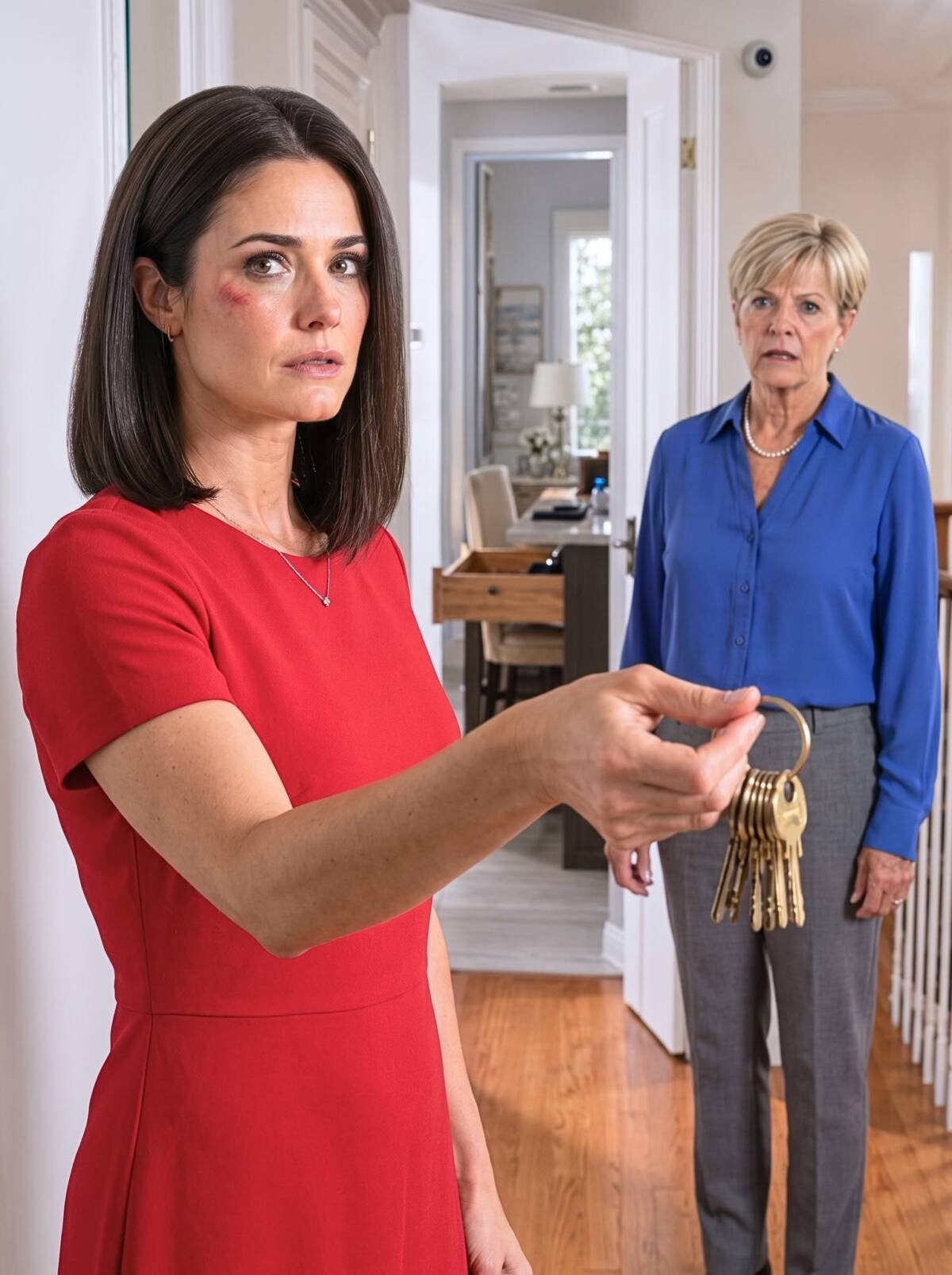
At 2:13 a.m., a glowing phone screen shattered nineteen years of marriage. Thousands of miles away at a luxury overseas resort, a husband who had just married a younger woman sent his wife a blunt ultimatum: clear out before he got back, because he was tired of “old things.”
He assumed she would quietly pack her bags and disappear, leaving behind the family home he planned to share with his new bride and their two teenagers. He had already arranged the flights, the resort, and the new life. The only detail he forgot was the one he had laughed about for years—the deed to the land beneath their feet belonged exclusively to her.
By the time his taxi pulled into the driveway a week later, the house wasn’t just empty. It was gone.
The 2:13 A.M. Text That Ended Nineteen Years
I remember the exact time my phone lit up because I was already wide awake, staring at the slow rotation of the ceiling fan and listening to the familiar settling sounds of a house my family had lived in for nearly two decades. The hum of the refrigerator downstairs, the faint creak of the hallway floorboards, the distant sound of traffic on the county road—every noise was a piece of a life I had spent nineteen years building.
For a split second, when the screen illuminated the dark bedroom, I thought Ethan might be checking in from his trip. Maybe one of the kids had forgotten something, or maybe a flight had been delayed.
Instead, two messages sat side by side on the lock screen.
“Be gone when we return. I hate old things. I work hard, so I deserve a new life.”
Before I could even process the first sentence, a second message arrived.
“Don’t embarrass yourself. The kids will be with us.”
I read both messages three times, letting the words settle in the quiet room, before setting the phone face-up on the nightstand. Somewhere across an ocean, Ethan was likely sleeping soundly in a five-star suite after dismissing his wife of nineteen years through a text message, as if he were canceling a subscription he no longer used.
Cruelty had always come easily to Ethan whenever he could disguise it as practicality. He spoke in crisp, efficient sentences and presented his personal desires as settled facts. For years, I had mistaken that certainty for confidence. It took far too long to realize that genuine confidence and an inability to imagine being wrong are two very different things.
Three weeks earlier, he had sat across from me at the kitchen island and announced that our marriage was over with the detached professionalism of a consultant delivering a quarterly review. There were no raised voices, no apologies, and no hesitation. The woman replacing me was Sienna, a twenty-six-year-old employee at his firm who, according to Ethan, made him feel alive again.
While he outlined his vision for the future, I kept my eyes fixed on an old ceramic coffee mug sitting near the sink. Our daughter, Lily, had painted it in elementary school. The handle had a small chip near the base, and the yellow flower on the side barely resembled a flower at all. Focusing on those imperfections was easier than watching my husband calmly explain that he had “already taken care of everything.”
That phrase lingered in my mind for days. Ethan genuinely believed that nineteen years of marriage, two children, and an entire shared history could be managed like an item on his calendar. Once he decided a chapter was closed, he expected everyone else to accept the memo and arrange themselves accordingly.
The destination wedding was entirely his production. He spared no expense booking a beachfront resort overseas, flying out relatives, mutual friends, colleagues, and our children. Seventeen-year-old Marcus followed his father’s lead with quiet eagerness, drawn to the glamour and the certainty Ethan projected. Fifteen-year-old Lily had grown increasingly distant over the past few months, retreating behind closed doors and seeming to blame me for the sudden collapse of her world.
I was never formally uninvited from the wedding. Ethan simply booked everyone else’s flights, hotel rooms, and itineraries while behaving as though my absence required no explanation at all.
After his 2:13 a.m. messages, I walked downstairs and sat alone in the dark living room. I thought about the early years of our marriage—when money was tight, dinner was occasionally bowls of cereal on the floor, our furniture came from thrift stores, and the future felt like something we were building side by side.
Success hadn’t changed Ethan overnight; it had eroded him gradually. He began correcting me in front of friends, brushing off my opinions as naive, and treating our home less like a partnership and more like a company where he had quietly promoted himself to management.
The Quiet Legacy My Father Left Behind
Sitting in the stillness of the living room, my thoughts eventually drifted to my father.
Six years before he passed away, my father had made a legal decision that Ethan never truly respected. He transferred the deed to the land beneath our home exclusively into my name. It wasn’t a joint title. It wasn’t placed in a shared family trust. The property belonged solely to me.
Whenever the subject came up, Ethan treated it as an amusing quirk.
“Your dad’s little paranoia,” he would laugh, shaking his head.
He even turned it into an anecdote at dinner parties, painting my father as an eccentric, overly cautious old man who didn’t quite trust his son-in-law. Guests would chuckle politely over their wine glasses, and I would smile along, because correcting Ethan in public had long ago become more exhausting than staying quiet.
That night, in the dark, I finally understood what my father had actually done. It hadn’t been paranoia. It had been foresight—a quiet layer of protection put in place years before I ever imagined I would need it.
He had left me a way out.
Turning Patience Into Strategy
The next morning, I didn’t cry, and I didn’t text Ethan back. I drank a cup of black coffee, got dressed, and drove across town to a modest law office tucked inside a quiet shopping center.
My attorney, Gloria Mendez, had the calm, unbothered expression of someone who had spent thirty years listening to bad excuses and had long since stopped being surprised by them. I sat across from her desk and slid my phone over without saying a word.
She read Ethan’s messages slowly, her eyes moving across the screen, before looking up at me.
“You want him out,” she said. It wasn’t a question.
“I want him to feel it,” I replied.
Gloria studied me for a moment, then gave a single, approving nod.
“Then we do this properly. No emotional scenes. No revenge speeches. Let the paperwork do the talking.”
For years, Ethan had interpreted my patience as weakness—proof that I was incapable of acting decisively. What he had never considered was how quickly a patient person can move once the fog clears and she knows exactly what needs to be done.
Within forty-eight hours, Gloria had filed the divorce papers. I opened separate bank accounts, secured my personal finances, froze joint credit lines, and began compiling every text message, email, and written note Ethan had sent me over the previous six months.
Reading through them all at once was eye-opening. Ethan had never bothered hiding his contempt because he couldn’t imagine a scenario in which he would be held accountable for what he put in writing. Every dismissive remark, every insult, and every ultimatum had been neatly preserved by a man who believed he was untouchable. His own arrogance had built the strongest case I could have asked for.
He had also made one more careless mistake: he had forwarded his complete travel itinerary through our shared email account. While he was posing for photographs beside turquoise water, I knew the exact date he had left the country and the exact hour his return flight was scheduled to land.
More importantly, I knew exactly how many uninterrupted days I had.
Gloria filed an emergency motion requesting temporary exclusive use of the property. Once the judge reviewed Ethan’s own messages—specifically the ones ordering me out of a home sitting on my own land—the motion moved quickly. Ethan had practically written the court’s justification himself.
Then came the final piece of the plan. I picked up my phone and called a man named Roy, whose company specialized in a service most people never think about until they see it rolling down a highway.
He moved entire houses.
Roy arrived the next afternoon and spent nearly an hour walking the perimeter of the property. He measured the structure, inspected the foundation, checked the utility lines, and studied the slope of the driveway. Finally, he brushed the dirt off his hands and looked at me.
“You want the lot completely cleared?” he asked.
I nodded. “I want it to look like the house was never there.”
Roy held my gaze for a beat, making sure he understood the weight of the request.
“We can do that.”
Erasing Nineteen Years in a Single Day
Once Roy’s crew was scheduled, everything moved with startling efficiency. While Ethan’s social media filled with sunlit photos of tropical beaches and champagne toasts, I spent my days signing permits, packing boxes, and dismantling the life he assumed would sit waiting for him.
I hired a moving company and carefully sorted through nineteen years of belongings. I packed Lily’s chipped coffee mug, the family photo albums, and the small keepsakes that still meant something to me. Anything belonging exclusively to Ethan was left neatly behind so there could be no legal dispute later about what I had taken.
My college roommate, Dana, immediately offered me her spare bedroom. She lived less than an hour away, had a friendly dog named Biscuit, and possessed zero sympathy for men who treated their wives like outdated furniture.
As movers carried my boxes out to the truck, I expected to feel a wave of grief. Instead, with every box that crossed the threshold, I felt lighter—as though I were reclaiming pieces of myself I had quietly surrendered over the last decade.
Roy and his team arrived Thursday morning with cranes, hydraulic jacks, and massive steel I-beams. They went to work with the calm precision of a surgical team, treating the relocation of a three-bedroom house as just another Thursday on the job.
I stood near the edge of the driveway and watched as they slid the steel beams beneath the frame. Slowly, inch by inch, the hydraulic lifts engaged. With one deep, resonant groan from the timber, the house separated from its foundation.
For thirty-one years, that house had stood on my father’s land. By late afternoon, it rested securely on a specialized multi-axle transport rig, ready to be hauled away to a new site Ethan would never think to look for.
The crew didn’t stop once the house rolled down the street. They cleared the leftover debris, broke down the remnants, and graded the earth until almost every obvious sign that a home had ever stood there was gone.
When the last truck pulled away, I stood alone at the curb for several minutes. In front of me was nothing but open, leveled ground, an unobstructed view of the sky, and the faintest outline of where the old foundation had been—something you would only notice if you already knew where to look.
I didn’t feel devastated. For the first time in years, I wasn’t standing inside walls arranged around Ethan’s preferences. I was standing on ground that belonged entirely to me.
That night, I arrived at Dana’s house exhausted. Biscuit greeted me at the door as if I had been gone for a year, and Dana handed me a glass of wine without asking a single probing question. We sat on her porch listening to the wind chimes in the dark. For the first time since the conversation at the kitchen island, I slept through the night.
Sunday Morning at 11:24 A.M.
Ethan’s flight landed Sunday morning, right on schedule. By eleven o’clock, I was parked a short distance down the street in Dana’s car, a travel mug of hot coffee resting in the cupholder.
At 11:24 a.m., a taxi pulled up in front of the property.
Ethan stepped out first, tanned from a week in the sun, carrying himself with the relaxed certainty of a man returning home to his kingdom. Sienna followed with her designer luggage, and Marcus and Lily climbed out behind them.
All four of them froze on the sidewalk.
Where a three-bedroom home with a wraparound porch had stood a week earlier, there was only an empty, leveled lot.
For several long seconds, nobody moved. Ethan’s suitcase slipped from his hand and hit the pavement with a dull thud. Sienna took two tentative steps forward, looking left and right as if she thought the taxi driver had dropped them at the wrong address.
Even from down the street, I could see Lily’s lips move as she looked up at her father. Ethan didn’t answer her. He just stared at the bare dirt, as though concentrating hard enough might force the house back into existence.
Three minutes later, my phone started ringing.
Through the windshield, I watched Ethan pacing along the edge of the road, one hand buried in his hair—a telltale habit that only surfaced when stress cracked his polished exterior.
I answered on the third ring.
“Where is it?”
His voice was barely recognizable. The smooth, condescending certainty from his 2:13 a.m. text had vanished, replaced by raw disbelief.
“Gone,” I said calmly.
Silence stretched across the line. When he spoke again, outrage had begun to replace the shock.
“You can’t just do this! That’s my house!”
I took a slow sip of my coffee.
“It was my land, Ethan. You’ve always known that.”
Across the street, I watched him turn in a slow circle, scanning the empty lot from every angle. What was shaking him wasn’t just the missing house—it was the sudden realization of everything it had taken to make it disappear. Permits, attorneys, court orders, heavy machinery, and days of quiet, methodical execution—all carried out without his knowledge, his input, or his permission.
For the first time in nineteen years, he was staring at undeniable proof that the woman he had dismissed as passive and predictable was neither.
“You’re going to regret this,” he said, trying to summon his familiar coldness, though the panic bled right through it.
I thought about the text message. I thought about the kitchen island. I thought about nineteen years of shrinking myself to keep the peace.
“Maybe,” I replied. “But not today.”
Then I hung up.
I stayed parked for one more minute. Sienna stood with her arms crossed tightly over her chest, Marcus stared blankly at the pile of luggage, and Lily took a few slow steps onto the empty lot, looking down at the ground where her childhood home had once been.
Seeing Lily like that hurt. None of this had been her choice. Still, I reminded myself of a hard truth: I wasn’t the one who ended a nineteen-year marriage with a cruel text message, replaced a spouse with a younger colleague, and expected the rest of the world to stay frozen in place while I celebrated.
I turned the key in the ignition and pulled away. In the rearview mirror, Ethan was already making another frantic phone call while Marcus bent down to pick up the suitcase his father had dropped.
Reclaiming the Ground Beneath My Feet
When I got back to Dana’s house, fresh waffles were waiting on the kitchen table, and Biscuit was curled up in a warm square of sunlight on the couch. The house smelled like coffee and maple syrup. For the first time in nearly two decades, nothing about my morning revolved around what Ethan Caldwell wanted.
The divorce was far from over. I knew there were still hearings, negotiations, and difficult conversations ahead—especially with my children. But something fundamental had shifted. Ethan no longer held the pen to my story.
Later that afternoon, Gloria called to check in.
“How did it go?” she asked.
I smiled. “He sounded like a man who forgot he didn’t own the ground he was standing on.”
Gloria laughed softly before reminding me we had more paperwork to review later in the week. After we hung up, I clipped Biscuit’s leash on and took him for a long walk around the neighborhood, letting him stop at every tree and mailbox along the way. For once, there was nowhere I needed to hurry.
The land still belongs to me today—clean, open, and waiting. I haven’t decided yet whether I’ll sell it, build something entirely new, or put up a smaller home designed from the ground up to belong only to me.
Whenever I think about the future, I picture my father sitting across from a notary years ago, quietly signing that deed into my name. He never made a grand speech about it. He simply loved his daughter in the most practical language he knew: making sure she would always have options.
Ethan believed he could fly thousands of miles away, celebrate a brand-new life, and return to find his old one waiting patiently for him to claim it. He thought the world would stay exactly where he left it simply because he expected it to.
He was wrong. By the time he came home, the world had already moved on without him.
What do you think—did she go too far, or did Ethan get exactly what he deserved? Share your thoughts in the comments below, and pass this story along to someone who believes in the power of quiet strength!