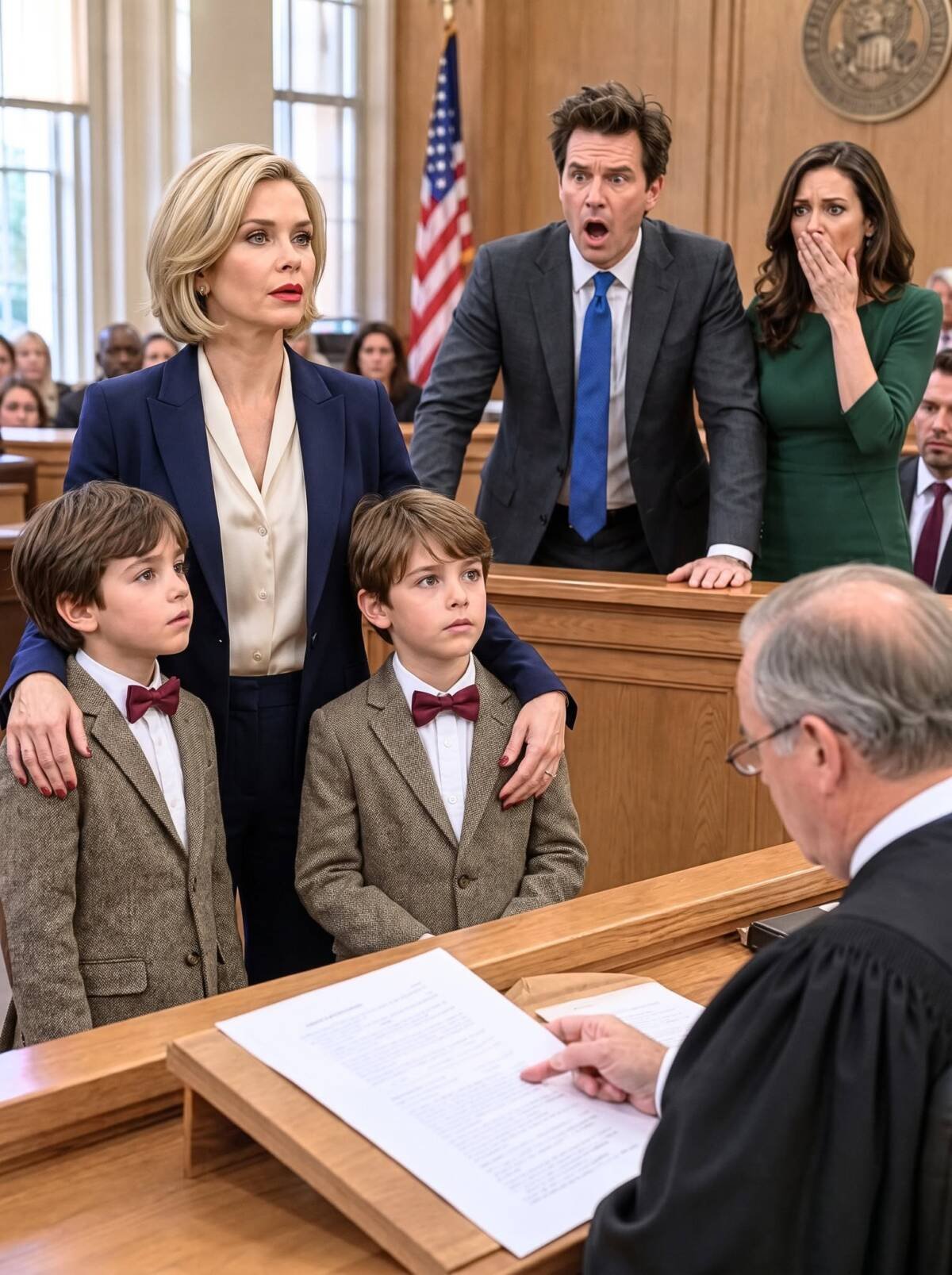
Two days before Christmas, Diane received a text from her husband that left her questioning eight years of marriage. He had decided she was no longer welcome on the family vacation she had planned and paid for. His reason? His adult daughter wanted her biological mother there instead. He expected Diane to accept the decision, stay home, and let the celebration continue at her expense. She calmly replied, “Of course.” What he didn’t realize was that she was about to cancel everything. And when she finally discovered the message he had sent his ex-wife, she realized the cabin had never been the real problem.
Introduction: The Text That Changed Everything
Two days before Christmas, I was sitting in my Subaru outside a Kroger grocery store when my husband, Mark, sent me a message that would change the way I understood our marriage.
The back seat was packed with grocery bags. I had bought a holiday ham, fresh coffee, cinnamon rolls, wine, and everything else we needed for the Christmas vacation I had spent months organizing.
The cabin was booked. The meals were planned. The activities were paid for. All that remained was to finish packing and enjoy four days in the mountains with the people I loved.
Then my phone buzzed.
Mark’s message was short.
“Plans changed. You’re not coming to the cabin. Emily wants her real mom instead.”
I stared at the screen, waiting for the next message to explain that he was joking or that something had been misunderstood.
Nothing came.
I read the words again.
My husband was telling me I could not attend a vacation I had planned, organized, and largely paid for because his twenty-nine-year-old daughter wanted to spend Christmas with her biological mother.
For a moment, I could not even feel angry. I was too stunned to understand how casually he had delivered the news.
I had not been asked what I thought. I had not been consulted about the arrangements. I had not been offered a compromise.
A decision had been made about my Christmas, and apparently, my only responsibility was to accept it.
I called Mark.
“Am I reading this correctly?” I asked when he answered. “You’re telling me I’m not going on the vacation I booked?”
“Diane, please don’t start.”
That was his first response.
Not an apology. Not an explanation. Not even an acknowledgment that he had just excluded his wife from Christmas.
He sounded irritated that I had called.
Mark explained that Emily had been feeling emotional about the holidays and wanted a nostalgic Christmas with him and her mother, Susan. He described it as an opportunity for Emily to reconnect with the family traditions she remembered from childhood.
I understood that complicated family relationships could become especially emotional around Christmas. I had never expected Emily to abandon her relationship with her mother, and I had never asked Mark to choose between them.
But Emily’s husband, Josh, was still invited to the cabin.
I was the only person being removed.
“So Susan is taking my place?” I asked.
“Nobody is taking your place.”
“Then why am I not coming?”
“It’s just something Emily wants. You need to understand that.”
I waited for him to explain where he expected me to spend the four-day holiday. Would he stay home with me? Would we celebrate separately? Had he considered another arrangement?
Instead, he told me to be the bigger person.
I had heard those words before.
They were what Mark said whenever keeping the peace required me to swallow my feelings. They were what he said when his daughter made an unreasonable request, when a family gathering left me feeling invisible, and when he wanted me to accept an arrangement that benefited everyone except me.
“Just let Emily have this,” he said. “It’s Christmas.”
I looked at the groceries in the back seat.
The ham alone had cost more than I wanted to admit. The catered Christmas dinner had already been arranged. I had bought tickets for the snow-tubing activity Emily had specifically requested.
I had spent months trying to make the trip special.
And now my husband was telling me that my contribution was welcome, but my presence was not.
I took a breath.
“Okay,” I said.
Mark paused.
“Okay?”
“Of course. Have a wonderful Christmas.”
The relief in his voice was immediate.
“Thank you, Diane. I knew you’d understand.”
I ended the call before he could say anything else.
For several minutes, I sat motionless in the grocery store parking lot.
Then I asked myself a question I should have asked years earlier.
If I was no longer welcome on the vacation, why was I still expected to pay for it?
That question changed everything.
Part One: The Vacation I Had Paid For
The cabin was outside Gatlinburg, Tennessee, in a wooded area that offered the kind of quiet mountain setting Mark had always said he wanted for Christmas.
I had found it months earlier.
It had three bedrooms, a fireplace, a large kitchen, and a deck overlooking the trees. It was the kind of place where we could drink coffee in the morning, cook together, and spend the evenings playing games while the weather turned cold outside.
When I first showed Mark the listing, he loved it.
“That’s perfect,” he told me.
He said he was waiting for a real estate commission to come through and asked whether I could pay the deposit to secure the reservation.
I agreed.
I had a steady salary, while Mark’s income from real estate was unpredictable. Some months, he earned more than I did. Other months, he struggled to close a deal.
We had agreed that I would cover certain expenses when necessary, with the understanding that he would contribute when his income improved.
Over time, that temporary arrangement had become the foundation of our financial life.
I paid the bills on time. I handled unexpected expenses. I covered the gaps when his commissions were delayed. I kept track of due dates and made sure that our household continued to function even when Mark’s income fell short.
The Christmas vacation followed the same pattern.
I paid the cabin deposit. I arranged the catered dinner. I purchased the snow-tubing tickets. I bought groceries and planned the meals.
Whenever Mark promised to reimburse me, I believed him.
“Once this next deal closes,” he would say.
Or, “I’m expecting a commission next month.”
Or, “We’ll balance everything out after the holidays.”
The money rarely came back.
At first, I did not mind helping. Marriage was supposed to involve partnership, and I believed that supporting each other during difficult periods was part of building a life together.
But partnership requires both people to recognize what the other contributes.
Somewhere along the way, Mark had stopped treating my financial support as a kindness. He had begun treating it as something he could depend on without discussion.
The cabin cost money I had budgeted carefully. Losing the deposit would hurt, but paying for a trip I had been explicitly excluded from felt worse.
I called the property management company.
The woman who answered asked for my reservation number and pulled up the booking.
“I can cancel this for you,” she explained, “but the reservation is within the cancellation window. The $1,200 deposit will be forfeited.”
I looked at the dashboard clock.
For a moment, I hesitated.
Twelve hundred dollars was not a small amount of money. I could use it for bills, savings, or something I actually wanted to do.
But I also knew that if I left the reservation intact, Mark would probably take Susan, Emily, and Josh to the cabin and proceed as though nothing unusual had happened.
My money would finance a celebration from which I had been deliberately excluded.
“Yes,” I told the woman. “Please cancel it.”
She confirmed the cancellation.
I sat quietly while the decision settled over me.
Then I called the catering company.
The dinner was canceled.
Next, I contacted the snow-tubing facility and canceled the tickets I had purchased.
I did not empty our bank accounts. I did not touch money that belonged exclusively to Mark. I did not interfere with any arrangements he had paid for himself.
I simply canceled the reservations I had made and paid for.
The distinction mattered to me.
I was not trying to punish anyone. I was no longer willing to finance an event that my husband had decided I was not allowed to attend.
When the final confirmation appeared on my phone, I placed it in my purse and started the car.
I had no idea that the cancellation would trigger a chain of events that would eventually expose years of deception.
At that moment, I thought I had merely canceled a vacation.
I was wrong.
Part Two: A Familiar Pattern I Could No Longer Ignore
The drive home felt strangely disconnected from reality.
Christmas decorations glowed in store windows. Families hurried through parking lots carrying gifts. Radio stations played familiar holiday songs.
Everything around me looked ordinary.
Inside my car, however, something had changed.
I kept thinking about the previous Thanksgiving, when Emily had handed me her phone and asked me to take a family photograph.
“Can you get one of just the family?” she had asked.
She was standing with Mark, Susan, and Josh.
I had taken the picture.
Then I had returned to the kitchen to pack leftovers while everyone else continued talking in the living room.
At the time, I had told myself not to be sensitive. Emily had grown up with Susan, and there were memories and traditions I could never replace.
I did not need to replace them.
I had never wanted to.
I had simply wanted to be treated as a member of the family I had helped build.
That distinction had become increasingly difficult for Mark to understand.
Whenever Emily made a request that left me uncomfortable, he insisted I should be more understanding.
If I felt excluded, he reminded me that Emily had been through a difficult family transition when her parents divorced.
If I questioned the amount of money I was spending, he said I was making the situation about finances.
If I asked him to establish reasonable boundaries, he accused me of creating unnecessary conflict.
Each conversation ended in much the same way.
I apologized for being upset.
Mark thanked me for understanding.
And life continued.
By the time I arrived home, I was exhausted.
I carried the groceries into the kitchen and set them on the counter. The Christmas garlands were still hanging above the cabinets. Holiday cards covered the table. Mark’s boots sat beside the back door.
Nothing in the house had changed.
Yet I felt as though I were seeing it for the first time.
I went upstairs and pulled a suitcase from the closet.
I did not have a complete plan. I only knew I did not want to spend Christmas sitting in that house, waiting for Mark to return from the holiday he had arranged without me.
I packed clothes, toiletries, medication, my laptop, and a few personal items.
Then I went downstairs to get my phone charger.
That was when I noticed Mark’s iPad on the kitchen island.
The screen lit up with an incoming message.
The sender was Susan.
“Does Diane know what you told me?”
I stopped walking.
I read the notification twice.
I knew I should have left the device alone. But the message raised a question I could not ignore.
What had Mark told Susan?
And why was she asking whether I knew?
I picked up the iPad and opened the conversation.
What I found was not a dramatic romantic confession. There were no explicit photographs or declarations of love.
The messages were ordinary, almost mundane.
That made them more disturbing.
For weeks, Mark and Susan had been discussing Christmas arrangements, Emily’s childhood memories, and the possibility of recreating a holiday from the years before their divorce.
Susan had asked whether inviting her was appropriate.
Mark had assured her that Emily wanted it and that I would understand.
In one message, Susan expressed concern that I might feel uncomfortable.
Mark brushed the concern aside.
He said I was practical. He said I understood how important Emily’s memories were. He said there was no reason for Susan to worry.
Then I found the message that made my hands go cold.
Mark had written:
“She booked the whole itinerary. She’s too invested. She won’t cancel this close to Christmas. She’ll just let us go.”
I stared at the screen.
I read it again.
And again.
For weeks, I had believed that Mark was struggling to manage his daughter’s emotions. I had believed that the decision to exclude me was an unfortunate response to a difficult family situation.
But that message revealed something different.
Mark had not simply assumed I would understand.
He had counted on me accepting the arrangement because he believed I would never risk losing the money I had already spent.
He had calculated my response.
He knew I would feel hurt. He knew I would hesitate to cancel. He knew I would probably put everyone else’s comfort ahead of my own.
And he had decided that this made me easy to manipulate.
I sat down at the kitchen table.
Suddenly, years of memories began rearranging themselves in my mind.
The money I had loaned Emily for her car repair.
The wedding expenses I had covered.
The household bills I had paid while waiting for Mark’s next commission.
The family gatherings where I was expected to help, contribute, organize, and smile, even when I felt like an outsider.
I had always considered myself a reliable person.
Now I wondered whether Mark had come to see my reliability as permission to disregard me.
I looked at the iPad again.
The message was still there.
I did not need to search for anything else to understand what it meant.
My husband had decided that my feelings were less important than the convenience of keeping his plans intact.
And he had assumed my financial investment would make me too afraid to stop him.
For the first time in eight years, I did not feel compelled to explain away his behavior.
I simply saw it.
Part Three: The Neighbor Who Asked the Right Question
A knock at the back door startled me.
I quickly put the iPad down.
My neighbor, Carol, stood outside holding a container of dinner rolls I had accidentally left on the porch earlier.
She had known me for years. She was the sort of person who could recognize when something was wrong before anyone said a word.
Her eyes moved from my face to the open suitcase in the hallway.
“Are you going somewhere?”
“I think so,” I answered.
She stepped inside and set the container on the counter.
“What happened?”
I hesitated.
For some reason, saying the truth aloud felt more difficult than reading it on a screen.
“Mark is taking Susan to the cabin for Christmas.”
Carol blinked.
“His ex-wife?”
“Yes.”
“And you’re not going?”
“No.”
She looked around the kitchen, taking in the groceries, the decorations, and the suitcase near the stairs.
“Did you pay for the trip?”
I nodded.
“How much?”
“The cabin deposit was $1,200. I paid for the food and activities too.”
Carol’s expression changed.
“And he told you that you couldn’t come?”
“He said Emily wanted her real mom instead.”
For several seconds, Carol said nothing.
Then she shook her head.
“Diane, I don’t know what he’s thinking. But you need to make a decision based on what you want, not on what he expects you to tolerate.”
I looked down at the counter.
“I don’t want to make a decision I’ll regret.”
“Then don’t make one out of anger. Make one because you’ve finally decided what you’re willing to accept.”
Her words stayed with me.
I did not need to prove anything to Mark. I did not need to create a scene. I did not need to convince his family that I had been treated unfairly.
I needed to decide what I wanted my life to look like after Christmas.
I finished packing and booked a hotel in Lexington, Kentucky. I would spend the holiday somewhere quiet, away from the house and away from the expectation that I would make everyone else comfortable.
Before leaving, I checked the cancellation confirmations one last time.
Everything was complete.
At 6:43 that evening, I was sitting on the hotel bed when my phone buzzed.
Mark had sent a message.
“Forward the cabin lockbox code.”
I stared at it.
He had apparently not yet realized that the reservation was gone.
Three minutes later, another message arrived.
“Did you cancel the reservation?”
Then:
“Diane?”
My phone began ringing.
I watched his name flash across the screen before answering.
“What the hell did you do?” he demanded.
“I canceled the reservation.”
“You canceled the cabin?”
“Yes.”
“Why would you do that?”
I took a breath.
“Because I’m not going.”
“That makes no sense. We already planned everything!”
“You planned everything after telling me I wasn’t welcome.”
“You know what I meant.”....