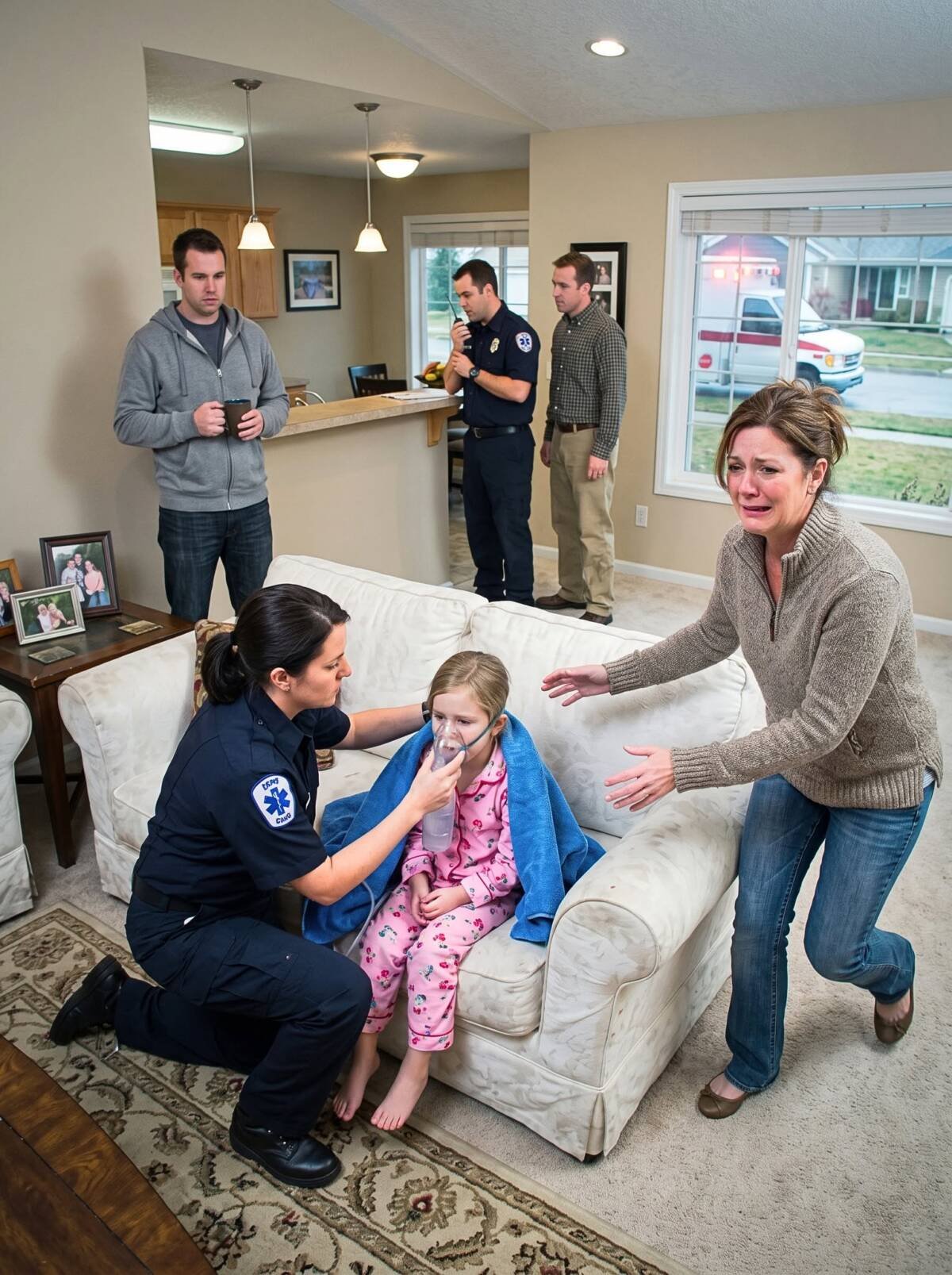
The Day Everything Changed
Christmas morning is supposed to be a sanctuary of warmth, ordinary joy, and deeply held family traditions. Our living room that morning was a picture-perfect scene ripped straight from a holiday catalog. The air smelled of pine needles, cinnamon, and the dark roast coffee brewing in the kitchen. Our nine-year-old daughter, Emma, sat cross-legged on the plush rug beside the illuminated tree, completely surrounded by a chaotic, colorful sea of torn wrapping paper and discarded ribbons. My husband, Daniel, was leaning back on the living room couch, sipping from his favorite ceramic mug, his eyes heavy with exhaustion but bright with a father’s quiet pride.
And then there was my father-in-law, Richard Pierce.
He sat rigidly in the overstuffed armchair beside the brick fireplace, wearing the calm, respectable, flawlessly composed expression he always reserved for an audience. He was dressed meticulously, as he always was, in a pressed button-down shirt and a wool sweater, looking every inch the distinguished patriarch.
For months, the atmosphere between Richard and me had been suffocatingly tense, a silent war of attrition fought over family dinners and weekend visits. He was a man who rarely expressed his anger through shouting or overt aggression; instead, he weaponized silence, passive-aggressive remarks, and a quiet, unrelenting demand for absolute obedience from everyone in his orbit. But for the sake of the holidays, for the sake of Emma’s innocence, we had all agreed to an unspoken truce. We had unlocked our doors and allowed him into our home, desperately hoping the magic of Christmas would bridge the growing, toxic divide.
We were wrong. By the end of the day, our festive living room would be cordoned off as an active crime scene, and the comforting illusion of our family would be shattered forever, replaced by a truth none of us had been prepared to face.
The Warning Signs We Missed
To fully understand the profound horror of that Christmas morning, you have to understand the bitter conflict that preceded it. The real trouble with Richard began late in the summer, following an incident I still struggle to think about without feeling a cold spike of adrenaline.
Richard had offered to take Emma out for a Saturday afternoon to a local park and a diner for milkshakes, a rare gesture of grandfatherly bonding that Daniel and I had enthusiastically encouraged. Hours later, through a horrifying stroke of luck and a neighbor’s chance passing, I discovered the truth of that afternoon. Richard had not taken her to the park. He had driven to a local sports bar to meet a former colleague, and he had left my nine-year-old daughter locked inside his sweltering truck in the parking lot for nearly two hours.
When I confronted him that evening, my heart hammering against my ribs, his reaction was chilling. He didn’t apologize. He didn’t flinch. He didn’t show a single ounce of remorse or understanding for the danger he had put her in. Instead, he seamlessly twisted the narrative with the practiced ease of a master manipulator. He gaslit me until I was painted as the unreasonable, hysterical mother who was systematically teaching her daughter to fear the world.
He turned to Emma, who was still trembling from the heat and isolation, and told her that “big girls” didn’t cry over small things, effectively teaching my child to suppress her own survival instincts and hide her fear to protect his ego.
That was my breaking point. The illusion of the harmless, quirky grandfather dissolved, leaving behind something cold and deeply controlling. That night, I established one firm, non-negotiable boundary: Richard would never be allowed to take Emma anywhere alone again. If he wanted to see her, it would be supervised, in our home or in public with Daniel and me present.
Daniel supported me completely, stepping up to defend our family and backing my decision against his father’s fierce protests. But Richard treated this boundary not as a safety measure for a vulnerable child, but as a severe personal betrayal. To a man who thrived on unchecked authority and control, losing his unsupervised access to his granddaughter was an unforgivable insult, a challenge to his dominance that he simply could not let stand.
He didn’t yell. He didn’t threaten us openly. Instead, he spent the next few months quietly planting poisonous seeds of doubt among our extended relatives, whispering at family gatherings that I was mentally unstable, overprotective, and maliciously determined to poison Daniel against his own flesh and blood. He played the victim perfectly, and the family tension became a suffocating weight we carried into the holiday season.
A Normal Christmas Turned Nightmare
Despite the simmering resentment that colored every interaction, Richard arrived on Christmas morning carrying a stack of beautifully wrapped gifts, effortlessly playing the role of the doting, generous grandfather. Most of the presents were entirely unremarkable—heavy winter sweaters, a few popular books, ordinary things that blended easily into the holiday cheer.
But tucked carefully beneath the lower branches of the pine tree sat a heavy silver box, meticulously wrapped in high-grade metallic paper and tied with a thick, luxurious red velvet ribbon. The tag was written in Richard’s precise, sharp handwriting: “For my sweet Emma. Love, Grandpa Richard.”
When Emma finally reached the silver box and peeled back the stiff paper, she gasped in pure delight. Inside, nestled in crushed white velvet, was a high-end, expensive-looking pink skincare collection. It was exactly the kind of trendy, aesthetic product line heavily marketed to pre-teens. The set contained a shimmering lotion, a tinted lip balm, a hydrating rosewater face mist, and a small, elegant frosted glass jar labeled with swirling silver letters: Snow Angel Glow Cream.
Like many girls her age, Emma was just beginning to take a deep interest in skincare routines, watching tutorials online and begging for products she saw her older cousins using. Her initial hesitation about interacting with Richard—a wariness born from the tension she undoubtedly felt radiating between the adults—vanished entirely in the face of the perfect gift. Her eyes lit up, especially when Richard leaned forward in his armchair, his voice dropping to a soft, encouraging timber.
“Try the cream, Emma,” he urged, his tone smooth, reassuring, and completely unwavering. “It’s very gentle. Specially made for sensitive skin.”
Something about his intense focus, his absolute certainty, made a heavy knot of anxiety tighten in the pit of my stomach. It was a visceral, maternal instinct screaming that something was fundamentally wrong with the picture in front of me. I instinctively stepped forward and suggested she wait until after breakfast, offering to help her wash her face properly in the bathroom first.
But I was seconds too late. Emma had already twisted the silver cap off the frosted jar, dipped her fingers into the thick, perfectly pink cream, and rubbed it eagerly in wide circles across both of her cheeks.
For three agonizingly long seconds, the room was perfectly silent. The only sound was the crackle of the fire in the hearth.
Then, Emma’s excited, glowing smile vanished.
Her shoulders hitched up aggressively toward her ears, her entire body went rigidly stiff, and both of her hands flew toward her face as if she had been struck. She looked up at me, her brown eyes wide with a sudden, uncomprehending, primal panic.
“Mommy…” she whispered, the word catching in her throat. “My face burns.”
A heartbeat later, the breathless whisper transformed into a blood-curdling, desperate scream that tore through the quiet morning.
“It hurts! Mommy, it hurts! Make it stop!”
Absolute chaos erupted. The coffee mug in Daniel’s hand shattered against the hardwood floor as he lunged forward. We both sprinted toward her, scooping her up from the rug and rushing her blindly into the kitchen. I slammed the faucet handle on, desperately splashing handfuls of freezing cold water over her cheeks while Daniel gently but firmly pinned her flailing hands to her sides so she wouldn’t claw at her own melting skin. Emma sobbed uncontrollably, her chest heaving violently as an angry, blistering redness began to spread across her face, bubbling up in a terrifying chemical reaction.
In the midst of the sheer panic, as I reached for a clean towel, I glanced back through the open doorway into the living room.
Richard hadn’t moved a single muscle. He hadn’t jumped up. He hadn’t rushed forward to help. He didn’t ask what was wrong, nor did he call for an ambulance. He simply remained seated in his armchair beside the fireplace, his legs crossed, calmly lifting his coffee cup to his lips to take another sip.
“What was in that?!” I screamed at him, my voice cracking over the sound of rushing water and my daughter’s agonized wails.
“It’s just skincare,” Richard replied, his tone chillingly detached, echoing through the house with an unnatural calm. “She probably just had a mild allergic reaction. You’re overreacting, as usual.”
A mild reaction? I looked down at my daughter, who was writhing in unimaginable agony, the skin on her cheeks visibly blistering and weeping. Richard’s utter lack of empathy, his robotic detachment in the face of his granddaughter’s suffering, disturbed me to my very core.
Daniel didn’t wait to argue. He wrapped Emma tightly in his heavy winter coat, scooped her lightweight frame into his arms, and yelled that he was taking her straight to the emergency room. Before he kicked the front door open, he turned to me, a fierce, protective intensity burning in his eyes that I had never seen before.
“Stay here,” Daniel commanded, his voice shaking with a terrifying rage. “Find the box. Keep the gift exactly as it is. Don’t let anyone touch a single thing in this room.”....