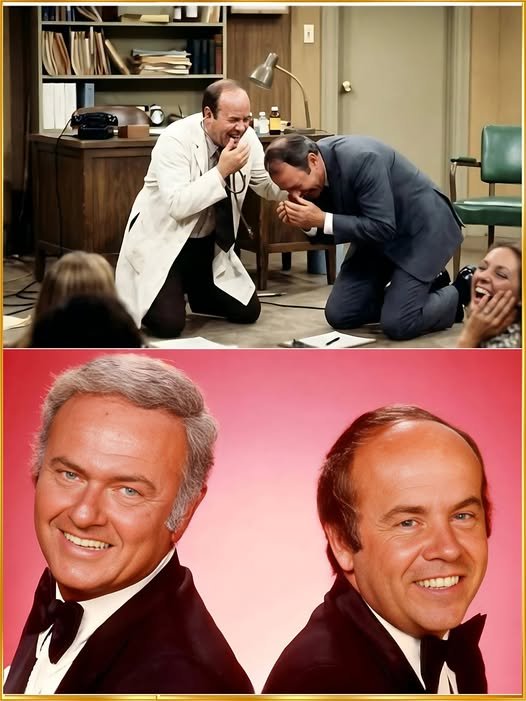
Hollywood has seen many comedic legends, but few dynamics were as famously unpredictable as the partnership between Carol Burnett, Tim Conway, and Harvey Korman on The Carol Burnett Show.
To the audience, it looked like effortless comedy.
Behind the scenes, it was controlled chaos.
And at the center of it all was Tim Conway — a performer so calm, so mild, that no one ever saw the disaster coming.
He didn’t act like a troublemaker. He didn’t behave like a scene-stealer. Instead, he appeared almost harmless. Slow-moving. Gentle. Almost forgettable.
That was the trick.
Because once the cameras started rolling, everything changed.
Conway would take a perfectly structured sketch and slowly bend it out of shape without ever breaking character. A pause here. A strange detail there. A line delivered slightly too seriously. Before anyone realized it, the entire scene was slipping off its rails.
And Harvey Korman always paid the price.
Korman, a trained and disciplined actor, tried desperately to maintain structure. He needed rhythm, logic, and progression. Conway needed none of those things.
He needed timing… and patience… and Korman’s absolute inability to survive what came next.
One of the most famous examples is the legendary “Dentist Sketch,” where Conway played a medical professional whose simple procedure spirals into total absurdity. Improvising physical chaos — including numbing himself mid-procedure — Conway pushed the scene far beyond its scripted limits.
And Korman lost it completely.
What made it even more powerful was Conway’s commitment. He never acknowledged the humor. He never winked at the audience. He never signaled that anything was wrong.
That seriousness made everything funnier.
Carol Burnett herself often struggled to stay in character, biting her lip or turning away from the camera just to avoid breaking into laughter. The tension between professionalism and pure comedic collapse became part of the show’s magic.
Because the audience wasn’t just watching jokes being told.
They were watching control being lost in real time.
And somehow, that felt more honest than anything scripted.
Even in rehearsals, Conway played it straight. He followed every line exactly, earning trust from his castmates. Then, during live taping, he would quietly shift everything, turning familiarity into unpredictability.
It wasn’t sabotage.
It was performance art.
A slow unraveling disguised as innocence.
That’s why Harvey Korman became the most famous “victim” of Conway’s comedy. His reactions weren’t scripted laughter — they were real human struggle. The harder he tried to stay composed, the deeper he fell into the moment.
And audiences loved it.
Because perfection is predictable.
But collapse — especially when it’s shared — is unforgettable.
In the end, Tim Conway’s legacy isn’t just about jokes or sketches. It’s about timing, trust, and the courage to let comedy break apart naturally.
Carol Burnett didn’t just work with him.
She survived him.
And television was better because of it.