Military deployment changes the passage of time. When you are thousands of miles away, months blur into a monotonous loop of routines, communications over low-bandwidth satellite links, and the constant, underlying hope that when you finally return, everything you left behind will be waiting precisely as you remember it. I had spent nine months imagining the exact moment I would walk through our front door. I pictured my daughter, Sophie, dropping whatever was in her hands and running toward me. I pictured the overwhelming relief of shedding my gear, dropping my duffel bag in the hallway, and breathing in the familiar scent of home.
Instead, the house was unnaturally quiet.
My deployment had ended three weeks ahead of schedule, an unexpected blessing that I intended to turn into the ultimate surprise. But when I stepped into the kitchen, my wife, Laura, stood frozen by the counter. Her expression wasn’t one of joy or even shock; it was the deer-in-the-headlights terror of someone whose carefully constructed world had just imploded. That single, infinitesimal pause before she spoke set every alarm bell in my mind ringing. It was the moment the life I thought I knew began to fracture.
Part 1: The Cold Reality of Aurora
“Where’s Sophie?” I asked, keeping my voice steady, though my pulse was already racing.
Laura hesitated again, shifting her weight from one foot to the other. “She’s at my mother’s place for the weekend. They’re doing a sleepover. It’s just me tonight.”
The explanation grated against every instinct I possessed. Sophie knew my tentative return window; she had spent our last video call counting down the days and planning the exact games we would play. It made no sense for her to be shipped off to her grandmother’s house the moment I was due back—especially not to Evelyn. My mother-in-law’s rigid, austere views on child-rearing had always made me deeply uncomfortable, a friction point Laura and I had argued about more than once.
“I’m driving to Aurora,” I said, turning back toward the door. “I want to see Sophie. She should already be asleep by now anyway.”
“Now? It’s late,” Laura protested, her voice tightening in a way that felt less like maternal concern and more like panic.
“Exactly. I’ll just check on her and make sure everything is fine.”
I didn’t wait for her blessing. The drive out to Aurora was long, lonely, and blanketed by a heavy, drifting skim of light snow that blurred the edges of the dark asphalt. The farther I drove, the heavier the knot in my stomach grew. Laura had hidden something from me. I could feel it in my bones.
When I pulled up to Evelyn’s property, the main house was pitch-black, shrouded in silent shadows. I pounded on the front door, receiving only the hollow echo of my own knocks in return. Frustrated, I walked around to the side of the property, navigating the frozen perimeter until a faint, pathetic sound drifted across the icy yard.
“Dad?”
The whisper was barely audible, muffled by the bitter wind.
“Sophie?”
I sprinted toward the back of the property, where a small, dilapidated guest cottage—used primarily for long-term storage—stood dark and menacing. As I reached it, my blood ran cold. The heavy wooden door had a thick metal padlock secured on the outside.
“Dad! Please!”
Panic overrode reason. I raced back to my car, grabbed a heavy-duty crowbar from the trunk, and rushed back to the cottage. With a surge of adrenaline-fueled fury, I jammed the iron bar into the latch and threw my weight against it. The metal shrieked, the screws tore out of the rotted wood, and the door swung open.
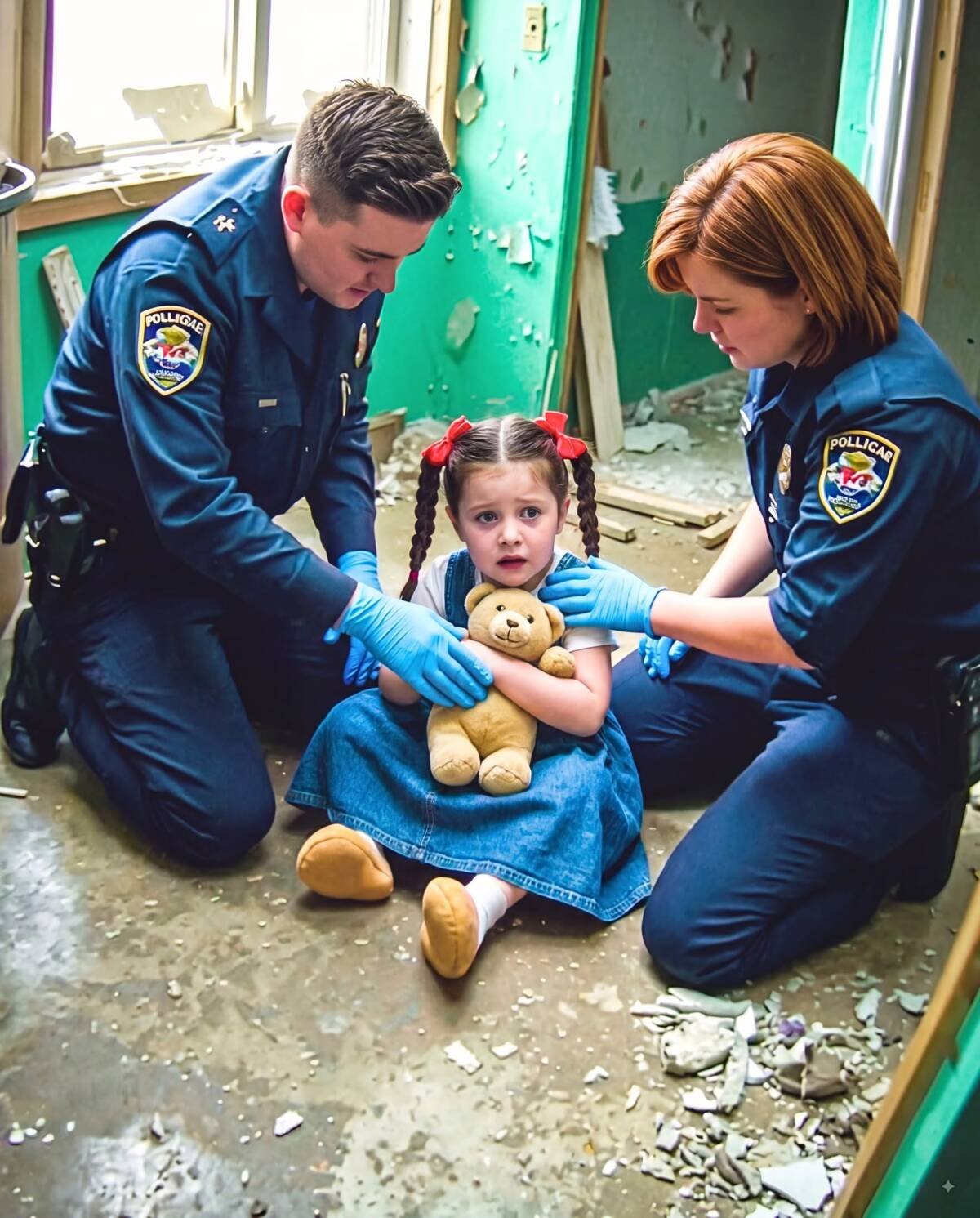
A wave of freezing, stagnant air rushed out. Inside, huddled on the bare concrete floor in the pitch dark, was my nine-year-old daughter.
“Oh, God, Sophie!”
I dropped to my knees, scooping her up and wrapping her in my arms. She clung to me with a desperate, crushing strength, her entire body convulsing with violent shivers.
“Grandmother said disobedient girls need correction,” she sobbed into my shoulder, her teeth chattering so hard she could barely form the words. “She left me here for twelve hours.”
Twelve hours. At midnight, with the outside temperature hovering around 4°C, and dropping fast. If I hadn’t come home early… the thought didn’t bear finishing.
“Where is Evelyn?” I ground out, fighting the raw fury threatening to consume me.
“She left,” Sophie whimpered. “She said she wouldn’t be back until tomorrow afternoon.”
I stripped off my heavy military jacket, wrapped it securely around Sophie, and carried her straight to the warmth of my car. I cranked the heater to maximum, making sure she was safe and secure in the passenger seat. But as I closed the door to check on her one last time before calling emergency services, she caught my sleeve. Her eyes, wide and terrified in the dashboard light, pleaded with me.
“Dad, don’t look in the filing cabinet in the cottage. Please… don’t.”
Part 2: What Laura Knew
Every instinct in my body screamed to get my daughter to the nearest emergency room immediately. Hypothermia was a very real and present danger. But Sophie’s absolute terror regarding a simple piece of office furniture planted a seed of dread that I couldn’t ignore. Children don’t plead like that over mundane things.
I promised her I’d be right back, stroking her hair before marching back into the freezing darkness of the guest cottage.
The beam of my phone flashlight cut through the dust motes. In the corner sat a gray metal filing cabinet. I pulled the top drawer open. Inside sat a single, neatly tabbed manila folder: SOPHIE – BEHAVIORAL RECORDS.
I opened it, and the breath left my lungs.
It wasn’t a school report. It was a meticulous, chillingly clinical logbook. Evelyn had documented every perceived infraction over the past year: talking back, crying too loudly, leaving food on her plate, showing defiance. Beside every infraction, Evelyn had recorded a corresponding “correction”—terms that thinly veiled systematic emotional and physical abuse: withheld dinner, mandatory isolation in the unheated cottage, cold exposure trials, silent treatment.
The methodical nature of it sickened me. She had treated my daughter like a lab rat in a behavioral experiment. And taped inside the back cover was a small envelope containing photographs—pictures of Sophie crying alone in this very room, trapped and helpless.
I grabbed the folder, bolted back to the car, and drove straight to the regional hospital.
The hours that followed were a blur of sterile lights, urgent medical personnel, and the cold, clinical assessment of emergency doctors treating Sophie for early-stage hypothermia, dehydration, and acute psychological trauma. As Sophie finally drifted into an exhausted sleep beneath heated blankets, a hospital social worker named Grace sat down with me in the private consultation room, sliding the folder across the table.
“Mr. Anderson,” Grace said, her voice heavy with professional sorrow. “This isn’t a case of harsh discipline. This is systematic child abuse. We are legally required to notify the authorities immediately.”
My hands curled into fists on my lap. “My wife told me Sophie was just staying with her mother for a normal sleepover.”
Grace paused, looking at me with a quiet, devastating intensity. “Your wife’s mother has a pattern here. But the real question is… how long did Laura know?”
The question hit me like a physical blow. Laura hadn’t just known Sophie was here; she had lied to me about it. She had looked panicked when I said I was driving to Aurora.
Ten minutes later, the hospital room door clicked open, and Laura walked in. Her face was pale, her eyes red-rimmed from crying. But when she saw me standing by the door with Evelyn’s folder in my hand, she stopped dead in her tracks.
The silence in the room was deafening.
“Daniel,” she whispered, her voice cracking. “I… I didn’t know it was that bad. I thought Sophie was just exaggerating. I thought she was being dramatic.”
“Exaggerating?” My voice dropped to a lethal, dangerous register. “She was locked in an unheated shed for twelve hours in the freezing cold, Laura! She has hypothermia! You told me she was having a fun sleepover with her grandmother!”
Laura collapsed into a chair, burying her face in her hands as hysterical sobs wracked her frame. “My mother is… she’s overwhelming. She always has been. She told me Sophie was rebellious, that she needed structure. She said I was too soft on her. I didn’t know she would actually do that! I was afraid of my mother, Daniel. I didn’t know how to stand up to her!”
“You’re her mother!” I shouted, the sheer injustice of it tearing through my control. “Protecting Sophie was your only job while I was gone, and you chose to protect your own comfort instead!”
By morning, the police had intervened. Evelyn was arrested at her home, taken into custody while investigators secured a warrant to search the property. Sophie was placed temporarily under my sole custody, and Laura found herself swept up in a criminal investigation, facing difficult questions about complicity, negligence, and willful blindness.
I thought I had seen the worst of what Evelyn was capable of.
I was catastrophically wrong. Because when the police finished searching Evelyn’s main house, they found a second hidden compartment behind the study filing cabinet.
And those records weren’t about Sophie. They were about Laura.
Part 3: The Records from Laura’s Childhood
The days blurring past in our temporary living arrangement were emotionally exhausting. Sophie was safe, sleeping with her small hand wrapped tightly around my finger every single night, refusing to let go. She wouldn’t speak to Laura, flinching away whenever her mother entered her line of sight. The bridge between them had been burned to ash.
And my relationship with Laura was hanging by a thread, defined by cold civility and heavy, unanswerable silences.
Then came the knock on the door that changed the entire framework of our nightmare.
A detective from the Aurora police department stood on our porch, holding a worn, dust-covered manila folder. He asked to come inside.
“Mr. Anderson, during our secondary sweep of Mrs. Vance’s home, we found a collection of older documents hidden deep inside the framework of a built-in bookshelf in her private study. Based on the dates, we believe they belonged to your wife when she was a child.”
He handed me the folder. I opened it, and the breath caught in my throat.
It was an exact historical precedent to Sophie’s file. Page after yellowed page of rigid behavioral logs, detailing Laura’s childhood infractions—crying too loudly at age six, talking back at age eight, failing to finish a meal at age ten—all paired with the corresponding “corrections” Evelyn had inflicted upon her own daughter decades ago.
The room tilted.
All those years, I had quietly resented Laura for her submissive, almost fearful compliance whenever Evelyn entered a room. I had viewed it as a character flaw, a spineless inability to set boundaries with an overbearing mother.
Now, I understood. Laura hadn’t been weak. She had been conditioned.
She had grown up inside a domestic prison camp, trained from infancy to believe that absolute obedience was the only path to survival. Her fear of her mother wasn’t an adult preference; it was a deeply ingrained, trauma-induced paralysis. When Sophie had begun complaining about Evelyn, Laura’s brain hadn’t processed it as abuse—it had processed it through the warped lens of her own survival mechanism: This is just how my mother is. You have to endure it.
That evening, I laid the folder on the kitchen table in front of Laura.
She stared at the weathered cover, her face draining of all color.
“She kept them,” she whispered, her voice hollow. “I thought… I thought she burned them when I left for college.”
“You knew,” I said quietly. Not as an accusation, but as a realization.
“When I was little, she wrote down everything,” Laura cried softly, tears spilling down her cheeks. “If I cried, she said I was manipulating her. If I tried to tell anyone outside our family what happened behind closed doors, she told me I was committing an unforgivable betrayal. I spent my whole life trying to convince myself that she was just strict… because if I admitted she was abusive, I would have had to admit that my entire childhood was a lie.”
“And you let her do it to our daughter because you couldn’t face your own past,” I said, the words tasting like ash.
“I told myself Sophie was different!” she screamed, the grief finally breaking through her defenses. “I told myself Mom had mellowed out with age! I wanted so badly to believe I had a normal mother that I sacrificed my own child to keep the illusion alive!”
Sympathy warred with fierce anger inside my chest. I understood the psychological chains that had bound her, but understanding did not equal absolution. Explanation was not a pardon. Sophie had paid the price for Laura’s inability to break free from her past.
Part 4: Breaking the Generational Curse
Recovery is rarely a cinematic montage; more often, it is a slow, agonizing accumulation of micro-moments.
Laura entered intensive trauma therapy, diving headfirst into the dark, unresolved history she had spent decades burying. She stopped making excuses. She stopped hiding behind the defense mechanism of fear. She sat in the uncomfortable, scorching truth of her failures, accepting that rebuilding her life—and potentially earning back her family—would require more than apologies. It would require complete accountability.
For Sophie, the healing took an entirely different path.
One afternoon, while helping her set the dinner table, Sophie accidentally knocked a glass of milk off the edge. It shattered against the tile floor, sending white shards and liquid splashing everywhere.
Instantly, Sophie froze. Her face drained of color, and she backed away into the corner of the kitchen, crossing her arms over her chest defensively, squeezing her eyes shut.
“I’m sorry! I’m sorry! Don’t put me in the box! I didn’t mean to!”
My heart shattered. I dropped the dish towel I was holding, ignored the broken glass, and knelt down in front of her, keeping my movements slow and deliberate.
“Sophie, look at me.”
She peeked open one terrified eye.
“It was an accident,” I said softly, my voice steady and calm. “Nobody is mad. Nobody is going to punish you.”
“B-but I broke it,” she stammered, trembling.
“It’s just a glass, sweetie. Glass breaks. We have a whole cabinet full of them. You are safe here.”
She stared at me for a long, agonizing moment, searching my face for any sign of deception or anger. When she found none, the rigid tension slowly leaked out of her small frame, and she began to cry—not with the hysterical panic of that night in Aurora, but with the quiet release of a child realizing, perhaps for the first time, that mistakes did not equal terror.
Laura, watching quietly from the doorway, whispered hoarsely, “I used to do that. Exactly that.”
“I know,” I replied without looking up. “And that’s why the pattern stops with us.”
Part 5: The Pattern Ends Here
Months melted into a new normal. The legal case against Evelyn proceeded inexorably forward; the overwhelming mountain of physical evidence—spanning two generations of documented psychological torture—ensured that her days of wielding tyrannical control over children were permanently behind her.
Laura and I maintained a tense, respectful coexistence under the same roof, focused entirely on Sophie’s rehabilitation. There were no shortcuts, no forced reconciliations. Laura respected the boundaries Sophie set, communicating her remorse not through empty words, but through consistency, patience, and small, unobtrusive acts of devotion.
Gradually, the ice began to thaw.
It started with a single crayon pushed across the dining table. A hesitant invitation to sit. A shared moment of quiet coloring. It wasn’t forgiveness—not yet—but it was a bridge being rebuilt, plank by plank, built on honesty rather than swept-under-the-rug silence.
One evening, nearly a year after that freezing night in Aurora, I found Sophie sitting at the kitchen table, intensely focused on a drawing. I walked up behind her and peered over her shoulder.
It was a vibrant, colorful portrait. Three figures standing under a bright, oversized purple sun.
“Who’s that?” I asked gently, pointing to the figures.
Sophie pointed to the tallest stick figure. “That’s you.” She pointed to the next. “That’s me.” Then, her finger hovered over the third figure before she proudly outlined it with a pink crayon. “And that’s Mom.”
Laura, sitting across the room, looked up. Her eyes shimmered with unshed tears, but she didn’t rush over or try to force a moment. She simply smiled—a fragile, beautiful, hard-earned smile.
“She’s still learning,” Sophie added wisely, echoing words she had undoubtedly heard us use in hushed conversations.
Laura’s voice trembled slightly as she replied, “Yes, sweetie. I am.”
We didn’t have a fairy-tale ending wrapped in a neat bow. Scars remain, and the past cannot simply be edited out of history. But as I looked at my daughter—laughing, safe, and bold enough to make mistakes without fear—I knew we had accomplished the impossible.
Evelyn had spent a lifetime teaching her family that love was conditional, obedience was mandatory, and fear was the glue that held a household together.
She had tried to pass that curse down to Sophie.
She just didn’t count on a father who would tear down a locked door in the middle of a snowstorm to make sure the legacy died right there in the dark.
What Do You Think?
If you were in Daniel’s shoes, could you ever truly forgive a partner who allowed your child to suffer out of fear—even if that fear was rooted in deep-seated childhood trauma? How do you balance empathy for someone’s past abuse with accountability for their current failures?
Drop your thoughts in the comments below, and share this story with someone who understands that breaking generational trauma is the hardest, most important fight a family can ever take on.