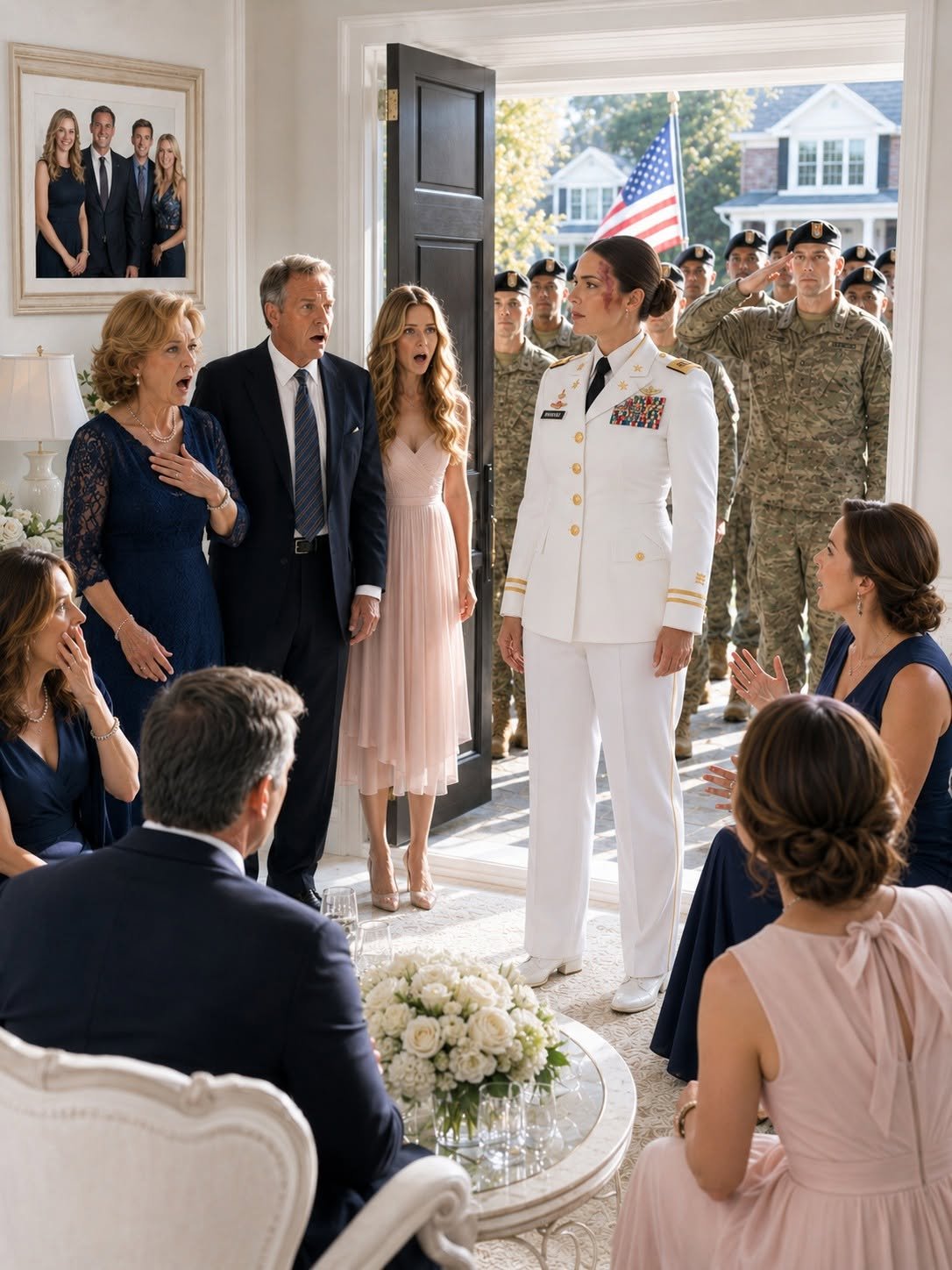
The ballroom was filled with champagne, music, expensive flowers, and nearly 150 wedding guests when the groom raised his glass and decided to make the bride’s father the evening’s punchline.
“This is Floyd King,” Wesley Howard announced with a grin. “My father-in-law. The old man we all have to put up with now.”
Laughter rippled across the room.
Wesley’s wealthy parents laughed along. A few guests chuckled behind their glasses. Someone at a nearby table whispered something that made another guest smile.
Floyd said nothing.
He simply stood there, holding his glass and listening as the family of the man his daughter had just married turned his generosity into entertainment.
What they didn’t know was that Floyd had quietly paid for nearly every major expense of the wedding.
The ballroom.
The flowers.
The musicians.
The lighting.
The custom desserts.
And most of the expensive last-minute requests that had somehow appeared during the weeks leading up to the ceremony.
They also didn’t know something far more important.
Two days earlier, Floyd had accepted a senior executive position at one of the most respected crisis-management firms in the country.
And the man laughing the loudest at the wedding?
He was about to become Floyd’s employee.
But the biggest surprise was still waiting.
Because Wesley’s father, Hartley Howard, recognized Floyd’s name.
And when he finally realized exactly who was standing in front of him, the color drained from his face.
“Wait,” Hartley whispered.
He stared at Floyd.
“Aren’t you the man who just became my new boss?”
The laughter stopped.
The ballroom went completely silent.
And suddenly, the man everyone had treated like an inconvenience was the only person at the table nobody knew how to face.
The Wedding Joke
The Belleview Hotel ballroom had been transformed into the kind of setting people photographed before they even sat down.
Crystal chandeliers reflected against polished walls. Tall arrangements of white flowers decorated the tables. A string quartet played softly near the dance floor while servers moved between guests carrying champagne.
Floyd King stood near the head table, watching his daughter, Inez, smile for photographs.
She looked beautiful.
That was all that mattered to him.
For years, Floyd had imagined this moment.
His daughter walking down the aisle.
Her mother’s old jewelry around her neck.
The nervous smile before she said her vows.
The first dance.
The photographs.
The speeches.
He had wanted her to have a wedding she would remember for the rest of her life.
So when Inez and Wesley began planning the ceremony, Floyd had offered to help.
Then he kept helping.
The venue became more expensive.
Then came the upgraded flowers.
Then the musicians.
Then the custom desserts.
Then additional lighting.
Then transportation for several members of the wedding party.
Every time another expense appeared, Floyd quietly handled it.
He never complained.
He never asked for recognition.
He simply wanted his daughter to be happy.
But somewhere along the way, his generosity had been mistaken for weakness.
Wesley Howard seemed especially comfortable with that assumption.
The groom had spent much of the evening moving from table to table, accepting congratulations and soaking in the attention.
Then, shortly after dinner, he returned to the head table with a champagne glass in his hand.
He placed one hand on Floyd’s shoulder.
Floyd looked up.
Wesley smiled.
“Everybody, this is Floyd King,” he announced. “My father-in-law. The old man we all have to put up with now.”
The first laughter came from Wesley’s parents.
Vida Howard covered her mouth with a napkin.
Hartley Howard leaned back in his chair and laughed.
Then Wesley added, “At least he paid for the evening. That earns him a seat.”
More laughter.
Floyd looked around the room.
Some guests were genuinely amused.
Others appeared uncomfortable.
A few simply laughed because everyone else was laughing.
Floyd slowly lowered his glass.
He could have embarrassed Wesley.
He could have reminded everyone exactly who had paid the bills.
He could have told the guests that the man standing beside him had spent weeks making expensive requests while barely offering a thank-you.
Instead, Floyd remained silent.
Years of working with executives had taught him something valuable.
Anger often revealed exactly what people expected from you.
Silence revealed what they expected from themselves.
Floyd simply looked at Wesley.
Then he looked at Hartley.
And something changed in Hartley’s expression.
The older man stopped smiling.
His eyes narrowed.
He stared at Floyd as though he were trying to place a face he had seen somewhere before.
“Your last name is King?” Hartley asked.
Floyd nodded.
“Yes.”
Hartley leaned forward.
“Floyd King?”
“Yes.”
The amusement disappeared from Hartley’s face.
He reached for his wineglass.
His hand shook.
The glass slipped slightly, splashing red wine across the white tablecloth.
Nobody laughed.
Hartley stared at Floyd.
“You’re Floyd King from Quantum Crisis Solutions.”
Floyd gave him a polite smile.
“Starting Monday.”
Hartley froze.
“My new department head,” he whispered.
The room fell silent.
Wesley looked at his father.
Then at Floyd.
Then back at his father.
“Dad?”
Hartley barely heard him.
“My new boss,” he repeated.
And suddenly, the joke no longer seemed funny.
The Man Behind the Wedding Bill
Floyd had never been interested in displaying his financial success.
He drove an older car.
He kept the same phone for years.
He lived comfortably but modestly.
He had spent four decades working, saving, and investing carefully rather than trying to impress people.
That was partly why Wesley had underestimated him.
A few days before the wedding, the family had gone to dinner at Vetri Cucina.
The restaurant was elegant and expensive.
Wesley had spent most of the evening talking about his career, his family, and the lifestyle he expected after marriage.
At one point, Floyd pulled his phone from his pocket.
It was an old Nokia.
Wesley noticed immediately.
He laughed.
“He still uses buttons.”
A few people smiled.
Wesley held up his own smartphone.
“Actual buttons. It’s like he’s living in a museum.”
Floyd looked at the phone.
Then at Wesley.
“I’m not applying for a technology award.”
Wesley laughed.
Nobody else did.
For a few seconds, the table was quiet.
Then the conversation moved on.
When the check arrived, something predictable happened.
Everyone became unusually interested in the conversation.
Nobody reached for the bill.
Floyd finally picked it up.
He paid.
As he placed his card back in his wallet, Vida smiled.
“At least he’s useful.”
She said it quietly.
Quiet enough to deny she had intended him to hear.
But Floyd heard every word.
Later that evening, he stood alone in the restaurant restroom.
He looked at himself in the mirror.
He wasn’t angry.
He was disappointed.
Not because Wesley had made a joke.
Not even because Vida had insulted him.
It was because his daughter had been sitting at that table.
And she had said nothing.
Floyd washed his hands and returned to the table.
He smiled.
He continued the dinner.
He paid the bill.
And he went home.
The Message That Changed Everything
Two days later, Floyd was reviewing documents for his new position at Quantum Crisis Solutions.
The promotion was significant.
He would be taking charge of the company’s Crisis Management division.
It was the kind of position that came with responsibility, pressure, and authority.
Floyd had spent years earning it.
He was reviewing the company’s organizational structure when a familiar name caught his attention.
Hartley Howard.
Floyd stared at the screen.
At first, he assumed it was another person.
There were plenty of Howards in the corporate world.
Then he opened the company directory.
A photograph appeared.
Floyd immediately recognized him.
Hartley Howard.
The same man who had laughed at the restaurant.
The same man who had watched his son mock Floyd.
The same man who would soon report directly to him.
Floyd sat back in his chair.
He could have said something.
He could have called Inez.
He could have warned her.
He could have told Wesley.
He didn’t.
Instead, he closed the document.
His phone buzzed.
It was a message from Inez.
“Thank you again for dinner, Daddy. Wesley’s parents really liked you.”
Floyd read it twice.
Then he looked at Hartley Howard’s name on the screen.
Monday was only two days away.
But first, there was still a wedding.
The Silence After the Revelation
The atmosphere in the ballroom had changed completely.
Only minutes earlier, Wesley had been the center of attention.
Now nobody knew what to say.
Wesley stared at his father.
“So?”
Hartley finally turned toward him.
“So he will be my boss.”
Wesley blinked.
The words seemed to take several seconds to register.
“You’re serious?”
Hartley looked at his son.
“I’ve never been more serious.”
Wesley turned toward Floyd.
The confidence in his face had disappeared.
“But… you knew?”
Floyd said nothing for a moment.
Then he answered calmly.
“I learned about the reporting structure two days ago.”
Wesley swallowed.
“And you didn’t tell me?”
“No.”
“Why?”
Floyd looked at him.
“Would you have treated me differently?”
Wesley didn’t answer.
He couldn’t.
Because they both knew the answer.
If Floyd had arrived at the wedding wearing an expensive suit, carrying a luxury watch, and introducing himself as an executive, Wesley might have treated him differently.
But Floyd had arrived as an ordinary father.
And that had been enough for them to disrespect him.
An Apology That Came Too Late
Wesley approached Floyd several minutes later.
His smile was gone.
“Mr. King…”
Floyd looked at him.
“Floyd,” Wesley corrected himself quickly.
“If that joke upset you, I’m sorry.”
Floyd watched him carefully.
“Were you joking?”
Wesley hesitated.
“Yes.”
“You seemed to enjoy it.”
Wesley looked down.
“I didn’t mean—”
“You meant exactly what you said.”
Wesley became silent.
Floyd didn’t raise his voice.
He didn’t insult him.
He didn’t threaten him.
He simply said:
“Your mistake wasn’t making a joke about me. Your mistake was believing my value depended on whether you knew my job title.”
Wesley had no response.
Hartley stepped forward.
“Mr. King, I owe you an apology on behalf of my family.”
Floyd nodded.
“I appreciate that.”
Hartley seemed relieved.
Then Floyd added:
“But the workplace and the family are two separate matters.”
Hartley nodded.
“I understand.”
Floyd looked at him.
“I hope you do.”
The Daughter Who Looked Away
The wedding reception continued.
The music resumed.
Guests returned to their conversations.
The cake was cut.
People danced.
Photographs were taken.
But something had changed.
Everyone knew it.
Inez eventually found Floyd near the ballroom entrance.
“Dad…”
Floyd turned.
She looked like she had been crying.
“Why didn’t you tell us?”
Floyd smiled gently.
“Would it have changed anything?”
Inez lowered her eyes.
“I don’t know.”
“Yes, you do.”
She looked at him.
He continued.
“If you had known I was becoming an executive, would Wesley have made that joke?”
She remained silent.
“Would his parents have laughed?”
Again, silence.
Floyd sighed.
“I didn’t want respect because of my position.”
Inez wiped her eyes.
“I should have defended you.”
“Yes.”
The honesty hurt her.
“But you didn’t.”
“I was afraid.”
“Afraid of what?”
“Of embarrassing Wesley.”
Floyd nodded.
“You were trying to protect your marriage.”
Inez began to cry.
“I was wrong.”
Floyd reached for her hand.
“You weren’t protecting your marriage.”
She looked at him.
“You were abandoning yourself.”
The words stayed with her.
Monday Came Early
Monday morning arrived.
Floyd walked into Quantum Crisis Solutions shortly after eight.
The receptionist greeted him warmly and escorted him to the executive floor.
His office was larger than he expected.
A wall of windows overlooked the city.
On the desk sat a small plaque with his name.
FLOYD KING
HEAD OF CRISIS MANAGEMENT
Floyd placed his briefcase beside the desk.
A few minutes later, someone knocked.
“Come in.”
The door opened.
Hartley Howard stood there.
The confident businessman from the wedding was gone.
He looked like an employee who had suddenly realized that every assumption he had made about someone had been wrong.
“Good morning, Mr. King.”
“Good morning, Hartley.”
Hartley remained standing.
“I wanted to apologize again.”
Floyd motioned toward the chair.
“Sit down.”
Hartley sat.
“I regret what happened at the wedding.”
“I believe you.”
Hartley looked surprised.
“But that doesn’t erase it.”
Hartley nodded.
“I understand.”
Floyd opened the first folder of the morning.
“Then let’s move forward.”
Hartley stood.
“Thank you.”
Floyd looked up.
“One more thing.”
Hartley stopped.
“What happened at my daughter’s wedding will not affect your professional treatment here.”
Hartley looked relieved.
“You have my word.”
Floyd continued.
“You will be evaluated on your work.”
Hartley nodded.
“And nothing else.”
What Floyd Discovered at Work
Over the following weeks, Floyd began to understand why Hartley had reacted so strongly at the wedding.
Hartley was highly intelligent.
His technical knowledge was impressive.
His experience was extensive.
But his leadership style was deeply flawed.
He interrupted junior employees.
He dismissed assistants without looking at them.
He rarely listened to people who held lower positions.
He treated job titles as indicators of human worth.
During one meeting, a young analyst attempted to explain a problem with a project.
Hartley interrupted him.
“You’re not senior enough to understand the bigger picture.”
Floyd watched quietly.
The analyst stopped speaking.
After the meeting, Floyd asked Hartley to stay.
“Hartley.”
“Yes?”
“Why did you interrupt him?”
“He didn’t understand the situation.”
“Did you give him a chance to explain?”
Hartley hesitated.
“No.”
“Then how did you know?”
Hartley didn’t answer.
Floyd leaned back.
“Your technical performance is excellent.”
Hartley looked relieved.
“But your leadership needs work.”
The relief disappeared.
Floyd slid a performance review across the desk.
“You’re creating an environment where people are afraid to tell you when something is wrong.”
Hartley looked at the document.
“That isn’t my intention.”
“I know.”
Floyd paused.
“But leadership isn’t measured by intention alone.”
The Second Chance
Floyd gave Hartley six months.
He required him to attend executive leadership training.
He assigned him to mentor junior analysts.
He required regular feedback from members of his team.
And, most importantly, he told Hartley that respect could not be demanded.
It had to be earned.
The transformation wasn’t immediate.
There were setbacks.
There were difficult conversations.
There were moments when Hartley slipped back into his old habits.
But slowly, things changed.
He started listening.
He started asking questions.
He stopped interrupting.
He learned employees’ names.
He began acknowledging mistakes.
And eventually, his team noticed.
One afternoon, Hartley walked into Floyd’s office.
“I owe you something,” he said.
Floyd looked up.
“What?”
“Thank you.”
Floyd smiled.
“For what?”
“For not destroying my career after what I did.”
Floyd leaned back.
“I never wanted to destroy your career.”
Hartley nodded.
“I know that now.”
“What did you think I wanted?”
Hartley thought for a moment.
“Revenge.”
Floyd shook his head.
“I wanted accountability.”
Hartley smiled faintly.
“I understand the difference now.”
The Apology From Inez
Several days later, Inez visited Floyd at home.
She brought an apple pie she had baked herself.
They sat together on the back porch.
For nearly an hour, they talked about ordinary things.
Then Inez finally said:
“Dad?”
“Yes?”
“I keep thinking about the wedding.”
Floyd looked at her.
“I know.”
“I should have stopped him.”
“Yes.”
“I should have said something when his parents laughed.”
“Yes.”
“I should have defended you.”
Floyd reached across the table.
“You should have.”
Tears filled her eyes.
“Are you disappointed in me?”
Floyd was quiet for a moment.
“Yes.”
She looked down.
“But I’m still your daughter.”
She looked up.
“And I still love you.”
Inez wiped her eyes.
“How can you forgive me?”
“Because forgiveness isn’t pretending something didn’t happen.”
He squeezed her hand.
“It’s deciding that what happened doesn’t get to control what happens next.”
Inez nodded.
“I want to be better.”
“Then be better.”
Wesley Finally Understood
Months passed.
Wesley eventually came to Floyd’s home alone.
No Inez.
No parents.
No audience.
Just him.
Floyd opened the door.
“Come in.”
Wesley sat in the living room.
For several seconds, he didn’t speak.
Then he said:
“I owe you an apology.”
Floyd nodded.
“You do.”
Wesley smiled sadly.
“And not because you’re my father’s boss.”
Floyd looked at him.
“Why, then?”
“Because I finally understand what I did.”
Floyd waited.
“I treated you like you were beneath me.”
“Yes.”
“I thought because you were older, quiet, and didn’t show off your money, you weren’t successful.”
“Yes.”
“I thought because you paid for things, that meant I could take advantage of you.”
Floyd remained silent.
Wesley looked down.
“I don’t like the person I was becoming.”
“What changed?”
Wesley took a breath.
“Watching my father.”
Floyd raised an eyebrow.
“What about him?”
“I watched him spend months trying to earn back the respect he almost threw away in one night.”
Floyd nodded slowly.
“That was a difficult lesson.”
“The most difficult one I’ve ever learned.”
The Last Lesson
A year later, Floyd’s career at Quantum Crisis Solutions was coming to an end.
He had decided it was time to retire.
His final afternoon at the company was marked by a small reception attended by colleagues and members of the executive team.
Floyd hadn’t expected anything elaborate.
He never liked attention.
But when he stood to say goodbye, Hartley asked for a moment to speak.
Hartley walked to the front of the room.
He looked at Floyd.
Then at the employees.
“I spent most of my career believing authority earned respect.”
The room became quiet.
“I thought the higher someone’s position, the more important they were.”
Hartley paused.
“I was wrong.”
He looked at Floyd.
“Floyd King taught me that respect has to come before authority.”
The room erupted in applause.
Floyd smiled.
He didn’t say anything.
He didn’t need to.
Conclusion
That night, Floyd drove home carrying a small box containing the few personal items from his office.
He thought about the wedding.
The laughter.
The champagne.
The cruel joke.
The moment Hartley recognized him.
And the silence that followed.
For a brief moment, he wondered what would have happened if he had announced his new position before the wedding.
Would Wesley have treated him differently?
Would Vida have smiled more warmly?
Would Hartley have laughed less?
Probably.
And that was exactly the problem.
Floyd hadn’t wanted respect because of his title.
He wanted the basic respect every human being deserves.
The lesson wasn’t that wealth matters.
It wasn’t that having an important job makes someone more valuable.
And it certainly wasn’t that revenge is the answer when people disrespect you.
The real lesson was much simpler.
You never know who is standing in front of you.
The person you dismiss may be more accomplished than you realize.
The person you mock may have sacrificed more than you’ll ever know.
And the person you believe has nothing to offer may be the one who changes your life.
But perhaps the most important lesson of all is this:
Respect should never depend on someone’s position, income, clothing, phone, or social status.
Because by the time you discover someone’s true value, you may already have shown them exactly what you think they are worth.
And sometimes, respect arrives only after the damage has already been done.
Final Thought
Floyd didn’t need to humiliate anyone.
He didn’t need revenge.
He simply allowed people to reveal themselves.
And in the end, that was enough.
Never mistake quietness for weakness. Never mistake simplicity for failure. And never judge a person’s worth before you know their story.
If this story made you think about someone who was underestimated, share it with them. Sometimes the quietest person in the room is carrying the greatest story.