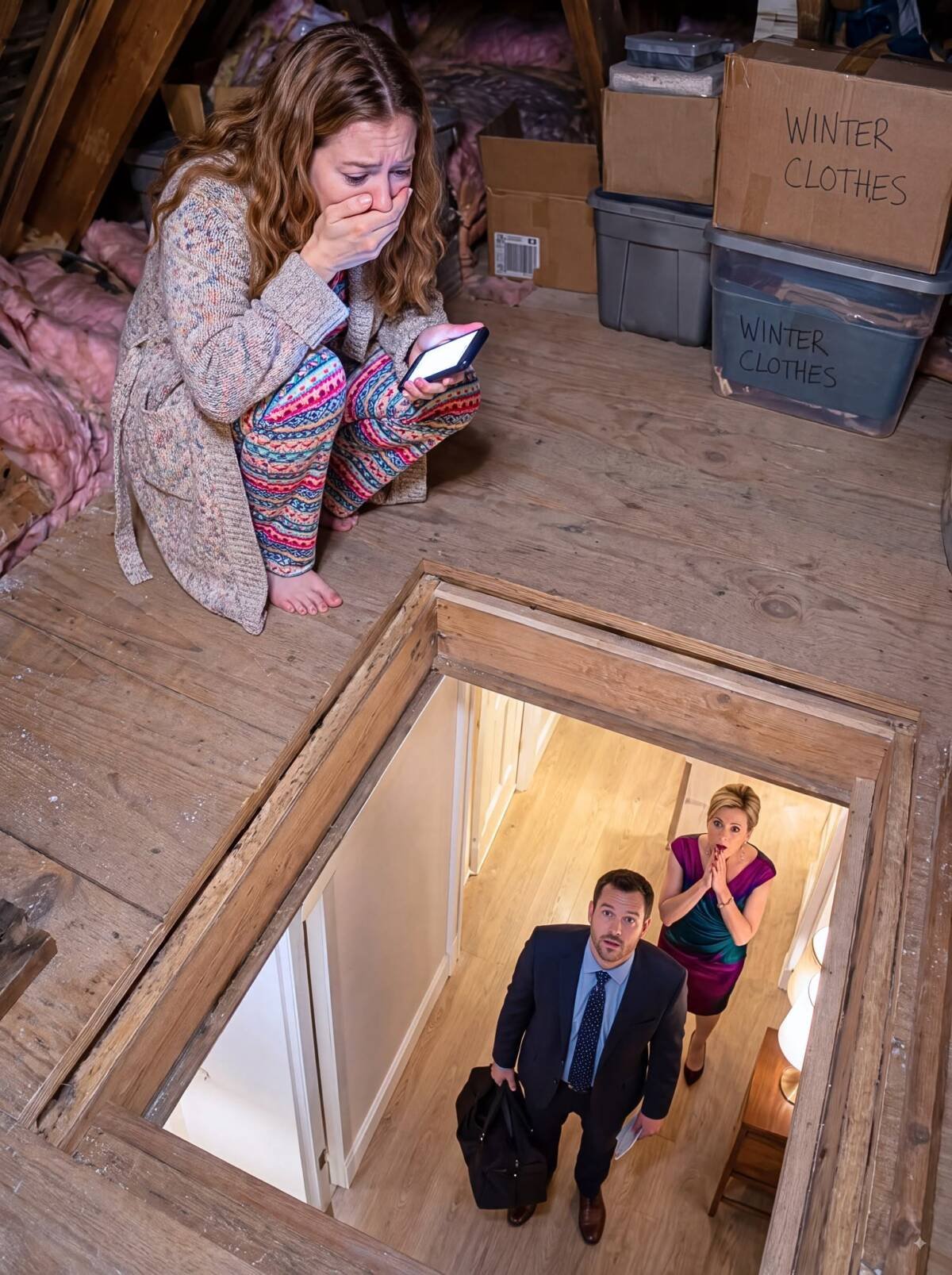
At three in the morning, the world is supposed to be quiet. For most families, it is the hour of deepest rest, a time when the house settles and the only sounds are the rhythmic breathing of loved ones. But for Emma Lawson, 3:00 a.m. became the exact moment her entire reality fractured.
It started with a sound that would seem innocuous to anyone else: the faint, metallic click of a bedroom door opening down a dark suburban hallway.
Emma woke instantly. Her maternal instincts, operating on a primal frequency, recognized the specific creak of the hinges. It was the door to her nine-year-old daughter Lily’s room. More troublingly, as Emma lay frozen in the dark, her heart hammering against her ribs, she realized this was not the first time she had heard that sound in the dead of night.
In the modern era of true crime obsession, we are often conditioned to look for monsters hiding in the bushes or strangers lurking in the shadows. But the most devastating betrayals do not announce themselves with broken windows or shattered glass. They slip quietly through the front door, wearing the face of someone you trust. This is the harrowing true story of a mother who refused to ignore the subtle, chilling signs of trauma, the hidden camera that captured an unthinkable truth, and the grueling fight to bring a child back into the light.
The Invisible Architecture of Fear
Crises of this magnitude rarely happen overnight. For several weeks, a quiet, insidious tension had been taking root inside the Lawson home. Emma had sensed that something was fundamentally wrong with her daughter, though she couldn’t immediately pinpoint the cause.
Lily, previously a vibrant, talkative nine-year-old whose laughter filled the house, had slowly begun to fade into herself. The changes were subtle at first—the kind of shifts a busy parent might chalk up to a difficult week at school or a passing phase. Lily had become unusually withdrawn, spending hours alone in her room. She began startling easily, flinching at sudden noises or unexpected movements.
But the most alarming shift was in her relationship with her father, Mark. Emma noticed that Lily actively avoided looking directly at him. When Mark entered a room, the air seemed to leave Lily’s lungs. If Emma asked her daughter about her quiet behavior or if anything was bothering her, Lily would respond with stiff, rehearsed smiles. They were the smiles of a child carrying a burden far too heavy for her shoulders, performing happiness rather than feeling it.
The breaking point arrived three nights before the incident that would change everything. Emma was helping Lily get ready for bed when she noticed an unexplained, dark bruise on her daughter’s arm. When asked about it, Lily’s explanation was disjointed and nervous, completely out of character for the usually honest child.
The excuses didn’t align with the injury, and the creeping dread Emma had been suppressing in her gut suddenly demanded to be acknowledged. She desperately hoped she was overreacting. She wanted nothing more than to be a paranoid mother whose imagination was running wild. But she could no longer rely on hope. She needed proof.
Driven by a terrifying intuition, Emma purchased a small, motion-activated hidden camera. While Mark was out of the house, she carefully concealed the device inside one of Lily’s favorite stuffed animals, positioning it on a shelf so the lens had a clear, unobstructed view of the young girl’s bed. She connected the feed to a secure application on her phone.
She expected the recordings to capture nothing but a peacefully sleeping child, proving that her growing suspicions were nothing more than unfounded fear.
She was wrong.
The Video Feed That Shattered a Family
When the faint click of the door echoed down the hallway that night at 3:00 a.m., Emma did not hesitate. With shaking hands, she grabbed her smartphone from the nightstand and opened the camera application.
The screen flickered to life, bathing Emma’s face in the cold, blue light of the infrared feed. In the dim, black-and-white view of Lily’s bedroom, Emma watched as Mark stepped quietly inside, gently pushing the door closed behind him to mute the sound.
On the bed, the reaction was immediate and heartbreaking. Lily did not roll over sleepily. She did not ask for a glass of water. She sat bolt upright, her small body visibly tensing into a rigid posture of absolute terror the second she realized her father was in the room.
Emma’s breath hitched in her throat. She tapped the screen to activate the audio feed, a decision that would haunt her nightmares but ultimately save her child.
Through the tiny speaker of the phone, a small, fragile voice broke the silence of the room.
“Daddy… please don’t come in again. I want to sleep.”
The sheer, unadulterated fear in her daughter’s voice was paralyzing. It was not the voice of a child waking from a bad dream; it was the voice of a child trapped in an ongoing, waking nightmare.
Mark did not answer. He offered no words of comfort. Instead, he continued his slow, silent approach toward the bed. On the screen, Emma watched her daughter pull herself frantically backward, retreating as far as the headboard would allow, wrapping her arms around her legs and pulling her knees tightly against her chest in a desperate, defensive posture.
Emma didn’t wait to discover what would happen next. The footage, the tension in the room, and her daughter’s terrified plea were all the evidence she needed.
She threw off the covers, bolted out of bed, and sprinted down the hallway.
When Emma pushed open Lily’s bedroom door, the reality of the scene was even more devastating than the glowing screen of her phone. Lily turned toward the sudden noise, her face slick with silent, flowing tears. At the sight of his wife, Mark immediately stepped backward, his hands raising slightly in defense.
“What are you doing?” Emma demanded, her voice shaking with a mixture of pure terror and explosive maternal rage.
For what felt like an eternity, Mark stood frozen. He offered no explanation, no excuse. The silence in the room was deafening.
Emma didn’t wait for a lie. She walked directly past her husband and went straight to the bed. The moment she wrapped her arms around Lily, the young girl’s tense posture broke. She collapsed against her mother’s shoulder, sobbing violently but almost entirely without sound—a tragic indicator of a child who had learned to hide her pain.
“Sweetheart, you’re safe,” Emma whispered fiercely into her daughter’s hair, her eyes locking onto the man she had married. “You’re safe now. I’m here.”
Still shielding Lily with her body, Emma turned her full fury on Mark.
“Get away from her.”
Cornered, Mark finally attempted to speak, falling back on the most common tactic of abusers: gaslighting. He claimed Emma had completely misunderstood the situation. According to him, Lily had been suffering from terrible nightmares, and he had simply entered the room to check on her and offer comfort.
Emma’s response cut through the darkness like a knife.
“Nightmares that happen only when you walk into her room in the middle of the night? Nightmares she never had before? Nightmares that make her terrified to be alone with you?”
When he took a step forward, Emma stopped him dead in his tracks. She informed him that there was a camera. She told him she had watched him enter, and more importantly, she had heard Lily explicitly beg him not to come closer.
Mark stopped trying to approach. The realization that he had been caught on tape seemed to drain the manufactured confidence from his posture.
Emma did not hesitate to make the hardest, most vital decision of her life. She picked Lily up in her arms. She did not open a suitcase. She did not pack clothes, toothbrushes, or favorite toys.
“We’re leaving,” Emma told her daughter softly, keeping her eyes locked on Mark. “Pack nothing. We go now.”
Still wearing their pajamas, Emma carried Lily out the front door, secured her in the backseat of the car, and drove directly into the night. She didn’t know where they would sleep tomorrow. She didn’t know how she would pay for lawyers, or how she would rebuild their shattered existence. The only priority that night—the only thing that mattered in the entire world—was putting as much distance as possible between her daughter and the man who had caused her so much pain.
She drove straight to the nearest police station.
The System and the Safehouse
The fluorescent lights of the police precinct were blinding after the darkness of the suburban streets. Inside, the gravity of the situation prompted an immediate response. Officers ushered the trembling mother and daughter into a quiet, secure room, wrapping Lily in heavy blankets and providing warm drinks to shock the cold from their systems.
While a female detective specially trained in child trauma gently interviewed Lily in a separate space, Emma sat across from investigators, handing over her entire life. She provided her phone, the raw camera recordings, the timestamps, and a meticulously detailed timeline of every behavioral change she had noticed in her daughter over the preceding weeks.
The detective looking over the footage paused, looking up at Emma with a solemn, respectful expression.
“You did the right thing. You protected your daughter. That’s what matters now.”
By the time the sun began to rise, painting the precinct windows in pale morning light, Lily had finally succumbed to exhaustion, falling asleep with her head resting on Emma’s shoulder. As Emma watched her daughter breathe, the monumental scale of what lay ahead began to crush down on her. In the span of a few hours, her marriage had ended, her home was gone, and her family was destroyed. Ahead of them lay a grueling gauntlet of criminal investigations, child protective services interviews, forensic evaluations, legal proceedings, and intense psychological counseling.
But as Emma stroked her daughter’s hair, one absolute truth anchored her to the earth: Lily no longer had to face her fear alone in the dark.
Later that afternoon, authorities relocated Emma and Lily to an undisclosed safehouse—a temporary, protected facility where they could stay while emergency protective orders were filed and the initial investigation commenced.
That first night in the safehouse, the adrenaline finally wore off, leaving Emma with a suffocating wave of guilt. She sat beside the small, unfamiliar bed where Lily slept, torturing herself with a toxic internal monologue. Why didn’t I see it sooner? How did I let him near her? What kind of mother misses the signs?
She leaned down, whispering to the sleeping child. “I’m so sorry, baby. I’m so, so sorry I didn’t see it sooner. But I promise you, I will never let anyone hurt you again.”
Lily’s eyes fluttered open in the dim light of the unfamiliar room.
“Mommy?”
“Yes, sweetheart?”
“Are we really safe now?”
The innocence and desperation in the question broke Emma’s heart all over again. “Yes, my love. We are.”
For the first time in weeks, the tight, rehearsed mask on Lily’s face melted away. She managed a small, genuine smile before drifting back to sleep. Leaving the house at 3:00 a.m. had only been the first step. The real war was just beginning.
The Courtroom Battle and the DARVO Defense
Three days later, the reality of the legal system set in. Emma sat in a sterile county courthouse conference room, the table between her and her attorney, Caroline Reed, buried under a mountain of documents, timelines, and evidentiary files.
A child psychologist who had conducted the initial forensic interview with Lily joined the meeting. The prognosis was challenging but hopeful.
“Your daughter trusts you deeply,” the psychologist explained, noticing the guilt radiating from Emma. “The fact that she opened up to you so quickly, and the fact that you validated her fear immediately, is a massive positive sign. She’s frightened, but she’s not broken.”
When Emma voiced her agonizing guilt over not acting sooner, the psychologist stopped her. Children, she explained, are uniquely vulnerable to abuse from authority figures because they are systematically manipulated into believing the abuse is a secret they must protect. Children rarely have the vocabulary or the emotional safety to report an abusive parent outright. Emma had done exactly what a parent should do: she noticed the non-verbal cues, investigated the behavioral shifts, and took decisive, immediate action the moment she confirmed the threat.
But the relief of the psychologist’s words was immediately undercut by news from the prosecutor.
Mark was not going quietly. He had retained a high-powered, aggressive defense attorney and was officially pleading not guilty. More disturbingly, he was deploying a classic psychological defense strategy known in legal and psychological circles as DARVO: Deny, Attack, and Reverse Victim and Offender.
Mark was claiming that Emma had completely fabricated the allegations. He was framing her as an unstable, vindictive wife who was using a doctored hidden camera setup to win a bitter marital dispute and steal full custody of their child.
“It’s a standard defense tactic,” Caroline Reed reassured her client, seeing the panic in Emma’s eyes. “It doesn’t matter what lies he spins. We have the digital evidence. His reaction inside that room, caught on tape, tells more truth than he ever will on the stand.”
Logically, Emma knew Caroline was right. But emotionally, the accusation struck terror into her heart. Mark was a master manipulator. To the outside world, their friends, and their community, he had always been charming, respectable, and entirely convincing. Emma knew exactly how persuasive he could be, and the fear that a judge or jury might actually believe his charismatic lies threatened to consume her.
When a Private Nightmare Becomes a Public Spectacle
Two weeks later, the preliminary hearing commenced. As Emma walked into the courtroom, holding her head high, she saw Mark sitting at the defense table. He was impeccably dressed in a tailored suit, projecting calm composure. He looked exactly like the respectable, loving father he had always pretended to be.
The prosecution laid out the timeline. They played the hidden camera recording, highlighting the irrefutable timestamp. The court heard the audio of Lily begging her father to leave, and reviewed the detailed behavioral changes Emma had logged, supported by the forensic psychologist’s initial findings.
When it was the defense’s turn, Mark’s attorney stood up and attempted to paint an alternate reality.
“Your Honor, this entire proceeding is built on a gross misunderstanding,” the defense lawyer argued smoothly. “This is nothing more than a tragic marital dispute exaggerated into a false, life-ruining allegation. My client was simply comforting his daughter during a period of severe night terrors.”
The defense attempted to frame Emma’s decision to hide a camera inside a teddy bear as evidence of deep-seated marital paranoia and mental instability, rather than the desperate act of a protective mother.
Caroline Reed immediately fired back, refusing to let the victim-blaming narrative take root.
“The child’s recorded fear speaks louder than any fabricated explanation,” Caroline stated firmly, redirecting the judge’s attention to the most crucial piece of evidence: Lily’s voice. “A child waking from a nightmare seeks comfort from a parent. This child was actively fleeing from the parent.”
After reviewing the material, the judge did not hesitate.
“Based on the overwhelming evidence presented, the emergency protective order will remain in full effect. We move to a formal, criminal trial.”
Emma let out a breath she felt she had been holding for two weeks. Lily was legally protected. But as she walked out of the courthouse doors, she was about to discover that the modern justice system is not the only place where victims are put on trial.
As Emma and Caroline navigated the courthouse steps, Emma noticed people staring, pointing, and whispering. Her phone began to buzz frantically. Within hours, details of the closed-door hearing, leaked by unknown sources, began circulating on local community boards and social media platforms.
The internet, fueled by its insatiable, toxic appetite for true crime and domestic drama, seized upon the story. Overnight, Emma’s private tragedy became a public spectacle. The comments sections were vicious, polarized battlegrounds. While many strangers praised Emma as a hero for saving her child, a loud, aggressive faction took Mark’s side. Because Mark had carefully cultivated a flawless public image for years, acquaintances and strangers alike refused to believe the allegations. They accused Emma of being a manipulative, hysterical woman out to destroy a good man’s life.
“Don’t look at it,” Caroline warned her, snatching the phone away. “The internet is a circus. Focus on your daughter. Focus on the trial.”
It was the right advice, but it was agonizing to endure. Emma had sacrificed everything to create a quiet, protected sanctuary for Lily, only to find the most traumatic moment of their lives being consumed as entertainment by people who had never met them.
That evening, back at the safehouse, the tension leaked into the room. Lily, highly attuned to her mother’s emotional state, climbed into Emma’s lap.
“Mommy, are people mad at us?” the nine-year-old asked quietly.
Emma held her daughter fiercely, filtering out the cruelty of the outside world. “No, sweetheart. People just don’t understand yet. But they will. And even if they don’t, it doesn’t matter. The only thing that matters is us.”
The Verdict and the Long Road to Healing
For the next two months, Emma’s life was a blur of legal preparations, therapy appointments, and the agonizing attempt to maintain a sense of normalcy for Lily. Emma refused to let the online vitriol dictate their reality.
Finally, the day of the verdict arrived. Emma sat in the front row of the heavy oak courtroom, her hands gripping Lily’s so tightly her knuckles were white. The air in the room was thick, suffocating.
The jury foreperson stood up, holding the slip of paper that would dictate the rest of their lives.
“On all counts, we find the defendant… guilty.”
For a full ten seconds, Emma’s brain could not process the English language. She remained completely still, frozen in time. Then, the dam broke. A wave of relief so violent and absolute crashed over her that her knees buckled slightly against the wooden pew.
Lily looked up, her wide eyes searching her mother’s weeping face for translation.
“It’s over, baby,” Emma sobbed, pulling Lily to her chest. “We won. It’s over.”
As Mark was handcuffed and escorted out of the courtroom by bailiffs, he didn’t look back. Emma watched the door swing shut behind him. It was a massive, historic victory. But as they walked out of the courthouse for the last time, Emma realized a profound truth: a guilty verdict settles the legal score, but it does not magically cure trauma.
The real work was just beginning.
In the months following the trial, Emma and Lily moved into a new home, far from the shadows of their past. Emma deliberately stripped away the chaos of legal deadlines and focused entirely on the architecture of healing. They built a life rooted in soft, predictable routines.
Lily continued intensive trauma therapy, where she was given the tools to process her pain at her own pace. At home, Emma bought her a journal, encouraging her to write down the feelings that were too heavy to speak aloud. Their evenings became sacred spaces of ordinary life—cooking dinner together, watching animated movies, and taking long walks at dusk where Lily was free to talk about her fears, or simply walk in silence without having to explain herself to anyone.
Healing is not a cinematic montage; it is a grueling, non-linear process. But slowly, the light began to return.
Lily began to laugh again. It started as a cautious, brief giggle, as if she were testing the air to see if joy was safe. But as the months passed, those small sounds blossomed into deep, uninhibited, belly laughter that filled the corners of their new home.
Emma’s own healing mirrored her daughter’s. She stopped punishing herself for what she missed, and started honoring herself for what she had done.
The ultimate turning point came on an unremarkable Tuesday evening, several months post-trial. Emma was tucking Lily into bed, completing their quiet nightly routine. As Emma leaned down to kiss her forehead and moved to shut the door, Lily stopped her.
“Mommy?”
“Yes, sweetie?”
“I want to sleep with the door open now. I’m not scared anymore.”
Emma stood frozen in the doorway, tears pricking the corners of her eyes. Just a year ago, the sound of a door opening was the trigger for absolute terror. A closed door was the only barrier Lily had against a monster. Now, her daughter was asking for the door to remain wide open, because the space beyond it no longer represented a threat. It represented safety. It represented a mother who was always listening.
“Of course, sweetheart,” Emma whispered, her voice thick with emotion. “Whatever makes you feel safe.”
Emma stepped into the hallway, leaving the door ajar. She leaned against the wall, listening to the absolute, peaceful silence of the house. For the first time in over a year, she didn’t feel the need to monitor the floorboards. She didn’t flinch at the wind against the windows. They were finally, truly, living again.
Turning Pain Into a Voice for the Voiceless
Emma realized that strength is rarely about being fearless. Real strength is feeling absolutely terrified, but refusing to let that fear dictate your actions.
She knew there were other parents out there right now, sitting in the dark, watching their children change, and actively suppressing their own gut instincts out of fear of destroying their families. Emma couldn’t change what Lily had endured, but she could use their survival to light a flare for others.
One morning, Emma opened her laptop and navigated to a major online support forum for parents. Protecting Lily’s identity and using an anonymous handle, Emma began to type.
She didn’t write about the legal victory. She wrote about the agonizing, terrifying weeks before the camera. She wrote about the subtle behavioral shifts, the rehearsed smiles, the flinching, and the profound guilt of doubting your own intuition. She described what it felt like to realize that the monsters we tell our children to watch out for are sometimes the people tucking them into bed.
“Concern doesn’t always arrive as a blinding revelation,” Emma typed, the words pouring out of her. “Sometimes it arrives as a quiet, persistent whisper in your gut that tells you something isn’t right. Do not ignore that whisper. Do not let the fear of being wrong stop you from investigating. Abusers rely on our silence, our politeness, and our desire to maintain the status quo. Refuse to be polite when it comes to your child’s safety.”
She hovered her finger over the ‘Submit’ button. A year ago, the fear of public judgment would have paralyzed her. Now, she pressed down firmly.
She didn’t know who would read it. She didn’t know whose algorithm would push the story onto the screen of a mother sitting awake at 3:00 a.m., terrified of a creaking floorboard. But she knew that her voice was out there.
Their story had begun in the suffocating darkness of a terrified child’s bedroom. But it ended with a mother and daughter who had reclaimed their lives, proving that trauma does not have to be a life sentence.
As Emma wrote in the final, powerful line of her post:
“Silence protects no one. Courage saves lives.”
Does Emma’s story resonate with you? If you have ever felt that quiet, nagging intuition that something was wrong, trust it. We urge you to share this story on Facebook, Twitter, and your personal networks. You never know who is scrolling through their feed in the middle of the night, desperate for the courage to open the door and uncover the truth. Share this article, raise your voice, and help us break the silence.