For twelve years, I had perfected the art of making myself smaller to keep the peace in the Mercer family, swallowing insults and excusing cruelty under the guise of maintaining a unified home, but it took only five seconds and a shattered pink cake stand to make me realize that peace was just another word for surrender.
The morning of Emma’s tenth birthday began with the kind of quiet, humming anticipation that only a house with children can generate. I had been awake since dawn, standing in our sprawling suburban Ohio kitchen, carefully piping pale pink buttercream roses onto a three-tiered vanilla sponge cake. It was Emma’s favorite. She had spent the entire week sketching how she wanted it to look, leaving her little drawings on the kitchen island for me to find. Beside me, my six-year-old daughter, Lily, was tasked with carefully placing edible silver pearls around the base, her tongue poking out of the corner of her mouth in absolute concentration. For those few hours, the house felt like a sanctuary. It felt safe. But beneath the warmth of the morning, a familiar, heavy dread was already pooling in my stomach. Diane was coming.
My mother-in-law, Diane Mercer, was a woman who moved through the world as though everyone else was merely auditioning for a role in her life, and for twelve years, my daughters and I had consistently failed to get the part. Diane suffered from a deep, archaic obsession with bloodlines, specifically the continuation of the Mercer name. The fact that I had given birth to two bright, funny, deeply empathetic girls was, in her eyes, a biological failure. She never missed an opportunity to subtly remind us of this perceived deficit. There were the Christmases where Mark’s nephews received expensive electronics while Emma and Lily were handed generic, poorly wrapped doll sets. There were the family dinners where Diane would loudly lament to her friends that Mark would have no one to pass his landscaping business down to, completely ignoring Emma, who was sitting right across the table. And then there was Mark. My husband had spent his entire life shrinking in his mother’s shadow, adopting a policy of aggressive neutrality. Whenever Diane launched a barb, Mark would suddenly become deeply interested in his phone, or he would wait until we were in the car to tell me that I was being overly sensitive and that his mother just came from a different generation. I had spent a decade convincing myself that his passivity was just conflict avoidance. I didn’t want to admit that silence, when weaponized against your own children, is a choice.
By two o’clock, the dining room was decorated, the gifts were stacked, and the air conditioning was struggling against the thick Ohio summer humidity. The doorbell rang, and the atmosphere in the house instantly shifted. The light, airy joy evaporated, replaced by a rigid, performative tension. Diane walked in, followed closely by Mark’s quiet father, Richard, and Mark’s sister, Claire. Diane didn’t greet me. She barely looked at the girls. She immediately began criticizing the temperature of the house, the layout of the appetizers, and the volume of the music. Mark, who had been relaxed just moments before, instantly morphed into a frantic concierge, rushing to adjust the thermostat and fetching his mother a glass of iced tea exactly the way she preferred it. I watched him from the kitchen, feeling a deep, hollow exhaustion. I had spent the last two years quietly drowning in this marriage. Beyond the issues with his mother, Mark had become increasingly controlling, monitoring my credit card statements while dismissively waving away my successful career in commercial real estate as a “little hobby.” Our marriage was a house with rot in the foundation, but I had kept painting the walls, desperate to make it look livable for the girls.
“Let’s just do the cake,” I whispered to Mark as he rushed past me. “Emma’s been waiting all day.”
Mark sighed heavily, acting as if my request was an enormous burden. “Fine. Just get it over with before Mom gets a headache.”
I carefully carried the heavy glass cake stand into the dining room. Emma’s eyes lit up immediately. She bounced on her heels, her hands clasped together, completely captivated by the pink frosting and the ten glittering candles I had yet to light. Lily clapped her hands, proud of her silver pearls. Even Claire smiled, opening her mouth to tell Emma how beautiful it looked.
Before I could even set the matches down, Emma reached out, her small index finger hovering just above a frosting rose. She didn’t even touch it. She was just pointing out her favorite part to her little sister.
Without a sound, Diane stepped forward.
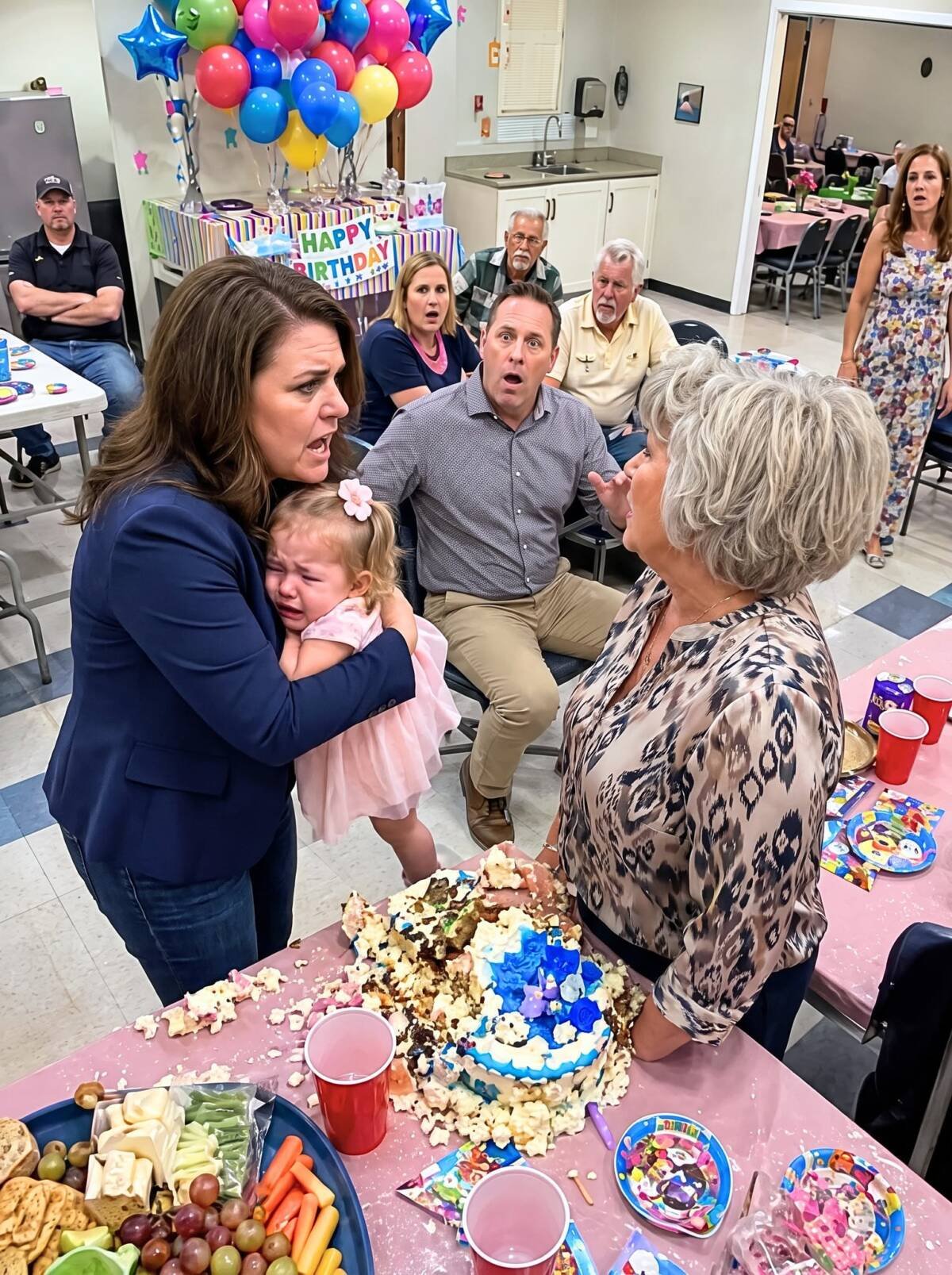
Her hand shot out with a speed and violence that defied her age. The sharp, cracking sound of Diane’s palm striking Emma’s cheek echoed through the dining room like a gunshot. Emma’s head snapped back, her eyes wide with shock, but before any of us could even process the assault, Diane’s hands were already moving again. She grabbed the edge of the heavy glass cake stand and violently yanked it toward her.
The world seemed to drop into agonizingly slow motion. I watched the three-tiered cake, the culmination of my daughter’s excitement and my morning of love, slide off the edge of the mahogany table. It hit the hardwood floor with a deafening crash. The glass stand shattered into dozens of jagged pieces, sending shrapnel sliding across the room. Pink buttercream, crushed vanilla sponge, and silver pearls splattered across the floorboards, mixing with the ruined wax of the unlit candles.
The silence that followed was absolute. It was a thick, suffocating vacuum.
“Don’t touch it,” Diane hissed, her voice dripping with venom.
Emma stood frozen, her hand still raised in the air. A fierce red handprint was already blooming across her pale cheek. Tears welled in her eyes, spilling over her lashes and dropping silently onto her party dress. She looked down at the ruined cake, then up at the woman who was supposed to love her unconditionally.
“Grandma,” Emma whispered, her voice trembling so violently it broke my heart into a thousand irreparable pieces. “It’s my cake.”
Diane looked at her ten-year-old granddaughter with eyes completely devoid of warmth, remorse, or humanity. She straightened her posture, looking down her nose. “No son, no celebration.”
A primal, white-hot rage ignited in the center of my chest, so intense it made my vision blur. I spun around to face Mark. This was the moment. This was the absolute boundary. His mother had just physically assaulted his child and destroyed her joy simply because of her gender. I waited for the eruption. I waited for my husband to transform into a father, to step between his mother and his bleeding, weeping daughter, to throw Diane out of the house and demand respect for his family.
Instead, Mark shifted his weight. He leaned casually against the doorframe of the kitchen. He looked at the smashed cake, looked at his mother, and gave a small, indifferent shrug.
“She’s right.”
The air left my lungs. The ground beneath me ceased to exist. I looked at Mark’s father, Richard, who was intensely studying a spot on the wall, completely cowed by his wife. I looked at Claire, who had covered her mouth with her hands but was stepping backward, retreating from the fallout. And then I looked back at Mark. Emboldened by the lack of immediate screaming, Mark uncrossed his arms and took a step forward, completely missing the absolute devastation in the room.
“Look, Laura, don’t make a scene,” Mark said, gesturing loosely to the mess on the floor. “Emma needs to learn she can’t always be the center of attention. Mom is just trying to teach her some respect. The world isn’t going to bow down to her just because she wants a piece of cake.”
“It’s her birthday,” I said. My voice didn’t belong to me. It was devoid of inflection, a flat, mechanical sound.
Diane let out a short, dismissive bark of laughter. “And what exactly does that mean? Someday she’ll marry and take another man’s name. All of this is pointless. What exactly are we celebrating here today, Laura? Another Mercer name disappearing into nothing? She’s a girl. She’s temporary.”
I didn’t look at Diane. I didn’t look at Mark. I looked directly at Emma.
My beautiful, brilliant ten-year-old daughter was staring at me. The tears were still falling, but her expression had shifted. The shock was fading, replaced by a profound, agonizing waiting. She wasn’t looking at me to fix the cake. She wasn’t even looking at me to soothe her stinging cheek. She was waiting to see what her mother would do. She was waiting to see if this was her worth. She was waiting to see if I would validate her grandmother’s cruelty and her father’s betrayal by screaming, crying, bargaining, or eventually—inevitably—cleaning up the mess and serving them dinner. She was waiting to learn how she should allow the world to treat her for the rest of her life.
I felt a sudden, profound calm wash over me. It was the absolute absence of doubt.
I didn’t scream. I didn’t cry. I didn’t utter a single defense. I slowly knelt down, ignoring the frosting ruining my jeans, and carefully picked up one of the unbroken candles from the debris. I stood up, walked to the kitchen counter, and placed it down with a soft click. I turned around and looked directly into Diane’s smug, triumphant face.
“Okay.”
Diane’s lips curled into a victorious smile. She had won. She had broken me in my own home, in front of her son, and I had folded. Mark let out a loud, theatrical sigh of relief, his posture completely relaxing as he ran a hand through his hair.
“Good,” Mark muttered, turning toward the kitchen. “Maybe now we can stop making everything so damn dramatic. I’ll get a broom.”
“Absolutely,” I replied softly.
I walked over to Emma and gently took her hand. It was cold and shaking. I called Lily, who had been hiding behind the sofa, her wide eyes locked on the smashed cake. I grabbed my purse from the entryway table, pulled my car keys from the bowl, and walked steadily toward the front door.
Mark stopped dead in his tracks, the broom in his hand. Confusion replaced his relief. “Where are you going? We have guests.”
“Out.”
“For how long?” he demanded, his voice rising, the illusion of control slipping. “Laura, don’t play this game. If you walk out that door right now, you’re embarrassing me in front of my family.”
I didn’t answer him. I opened the door, ushered my daughters out into the heat of the afternoon, and closed it firmly behind me. As I walked down the driveway, I felt lighter than I had in a decade. Mark thought I was going for a drive to cool off, that I would return in an hour, apologize for the tension, and begin sweeping up the glass. He had absolutely no idea that my attorney, Melissa Grant, had already emailed me the final drafts of our divorce documents three days prior.
I strapped the girls into the car, my hands perfectly steady. The house sitting behind me—the sprawling suburban property Mark loved to boast about at dinner parties, the house he proudly called his kingdom—was purchased entirely through an irrevocable trust left by my late grandmother two years before I even met Mark. Because of the way I had structured the deed, Mark’s name had never touched the property records. He owned exactly zero percent of the home he was currently standing in. But there was another, far more catastrophic detail he was entirely ignorant of. For years, I had quietly managed a commercial real estate portfolio through an LLC named Bennett Holdings. Mark’s landscaping business, his pride and joy, operated out of a massive industrial warehouse.
Bennett Holdings owned that warehouse. Mark’s lease was set to expire in exactly four months.
I backed out of the driveway, the tires crunching over the gravel. Diane believed my quiet “okay” meant she had finally forced me into submission. Mark thought it meant I was throwing a temporary tantrum that would end in an apology. Neither of them possessed the capacity to understand that I wasn’t agreeing with their twisted worldview. I was completely, irrevocably finished.
The twenty-minute drive to my sister Rachel’s house was suffocatingly silent. Emma pressed her face against the glass, the red mark on her cheek a glaring brand against her pale skin. Lily sat in her car seat, clutching her favorite stuffed animal, her little brow furrowed in deep confusion. When we pulled into Rachel’s driveway, my sister took one look at my face and swung her front door wide open.
While Rachel whisked Emma into the kitchen to press a towel-wrapped bag of frozen peas to her face, I sat on the edge of the guest bed with Lily.
“Mommy,” Lily whispered, her voice barely audible. “Why did Grandma break the cake? Is she mad because we aren’t boys?”
It was a question that physically ached to hear from a six-year-old. I wanted to lie. I wanted to weave a protective fairy tale around her, to tell her Grandma was just having a bad day, that she was tired, that it was all an accident. But looking into her earnest eyes, I knew that lying would only teach her to doubt her own reality. It would teach her to accept abuse under the guise of misunderstanding.
“Grandma believes something very cruel and very stupid,” I told her, my voice fierce but controlled. “She thinks boys are more important than girls. But that is a lie, Lily. It is a lie she tells herself because her own heart is broken and small. It has absolutely nothing to do with how wonderful, important, and valuable you and your sister are. Do you understand me?”
Emma appeared in the doorway, holding the peas to her cheek. She leaned against the frame, her eyes hollow. “Dad believes it too.”
The truth was a knife, but I refused to twist it with a lie. “Yes,” I said, holding her gaze. “He stood beside her. And that is why we are never going back.”
Once Rachel had the girls settled in the living room with a movie, I walked out to the back patio and called Melissa. I had originally consulted her as a precaution, a desperate attempt to map out my options as Mark’s financial control tightened and our marriage decayed. But after watching him shrug while his daughter wept, every shred of hesitation evaporated.
“Did anyone witness the physical assault?” Melissa asked, her tone shifting instantly from counselor to shark.
“Five adults. Mark, his parents, his sister, and me.”
“Take photographs of Emma’s cheek right now in natural light. Write down exactly what happened, word for word, while it’s fresh in your memory. Do not answer any phone calls from Diane or Mark. If they text, do not argue. Let them dig their own graves in writing.”
As the evening wore on, my phone screen became a strobe light of escalating panic and rage. Diane called nine times, leaving voicemails I didn’t listen to. Mark resorted to text messages. His initial texts were arrogant and dismissive, demanding I stop throwing a tantrum and bring his children home. When I didn’t reply, his tone shifted to furious accusations. He claimed I was destroying his family, that I was humiliating him, and that I was emotionally abusing his mother by withholding the girls. Finally, just before midnight, he sent the message he believed would shatter my resolve and send me crawling back to his doorstep.
If you don’t come back tonight, don’t bother coming back at all. You’ll be begging me to let you back in by morning.
I stared at the glowing screen in the dark of my sister’s guest room. I thought about the smashed cake. I thought about Emma’s tears. I thought about the twelve years I had spent shrinking to fit into a box Diane built and Mark taped shut. I typed four letters, hit send, and turned the phone completely off.
Okay.
On Monday morning, the legal machinery engaged with brutal efficiency. Melissa filed the divorce papers the moment the courthouse opened, along with a petition for exclusive use of the marital residence based on the ownership records. At exactly 10:15 AM, a process server walked into the front office of Mercer Outdoor Services and handed Mark a thick manila envelope.
The fallout was immediate and spectacular.
Mark called me from an unknown number, completely bypassing my block. When I answered, he wasn’t furious; he was completely unmoored, his voice cracking with a high-pitched panic I had never heard from him before.
“Laura, what is this? What the hell is this?” he stammered. “I just got served. It says… the petition says the house isn’t marital property. It says you want me out by Friday. That’s my house, Laura! I’ve paid the utilities for a decade! You can’t legally evict me from my own home!”
I stood at Rachel’s kitchen window, watching Emma and Lily chasing my sister’s golden retriever around the fenced yard. “It was never your home, Mark. It was purchased entirely by my grandmother’s trust. You never signed a deed. You never paid the mortgage. The house belongs to the trust, and I am the sole beneficiary.”
“You’re seriously divorcing me and throwing me on the street over a birthday cake?” he yelled, desperation making him vicious. “Because my mother lost her temper for three seconds?”
“No, Mark,” I said, my voice eerily calm against his hysteria. “I am divorcing you because when your mother violently struck your daughter and destroyed her joy, you stood exactly beside her and said she was right. I am divorcing you because you are a coward. And I refuse to let my daughters be raised by a man who thinks they are secondary citizens.”
Mark let out a bitter, mocking laugh, falling back on the one defense mechanism he thought he still possessed: financial superiority. “You think you can survive this? You think you can maintain that house on your own? I pay for everything, Laura. Your little real estate hobby isn’t going to cover the property taxes. You’re going to drown without my income.”
I hung up the phone.
Mark had spent our entire marriage deeply underestimating me, convinced that his role as the primary provider was the only thing holding our lives together. He had conveniently ignored the fact that prior to having the girls, I was a senior portfolio manager for a major commercial real estate firm. Five years ago, when I inherited a substantial sum from my grandfather, I didn’t buy designer clothes or luxury cars like Diane assumed. I quietly created an LLC called Bennett Holdings, partnered with my old firm, and purchased a massive, underperforming industrial park on the edge of the city. Over five years, I had quietly turned it into a highly profitable commercial hub.
Mark’s landscaping company leased fifty thousand square feet of warehouse and yard space in that exact industrial park.
Because Mark viewed my career as a cute little pastime, he never once looked at the legal paperwork of Bennett Holdings, even though I had mentioned the investment to him years ago. He dealt exclusively with my property manager, an aggressive, no-nonsense man named Greg.
Six weeks prior to Emma’s birthday, Greg had sent Mark a standard lease renewal offer. The industrial market in our area had exploded, and the rent increase reflected the current market value. Diane, ever the mastermind of terrible advice, had convinced Mark that the landlord was bluffing. She told him that landscaping companies were the anchor tenants of industrial parks and that if Mark simply rejected the renewal and demanded a twenty percent decrease, the landlord would eventually cave in a panic.
Mark had confidently rejected the renewal, assuming his space would simply be waiting for him whenever he felt like negotiating.
It wasn’t.
Three days after Mark was served with divorce papers, Greg formally leased Mark’s entire warehouse and yard space to a massive logistics company. Mark received the official notice to vacate by certified mail. He had exactly four months to locate a new facility, secure the massive deposits required, and physically relocate his fleet of twenty trucks, massive excavators, tons of raw materials, and thirty employees.
When Mark called Greg, screaming about loyalty and demanding to speak to the owners of Bennett Holdings, Greg calmly informed him that the majority owner had personally reviewed and approved the new tenant’s lease.
Thirty minutes later, my phone rang again.
“You own Bennett Holdings?” Mark’s voice was barely a whisper, hollowed out by pure shock. “You’re my landlord?”
“I am the majority owner, yes.”
“You knew my company was in that building, Laura! You knew my lease was up! You let me reject the renewal!”
“I didn’t let you do anything, Mark. I am not your mother. I don’t control your decisions. Greg offered you a fair market renewal. You chose to reject it. You demanded a ridiculous price reduction on a property that is highly sought after. Greg found a tenant willing to pay above market rate. It’s just business.”
“You are destroying my company out of spite!” he screamed, his voice echoing off whatever warehouse walls he was standing between.
“I didn’t cancel your contract, Mark. I didn’t break a single agreement. I simply stopped stepping between you and the consequences of your own arrogant decisions. You made a terrible business move, and now you have to pack up your trucks.”
The financial devastation didn’t end there. During the initial discovery phase of the divorce, Melissa subpoenaed all of our financial records. That was when the truth about the missing $38,000 finally came to light. For a year, Mark had been quietly siphoning money out of our joint savings account, claiming it was for emergency equipment repairs. In reality, he had been transferring it directly into a shadow account controlled entirely by Diane.
When confronted in mediation, Mark sat across the mahogany table, looking completely defeated.
“Why did you give our family savings to your mother, Mark?” Melissa asked, her pen hovering over her notepad.
Mark wouldn’t look at me. “She was holding it.”
“Holding it from whom?”
Mark swallowed hard. “From Laura. Mom said… Mom said Laura was becoming too independent. She said if things went south, Laura would take everything, and I needed a nest egg that she couldn’t touch.”
The profound irony hung in the air like smoke. Mark had secretly stolen his children’s financial security because his mother convinced him I was untrustworthy, and in doing so, he legally committed financial fraud during the marriage. The mediator coldly informed Mark’s attorney that not only would that $38,000 be deducted entirely from Mark’s side of any remaining marital assets, but Diane would be formally legally pursued if the funds were not returned to the escrow account within seventy-two hours.
Diane’s reaction to the crumbling of her son’s empire was a masterclass in narcissistic rage. She began calling every extended family member, attempting to launch a vicious smear campaign. She claimed I was a sociopath who had engineered a minor disagreement over a cake to steal her son’s house and destroy his livelihood. She insisted Emma had made up the slap, that the cake fell by accident, and that I was emotionally manipulating my children to hate their father.
Her narrative fell apart spectacularly when Melissa formally submitted the evidence file to the family court for the custody hearing.
The judge reviewed the sworn statements from Richard and Claire, both of whom, under the threat of perjury, admitted that Diane had struck Emma unprovoked. The judge reviewed the high-definition photographs of the red handprint on Emma’s cheek. And finally, the judge listened to the voicemail Diane had left me, her voice dripping with venom as she called her own ten-year-old granddaughter “a spoiled, worthless little bitch who needs to learn her place.”
The custody ruling was swift and brutal. Mark was granted structured, supervised visitation. Diane was legally barred from coming within five hundred feet of my daughters.
For the first time in his life, Mark had nowhere to hide. He had lost his home. He was hemorrhaging money trying to relocate his business to an inferior, expensive location outside the city. His secret savings were gone. And he was only allowed to see his children in a sterile therapist’s office twice a week.
It was in that sterile office, four months into the separation, that Mark finally had to face the monster he had allowed to grow in his home.
During a supervised Saturday visit, Mark brought the girls lunch. Emma sat quietly, eating her sandwich, refusing to make eye contact with him. In a misguided attempt to foster a sense of normalcy, Mark forced a cheerful smile.
“So, Grandma misses you girls a lot,” he said lightly. “She asked if maybe, once the judge says it’s okay, we could all go get ice cream.”
Emma stopped chewing. She slowly placed her sandwich down on the wrapper. She looked up at her father, her eyes carrying a weight no child should ever have to bear.
“I don’t want to see Grandma,” Emma said.
Mark instinctively slipped into his decades-old habit of defending Diane. “Emma, honey, Grandma just made a mistake that day. She was stressed out. But she loves you, and family forgives family.”
Emma stared at him, unblinking. “If she just made a mistake, why did you say she was right?”
According to the therapist’s notes, Mark went completely, deathly silent. Emma wasn’t asking about the cake. She wasn’t even asking about the slap. She was asking the fundamental question of her existence in his heart. She wanted to know why her father, the man who was supposed to be her ultimate protector, had stood beside her abuser and validated her pain.
“I was angry,” Mark stammered, the color draining from his face. “I shouldn’t have said that.”
“But you did,” Emma pushed, relentless in her clarity. “Do you think Lily and I are less important because we’re girls?”
“No,” Mark whispered, tears finally pooling in his own eyes. “Never. You are my whole world.”
Emma didn’t smile. She didn’t offer him grace. She delivered the final, crushing blow. “Then why did you let Grandma think that? Why didn’t you protect me?”
There was no excuse Mark could offer that wouldn’t sound like a lie. For the first time, he saw the true cost of his cowardice. He had spent his life trying not to upset his mother, and the price he paid was the complete loss of his daughter’s trust.
Two days later, the final confrontation occurred.
Diane, furious that the court order was preventing her from exerting control, drove to my sister Rachel’s house while I was at work and the girls were playing in the front yard. Rachel, seeing Diane march up the driveway, immediately pulled the girls inside and locked the deadbolt, calling me and the police simultaneously.
By the time I arrived, speeding into the neighborhood with my hazard lights flashing, Diane was screaming on the front lawn, banging her fists against Rachel’s front door.
“You can’t keep my family from me!” Diane shrieked, her face purple with rage. “I have rights! They are Mercers! You vindictive little—”
Before I could even put my car in park, a familiar black truck screeched to a halt behind me. Mark jumped out.
Diane spun around, her face instantly lighting up with relief and triumph. She believed her reinforcements had arrived. She believed Mark was finally coming to put his foot down, to overrule the courts, to put his wife back in her place.
“Tell her, Mark!” Diane yelled, pointing a shaking finger at me. “Tell this woman she cannot legally keep a grandmother from her own blood! Tell her to open this door right now!”
Mark didn’t look at me. He walked straight up the driveway, stepping squarely between his mother and the front door where Emma was watching through the glass.
“Mom, stop,” Mark said. His voice wasn’t a yell, but it carried a deep, resonant authority I had never heard from him before.
Diane blinked, genuinely confused. “What? Tell her to open the door, Mark.”
“No,” Mark said. “You need to get in your car and leave.”
Diane recoiled as if she had been physically struck. “Excuse me? I am your mother! You are taking her side over your own flesh and blood?”
“I am taking my daughters’ side,” Mark said, his jaw locked. “What you did to Emma was unforgivable. Your obsession with having a grandson is sick, Mom. It has damaged my girls, and it has destroyed my marriage. You will not see them today. You will not see them tomorrow. You will not see them until Emma decides she wants to see you, and if that day never comes, then you will die having never seen them again.”
Diane stared at him, her mouth opening and closing silently. The absolute reality of her situation was finally crashing down on her. The son she had controlled for nearly forty years had finally severed the puppet strings, and he had used the knife she handed him.
“She turned you against your family,” Diane whispered, venom dripping from every syllable.
Mark shook his head, looking back at the window where Emma was standing. “Emma is my family. Lily is my family. I should have remembered that before I stood there and watched you break that cake. Now get off this property before the cops get here.”
Diane left. She didn’t yell anymore. She walked to her car, a suddenly frail, deeply isolated old woman who had sacrificed every meaningful relationship in her life on the altar of her own ego.
Watching her drive away brought no profound sense of joy. Mark had finally done the right thing, but twelve years of complicity couldn’t be erased by five minutes of bravery on a suburban lawn. I didn’t cancel the divorce. I didn’t invite him inside. I simply nodded at him, got back in my car, and drove to work.
A year after the birthday that broke our lives apart, the dust had finally settled into a new, permanent reality.
Our divorce was finalized without a trial. I retained complete ownership of my house and Bennett Holdings. The stolen $38,000 was deducted from Mark’s equity in our shared investments. Mark was granted standard weekend visitation, contingent upon his continued individual therapy. He had successfully moved his landscaping business to a new location, though he was working twice as many hours to cover the increased overhead, completely devoid of the financial safety net I had unknowingly provided him for years.
But beneath the legal and financial shifts, the most profound changes were quiet and personal.
Without the constant, draining necessity of managing Mark’s fragile ego and mitigating Diane’s toxic presence, my house became a place of absolute peace. Emma, now eleven, and Lily, now seven, flourished. They were no longer walking on eggshells, no longer waiting for the inevitable shoe to drop whenever a holiday or birthday approached. They learned that their voices mattered, that their boundaries were sacred, and that love should never require them to make themselves smaller.
Mark was fundamentally changing, too. Stripped of his mother’s influence and forced to navigate fatherhood without a wife to manage his emotions, he was slowly becoming the man I had hoped he would be a decade ago. He didn’t try to force the girls to forgive Diane. When Emma wanted to talk about how angry she still was, Mark didn’t defend his mother; he just listened, nodded, and apologized for not protecting her.
On a warm Saturday afternoon, Emma returned from a weekend visit at Mark’s new apartment. She walked through the front door carrying a large, carefully wrapped cardboard box. She set it gently on the kitchen island and opened it.
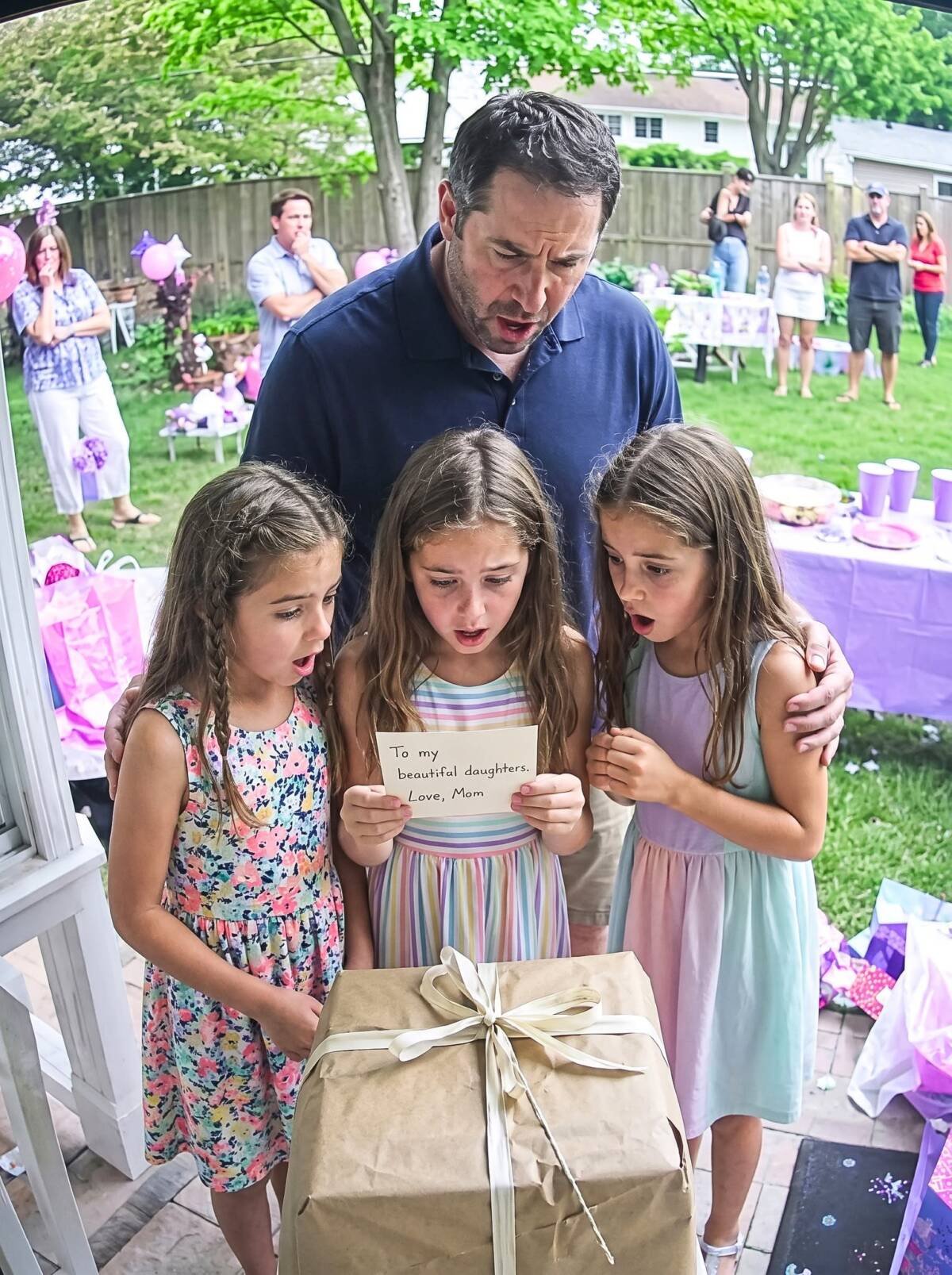
Inside, nestled in tissue paper, was a heavy glass cake stand. It was almost identical to the one Diane had shattered. Taped to the glass was a small, handwritten note from Mark.
I know I can’t go back in time, and I know I can’t undo what happened. But I want you to have this for your birthdays. I love you, Emma. I am so proud of the young woman you are becoming.
I watched Emma trace her fingers over the smooth edge of the glass.
“How do you feel about that?” I asked gently.
Emma shrugged, a small, genuine smile playing on her lips. “I think he’s really trying, Mom.”
It mattered. It mattered because Mark had finally stopped expecting a grand, sweeping gesture to erase years of damage. He was learning that trust isn’t rebuilt in a day; it is earned back through tiny, consistent choices repeated over a lifetime. Our marriage was permanently over, but I could finally see him becoming a safe harbor for our daughters.
Even Diane attempted a fragmented version of amends. After six months of total silence, she sent a letter to the house, addressed directly to Emma. In it, she admitted that her obsession with the Mercer name had blinded her, that she had been cruel, and that being a girl never made Emma less valuable. Emma read the letter twice, folded it up, and put it in her desk drawer. A few months later, she agreed to a supervised meeting at a local park. Diane brought no gifts and made no demands. She simply sat on a bench and apologized.
“I’m still mad at you,” Emma told her grandmother, her voice clear and strong.
“You have every right to be,” Diane replied softly.
It wasn’t a cinematic reconciliation. It was simply the first time Diane had ever allowed someone else to hold the power in a relationship, and it was enough for Emma to find closure.
On Emma’s eleventh birthday, we threw a party in our backyard. The Ohio humidity was thick, the string lights were glowing, and the air was filled with the sound of Rachel’s kids splashing in the inflatable pool. Mark attended for a few hours, keeping a respectful distance, chatting politely with my family before hugging the girls and heading home.
When it was time for cake, Lily proudly carried out a massive, slightly lopsided chocolate cake covered in an aggressive amount of bright pink frosting. It sat perfectly on the new glass cake stand Mark had bought.
I lit the eleven candles, the small flames flickering in the twilight. Emma closed her eyes, her face glowing in the warm light. She took a deep breath, and before she blew them out, she looked across the table at me, her eyes bright and completely free of shadows.
“Can I make two wishes this time, Mom?” she asked, a mischievous grin spreading across her face. “Since I kind of lost my last one?”
Rachel laughed from the patio chair. “I think that’s totally fair, Em.”
Nobody argued. Nobody told her she was asking for too much.
As I watched my daughter lean forward and blow out the candles to the sound of cheering family, I thought back to the dining room a year prior. I remembered the sickening crunch of glass under my shoes, the taste of copper in my mouth, and the profound, agonizing betrayal in my husband’s indifferent shrug. I remembered the smirk on Diane’s face as she waited for me to break.
“Okay.”
It was the smallest, simplest word in the English language. But in that moment, it hadn’t meant surrender. It hadn’t meant acceptance. It meant that the debate over my daughters’ inherent worth was permanently closed. It meant I was walking away from a table where love was conditional and respect was a commodity.
I hadn’t destroyed my family that day. I had saved it. I had stopped teaching my daughters that keeping a toxic system intact was more important than their own dignity. And as Emma sliced into her cake, surrounded by people who loved her exactly as she was, I knew that walking out that door was the most beautiful, expensive, and absolutely necessary choice I would ever make.
Have you ever experienced a breaking point where a single word changed everything? Let us know in the comments below, and share this story to remind everyone that walking away from toxicity isn’t just an option—sometimes, it’s the only way to save yourself!