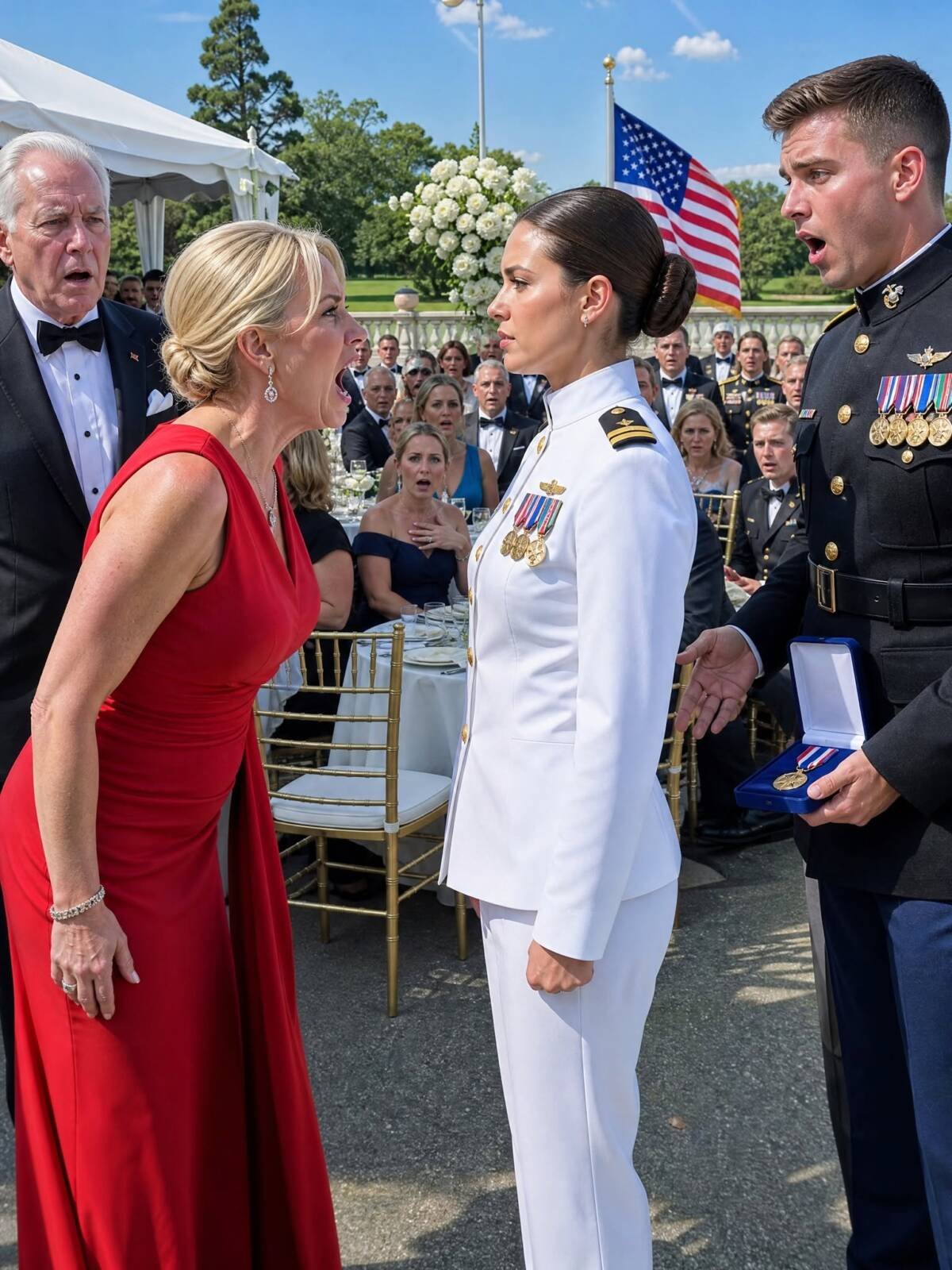
For months, Claire Morgan had been told the same thing: she was exhausted.
Every time she became dizzy at her in-laws’ house, her husband blamed stress. When she woke up confused after dinner, his explanation was always the same. She had not eaten enough. Her blood pressure had dropped. She was working too hard.
Claire wanted to believe him.
After all, she was a senior accountant in Topeka, Kansas, a woman who spent her days surrounded by spreadsheets, tax documents, deadlines, and carefully calculated numbers. She was accustomed to finding inconsistencies in financial records.
What she was not prepared for was discovering that the people sitting across the dinner table from her were hiding something far more dangerous.
It started with a bowl of broth.
Then came the strange disappearances of time, the unexplained condition of her clothing, and the uneasy feeling that someone was taking advantage of her while she was unconscious.
By the third incident, Claire stopped believing the explanations.
Instead, she began collecting evidence.
What she discovered would eventually lead investigators to a much larger property scheme involving forged documents, intimidation, financial manipulation, and multiple potential victims.
And the most painful part was not that strangers were involved.
It was that her own husband knew far more than he admitted.
PART 1: The First Saturday
My name is Claire Morgan.
I was twenty-eight years old, and until recently, I believed my life was predictable in the best possible way.
I worked as a senior accountant at a mid-sized auditing firm in Topeka. My days were built around numbers, deadlines, spreadsheets, tax files, and strong coffee. I liked knowing where things stood. I liked documentation. I liked being able to trace a problem back to its source.
My husband, Brian Peterson, was a civil engineer.
We had been married for three years.
From the outside, our marriage looked stable. We owned a comfortable home, both had professional careers, and we rarely argued in public.
Brian’s father, Frank Peterson, was a powerful and well-connected local official who had spent years building a reputation as an influential figure in the community.
His wife, Martha, was quieter. She was polished, organized, and known for preparing enormous family meals whenever relatives gathered.
From the beginning of our marriage, there was one tradition everyone treated as if it were a law.
The first Saturday of every month belonged to Brian’s parents.
No exceptions.
“Family is non-negotiable,” Frank would say whenever Brian suggested skipping dinner.
I never particularly enjoyed those evenings, but I went.
At first, I thought they were simply ordinary family dinners.
Then, in April, something strange happened.
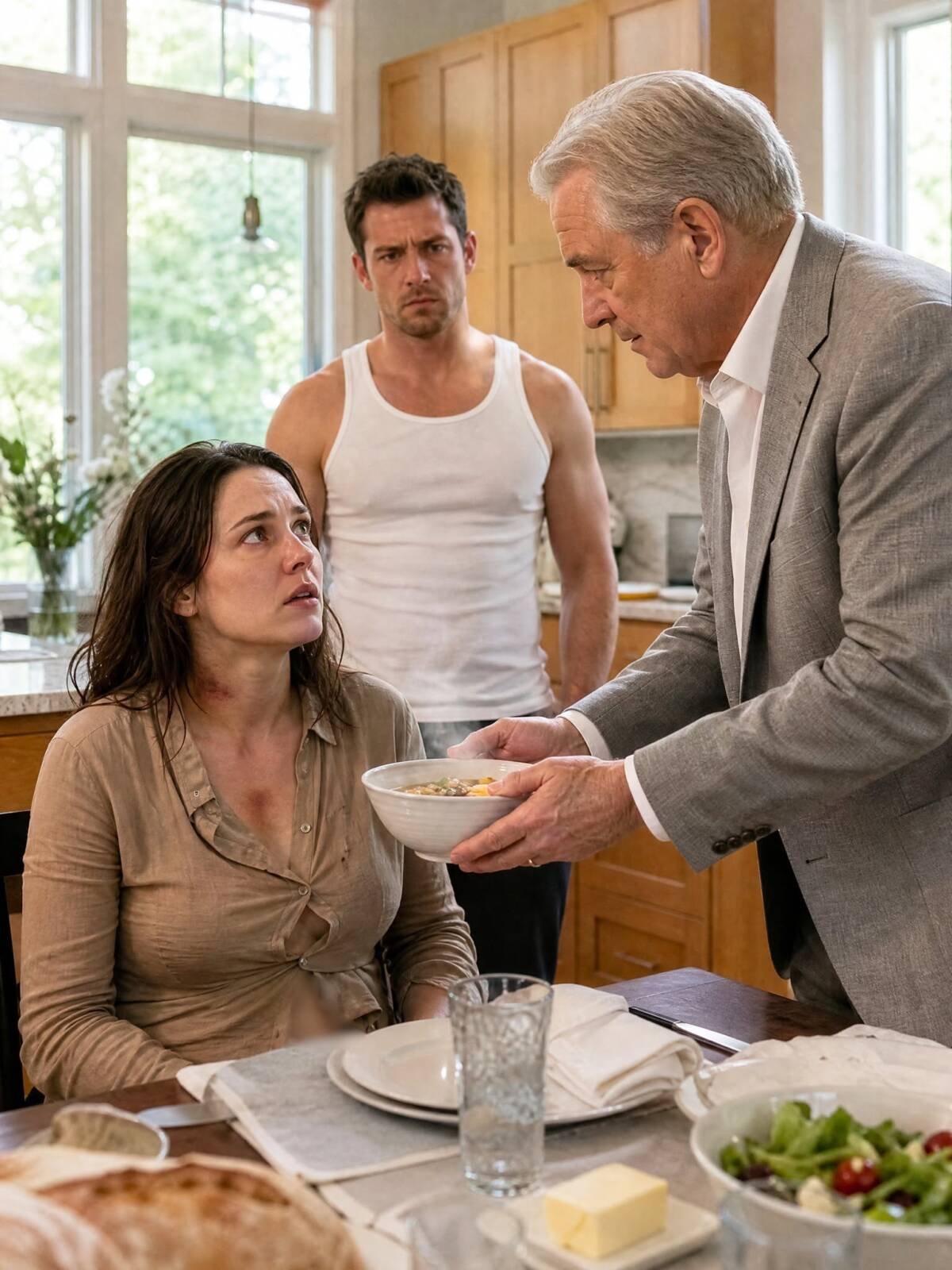
Martha served beef broth with vegetables, seasoned rice, and iced hibiscus tea. Frank personally carried a large bowl of broth to the table and placed it directly in front of me.
“Eat up, Claire,” he said with a smile. “You’ve looked pale lately. Women who work as hard as you do need strength.”
I thanked him.
I remember taking several spoonfuls.
I remember the taste.
Then everything began to blur.
The conversation around me became distant. The dining room seemed to move in slow motion. Brian’s voice sounded as if it were coming from somewhere far away.
I tried to stand.
My legs didn’t cooperate.
“Claire?”
Brian’s voice sounded worried.
Or at least I thought it did.
The next thing I remember was waking up in the guest room.
Nearly three hours had passed.
My mouth was painfully dry. My head was pounding. My clothes felt uncomfortable, and one of my blouse buttons was fastened incorrectly.
Brian was sitting beside the bed.
“What happened?” I asked.
He gave me the same reassuring smile he had used many times before.
“Your blood pressure dropped.”
“What?”
“You probably didn’t eat enough this morning. You’ve been working too hard.”
I looked at him.
Something about the explanation felt wrong.
But I had no evidence to challenge him.
So I accepted it.
At least for the moment.
The following month, it happened again.
This time, Frank offered me a glass of fruit punch.
Within minutes, I began feeling dizzy.
I remember telling Brian that something was wrong.
Then I lost consciousness.
When I woke up, I was confused again.
My hair was messy. My lipstick was smeared. My blouse was not sitting the way I remembered.
I immediately looked at Brian.
“Why is my blouse buttoned like this?”
He barely looked up.
“You probably moved around in your sleep.”
“I don’t move like that.”
“Claire, you’re exhausted.”
He said it so casually that I almost felt embarrassed for questioning him.
But something had changed.
I was no longer simply tired.
I was suspicious.
By June, I had decided I would not accept another explanation without evidence.
Before we left for the next family dinner, I stood in front of our bedroom mirror and took a photograph of myself.
My white blouse was clean.
Every button was aligned.
My watch was positioned correctly.
My hair was tied back.
I even made a tiny hidden mark beneath the strap of my camisole.
It was nothing anyone would notice.
I simply wanted to know whether someone had touched my clothing while I was unconscious.
At dinner that evening, Frank served the broth again.
I lifted the spoon.
The smell seemed different.
There was something bitter and metallic underneath the rich flavor.
I pretended to take several sips.
Then I pushed the bowl away.
“I don’t feel well,” I said.
Frank immediately looked at Brian.
Brian stood.
“I’ll take her upstairs.”
I allowed him to help me to the guest room.
He laid me on the bed.
Then he left.
I closed my eyes.
I pretended to be unconscious.
My heart was beating so hard I was afraid they could hear it.
Minutes passed.
Then I heard footsteps.
The door opened.
Brian entered.
I recognized his cologne before I heard his voice.
He stood beside the bed.
There was a click.
Then another.
A camera.
He was taking photographs of me.
I stayed completely still.
Click.
Another photograph.
Then Frank entered.
His voice was low.
“Now it looks convincing enough for the documents.”
My entire body went cold.
Documents?
What documents?
I wanted to open my eyes, but I forced myself to remain still.
The two men spoke quietly for several minutes.
I couldn’t hear everything.
But I heard enough to know that the situation was not what Brian had told me.
Later that night, after we returned home, I checked my phone.
I discovered that an audio recording had accidentally been activated when I dropped my purse near the guest-room bed.
I listened.
At approximately seven seconds into the recording, a man’s voice became clear.
“This time, add more of the sedative. She’s getting suspicious.”
I replayed it.
Then I replayed it again.
There was no misunderstanding.
Someone had been drugging me.
And my husband knew.
I didn’t sleep that night.
By morning, I had made a decision.
I would not confront them yet.
I would collect evidence first.
I bought a small pen recorder and placed it inside my purse.
I also purchased a tiny camera disguised as a wall charger.
I told no one except my closest friend, Kelly.
I explained what had happened and asked her to help me create an emergency system.
If I failed to respond to her check-in after our next family dinner, she would receive my location and whatever evidence my devices had captured.
I hoped I would never need it.
I was wrong.
The Dinner That Changed Everything
When we arrived at my in-laws’ house the following month, I immediately noticed something different.
There were two unfamiliar pairs of men’s shoes near the front door.
Martha saw me looking at them.
“We have a few guests joining us tonight,” she said.
Her voice sounded unusually tense.
Frank introduced the men as Roger and Victor.
Victor barely spoke.
Instead, he looked at me for several seconds longer than necessary.
Every instinct in my body told me not to trust him.
I sat at the dining table.
Frank raised his glass.
“To family,” he said.
Everyone lifted their glasses.
“And to important agreements that will benefit everyone’s future.”
I smiled.
I pretended to drink.
I pretended to eat.
And when I felt the familiar dizziness begin, I allowed my head to fall forward.
I pretended to collapse.
Brian immediately moved toward me.
“Claire?”
He helped me from the dining room.
This time, however, I knew exactly what I was doing.
He carried me to the guest room.
The door closed.
Then I heard a lock click from the outside.
My heart stopped.
They had locked me in.
A few seconds later, heavy footsteps approached.
Victor spoke first.
“Is she finally out?”
Frank answered.
“She won’t wake up easily tonight. We have work to do.”
I remained perfectly still.
Then the bedroom door opened.
PART 2: The Truth Behind the Locked Door
The room became silent.
I kept my eyes closed beneath the blanket.
I could identify each person by the sounds around me.
Brian’s cologne.
Frank’s cigar smoke.
Victor’s heavy breathing.
Frank spoke quietly.
“Did you turn off her phone?”
Brian answered immediately.
“Yes. It’s in her bag in the hallway.”
Hearing him say it so calmly made my stomach turn.
There was no hesitation.
No concern.
No uncertainty.
He knew exactly what they were doing.
Victor spoke next.
“Your wife is smarter than the others. She’s been asking too many questions.”
The others.
That phrase stayed in my mind.
The others.
I suddenly understood that whatever was happening to me might not have started with me.
Frank sounded impatient.
“Stop wasting time. We need her signature on the land-transfer documents before Monday.”
Land-transfer documents.
That was when the pieces began to come together.
My parents had inherited two valuable parcels of land near the edge of the city.
The properties had increased substantially in value because of development plans in the surrounding area.
I had advised my parents not to sign anything without having independent attorneys review the deeds, appraisals, zoning records, and proposed contracts.
Frank had asked several questions about those properties.
I had refused to give him information.
At the time, I thought he was simply being curious.
Now I understood.
I had become an obstacle.
Frank continued speaking.
“We don’t have time to keep playing games.”
Victor laughed quietly.
“Then make her sign.”
A rough hand moved toward my neck.
Someone was checking whether I was actually unconscious.
I knew that if I waited any longer, I might not get another opportunity.
I opened my eyes.
And kicked.
Hard.
Victor stumbled backward and crashed into a heavy chair.
“Damn it!”
I jumped from the bed.
Brian grabbed my arm.
“Claire, please!”
“Don’t touch me!”
I screamed and pulled away.
“What are you doing?”
Brian looked terrified.
Not because I was hurt.
Because the plan had failed.
Frank stepped forward.
“Don’t make a scene.”
“You drugged me!”
He waved his hand dismissively.
“We only need your signature.”
I stared at him.
“Why?”
“Because this can be made very easy for everyone.”
He reached into a folder.
Inside were documents I had never seen before.
“Sign them,” he said, “and we’ll compensate you generously.”
I stared at him.
“How generously?”
“Two million dollars.”
For several seconds, nobody spoke.
Then I looked at Brian.
“And you?”
He lowered his eyes.
“How much were you supposed to get?”
Brian didn’t answer.
He didn’t have to.
His silence told me everything.
Frank stepped closer.
“If this gets out, you will ruin your husband, your family, and yourself.”
I shook my head.
“You’ve been drugging me.”
“We have not harmed you.”
“You made me unconscious.”
“You are making this more dramatic than it needs to be.”
I couldn’t believe what I was hearing.
Then Frank said the sentence that made the entire situation even clearer.
“Nobody is going to believe a hysterical woman over a respected public official.”
Before I could respond, a faint electronic beep came from the corner of the room.
Frank stopped.
He looked toward the wall charger.
His expression changed.
He walked over.
He pulled the device from the outlet.
“What is this?”
I said nothing.
He examined it.
Then he smashed it against the floor.
“What did you record?”
Still, I said nothing.
Because I knew something he didn’t.
The camera had already connected to the cloud.
The evidence was no longer inside that device.
And my emergency system had already been activated.
If I failed to respond to Kelly’s check-in, the information would be transmitted automatically.
Frank grabbed my wrist.
“Where’s the backup?”
His grip tightened.
I pulled away.
Then someone knocked on the front door.
Hard.
Three times.
Everyone froze.
A voice came from downstairs.
“Police. Open the door.”
Victor immediately looked toward the patio.
Brian stood completely still.
Martha appeared in the hallway.
Tears were already forming in her eyes.
Frank tried to regain control.
“This is a private residence,” he called out. “You cannot simply enter.”
The response came immediately.
“We have a warrant.”
Frank’s face changed.
The police entered the house.
Officers separated everyone and began searching the property.
I stood against the wall, shaking.
For the first time that night, I felt like I could breathe.
The search quickly produced evidence.
In Frank’s upstairs study, investigators found a laptop, multiple USB drives, property records, financial documents, and files connected to land transfers.
Some of the names were unfamiliar to me.
Others were names I recognized from the community.
People who had sold property.
People who had supposedly signed agreements.
People whose signatures appeared on documents that, according to investigators, required further examination.
An officer eventually asked me to come to the station and provide a formal statement.
As I walked through the hallway, Brian approached me.
“Claire.”
I stopped.
“Please.”
I looked at him.
“Don’t destroy everything.”
I stared at him in disbelief.
“You destroyed everything the moment you locked that door behind me.”
Then I walked away.
PART 3: The Cost of Looking Away
I spent most of that night at the police station.
I gave investigators everything I had.
The photographs.
The audio recording.
The hidden-camera footage.
The messages.
The timeline of every dinner.
The symptoms I experienced.
The changes in my clothing.
The conversations I remembered.
The names of everyone who had been present.
For the first time, I realized how important it had been to document every detail.
I had spent years working with financial records.
I knew that patterns mattered.
One strange transaction could be an accident.
Ten strange transactions were a pattern.
And the same principle applied here.
The following morning, I returned home exhausted.
I thought the worst part was over.
It wasn’t.
At 1:42 a.m., my phone received an encrypted message from an unknown number.
The message contained only one sentence.
“Do not trust Martha. She has more evidence than anyone, but she is more afraid than you realize.”
I stared at the screen.
Then I read it again.
Martha.
The quiet woman who had served the meals.
The woman who had watched me become unconscious.
The woman who had remained silent.
What did she know?
By that afternoon, the investigation had become public.
Local news organizations began reporting on a property-related investigation involving a prominent public official.
As more information emerged, my name began circulating online.
Some people expressed support.
Others speculated.
Some questioned why I had continued attending family dinners after the first incident.
I ignored all of it.
They weren’t there.
They didn’t know what I knew.
They didn’t know how difficult it was to believe that the people closest to you could deliberately put you in danger.
Then Brian called.
“My father is going to take responsibility for everything,” he said.
I said nothing.
“He’s telling investigators that I didn’t know what was happening.”
I finally asked him a question.
“Did you know?”
There was silence.
A long silence.
“I never wanted to hurt you,” he eventually said.
“You locked me in that room.”
“I thought they only wanted to pressure you into signing documents.”
I closed my eyes.
“You thought?”
Brian didn’t answer.
“You knew I was afraid,” I continued. “You knew something was wrong. You knew I was being drugged. And you still helped them.”
“I didn’t think it would go this far.”
That sentence stayed with me.
Because that was how people justified terrible decisions.
They didn’t always say they wanted the worst possible outcome.
Sometimes they simply convinced themselves that the next step wasn’t their responsibility.
I ended the call.
Later that day, another anonymous video arrived.
It showed Brian arguing with Victor outside a warehouse.
Brian was demanding that Victor leave town once the investigation ended.
Victor laughed.
“Now you want to act like the good guy?”
Brian appeared angry.
Victor continued.
“Tell me again how much money you collected from every piece of land we took.”
The video ended.
Then came a sentence that changed the investigation.
“Claire wasn’t the first.”
I watched the video several times.
I knew immediately that investigators needed it.
I sent them a copy.
Within days, authorities began identifying additional potential victims.
The investigation expanded.
What had initially appeared to be an isolated dispute over property began looking like part of a much larger operation.
According to investigators, Frank had allegedly used a combination of financial pressure, intimidation, questionable documentation, and personal relationships to target property owners.
Some people had been pressured into signing agreements.
Others appeared to have sold property under circumstances investigators wanted to examine more closely.....