After six years of marriage, Leah Sutton was ordered out of her husband’s luxurious Seattle estate with barely a chance to defend herself. Her mother-in-law believed she was leaving with nothing. But hidden inside a safe was a folder containing the documents that could unravel the Rhodes family’s carefully protected empire.
An emotional story of betrayal, hidden ownership, corporate secrets, and a woman who discovers that walking away can be the first step toward reclaiming everything she has lost.
INTRODUCTION: THE DIVORCE THAT WAS SUPPOSED TO END EVERYTHING
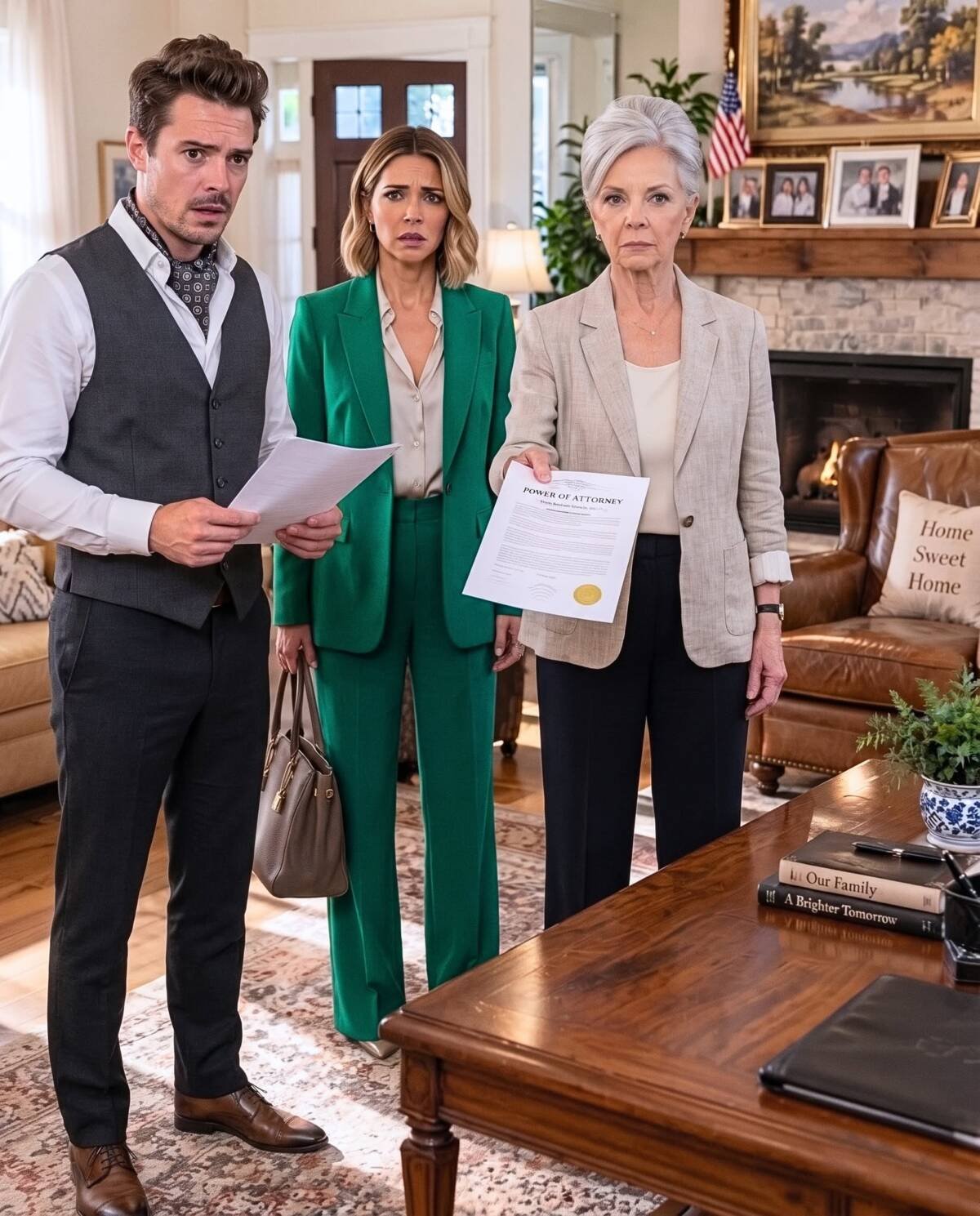
The divorce papers had barely been signed when my mother-in-law gave me 24 hours to leave the house.
She stood in the middle of the grand living room, holding a porcelain teacup as though she were presiding over an ordinary family meeting rather than ordering a woman out of her own home.
“Take your clothes, your personal belongings, and anything that belongs exclusively to you,” Eleanor Rhodes said. “Everything connected to Vanguard Architects stays here. I will not have you walking away with company property.”
Her son, Julian, sat beside her.
He was my husband—or, more accurately, he had been my husband until a few minutes earlier.
He did not look at me.
His younger sister, Mila, sat on the velvet sofa, scrolling through her phone. When she finally raised her eyes, she smiled with the satisfaction of someone who believed the most difficult part of her life had just been taken care of.
“Good luck starting over, Leah,” she said. “Something tells me the real world is going to be a lot harder than living here.”
I looked at Julian, waiting for him to say something. Anything.
He adjusted his cuff and muttered, “Let’s not make this more difficult than it needs to be.”
For nearly six years, I had designed buildings, developed projects, and helped establish the reputation of the architectural firm he now led as CEO. I had worked through sleepless nights, watched my ideas appear in presentations without my name, and trusted him when he insisted that our financial arrangements were designed to protect our future.
Now, with our marriage officially over, his family was treating me like an unwanted guest.
Eleanor mistook my silence for defeat.
She had no idea that I already knew something about the company she was so desperate to protect.
Something hidden in a safe behind the bookshelf in my third-floor office.
Something that could change the future of Vanguard Architects—and expose a history the Rhodes family had spent years trying to conceal.
I picked up my handbag, stood, and looked directly at Eleanor.
“I understand.”
Then I added one final sentence.
“And Eleanor? That is the last time I will ever call you Mom.”
Her expression hardened.
I walked upstairs without another word, opened the concealed safe, and removed a thick manila folder tied with red string.
Inside were original ownership agreements, financial records, copyright documents, and evidence that contradicted the story the Rhodes family had told for years.
I packed the folder, an encrypted hard drive, and a photograph of my late grandmother into my suitcase.
Then I called for a private car.
When a black luxury sedan arrived at the estate, Eleanor laughed.
“Showing off now?” she called from the doorway. “Do you think a fancy car is going to make you someone important?”
I paused beneath the umbrella the driver had opened for me.
“No,” I replied calmly. “But by tomorrow, you’ll understand exactly why I needed it.”
I got into the car and watched the estate disappear behind us.
For the first time in six years, I was leaving the Rhodes family without asking permission.
And the next morning, the documents in my suitcase would force them to confront a truth they had spent years pretending did not exist.
PART 1: A HOUSE THAT NEVER FELT LIKE HOME
Autumn in Seattle had always brought cold rain, sharp winds, and a grayness that seemed to settle over everything. That afternoon, Lake Washington stretched beneath a heavy sky, and the last traces of a storm clung to the enormous windows of the Rhodes estate.
Inside, however, nothing appeared out of place.
The marble floors gleamed. Fresh flowers stood in crystal vases. A fire burned in the living room, and a housekeeper moved quietly through the hallways.
Everything was polished, expensive, and perfectly controlled.
Everything except my life.
My name is Leah Sutton. I was thirty-six years old, a lead architect, and a woman who had spent much of her adult life believing that hard work and loyalty would eventually earn her a permanent place in the world she helped build.
I had been wrong about the loyalty part.
Across from me sat Julian Rhodes, the celebrated CEO of Vanguard Architects. His family had built a reputation around ambitious developments, prestigious clients, and a succession of projects that had transformed their company into one of Seattle’s most recognizable architectural firms.
Julian had the title, the office, and the public recognition.
I had spent years helping make those things possible.
When we first met, he had admired my independence. He liked that I could challenge a design, defend a structural decision, and spend hours working through a complicated project without losing sight of the bigger picture.
He used to tell me that I was the best architect he had ever met.
After we married, those compliments gradually disappeared.
My contributions became part of the company’s collective achievements. My designs were presented under Julian’s leadership. My name was omitted from project summaries, and the explanations were always the same.
It was better for the company.
It was better for our future.
It was easier that way.
I believed him because I loved him.
I also believed him when he said that putting certain bonuses into shared financial arrangements would protect our household. When he suggested that some of my professional compensation should be managed through company-related structures, I trusted his judgment.
I never imagined that the same arrangements might later make it difficult to establish what belonged to me.
That afternoon, however, none of those details seemed to matter to Eleanor Rhodes.
She had already decided that the divorce meant the end of my place in her family.
“The papers are signed,” she announced, placing her teacup on its saucer. “From this moment forward, you are no longer a member of this family.”
She looked toward the staircase.
“I expect you to collect your belongings and leave tonight.”
I stared at her.
“You are giving me 24 hours?”
“Consider yourself fortunate that I am being reasonable.”
Mila finally put down her phone.
“I suppose we should start calling you Miss Sutton again.”
She smiled at her own remark.
“It’s probably for the best. You and Julian were never really suited to each other.”
I turned toward Julian.
He sat forward, staring at the marble floor.
“Do you have anything to say?”
His jaw tightened.
“Leah, Mom is establishing boundaries. Let’s not turn this into another argument.”
Boundaries.
That was the word he chose while his mother ordered me out of a house I had helped redesign and warned me not to take anything connected to the business I had helped build.
I looked at him for several seconds.
“Is that what you think this is?”
He finally met my eyes.
“I think we both need to move on.”
I had imagined the end of our marriage differently. Even during the worst months, I had thought there might be an honest conversation, an acknowledgment of what we had shared, or at least a moment when the man I married would remember who I was.
Instead, Julian seemed determined to make the separation as comfortable as possible for himself.
Eleanor leaned forward.
“This family gave you opportunities you never would have had otherwise. You should be grateful for what you received.”
I nearly laughed.
My grandmother had helped teach me to draw before I was old enough to understand architecture. I had earned scholarships, worked through demanding university programs, and built my career project by project.
I had not arrived at Vanguard as a favor.
I had arrived with talent, experience, and ideas.
Yet Eleanor had spent years telling the story as though the Rhodes family had rescued me from obscurity.
Mila added that people who arrived with nothing often became interested in taking things when they left.
Julian quietly told her to stop.
It was not a defense of me. He simply disliked hearing the accusation spoken so openly.
I collected my copy of the divorce papers and placed it inside my handbag.
“I understand.”
Eleanor relaxed, convinced she had won.
She did not know that my grandmother had taught me something more valuable than how to design a building.
She had taught me to keep records.
PART 2: THE SAFE BEHIND THE BOOKSHELF
I walked upstairs to my third-floor office and closed the door.
For a moment, I stood beside my drafting table, looking at the drawings pinned to the walls. Some belonged to projects that had never been built. Others represented years of work, revised plans, late-night calculations, and ideas that had gradually evolved into something meaningful.
The room was one of the few places in the estate where I had felt completely myself.
Even here, I had learned to be careful.
I crossed to the large oak bookshelf and moved several books aside. Behind the shelves was a concealed compartment that opened to reveal a biometric safe.
The Rhodes family had never discovered it.
Inside were three things I considered irreplaceable: an encrypted hard drive, a photograph of my grandmother, Rose Sutton, and a thick manila folder secured with red string.
There were no diamonds, bundles of cash, or expensive jewelry.
The contents were far more valuable.
The folder held original incorporation records connected to Vanguard Architects, correspondence concerning an early investment, copyright registrations for several architectural concepts, and financial statements that did not match the company’s later account of its ownership history.
Some documents were decades old.
Others were recent enough to reveal how the past had been altered.
I had not collected them because I wanted to destroy Vanguard. In fact, I had spent years hoping I would never need to use them.
I had kept them because certain details had never made sense.
My grandmother had been a quiet but successful investor. She had supported several businesses over the course of her life, and she believed that generosity should never require a person to surrender the ability to protect herself.
Before she died, she had given me the folder and told me to keep it somewhere safe.
“If you ever need to understand what happened,” she had said, “start with the original documents. Not the copies someone wants you to see.”
At the time, I thought she was simply being cautious.
Now I understood.
A knock interrupted my thoughts.
“Leah! Open the door!”
Mila’s voice echoed through the hallway.
I locked the safe, placed the folder and hard drive in my suitcase, and opened the door.
Mila stood outside with her arms crossed.
“What took you so long? Mom wants to make sure you’re not taking company documents.”
I looked at her.
“I’m packing my belongings.”
“Then why did you lock the door?”
“Because it is my office.”
She seemed irritated by the answer.
“Can you stop being so difficult for once?”
I pulled the suitcase into the hallway.
“I’m not being difficult, Mila. I’m leaving.”
Her gaze shifted toward the suitcase.
“What’s in there?”
“My belongings.”
“Open it.”
I studied her for a moment, then unzipped it.
Inside were a few professional outfits, my laptop, my passport, the photograph of my grandmother, the encrypted drive, and the red-string folder.
Mila looked unimpressed.
“That’s it?”
“That’s it.”
She glanced at the folder.
“Those are company documents.”
“No. These belong to me.”
“You can’t just take whatever you want.”
“And you can’t simply declare that my property belongs to Vanguard.”
She reached for the folder.
I moved it away.
“Mila.”
She stopped.
For the first time, she seemed to notice that I was no longer speaking to her as a sister-in-law who hoped to be accepted.
I was speaking to her as someone who understood that the relationship was over.
Eleanor appeared at the top of the stairs.
“What is going on?”
“She’s taking papers,” Mila replied.
Eleanor descended slowly, looking into the open suitcase.
When she saw the folder, she laughed.
“Is this what you’ve been hiding upstairs? A collection of old paperwork?”
She shook her head.
“Take it, Leah. I doubt those papers are worth anything.”
I closed the suitcase.
“You’re half right.”
Eleanor raised an eyebrow.
“I am taking my memories with me. They just happen to be very well documented.”
Julian appeared in the hallway.
“Leah, please. Does this really have to become so hostile?”
I looked at him.
“From now on, Miss Sutton would be more appropriate.”
He flinched at the formality.
“We wouldn’t want anyone getting the wrong idea about how close we still are.”
For a moment, he looked as though he wanted to say something meaningful.
Instead, he stepped aside.
I carried my suitcase downstairs.
The foyer was enormous, with a sweeping staircase and windows overlooking the wet driveway. I had helped select materials for its renovation years earlier, carefully balancing the proportions of the entrance with the rest of the house.
I remembered standing there with Julian, discussing the project while we imagined what our future might look like.
Now, the same house seemed determined to erase me.
Eleanor waited near the front door.
“Once you leave, do not imagine you can return here asking us for help.”
I placed my hand on the suitcase handle.
“I won’t.”
“Good.”
She smiled.
“Because you will discover that life without the Rhodes family is much harder than you think.”
I opened the door.
“You’ll understand tomorrow.”
Then I stepped into the rain.
PART 3: THE LUXURY CAR THAT CHANGED EVERYTHING
A black sedan waited in the driveway.
Its paint reflected the gray afternoon, and its driver stood beside the rear door beneath a black umbrella. The car was understated rather than extravagant, but it was clearly a luxury vehicle.
The driver approached me.
“Miss Sutton? Mr. Arthur Vance asked me to bring you to his office.”
I nodded.
“Thank you.”
Behind me, the front door remained open.
Mila had followed me onto the steps.
“Arthur Vance sent a car for you?”
Her surprise was obvious.
Arthur was a respected investor, a former university professor, and one of Vanguard Architects’ minority stakeholders. He was also one of the few people Eleanor treated with genuine caution.
Eleanor appeared behind Mila.
“So this is your grand exit?”
She glanced at the sedan.
“A luxury car? Really, Leah? Who are you trying to impress?”
I did not answer immediately.
For years, I had believed that I needed to explain myself to the Rhodes family. I had defended my decisions, softened my opinions, and carefully chosen my words to avoid creating conflict.
I no longer felt the need.
“I’m not trying to impress anyone.”
“Then what is all this about?”
I looked at her.
“You’ll understand tomorrow.”
I stepped into the car, and the driver closed the door.
As we pulled away, I saw Eleanor standing in the doorway with an expression that suggested she had just watched someone make a foolish mistake.
She was wrong.
But I could not yet know how much the coming days would change my life.
My hands trembled as the estate disappeared behind us.
Not because I wanted to return.
They trembled because I had finally stopped pretending that staying would make everything better.
Arthur’s office overlooked Elliott Bay. When I arrived, he was waiting in a private conference room with Margaret Shaw, a corporate attorney who specialized in ownership disputes, intellectual property, and complex business agreements.
Arthur stood as I entered.
“Leah. I’m glad you came.”
I placed my suitcase beside the table.
“I assume you know why I called.”
He nodded toward the red-string folder.
“I believe I do.”
Margaret introduced herself and asked me to explain the documents I had brought. I described my grandmother’s investment in Vanguard, the questions I had raised about the company’s ownership records, and the discrepancies I had discovered in the licensing agreements connected to my work.
Then I opened the folder.
Arthur’s expression changed as he saw the original documents.
“Your grandmother always hoped you would never need that.”
I sat down.
“What exactly did she leave me?”
Margaret began examining the paperwork.
“The answer depends on what the original agreement says, whether the conversion conditions were satisfied, and how the rights were handled after her death.”
She paused over a document dated nearly fifteen years earlier.
“This could be significant.”
PART 4: THE INVESTMENT THE RHODES FAMILY DENIED
Margaret explained that Vanguard Architects had once been a struggling design studio.
Before the company became successful, Charles Rhodes, Julian’s late father, had sought outside investment to support expansion. My grandmother, Rose Sutton, had invested $750,000 under a convertible ownership agreement.
The arrangement was not a simple loan.
It contained conditions under which the investment would convert into an equity interest if Vanguard reached specified revenue and expansion thresholds.
I stared at the page.
“Eleanor told me that Nana’s money had been repaid years ago.”
Arthur shook his head.
“Your grandmother didn’t lend the Rhodes family money, Leah. She bought a piece of what they were building.”
Margaret explained that the agreement appeared to establish contractual rights that could have converted into company equity once the specified conditions were met. Those conditions seemed to have been satisfied years earlier, but the records did not show that the resulting interest had been properly recognized.
After my grandmother’s death, her rights had passed into a trust for which I was the beneficiary.
That did not automatically make me the owner of a particular percentage of Vanguard. The trust’s rights, the conversion terms, and the company’s subsequent actions would need to be verified.
But it meant the Rhodes family might have obligations it had never acknowledged.
“Why wasn’t I told?” I asked.
Arthur looked at me carefully.
“Because the people responsible for administering the agreement may not have wanted to revisit it.”
Margaret continued examining the records.
Then she found an email from Charles to my grandmother.
It was short, direct, and difficult to misunderstand.
“Rose, once the conversion threshold is reached, your interest will be recognized exactly as agreed.”
I read the sentence twice.
For years, Eleanor had portrayed Nana as a generous woman who had helped the Rhodes family out of kindness. She had never mentioned an ownership agreement, a conversion mechanism, or any obligation to recognize my grandmother’s investment.
Now there was a written acknowledgment from the company’s original founder.
Arthur leaned back.
“This is why the original records matter.”
Margaret cautioned that the documents would require independent verification and a thorough review of the company’s accounting records. If the trust had an enforceable claim, it would still need to be established through the appropriate legal process.
Then she opened another file.
It concerned a project called Riverbend Commons.
My breath caught.
I had designed the original concept before marrying Julian. The project had been one of the most important milestones in my career, combining residential buildings, public spaces, and commercial areas into a carefully integrated development.
I had registered the copyright under my own name.
Later, I granted Vanguard a limited license to develop the project.
The agreement allowed the company to use the design under specified conditions while preserving certain authorship and compensation rights.
But the version currently held in Vanguard’s records was different.
It contained a permanent assignment of those rights to the company.
At the bottom was my signature.
I leaned closer.
“That isn’t my signature.”
Margaret studied the document.
“We need to establish exactly how this version was created and whether it was ever validly executed.”
Arthur opened the encrypted hard drive on an isolated computer.
Among the archived records were earlier versions of the agreement, email correspondence, and metadata showing when different files had been created or modified.
The evidence suggested that the permanent assignment had been created on a Vanguard legal department computer almost three weeks after the date printed beside my supposed signature.
That discrepancy did not, by itself, establish who had altered the document or prove every element of a legal claim. But it raised serious questions that could no longer be ignored.
I sat back in my chair.
For years, I had wondered why the company seemed to possess rights that I remembered granting only under limited terms.
Now I had a possible explanation.
Someone had taken an agreement that protected my ownership and replaced it with a document that appeared to transfer those rights permanently.
I looked at Margaret.
“What happens now?”
“We preserve the evidence, verify the records, and determine the appropriate claims. We do not make assumptions before the investigation is complete.”
Arthur nodded.
“And we make sure the board understands that this cannot be ignored.”
I looked down at my grandmother’s photograph.
Nana Rose had always believed that the truth eventually revealed itself, but she had never suggested that the process would be easy.
For the first time, I understood why she had insisted that I keep the originals.
The documents were not a weapon.
They were a record of what had happened.
And that record was about to become impossible for the Rhodes family to dismiss.
PART 5: THE EMERGENCY BOARD MEETING
The following morning, Arthur arranged an emergency meeting of Vanguard’s board of directors.
Eleanor arrived expecting to discuss a pending acquisition. Mila carried a presentation packet and appeared confident that she was on the verge of securing a larger strategic role within the company.
Julian entered a few minutes later.
When I walked in behind Arthur and Margaret, Mila immediately frowned.
“Why is she here? She doesn’t work for us anymore.”
Arthur placed the red-string folder on the conference table.
“That is exactly what we are here to determine.”
Eleanor’s expression hardened.
“This is a private company matter. Leah’s divorce has nothing to do with Vanguard.”
Margaret took her seat.
“Then the ownership records should be straightforward to explain.”
The board members exchanged glances.
The meeting began with a presentation of the original investment agreement and the available financial records. An independent forensic accountant had reviewed the preliminary documentation and identified a series of questions concerning the conversion of my grandmother’s investment, the recognition of the trust’s rights, and the treatment of related distributions.
The preliminary estimate suggested that the trust might have an economic claim equivalent to somewhere between 18 and 22 percent of Vanguard, depending on how the agreement was interpreted and how the missing records were resolved.
It was not a final ownership determination.
But it was more than enough to make the directors pay attention.
Julian stared at the documents.
Eleanor remained composed.
“That agreement was canceled years ago.”
Margaret slid a second document across the table.
“We found the cancellation record.”
Eleanor nodded, apparently relieved.
Then Margaret pointed to the notarization date.
“Perhaps you can explain why this document was notarized three days after Rose Sutton had already died.”
The room went silent.
Eleanor looked down at the page.
For the first time since I had known her, she seemed unable to find an immediate response.
Mila shifted in her chair.
Julian looked at his mother.
“What is this?”
Eleanor recovered enough to insist that the document might have been prepared earlier and notarized later. Margaret agreed that the circumstances required further investigation, but the timing raised serious questions about the document’s validity.
The board requested a full review.
Then Margaret turned to my intellectual-property records.
She showed the directors the original Riverbend Commons license, the later assignment, and the digital records indicating that the documents had been created at different times.
One board member asked whether the company had ever independently verified the assignment.
The legal department could not provide a clear answer.
Another asked why my authorship had been omitted from several project histories.
That question received no immediate response either.
I sat quietly while the people who had spent years dismissing my contributions examined the evidence.
I had once imagined that vindication would feel triumphant.
Instead, I felt exhausted.
Every document confirmed another piece of a reality I had spent years trying not to see.
My work had been used.
My grandmother’s investment might have been mishandled.
And the people who had benefited from both had expected me to leave without asking questions.
By the end of the meeting, the board authorized an independent investigation and ordered the preservation of relevant corporate records. Eleanor’s executive authority was temporarily suspended while investigators examined the ownership issues and related transactions.
Mila’s proposed promotion was placed on hold.
Julian remained silent.
For the first time, the Rhodes family had no choice but to confront the possibility that its carefully maintained version of Vanguard’s history was incomplete.
But the most troubling discovery had not yet surfaced.
PART 6: THE COMPANY BUILT ON MY WORK
The investigation expanded over the following days.
The forensic accountant reviewed company payments, licensing agreements, project records, and distributions connected to my grandmother’s trust.
Margaret also examined the original design files stored on my encrypted hard drive.
The records included dated CAD files, early sketches, project revisions, client correspondence, meeting notes, and presentation drafts.
They revealed a pattern.
Several of Vanguard’s most celebrated recent projects had been publicly associated with Julian’s creative leadership. Yet the earliest design concepts and development records showed that substantial portions of the work had originated with me.
In some cases, my contributions had been acknowledged internally but omitted from public presentations.
In others, the records raised questions about whether the company had properly documented its rights to use the designs.
Julian finally spoke.
“I never told anyone to remove your name.”
I looked at him.
“When my name disappeared from my work, did you ever ask where it went?”
He opened his mouth but said nothing.
I continued.
“You saw the presentations. You attended the meetings. You accepted the praise. You watched me work nights and weekends, and you never once asked why the company kept taking my name off the projects.”
He lowered his eyes.
“That’s not the same as forging a document.”
“No,” I said. “It isn’t.”
I paused.
“But benefiting from something and refusing to question it doesn’t make you innocent of every consequence.”
The room became quiet.
Mila leaned forward.
“This is ridiculous. You worked for Vanguard. Anything you designed here belonged to Vanguard.”
Margaret turned toward her.
“Anything?”
Mila hesitated.
“Yes. Mom always made sure everything Leah designed belonged to the company.”
The words hung in the air.
Margaret folded her hands.
“Always?”
Mila realized too late that she had made a sweeping claim about a process that was now under investigation.
She tried to explain that she had been referring to the company’s usual practices, but the statement only highlighted the need to examine how those practices had been applied.
Arthur requested a broader audit.
Two outside directors supported him.
The investigators then discovered repeated payments from Vanguard to an entity called Rhodes Legacy Holdings LLC.
The company had received substantial sums over several years through consulting fees, licensing payments, and project-development charges.
It was not owned by Vanguard.
It was controlled by Eleanor and Mila.
The payments were not automatically evidence of wrongdoing; related-party transactions can be legitimate when properly authorized and disclosed. But the records raised serious questions about whether these transactions had been adequately documented, independently reviewed, and approved.
More importantly, some of the revenue connected to the payments came from Riverbend Commons and other projects whose designs had originated with me.
Julian stared at the ownership records.
“You told me those payments were project reserves.”
Eleanor’s expression hardened.
“Everything I did was to protect this family.”
I looked at her.
“No. Everything you did was to make sure the family meant you.”
For once, Julian turned toward his mother.
“You moved company money into a private entity and never explained it to me?”
Eleanor replied that he had benefited from the company’s growth whether he understood the financial arrangements or not.
She reminded him that Vanguard had protected his career, his home, and the Rhodes name.
That answer did not help her.
It suggested that she viewed the company’s success and the family’s interests as interchangeable, even when the financial records demanded a more careful distinction.
The board ordered a detailed review of the payments and temporarily restricted certain transactions while the investigation continued.
Then the audit turned toward my divorce.
PART 7: WHY THEY WANTED ME OUT
For years, I had contributed bonuses and personal funds toward renovations at the Rhodes estate.
Julian had described the house as our long-term marital home. We had chosen materials together, discussed improvements, and made plans that assumed we would remain there for decades.
But the title had never been changed to reflect those conversations.
The divorce settlement had also been prepared using financial disclosures that did not fully address the potential ownership and compensation claims connected to my grandmother’s trust.
Margaret warned me that the newly discovered records might provide grounds to challenge parts of the settlement, depending on the applicable law, the terms of the agreement, and whether material information had been concealed.
Nothing would happen automatically.
The settlement would need to be reviewed, and any challenge would have to be supported by evidence.
Still, the timing was troubling.
The family had wanted the divorce finalized before I understood the possible value of my grandmother’s investment and the questions surrounding my intellectual-property rights.
Eleanor had given me 24 hours to leave because she believed that once I was out of the house, I would be out of the picture.
The evidence suggested that my departure might have been more than a personal matter.
It might also have served the company’s interests.
Then the investigators recovered a deleted email chain from Eleanor’s corporate archive.
The subject line read:
SUTTON EXIT PLAN
The earliest message had been sent fourteen months before Julian told me he wanted a divorce.
The recipients were Eleanor, Mila, and Julian.
I read the subject line twice.
Then I opened the first message.
It discussed the unresolved ownership issue involving my grandmother’s trust and the risks it could create during Vanguard’s planned acquisition.
The emails suggested that the family had discussed reducing my visibility within the company, changing the way my compensation was handled, and allowing the marriage to end before the ownership dispute became more complicated.
The language was careful.
The implications were not.
Julian stared at the screen.
I turned toward him.
“You told me our marriage fell apart.”
He rubbed his forehead.
“Leah, I can explain.”
“Then explain why the three of you were planning my exit more than a year before I knew there was a problem.”
He looked down at the table.
For a long time, he said nothing.
Finally, he admitted that his mother had presented the arrangement as a form of legal risk management. She had argued that the company needed to protect itself from uncertainty surrounding the trust’s rights and that separating the marital relationship from the business would make any later dispute easier to manage.
Julian claimed he had not understood the full implications.
I listened without interrupting.
Then I asked him the question that mattered most.
“Did you know I was being pushed out of the company?”
He nodded reluctantly.
“Did you know my work was being reassigned?”
“Yes.”
“Did you know I was being kept away from the ownership records?”
He looked away.
“I knew Mom didn’t want you involved in those discussions.”
I felt something inside me go very still.....