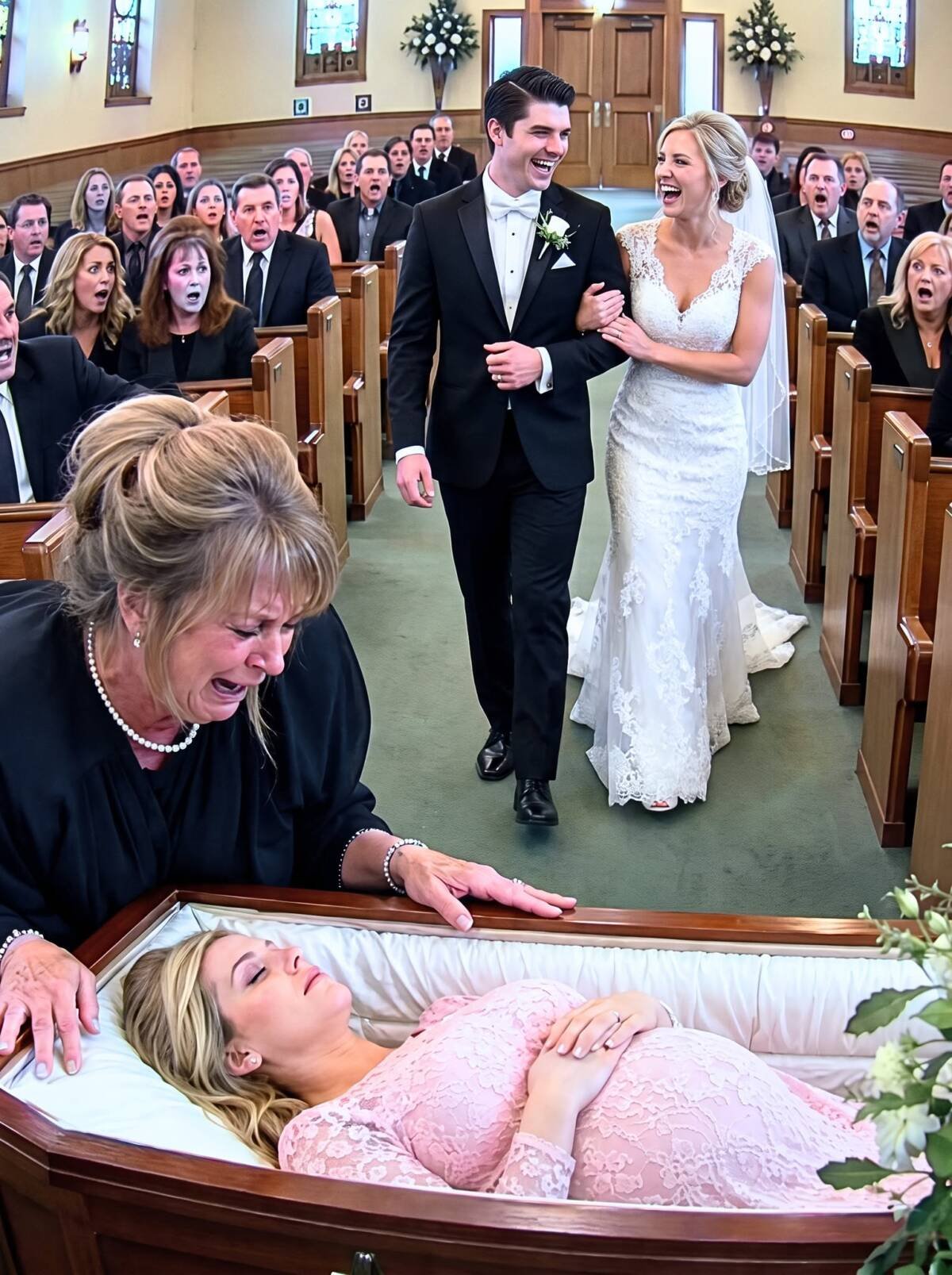
There is a particular kind of silence that falls over a hospital room when you realize the people you love only ever saw you as spare parts.
Three hours after I woke up with one kidney missing, my father walked into my recovery suite, tossed a black garbage bag stuffed with my clothes beside my bed, and said, “Don’t come home. You’ve done your part, but you’re still useless to this family.”
For twenty-four years, I had spent my life trying to earn a place at his table. This time, I didn’t beg. I didn’t cry. I stayed completely silent.
Minutes later, the hospital door swung open, police officers blocked the exit, and every trace of confidence vanished from my father’s face. Because what he didn’t know was that the truth about my stepsister’s illness—and the secret behind my surgery—was about to destroy the entire family he had tried so hard to protect.
The Daughter They Only Needed Once
The first thing I registered after the anesthesia began to fade was the sharp, sterile scent of disinfectant and a heavy, pulling ache beneath my ribs that made every breath feel shallow. My mouth was dry as paper, my arms felt too weak to lift, and the steady, rhythmic beeping of the heart monitor beside my bed was the only sound anchoring me to the room.
When I blinked through the haze and saw my father standing near the window, a foolish, aching part of me believed he had stayed because he was worried about me.
I had just donated a kidney to my stepsister, Maya. For one fragile moment, I allowed myself to believe that giving up a literal piece of my body had finally earned me the place in his heart I had spent my entire life chasing.
Richard Whittaker had never lacked money, charm, or generosity—just not for me. He wore tailored suits, drove luxury cars, and lived in a sprawling home overlooking the hills. Beside him stood my stepmother, Evelyn, a woman who carried herself with the polished, icy superiority of someone who believed the world owed her gratitude simply for entering a room.
Maya had always received everything I was denied: the sunlit bedroom, the effortless affection, the endless second chances, and the expensive gifts. Even now, recovering in a wheelchair near the far wall, she had a brand-new diamond bracelet sparkling around her wrist while I lay bruised and stitched together from the operation that had saved her life.
I had agreed to be her donor because my father had held my hand in the doctor’s office and promised that afterward, everything between us would finally change. Evelyn had conveniently produced a list of medical reasons why she couldn’t donate. Richard claimed his blood pressure made surgery too risky. When the lab results confirmed I was a near-perfect match, my father actually cried while begging me to save Maya.
I mistook those tears for love.
Three hours after I was wheeled out of surgery, Richard returned to my room carrying a heavy black garbage bag. He walked straight to my bed and dropped it onto the floor so carelessly that the plastic brushed against the blanket covering my legs.
“Don’t come home,” he said, his voice flat and devoid of warmth. “You’ve done your part, but you’re still useless to this family.”
For several seconds, the words didn’t even register. Behind him, Evelyn scrolled through her phone without looking up, showing not a flicker of surprise. Across the room, Maya sat quietly, turning her wrist just enough to watch the overhead hospital lights catch the diamonds on her bracelet.
Then Evelyn spoke, her tone as casual as if she were discussing the weather. She explained that my bedroom was already being cleared out. Now that I had served my purpose, they had decided the space would be far more useful as a home gym.
The realization cut deeper than the surgical incision in my side. I tried to inhale through the shock, but the sudden breath pulled sharply against my stitches, blurring my vision with pain.
The nurse-call button rested an inch from my fingertips. Yet for the first time in my life, I didn’t plead with my father to reconsider. I didn’t ask what I had done wrong. I simply stared at the black plastic bag holding everything I owned and accepted the truth: they had planned to throw me away the moment the surgeon closed the incision.
Then, the door to my suite swung open.
“Nobody Leaves This Room”
Dr. Evans, the lead transplant physician, stepped inside with two hospital security officers directly behind him. Behind them came a uniformed police officer who moved cleanly into the doorway, blocking the exit.
Instantly, Richard straightened his posture and slipped on the smooth, disarming smile he normally reserved for business partners and charity boards.
“Nobody leaves this room,” the police officer announced, his voice steady and final.
Richard frowned, clearly assuming this was some minor administrative misunderstanding he could easily talk his way out of. Dr. Evans didn’t acknowledge his charm. Instead, he raised a hand and pointed toward a small, dark lens mounted just above my heart monitor.
“This suite is equipped with a clinical recording camera,” Dr. Evans said calmly. “Your visit has been streaming directly to our hospital legal department since the moment you walked through that door.”
For the first time that morning, Richard’s composure cracked. The color drained from his face as his eyes darted toward the lens. Beside him, Evelyn’s hand shot out to grip his sleeve.
But the recording of my father’s cruelty wasn’t the only reason the police were standing in my room.
Dr. Evans tapped the screen of his tablet. “During our routine audit of the transplant documentation, several serious irregularities came to light. Hospital policy required us to initiate an immediate investigation.”
Evelyn shifted uncomfortably. “What irregularities?”
“The donor authorization process,” Dr. Evans replied.
I closed my eyes, already knowing what he had found. The night before the surgery, while lying on an exam table, I had quietly asked one of the transplant coordinators the one question I had been too terrified to ask my family.
What happens if I say no?
Before the nurse could answer, Richard had walked through the curtain. “You won’t say no,” he had told me, his voice low and immovable.
At the time, I had convinced myself it was just the desperation of a father trying to save his child. Hearing Dr. Evans read the staff’s notes aloud forced me to see it for what it really was.
Coercion.
“Multiple members of the surgical and nursing staff documented concerns that the donor was under severe emotional pressure,” Dr. Evans stated.
The police officer confirmed that hospital employees had already given formal statements. Richard scoffed, his arrogance briefly resurfacing. “So what? She’s an adult. She signed the forms. She agreed.”
Dr. Evans looked him dead in the eye. “No, Mr. Whittaker. She surrendered.”
Those three words hit me harder than anything else that day. For twenty-four years, I had been conditioned to believe that love was something I had to earn through sacrifice. For the first time, someone else had recognized the difference between freely choosing to give and surrendering out of fear of being abandoned.
The officer stepped forward, opening a small notebook. “Mr. Whittaker, did you tell your daughter she would finally be accepted into the family if she went through with this donation?”
Richard crossed his arms. “I encouraged her.”
“Did you promise she could return home to recover?”
My father didn’t answer.
The officer’s eyes shifted to Evelyn. “And did you already have contractors scheduled to convert her bedroom into a gym before the surgery even took place?”
Evelyn’s poise shattered. “How could you possibly—”
“The renovation company confirmed the booking,” the officer interrupted.....