For nearly three months, my sister-in-law, Sarah, had been living comfortably in our guest room while harboring a deeply rooted, condescending delusion about my life. To her, my old Ford F-150, my faded gray hoodies, and my habit of fixing broken appliances myself were definitive proof of one thing: I was a broke veteran who had somehow lucked out and convinced her younger sister, Claire, to carry the financial burden of our family.
Every insult, every snide remark about my lack of ambition, and every passive-aggressive sigh was met with absolute silence on my part. I had spent years of my life serving as a Colonel in Army Intelligence, operating in environments where discretion, patience, and reading human behavior meant the difference between safety and disaster. I understood when information mattered and when silence mattered infinitely more. I had no interest in proving my worth to someone who was willfully blind.
Until the afternoon I came home early, found my five-year-old daughter locked outside in the freezing cold with a raging fever because Sarah didn’t want her precious son getting sick, and watched as a bucket of icy water was dumped over us both.
In that singular, chilling moment, my patience evaporated completely. Sarah was about to learn a very hard lesson about who I really was—and what happens when you cross the line with a parent protecting their child.
Part 1: The Breaking Point
Sarah had chosen to station herself in our garage doorway that morning while I was elbow-deep under the hood of my truck, replacing a worn accessory belt. She held a warm vanilla latte in one hand, looking down her nose at me with that familiar, patronizing smirk.
“Still pretending to be useful?” she asked, taking a slow sip.
I wiped grease from my knuckles onto a shop rag and kept working. Years of experience had taught me that engaging with Sarah only fueled her desire to lecture.
She glanced dismissively at the old truck. “Maybe you should use that thing to drive to a real job interview. Claire is working herself to death traveling for corporate accounts while you play house mechanic in the driveway.”
I looked up, stared directly into her eyes for two seconds, and said nothing.
Sarah had no idea that Claire’s trip to Chicago had actually been a completely paid-for anniversary vacation funded entirely by me. She didn’t know our house was fully paid off with no mortgage, or that the credit card she had been using all week for her artisanal coffee runs and grocery hauls was tied directly to a private account that I funded.
And she certainly didn’t know anything about my military career. I preferred being Sophia’s dad at home rather than wearing my rank on my sleeve.
That afternoon, I left the house to pick up Sophia’s fifth-birthday cake—a custom creation shaped like a pink unicorn covered in glittering sprinkles that she had talked about every single day for two weeks.
When I pulled back into the driveway, the atmosphere inside the house felt immediately wrong. The television was blaring cartoons in the living room, but Sophia was nowhere to be found. Sarah was lounging on the sofa with a glass of white wine while her ten-year-old son, Lucas, stared mindlessly at video games on the floor.
“Where’s Sophia?” I asked, my voice dropping an octave.
Sarah barely glanced away from the screen. “Outside.”
I stopped dead in my tracks. “What do you mean outside?”
“She started coughing,” Sarah replied dismissively, taking a sip of wine. “Lucas has major soccer tryouts this weekend, and I am not letting him catch whatever nasty bug she’s carrying.”
I set the birthday cake gently on the kitchen island and walked rapidly toward the back of the house.
Then I saw her.
My five-year-old daughter was curled up against the thick glass of the sliding patio door, shivering on the cold stone patio wearing only thin cotton pajamas. Her cheeks were flushed an alarming bright red, her small body was trembling violently, and the heavy metal security bar had been dropped firmly into place across the track so she could not slide the door open herself.
I threw my weight against the door, forced it open, and dropped to my knees beside her.
“Daddy?” she whispered, her tiny teeth chattering so hard she could barely form the words. “Aunt Sarah said I have germs.”
I pressed the back of my hand against her forehead. She was burning up.
Behind me, the patio door slid open. Sarah stepped out onto the threshold, holding a yellow plastic cleaning bucket filled to the brim.
“She has a high fever,” I shouted over the rising panic in my chest.
Sarah shrugged, lifting the bucket higher. “I know. I’m helping.”
Before my military reflexes could process what she was about to do, she tipped the bucket forward.
Ice-cold water crashed over Sophia and me in a blinding, freezing wave.
My daughter let out a weak, terrified gasp and clung desperately to my neck as the freezing water soaked through her pajamas. From above us, Sarah looked down with a cold, detached expression.
“Fastest way to lower a fever,” Sarah said callously, turning back toward the warmth of the house. “Now take your burden and leave somewhere else before Lucas gets sick.”
I didn’t waste a single breath arguing with her. I wrapped my shivering daughter tightly against my chest, carried her straight out to the truck, and hit the highway toward the nearest emergency room.
Part 2: The Hospital Examination
The drive to the hospital felt agonizingly slow. I had a spare thermal blanket in the back of the truck which I wrapped securely around Sophia, but her pajamas were soaked through, and every shiver wracking her small frame ignited a cold fury inside me.
When we rushed through the sliding doors of the pediatric emergency department, an intake nurse took one look at Sophia’s pale face and elevated breathing rate, immediately calling for a gurney and a physician. They whisked her into an examination room, stripped away the wet clothing, wrapped her in warmed medical blankets, and began monitoring her vitals while the attending doctor turned his attention to me.
“What happened?” the doctor asked, pen poised over his clipboard.
I laid it out plainly.
The persistent fever. The locked patio door. The security bar. The bucket of ice-cold water dumped over a sick child.
The doctor stopped writing entirely. He looked up, his expression hardening into absolute disbelief. “Someone deliberately poured cold water over a febrile child?”
“Yes,” I answered evenly.
“And she had already been locked outside?”
“Yes.”
He immediately ordered a comprehensive diagnostic workup, IV fluids, and a consultation with the hospital social worker. Within twenty minutes, a compassionate social worker named Martinez entered the room. She didn’t start by questioning me about insurance or paperwork; she knelt beside Sophia’s bed and spoke to her with infinite gentleness.
“Sweetheart, do you know why your aunt put you outside on the patio?”
Sophia blinked heavy, tired eyes and nodded. “She said I would make Lucas sick.”
“Did she tell you how long you had to stay out there?”
“Until I stopped coughing.”
I looked away, gripping the metal rail of the hospital bed so hard my knuckles turned white.
The social worker continued softly, “Could you have come back inside on your own?”
Sophia shook her head. “No. Aunt Sarah put the stick on the door so it wouldn’t open.”
That single sentence shattered any remaining doubt about Sarah’s intent. She hadn’t just asked a sick child to step outside for fresh air; she had deliberately engineered a physical barrier to prevent a five-year-old from seeking shelter.
Then Sophia added something that made my stomach churn. “Aunt Sarah said crying would make my fever hotter, so I had to be quiet.”
I stared at my daughter. “Did she say anything else?”
Sophia hesitated, picking at the edge of her blanket. “She said… she said Daddy always lets me act like a baby.”
The realization hit me like a physical blow. For months, I had convinced myself that Sarah’s constant barrage of insults, passive-aggressive sighs, and condescending remarks were directed solely at me. I had absorbed them as the price of keeping temporary domestic peace.
Now I realized Sophia had been internalizing those exact messages.
The social worker gently probed further, asking if Sarah had treated Sophia differently in other ways. Sophia nodded again. “She always gives Lucas the front seat of the car, even when I was there first. And she made me move all my toys out of the living room because Lucas needed more space to play games.“
I had written those moments off as typical friction between children and houseguests. Standing under the fluorescent hospital lights, I saw them for what they truly were: Sarah had systematically established a rigid, toxic hierarchy inside my own home where her son took precedence in every situation, and my daughter was expected to shrink into the background.
I excused myself into the hallway and pulled out my phone. I dialed Claire’s number. She answered on the second ring, her voice bright with corporate exhaustion from her trip.
“Hey! How are my two favorite people?”
“Claire, listen to me very carefully,” I said, my voice entirely flat and controlled. “We are at the hospital.”
There was an instantaneous shift on the line. The background noise vanished. “What happened? Is Sophia okay?”
I told her everything. Every detail. The fever, the locked patio, the security bar, the ice water, and what Sophia had told the social worker.
For several long seconds, there was absolute silence on the line. When Claire finally spoke, her voice was barely recognizable—shaking, hollow, and laced with sheer horror.
“She locked Sophia outside?”
“Yes.”
“And poured ice water on her while she had a fever?”
“Yes.”
Claire whispered something ragged under her breath that sounded like a prayer mixed with a curse. Then, without a moment of hesitation or defense of her sister, she said words that surprised me: “I’m canceling my meetings right now. I’m coming home.”
Part 3: Preserving the Evidence
When social worker Martinez stepped back out into the hallway to speak with me, her professional demeanor was grave.
“We need to document the physical environment and gather timeline evidence while it’s still entirely fresh,” she told me.
“I have exterior security cameras,” I replied immediately. “They cover the entire patio and back perimeter.”
Martinez raised an eyebrow. “Good. Pull up the footage.”
Years of intelligence work had conditioned me never to rely solely on human memory when facts could be definitively captured and preserved. People lied, panicked, and altered narratives when faced with consequences. Evidence remained immutable.
I unlocked my phone, opened the secure, encrypted camera app, and scrolled back to the timestamp from earlier that afternoon.
The high-definition night-and-day vision crispness rendered every detail crystal clear. On the screen, Sarah appeared in frame gripping Sophia tightly by the arm. She marched her out onto the stone patio, forced her past the threshold, stepped back inside, and deliberately reached down to drop the heavy metal security bar into the floor track.
There was zero ambiguity. There was no hesitation. She knew exactly what she was doing.
The footage continued rolling. For over fifteen miserable minutes, my daughter stood shivering against the double-paned glass, coughing miserably into her sleeve and rubbing her bare arms against the chill. At one point, Sophia tapped weakly on the glass, looking pleadingly toward the living room. Sarah walked past the window, glanced right at her, pulled the curtain closed to shut her out, and walked away.
My chest tightened so hard it felt like a vise. She had looked right at my sick child begging for entry and chosen to ignore her.
“Save copies of those files immediately,” Martinez instructed, watching the screen over my shoulder.
“Already done,” I said, transferring secure backups to cloud storage. “Nothing gets deleted.”
A nurse emerged from Sophia’s room to deliver good news: her body temperature had finally stabilized within a safe range, her blood work showed no dangerous bacterial complications, and as long as she rested, she would be cleared for discharge by morning.
As I stepped back inside to sit beside my daughter, my phone buzzed continuously in my pocket. It was Claire again, calling from an airport terminal in Chicago where she had successfully booked the earliest available flight back to Miami.
“I’m on standby for a direct flight,” Claire said urgently. “Tell me you have proof of what she did.”
“I have the security footage, Claire. The hospital social worker has reviewed it, and child protective services are already involved.”
There was a heavy pause on the line. I could hear the hum of airport announcements in the background. “I knew Sarah was difficult,” Claire murmured, her voice thick with guilt. “I knew she thought you were lazy, and I knew she resented living in our space. But I never imagined… I never in a million years thought she would hurt my little girl.”
“You didn’t know,” I reminded her gently.
“She’s been texting me all evening,” Claire added, her tone hardening. “Complaining that you took Sophia out of the house without her permission, calling you unstable, and claiming you’re having some kind of veteran breakdown.”
I couldn’t help a dry, bitter sound escaping my lips. Sarah was still clinging to her delusions, desperately trying to control the narrative even from a distance.
“What else did she text you?” I asked.
“She said: ‘Claire, you need to stop letting him pretend he has authority over everyone. He doesn’t even have a real job, and he’s ruining the household harmony.’“
I looked down at Sophia, who had finally drifted off to a peaceful, warm sleep under the hospital blankets.
“Let her text whatever she wants,” I told Claire. “Because by the time you land tomorrow morning, the reality of who owns this house and who protects this family is going to become painfully clear to her.”
Part 4: Confrontation at the House
Claire landed before sunrise and came straight from the airport to the hospital, her travel bag slung over her shoulder and righteous fury written across her face. When Sophia woke up and saw her mother standing by the bed, she burst into tears and threw her arms around Claire’s neck.
We were officially discharged by mid-morning. Per the social worker’s strong advice, we did not return home immediately; instead, we drove straight to Claire’s mother’s house where Sophia could rest safely in a quiet environment while local authorities initiated their investigation.
Once Sophia was settled, Claire and I drove back to our house.
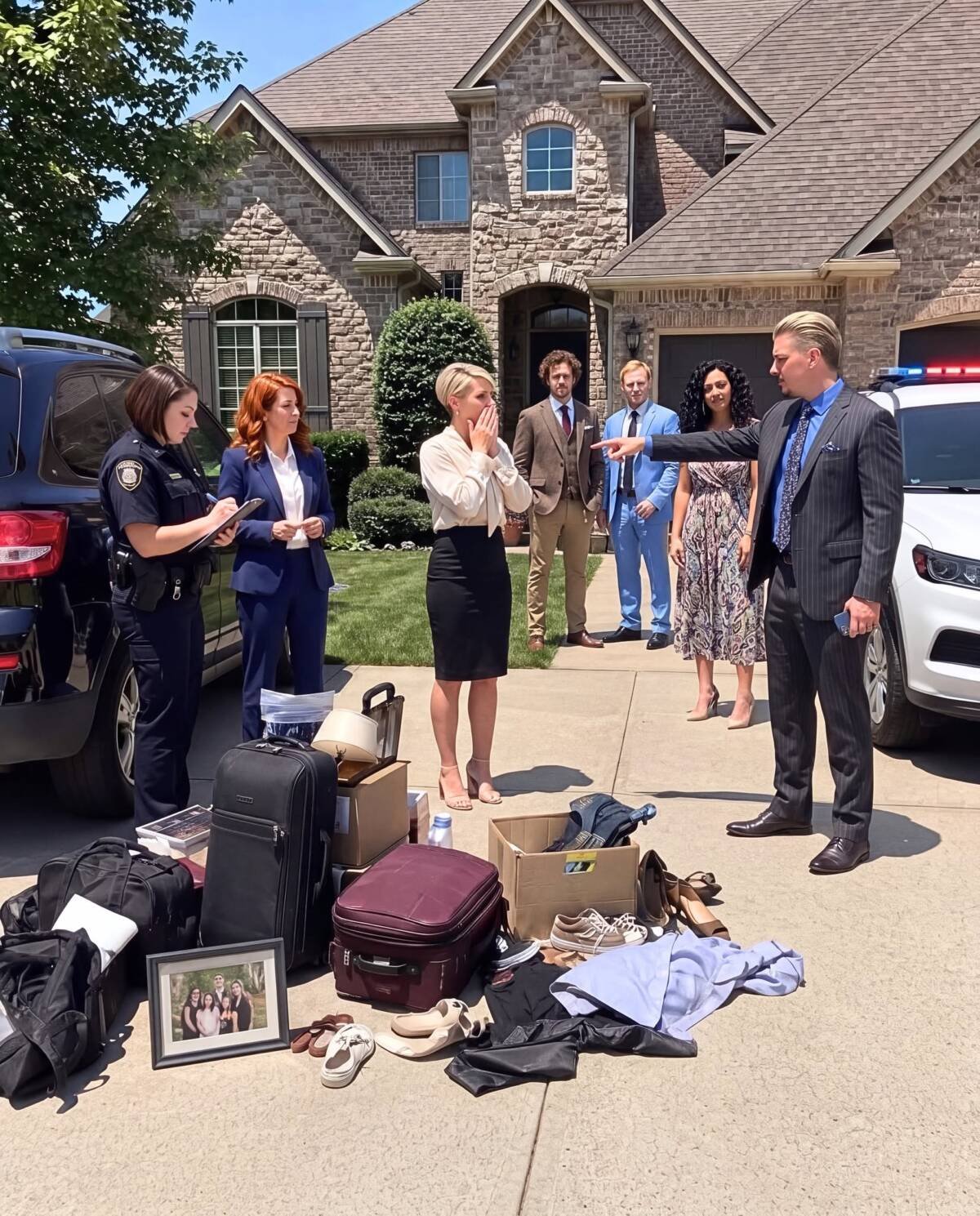
Two local police officers and a child welfare investigator were already parked in our driveway. Sarah was standing on the front porch with her arms firmly crossed over her chest, looking indignant and impatient. As we stepped out of the truck, she immediately raised her voice.
“Oh, finally! Where have you two been?” Sarah demanded, marching down the walkway. “You disappear for twelve hours, take Sophia out of the system without telling anyone, and leave me holding the bag while Lucas misses his soccer preparation?”
The senior police officer turned to her, his expression entirely neutral. “Are you Sarah Jenkins?”
“Yes, I am. And I want to report these two for erratic behavior—”
“Ma’am,” the officer interrupted calmly. “We’ve reviewed the medical reports from Jackson Memorial Hospital, and we’ve viewed the high-definition security footage provided by the homeowner.”
Sarah blinked, a flicker of genuine uncertainty crossing her features for the first time. “It was just a misunderstanding. She had a fever, and I was trying to cool her down and protect my son from getting sick.”
“By locking a five-year-old child outside behind a security bar in forty-degree weather and dumping a bucket of ice water over her head?” the officer asked pointedly.
Sarah scoffed, looking toward Claire for backup. “Claire, tell them! You know how dramatic he is about everything, and the kid gets fussy. I was just enforcing household discipline!”
Claire stopped dead in her tracks. She looked at her older sister—the same sister she had defended, excused, and financially supported for months—with a look of absolute disgust.
“Don’t you dare,” Claire said, her voice shaking with restrained rage. “Don’t you dare use that tone with my husband, and don’t you ever minimize what you did to my daughter.”
Sarah looked stunned. “Claire, are you taking his side? He doesn’t even work! He’s just a broke veteran playing handyman while you pay the bills!”
The silence that followed that statement was deafening.
The police officer raised an eyebrow, glancing back and forth between us. Claire let out a sharp, humorless laugh.
“A broke veteran?” Claire repeated, shaking her head. “Sarah, you absolute fool. Do you have any idea who you’ve been living with?”
Sarah sneered. “A freeloader.”
I didn’t say a word. I simply reached into my jacket pocket, pulled out a thick leather portfolio containing our property documents, deeds, and financial registries, and handed them directly to the police officer.
“For the record,” I said quietly, addressing the officer while looking straight at Sarah, “she keeps claiming she has authority over this house because she believes it belongs to her sister.”
The officer flipped open the document, reviewing the official county deed stamped with legal seals. He looked up at Sarah. “Ma’am, according to public records and property deeds, this entire estate was purchased and paid for outright by Mr. Vance prior to their marriage. Your sister’s name was added to the estate plan years later by his choice. You have zero legal standing in this home.”
Sarah stared at the officer, her mouth opening and closing like a fish out of water. She pivoted her wide, panicked eyes toward Claire. “That… that’s not true. He drives an old truck! He wears cheap hoodies!”
“Because I prefer a quiet life without pretending to be someone I’m not,” I replied coldly.
The officer stepped forward, gesturing toward the front door. “Ms. Jenkins, given the active child welfare investigation, you are being served with a formal trespass notice and an emergency restraining order barring you from this property and contact with the minor child. You have two hours to pack your personal belongings under our supervision.”
Part 5: The Truth Comes Out
The packing process was remarkably quiet. Without the shield of her arrogant assumptions, Sarah looked small, defeated, and utterly bewildered. She packed her bags under the watchful eyes of the police officers, casting hostile glares in my direction whenever she thought nobody was looking.
When she finally slammed the trunk of her car shut and drove away from our driveway, the oppressive weight that had hung over our household for three months lifted entirely.
A few weeks later, once the legal dust had settled and the child welfare case was formally closed with all findings pointing squarely at Sarah’s negligence, we hosted a quiet family dinner with Claire’s mother and a few close relatives.
During the dinner, the conversation drifted toward my career—a topic I usually kept tightly compartmentalized. Claire’s mother, who had always suspected there was more to my quiet demeanor than met the eye, looked across the table and smiled.
“You know, Sarah called me last week whining about how unfair everything was,” her mother said, shaking her head. “She was still ranting about how you were just an unemployed veteran who hoodwinked Claire.”
Claire chuckled, taking a sip of water. “Well, she finally found out the truth.”
“Oh?” her mother asked. “What did she say?”
“One of our mutual acquaintances—who happens to work federal compliance—mentioned my husband’s actual title,” Claire explained with a proud smile. “She found out he’s a Colonel in Army Intelligence, managing high-level security portfolios, and that the truck she mocked was just his project vehicle because he likes working with his hands.”
I kept my eyes on my plate, eating my dinner without fanfare. “Titles don’t matter at home, Claire.”
“They mattered to Sarah,” Claire noted softly. “She spent months building an entire fantasy world where she was superior to the ‘broke veteran,’ only to discover that her entire existence relied on the generosity of the very man she despised.”
I looked up and reached across the table to squeeze my wife’s hand.
The truth coming to light didn’t magically erase the trauma of that terrifying night, nor did it undo the emotional scars left by Sarah’s toxic presence. Sophia still needed a little extra reassurance at bedtime for a few weeks, and our household rules became permanently ironclad regarding who was allowed across our threshold.
But the fundamental dynamic of our lives had undergone a permanent, beautiful evolution.
I learned that silence is a tactical tool, but weaponized silence can sometimes allow toxic people to overstep boundaries if left unchecked. More importantly, my daughter learned something vital: she was never a burden, her voice mattered, and her father would always stand as an impenetrable wall between her and anyone who tried to harm her.
Months later, sitting on the back patio in the warm Miami evening breeze with Sophia playing happily on the grass nearby, I watched the sun dip below the horizon. The bougainvillea bloomed brightly along the fence line, the house was entirely peaceful, and the air was filled with laughter instead of judgment.
Sarah had built her entire argument on the fragile foundation of arrogance and underestimation. She thought she understood my silence, my clothes, and my life.
Instead, she discovered an immutable truth: kindness is never an invitation to cruelty, patience is never permanent permission, and a quiet man protecting his family is the most formidable force on earth.
Are you or someone you know facing a situation where manipulation, boundary violations, or emotional abuse is hiding behind closed doors? You are never as alone as you think, and your voice matters. Share this story to remind others that true strength is quiet, protective, and relentless when it matters most.