The Movement Inside the Coffin: Pregnant Woman Declared Dead Before Cremation, Then Her Husband Saw Her Abdomen Move
A final request to see his pregnant wife one more time changed everything. What happened next saved her unborn baby and triggered an investigation into what appeared to be a tragic highway accident.
Introduction
Marcos Almeida believed he was walking into a crematorium to say goodbye to his wife and the child they had spent seven months waiting to meet.
Instead, a faint movement beneath the fabric covering Ana Clara’s pregnant abdomen stopped the cremation and set off a chain of events that would transform a family tragedy into a criminal investigation.
Ana Clara had been seven months pregnant when she was involved in a serious highway accident in São Paulo. Her family had been told that she had died from her injuries, and preparations were made for her cremation at the Vila Alpina Crematorium.
But just before the procedure was supposed to begin, Marcos made one final request.
He wanted to see his wife again.
When the coffin was opened, Marcos noticed something that initially seemed impossible.
Her abdomen moved.
At first, the movement was so subtle that he questioned his own eyes. Grief, exhaustion and shock had already consumed him. He wondered whether what he had seen was simply a natural postmortem reaction.
Then it happened again.
Marcos immediately demanded that the cremation be stopped.
“Stop! Stop everything now!”
Within minutes, emergency medical personnel were called to the crematorium. A sensor was placed against Ana Clara’s abdomen, and after several agonizing seconds, a heartbeat was detected.
Her unborn son, Miguel, was still alive.
The discovery not only gave Marcos a chance to save his child. It also raised questions about the circumstances surrounding Ana Clara’s death.
What had initially been described as a fatal highway accident suddenly became the beginning of a much deeper investigation.
The Accident
Ana Clara had left home on a rainy afternoon to take care of several family errands and purchase a few things for her unborn son.
The couple had been preparing for Miguel’s arrival for months.
His nursery was not yet finished, but the room already contained many of the small details that had made the pregnancy feel real: baby soap, freshly painted walls, pieces of furniture waiting to be assembled and plans for a future that Marcos and Ana Clara had imagined together.
Ana Clara was seven months pregnant and had been carefully following her medical appointments.
She was known by her family as someone who was cautious about medications and particularly careful during pregnancy.
That afternoon, however, she never made it home.
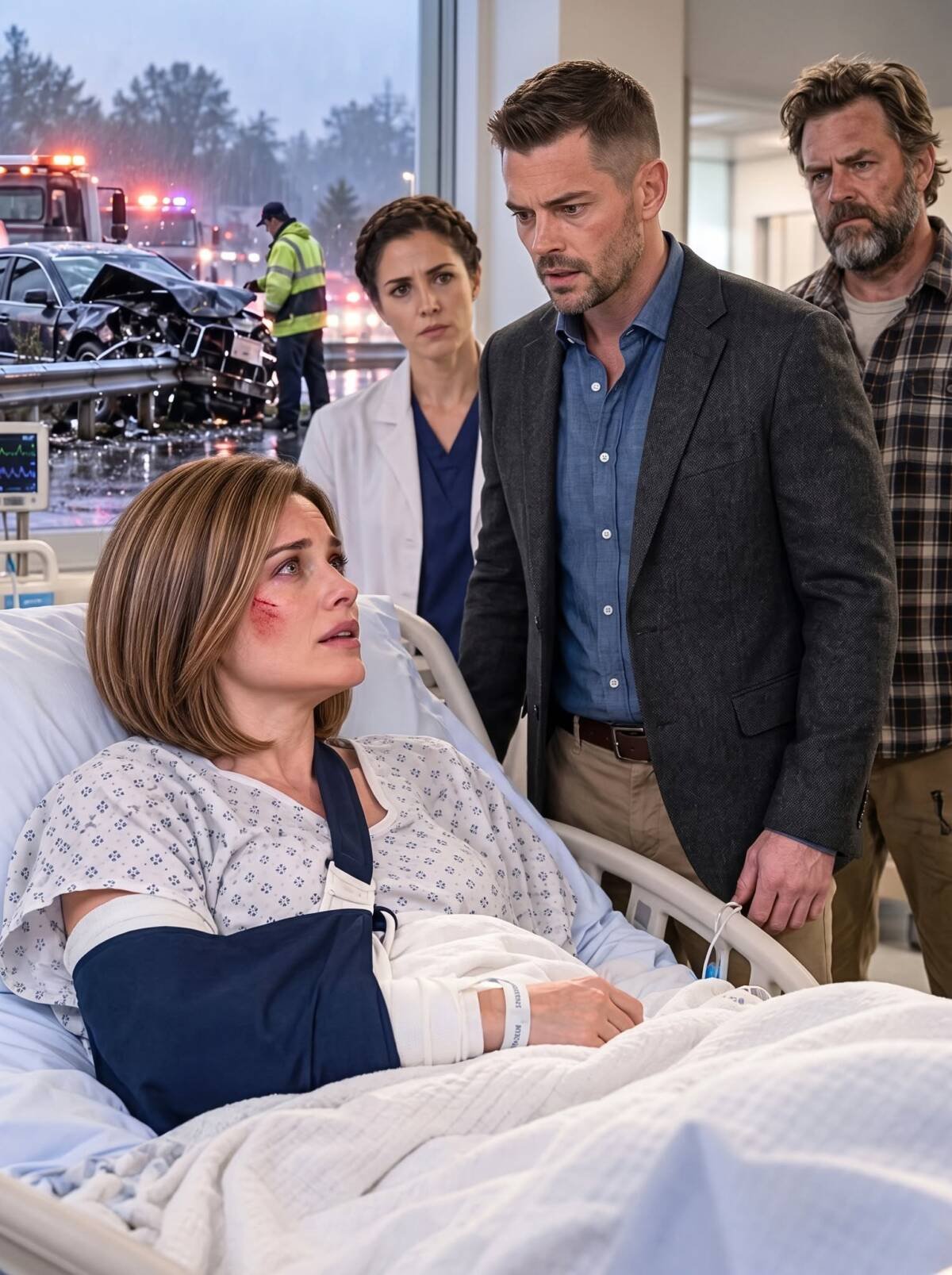
Her vehicle was involved in an accident on the Rodovia dos Imigrantes, a major highway in São Paulo. According to the initial explanation given to Marcos, the car lost control on the rain-soaked road and struck a barrier.
The words used by officials were clinical and restrained.
Impact.
Fatal injuries.
Immediate death.
For Marcos, none of those terms made the situation easier to understand.
His wife was gone.
And with her, he believed, the future they had been building for their unborn son had disappeared as well.
The phone call informing him of the accident became one of those moments that would remain permanently fixed in his memory.
He remembered the rain.
He remembered his phone vibrating on the kitchen table.
He remembered the unfamiliar voice explaining what had happened.
And then he remembered the silence that followed.
A Family Preparing to Say Goodbye
Marcos and Ana Clara had been together for years.
They had met in São Paulo while waiting in line at a bank, and Marcos later described the moment he began falling in love with her as something surprisingly ordinary.
Ana Clara had noticed an elderly woman who had lost her place in line and immediately defended her.
It was a small act of kindness, but Marcos never forgot it.
The couple eventually married in a simple ceremony surrounded by family members and close friends.
Ana Clara was also sentimental.
She kept medical notes, greeting cards, photographs and other objects that might have appeared insignificant to someone else but carried meaning for her.
Among the items she carefully preserved was a blue folder.
Inside were Miguel’s ultrasound images, medical records, information connected to her pregnancy and a handwritten list of things the couple still needed before their son was born.
The folder would later become an important part of the investigation.
At the time, however, it was simply another reminder of the baby Ana Clara had been preparing to welcome.
Her family gathered to mourn her.
Her mother held a rosary in her hands.
Relatives tried to comfort one another.
Marcos struggled to accept that he would never hear Ana Clara’s voice again.
The cremation was scheduled for the following day.
Everything appeared to be moving toward a final goodbye.
But Marcos could not bring himself to let that moment happen without seeing his wife one more time.
The Final Request
At the Vila Alpina Crematorium, Marcos stood beside Ana Clara’s coffin.
Her pregnant abdomen remained visible beneath the fabric.
The reality of what he was about to do became unbearable.
He knew that once the cremation began, there would be no possibility of seeing her again.
He approached an employee and asked to see her one final time.
The request initially caused hesitation.
The cremation process had already been prepared, and the necessary paperwork had been completed.
But Marcos continued to insist.
He needed to say goodbye.
Eventually, the coffin was reopened.
The atmosphere inside the room changed immediately.
Ana Clara’s mother stopped praying.
Family members fell silent.
Marcos leaned over his wife’s body.
He wanted to apologize.
He wanted to tell her that he was sorry he had not been there.
He wanted to tell her about Miguel.
He wanted to say goodbye.
Then he noticed something.
A movement beneath the cloth.
Marcos froze.
He looked again.
Nothing.
Then another faint movement.
This time, he was certain he had seen it.
The abdomen moved.
“Stop! Stop everything now!”
Employees attempted to explain that movement after death can sometimes have natural causes. Muscle activity and other postmortem changes can occur, and the movement did not automatically mean that Ana Clara was alive.
But Marcos was no longer willing to take that chance.
He demanded medical assistance.
“Call the ambulance! My son is alive!”
The room erupted into confusion.
The Heartbeat
Emergency personnel were called.
Within minutes, SAMU paramedics arrived at the crematorium carrying medical equipment.
Everyone was instructed to move away from the coffin.
A sensor was placed against Ana Clara’s abdomen.
For several seconds, there was no clear signal.
Only interference.
Then the equipment registered something.
A rapid, weak rhythm.
A heartbeat.
The unborn child was alive.
Marcos was overwhelmed.
He had arrived believing that he had lost both his wife and his unborn son.
Now doctors had discovered that Miguel was still fighting to survive.
The cremation was immediately stopped.
Ana Clara was transported to Hospital das Clínicas for emergency treatment.
Marcos followed the ambulance, holding onto the only hope he had left.
“Hang on, son. Your dad is here.”
A Race Against Time
At the hospital, medical teams immediately took Ana Clara into the surgical area.
Marcos was forced to wait outside.
He had already endured the news of his wife’s death. Now he was waiting to discover whether his son could survive.
Minutes felt like hours.
At 6:49 p.m., the silence of the corridor was suddenly interrupted by a tiny cry.
Miguel had been delivered alive.
He was premature, having been inside his mother’s womb for only seven months, and he required intensive neonatal care.
A nurse briefly appeared with the newborn wrapped in white cloth before taking him to the neonatal intensive care unit.
Marcos saw his son for only a few seconds.
But those seconds were enough.
Miguel was alive.
The baby everyone had nearly lost had survived.
For Marcos, the moment was both miraculous and devastating.
His son had been saved, but Ana Clara was not coming home.
And then doctors made another discovery.
Something about Ana Clara’s condition did not fit neatly with the explanation that she had simply died from injuries sustained in the highway accident.
Part 2: The Accident That Raised Questions
An Unusual Medical Finding
During the emergency procedure, doctors documented a mark on Ana Clara’s body and an unusual skin reaction.
The findings did not appear to correspond easily with the injuries described in the initial accident report.
That discrepancy was enough to change the direction of the case.
The cremation was no longer simply suspended because Ana Clara’s unborn child had been found alive.
Her body also needed to be preserved for further examination.
Investigators requested toxicology testing and a detailed examination of the vehicle.
The circumstances surrounding her death were no longer being treated as a straightforward accident.
Instead, investigators began reconstructing the hours leading up to the crash.
Who had spoken to Ana Clara?
Where had she gone?
What had happened before she lost control of her vehicle?
And why had certain medical findings appeared inconsistent with the original explanation?
The questions continued to multiply.
The Gas Station Footage
Investigators eventually obtained security footage from a gas station near the Rodovia dos Imigrantes.
The footage showed Ana Clara’s vehicle stopping shortly before the section of highway where the crash occurred.
But there was another detail.
Gustavo, Ana Clara’s brother, appeared at the location.
The footage did not show him physically attacking his sister or visibly tampering with the vehicle.
Instead, it showed Gustavo standing near the driver’s door and arguing with Ana Clara.
It was raining.
The conversation appeared tense.
And it happened shortly before the fatal crash.
Investigators questioned Gustavo about the encounter.
He said he had only wanted to speak with his sister about a private family matter.
According to his explanation, Ana Clara had become upset during the conversation.
He denied knowing what would happen afterward.
At first, the footage alone did not prove that Gustavo had caused the accident.
But it became another piece of a growing collection of unanswered questions.
The Toxicology Report
The investigation took another significant turn when toxicology testing detected a sedative in Ana Clara’s system.
According to the account of the investigation, the substance and its concentration were considered inconsistent with her pregnancy and her normal medical routine.
This was significant because Marcos knew how cautious Ana Clara had been.
She was not someone who casually took medication while pregnant.
She had been careful about what she consumed and had regularly consulted medical professionals about her pregnancy.
The presence of a sedative therefore raised an important question.
How had it entered her system?
Investigators began examining Ana Clara’s final communications and movements.
The accident was no longer being viewed in isolation.
The medical evidence, the security footage and the timeline were beginning to form a larger picture.
The Blue Folder
Investigators also examined Ana Clara’s phone and personal records.
Among the material recovered was a deleted conversation involving Gustavo.
The messages reportedly revealed tension between the siblings over money.
Gustavo had experienced financial difficulties and had regularly relied on relatives for assistance.
Ana Clara had helped him in the past.
But shortly before her death, she had apparently decided that she would no longer continue giving him money.
The messages suggested that the relationship had become increasingly strained.
Ana Clara also appeared to be preparing to tell her family about problems she believed Gustavo had been hiding.
That information gave investigators something they had not previously had:
a possible motive.
It was no longer simply a question of what happened on the highway.
Investigators now had to consider whether the confrontation between Ana Clara and Gustavo had been connected to the events that followed.
Marcos Remembers the Crematorium
As investigators explained their findings, Marcos began remembering details from the crematorium that had initially seemed meaningless.
He remembered Gustavo standing against the wall.
He remembered his brother-in-law’s expression.
Most importantly, he remembered Gustavo’s reaction when the paramedics discovered Miguel’s heartbeat.
Everyone else had looked toward Ana Clara.
Everyone else had reacted with shock.
But Marcos remembered Gustavo stepping backward.
He remembered Gustavo looking toward the exit.
At the time, Marcos had been too overwhelmed to understand what the behavior meant.
Now, in light of the investigation, those memories appeared different.
A detail that had seemed insignificant suddenly felt important.
Part 3: The Investigation
Reconstructing Ana Clara’s Final Hours
Investigators began reconstructing Ana Clara’s final hours in detail.
They examined telephone records, messages, security footage and the route she had taken.
The goal was to establish what happened between the moment she left home and the moment her vehicle crashed.
According to the investigation described in the case, Gustavo had met Ana Clara before the accident.
The confrontation was followed by the discovery of the sedative in her system.
Investigators considered whether the substance had impaired Ana Clara’s ability to react while driving.
That theory became one of the central elements of the criminal investigation.
The case was no longer simply about a woman who had lost control of a vehicle on a rainy highway.
It had become an investigation into whether someone had deliberately created circumstances that would make her death appear accidental.
An Arrest
Eventually, Gustavo was arrested.
For Marcos, however, seeing his brother-in-law in handcuffs did not bring the relief that people might have expected.
There was no celebration.
No sense of victory.
His wife was still dead.
His son was still growing up without a mother.
Nothing the justice system could do would change that.
What mattered to Marcos was that the circumstances surrounding Ana Clara’s death would not disappear.
The cremation that had nearly destroyed the last physical evidence had been stopped.
The medical examination had taken place.
The toxicology testing had been performed.
The vehicle had been examined.
The security footage had been reviewed.
And the unanswered questions had become evidence in a criminal investigation.
Miguel’s Fight to Survive
While investigators worked on the case, Miguel remained in neonatal intensive care.
He had been born prematurely and needed specialized medical attention.
For Marcos, life became divided between two worlds.
In one, he was grieving his wife.
In the other, he was learning how to be a father to a newborn who had nearly died before he was even born.
The experience changed his understanding of time.
Progress was measured in tiny steps.
A little more weight.
A stronger cry.
A feeding improvement.
One less piece of medical equipment.
One more day survived.
Marcos learned that when your child is fighting for his life, even the smallest improvement can feel enormous.
Ana Clara’s mother remained involved as well.
She visited Miguel and sat beside the incubator.
Her rosary was often wrapped around her wrist.
The family had lost Ana Clara, but Miguel became the living connection to the woman they had lost.
Every day he survived was another reminder that Ana Clara’s story had not ended with the crash.
The Court Case
Months later, the case moved into the courtroom.
Prosecutors presented the evidence collected during the investigation.
Among the evidence were medical findings from Hospital das Clínicas, toxicology results, telephone records, security footage and inconsistencies surrounding the original timeline.
The prosecution argued that the circumstances surrounding Ana Clara’s death could not reasonably be dismissed as an ordinary highway accident.
The defense, as in any criminal case, would have the opportunity to challenge the evidence and present its own arguments.
Ultimately, Gustavo was convicted for his role in the events leading to Ana Clara’s death and for endangering Miguel’s life.
For Marcos, the verdict did not represent a happy ending.
There could be no happy ending to a story in which a young mother died before meeting her child.
But the verdict meant something else.
It meant that the explanation surrounding Ana Clara’s death would not remain a simple accident.
Her death had been investigated.
The unanswered questions had been pursued.
And the truth, as established through the legal process, had been brought into the open.
Years Later
Time passed.
Miguel grew.
The premature baby who had once depended on machines and constant medical monitoring eventually became a healthy child.
But he grew up with a question that would always remain part of his life.
Who was his mother?
Marcos knew that one day Miguel would be old enough to understand the full story.
Until then, he chose to tell him about Ana Clara through memories rather than through the circumstances of her death.
He told him that his mother laughed easily.
He told him that she was sentimental.
He told him about the elderly woman she once defended at a bank.
He told him about the nursery she had helped prepare.
He told him about the ultrasound photographs she kept.
He told him that she had loved him before she ever held him.
And he kept the blue folder.
Inside were Miguel’s ultrasound images, medical documents and the hospital bracelet from the beginning of his life.
The folder became more than a collection of paperwork.
It became a connection to Ana Clara.
The Question Miguel Eventually Asked
Years later, Miguel asked his father why he had insisted on opening the coffin.
It was a simple question.
But for Marcos, the memory remained as vivid as ever.
He could still see the crematorium.
He could still remember the coffin.
He could still remember the silence.
And he could still remember that faint movement beneath the fabric.
Marcos looked at his son and gave him an answer that did not require an explanation of every detail.
“Because I loved your mother too much to leave without saying goodbye.”
Miguel was not yet old enough to understand everything contained within those words.
One day, he would learn.
He would learn about the accident.
He would learn about the investigation.
He would learn about the toxicology findings.
He would learn about his uncle.
He would learn about the court case.
And eventually, he would understand that his life had come extraordinarily close to ending before it had even begun.
But for the moment, Marcos allowed his son to remain a child.
The Moment That Changed Everything
The most extraordinary part of the story remains the moment inside the crematorium.
Everyone believed the final goodbye had arrived.
The documents had been signed.
The coffin was ready.
The family was grieving.
The cremation was about to begin.
Then Marcos asked for one final look.
That request lasted only a few minutes.
But those minutes changed the course of two lives.
A faint movement led to an emergency call.
The emergency call led to medical intervention.
The medical intervention revealed that Miguel was alive.
And the medical examination that followed raised questions about Ana Clara’s death.
Without that final request, the sequence of events could have been very different.
Marcos had not entered the crematorium expecting to uncover anything.
He was not investigating a crime.
He was not searching for evidence.
He was simply a husband who wanted to see his wife one last time.
That refusal to walk away without saying goodbye became the reason his son received a chance to live.
A Father’s Refusal to Give Up
There are moments in life when a person has only seconds to make a decision.
For Marcos, the decision was simple.
He could sign the final authorization and allow the procedure to continue.
Or he could ask to see Ana Clara again.
He chose the second option.
At the time, he did not know whether the movement he had seen was meaningful.
He did not know whether the paramedics would find a heartbeat.
He did not know whether Miguel could survive.
He did not know that investigators would later examine Ana Clara’s death.
He knew only that something had moved.
And he refused to ignore it.
That instinct changed everything.
Miguel survived.
The cremation was stopped.
Ana Clara’s body was preserved for examination.
The investigation continued.
And the story that might otherwise have ended with a tragic highway accident became a case that demanded answers.
The Blue Folder Remained
The blue folder stayed with Marcos for years.
Inside were the ultrasound photographs Ana Clara had carefully preserved.
Those images showed Miguel before he was born.
They represented the future she had been preparing for.
There were also medical documents and records associated with the events that followed her death.
To anyone else, they might have looked like ordinary papers.
To Marcos, they represented the line between what he almost lost and what he managed to save.
Sometimes, after Miguel had fallen asleep, Marcos would open the folder.
He would look at the ultrasound images.
He would remember Ana Clara.
He would remember the nursery.
And eventually, his thoughts would return to the crematorium.
The dark coffin.
The silence.
The movement.
The heartbeat.
His son’s first cry.
None of those memories could bring Ana Clara back.
But they reminded him that Miguel was still here.
Conclusion
Marcos Almeida entered the Vila Alpina Crematorium believing that he was about to lose the last remaining connection to his wife and unborn child.
Instead, one final request changed the course of his family’s history.
When he asked to see Ana Clara one more time, he noticed a faint movement beneath her pregnant abdomen.
Medical personnel were called.
A heartbeat was detected.
Miguel was delivered prematurely and taken to intensive care.
The discovery also triggered a closer examination of Ana Clara’s death, leading investigators to review medical findings, toxicology results, security footage, communications and the circumstances surrounding the highway crash.
What had initially appeared to be a tragic accident became a criminal investigation.
Gustavo was ultimately convicted for his role in the events surrounding Ana Clara’s death and the danger posed to Miguel.
But for Marcos, the most important outcome was not the courtroom verdict.
It was his son.
The child Ana Clara had loved before she ever had the opportunity to hold him.
The child whose heartbeat was discovered when everyone else believed there was nothing left to save.
Years later, Miguel would grow up knowing his mother’s name, her personality and the love she had for him.
He would also eventually learn about the extraordinary circumstances surrounding his birth.
And perhaps the most important lesson he would carry with him would not be about the investigation or the courtroom.
It would be about his father’s decision not to give up.
Because sometimes the smallest detail can change an entire life.
Sometimes a single question can delay a final goodbye.
And sometimes, when everyone believes the story is already over, there is still a heartbeat waiting to be heard.
If you found this story moving, share it with the people you love so they can read it too. Someone else may need to hear a story about hope, love and never giving up when everything seems lost.