The sound of rubber wheels rolling down my gravel driveway was the last thing I expected to hear while I was trapped in my upstairs bedroom.
By the time I pulled myself to the window, my thirty-four-year-old son was already helping a stranger lift my custom-fitted wheelchair into the bed of a pickup truck—smiling as casually as if he were offloading an old lawnmower. When I shouted his name, he didn’t flinch. He simply shrugged and told me, “You don’t go anywhere anyway.”
Minutes later, he dropped a bottle of water and a sleeve of crackers just out of reach on my bedroom floor, grabbed his suitcases, and drove off toward the airport with his girlfriend for a six-day vacation in Cancún.
What my son never realized was that losing the strength in my legs had never touched my mind. He thought he had left a helpless old woman stranded upstairs. Instead, he left behind the woman who had built the family fortune—and by the time he returned from the airport, every one of his cards was dead, his SUV had been repossessed, and his key no longer worked in the front door.
The Sound on the Driveway
“Daniel!” I called out, gripping the wooden windowsill to keep myself upright. “What on earth are you doing?”
He glanced up at the second-story window with annoyance rather than shame. At thirty-four, my only son had perfected the art of looking inconvenienced whenever anyone confronted him with the consequences of his own choices.
“Selling it,” he called back, wiping his hands on his jeans. “Relax, Mom. I got a great price.”
“That chair was custom-fitted for my spine,” I said, my voice shaking with disbelief. “I cannot get downstairs without it.”
Beside their rented-looking black SUV stood his girlfriend, Kendra, wearing oversized designer sunglasses and holding an iced coffee. She didn’t even bother looking up at the window.
“We’re going to Cancún, Evelyn,” she called out lazily. “The resort deposit was due today.”
Daniel gave a careless shrug as the buyer fastened the tie-down straps across my chair. “You don’t go anywhere anyway.”
I stood frozen at the glass as the pickup truck backed out through the iron gates and disappeared down the tree-lined road, carrying away the one piece of equipment that allowed me to move through my own home with dignity.
A minute later, Daniel’s heavy footsteps climbed the stairs. He stepped into my bedroom only long enough to grab two rolling suitcases and the passports I had paid to renew two months earlier. Before heading back out, he set a single plastic bottle of water and a small pack of saltine crackers on the carpet—deliberately placed several feet from the bed, far enough that reaching them would force me to lower myself onto the floor.
“There’s plenty of food in the kitchen,” he said without meeting my eyes.
“I cannot get down the stairs, Daniel.”
“You’ll figure it out. We’re only going to be gone six days.”
I stared at him, searching his face for even a faint echo of the little boy who had once refused to leave my hospital bedside when I had pneumonia. I waited for a flicker of hesitation, a trace of guilt, or a moment of realization that he was abandoning his disabled mother on the second floor without mobility equipment.
Nothing came.
Instead, Daniel stopped in the doorway and held out his open palm.
“I need the trust debit card, too. For resort incidentals.”
“No.”
His easy smile thinned into a hard line. “Fine. Doesn’t matter—I already put the flights and hotel on the household card.”
He turned and walked down the hall. Moments later, the heavy front door clicked shut downstairs, and the low rumble of the SUV faded down the driveway.
The house fell completely silent. And in that silence, I finally saw the full picture of what I had allowed to happen over the past three years.
The Woman He Forgot
Three years earlier, a severe spinal infection had robbed my legs of most of their strength. When Daniel offered to move back home “temporarily” to help me through recovery, I had been genuinely grateful. Having my only child under the same roof felt like a blessing.
But temporary help quietly mutated into total control.
First, Daniel took over grocery runs and doctor’s appointments. Then he began collecting the mail before I ever saw it, changing household passwords “for security,” and managing the day-to-day bills. Whenever neighbors asked how I was doing, he lowered his voice and told them I was “getting a little confused lately.” Whenever I questioned a missing statement or a canceled appointment, he sighed and reminded me how much of his own life he had sacrificed to take care of me.
What Daniel conveniently forgot was who I had been before illness changed my body.
For thirty years, my late husband, Thomas, and I had built a regional hotel group from a single struggling property into a thriving portfolio. I had spent three decades negotiating commercial leases, overseeing general managers, reviewing balance sheets, and making high-stakes financial decisions involving sums far larger than anything Daniel had ever touched.
Daniel remembered the private schools, the European summers, and the lakefront properties our success had paid for. He had simply forgotten the woman who helped build them.
After Thomas passed away, I transferred nearly every asset we owned—the house, the investment portfolios, the vehicles, and the company shares—into a tightly structured family trust. Daniel had dismissed the thick binders of legal paperwork as “boring old-people stuff” and never bothered reading a single page.
I never corrected him. That silence had been deliberate.
Because losing the use of my legs had never dulled my instincts. I might have needed assistance navigating a staircase, but I still knew every account number, every property deed, and every legal safeguard protecting the life Thomas and I had built.
The Sewing Basket Beneath the Window
Carefully, I eased myself off the edge of the bed and lowered my weight onto the bedroom carpet.
The fibers scraped raw against my elbows as I dragged myself inch by inch across the floor toward the built-in window bench. Twice, I had to stop and rest my forehead against my forearms while my shoulders trembled from the strain.
Tucked inside an old wicker sewing basket beneath the bench was something Daniel had no idea existed: a fully charged, prepaid emergency phone.
Months earlier, a quiet instinct had warned me that letting one person control my landline, my cell phone, and my front door was a mistake. I had hidden the backup phone hoping I would never have to turn it on.
My hands shook as I powered it up. My voice did not.
I dialed Margaret Sloan, the estate attorney who had managed Thomas’s trust for twenty-two years. She picked up on the third ring.
“Margaret,” I said steadily. “Activate the protection clause.”
There was a brief, razor-sharp pause on the other end of the line. “Evelyn… are you certain?”
I glanced out the window toward the empty driveway where my son’s SUV had vanished minutes earlier. “Completely.”
Margaret didn’t waste a second asking unnecessary questions over the phone. Exactly ninety minutes later, a black sedan and a white service van pulled through my gates. Stepping out onto the gravel were Margaret, a registered private nurse, a master locksmith, and two specialists from the trust’s private security firm.
They found me still sitting beside the window bench with the emergency phone resting in my lap. My elbows were bruised and raw, and my throat was parched, but my mind was completely clear.
While the nurse gently lifted me into a temporary transport chair and handed me a glass of water, Margaret crouched directly in front of me. The controlled fury in her eyes told me she already knew that selling my wheelchair was only the surface of the problem.
“Tell me everything,” she said quietly.
So I did.
I told her about the heirloom jewelry Daniel insisted I had “misplaced.” I told her about the blank checks he had pressured me to sign while covering the top half with his hand. I explained how he had slipped home-equity paperwork across the table calling them “routine insurance updates,” and how he had canceled my physical-therapy sessions whenever they clashed with his afternoon gym schedule.
Margaret listened without interrupting once. When I finished, she opened a leather portfolio containing the original trust documents Thomas and I had drafted years earlier.
“Thomas anticipated that family pressure might become an issue someday,” Margaret said evenly. “The trust holds title to this house, the investment accounts, the vehicles, and the hotel shares. Daniel is strictly a discretionary beneficiary. Under the protection clause, if a beneficiary exploits, abandons, or endangers you, his standing is suspended immediately.”
I looked straight into her eyes. “Then suspend him.”
Margaret’s expression didn’t flicker. “I already did on the drive over.”
She angled her tablet toward me.
Daniel’s access to every household account had been frozen. Both credit cards where he was listed as an authorized user were permanently canceled. Even the black SUV he and Kendra had driven to the airport didn’t belong to him—it was leased through the trust, and a formal recovery order had already been dispatched to the airport’s long-term parking garage.
But Margaret wasn’t done.
“There’s something else, Evelyn,” she said, her voice dropping. “When I ran the emergency audit this afternoon, I found something far worse than a sold wheelchair.”
For the past six months, Daniel had been submitting a forged durable power of attorney to regional banks, claiming I no longer had the mental capacity to manage my own affairs. Using those falsified papers, he had tried to open a line of credit against my home—and had already quietly wired $48,000 into a private checking account controlled by Kendra.
Margaret studied my face carefully. “They assumed the trust was just waiting for them to inherit. They never bothered to read that it was built to survive them.”
For the first time since watching my wheelchair disappear down the road, I smiled.
Daniel had spent three years mistaking physical dependence for helplessness. He was about to learn the difference.
The Clause He Never Read
Once the protection clause was active, Margaret’s team moved with surgical precision.
Downstairs, the locksmith replaced every exterior deadbolt and wiped the electronic keypad codes so Daniel could no longer walk through my doors at will. Margaret got directly on the phone with the bank’s fraud-investigation unit to lock down every account Daniel had touched. Meanwhile, the trust’s security specialists entered the downstairs study Daniel had claimed as his “office,” mirrored his hard drive, and cataloged every document inside his desk before sealing the room.
What they pulled from the top drawer confirmed that Cancún wasn’t an impulsive mistake—it was a celebration.
Alongside luxury travel receipts and practice sheets showing forged versions of my signature, a security officer found a printed text thread from Kendra. One line stood out in stark black ink:
Once she signs the new authority, we sell the house and put her somewhere cheap.
I stared at that sentence for a long time. Somehow, it cut deeper than watching my wheelchair get loaded into a stranger’s truck. They weren’t just stealing my money. They were actively planning to strip me of my home and warehouse me out of sight while spending the proceeds.
Margaret closed the folder gently. “They weren’t waiting for an inheritance, Evelyn. They were trying to manufacture one while you were still breathing.”
A strange, steady calm settled over me. For three years, Daniel had shrunk my world room by room until he truly believed my physical limits had erased my authority.
By sunset, an accessible transport van arrived to take me to a ground-floor rehabilitation residence owned by the trust. Every doorway was wide, the kitchen counters were lowered, the shower was roll-in, and there wasn’t a single staircase in sight. For the first time in years, I entered a home where my body wasn’t treated like an inconvenience.
That same evening, a mobility specialist arrived to take precise measurements for a brand-new custom wheelchair.
Meanwhile, across town at the airport, Daniel and Kendra were posting sunlit photos from the first-class lounge—designer luggage lined up beside flutes of champagne. Beneath her photo, Kendra had typed a three-word caption: Finally escaping responsibility.
I didn’t feel anger looking at the screen. I simply wondered how long their smiles would last once reality caught up with them.
It didn’t take long.
Their flight to Cancún was delayed by three hours. During the layover, the resort attempted to run the final balance on the household card—and hit a hard decline. Worse still, when Daniel went to check his parking app, the trust-owned SUV had already been towed from the airport garage by a licensed recovery team.
At 11:43 that night, my emergency phone rang.
Daniel.
Margaret, who was sitting across from me at the dining table reviewing bank logs, reached over, tapped a small digital recorder, and gave me a quiet nod.
I pressed answer.
“Mom, the card isn’t working.”
I glanced across the table at Margaret. “That sounds inconvenient.”
A beat of stunned silence followed. “Fix it.”
“No.”
His tone shifted instantly. The casual, irritated son vanished, replaced by the cold, controlling man who had spent three years using subtle intimidation to get his way.
“Don’t start acting powerful, Mom.”
I looked out the dark window at the city lights. Twelve hours earlier, I had been dragging myself across a bedroom floor with bruised elbows because my own son had sold the chair that gave me independence. Now he was stranded in an airport terminal because the money he treated like his birthright had vanished with a single phone call.
“You sold the machine that gave me freedom,” I said evenly. “Now you get to learn what powerlessness actually feels like.”
Silence hung on the line. In the background, Kendra’s sharp voice bled through. “What did she do?”
Daniel tried to muffle the receiver, but I could hear the rising panic in their whispered argument. They were finally realizing this wasn’t a bank glitch.
“Mom, listen to me,” Daniel snapped, his voice tighter now. “Whatever you did, undo it right now.”
“No.”
“You can’t just cut me off! I handle everything for you!”
“That arrangement ended the moment you left me trapped upstairs.”
“I told you there was food in the house!”
“Food I couldn’t reach.”
He let out an exasperated breath. “We were only going to be gone six days!”
Across the table, Margaret’s eyes went cold. Daniel genuinely couldn’t hear how monstrous his own excuse sounded—as if leaving his disabled mother stranded for six days was perfectly reasonable because he planned to come back eventually.
“Where are you?” he demanded suddenly. “Why are you answering on a different number?”
“Somewhere safe.”
“You need to tell me where you are.”
“No, I don’t.”
His breathing hitched. “Is Margaret with you?”
“Yes.”
This time, the silence stretched for ten full seconds. Daniel might have mocked the trust binders, but he knew exactly who Margaret Sloan was.
“What did you tell her?”
“The truth.”
“Mom, you’re confused,” he said quickly, slipping right back into his favorite script. “You’re getting things mixed up again.”
Before I could respond, Margaret leaned toward the speakerphone.
“Evelyn is not confused, Daniel,” she said crisply. “Your beneficiary access to the trust has been suspended. Your authorized cards are canceled, the trust-owned vehicle has been recovered, and the forged power-of-attorney documents you submitted to the banks have been referred to law enforcement.”
The arrogance drained completely out of his voice. “Forged? What are you talking about?”
“You will receive formal notice through counsel,” Margaret replied.
“Put my mother back on the phone!”
I picked up the receiver. “I’m here.”
His voice softened into a desperate plea. “Mom, please… don’t let her turn a family misunderstanding into something huge.”
“You turned it into a crime the day you forged my signature, Daniel.”
Another heavy silence. Then the line went dead.
Margaret tapped the recorder off. “He knows.”
“And now he’ll come home,” I said quietly.
“Yes.”
I looked out into the night. “Good.”
Locked Out of the Empire
Without working cards to pay the resort—and without a car waiting in airport parking—their Cancún getaway collapsed before they ever boarded a plane.
Two days earlier than planned, a yellow airport taxi pulled up outside my iron gates just before noon. Daniel and Kendra climbed out, hauling the same designer luggage they had flaunted online forty-eight hours earlier.
Nothing looked the way Daniel expected.
The heavy iron gates were locked shut. The keypad code had been wiped. Two uniformed security officers stood calmly on the inside of the driveway.
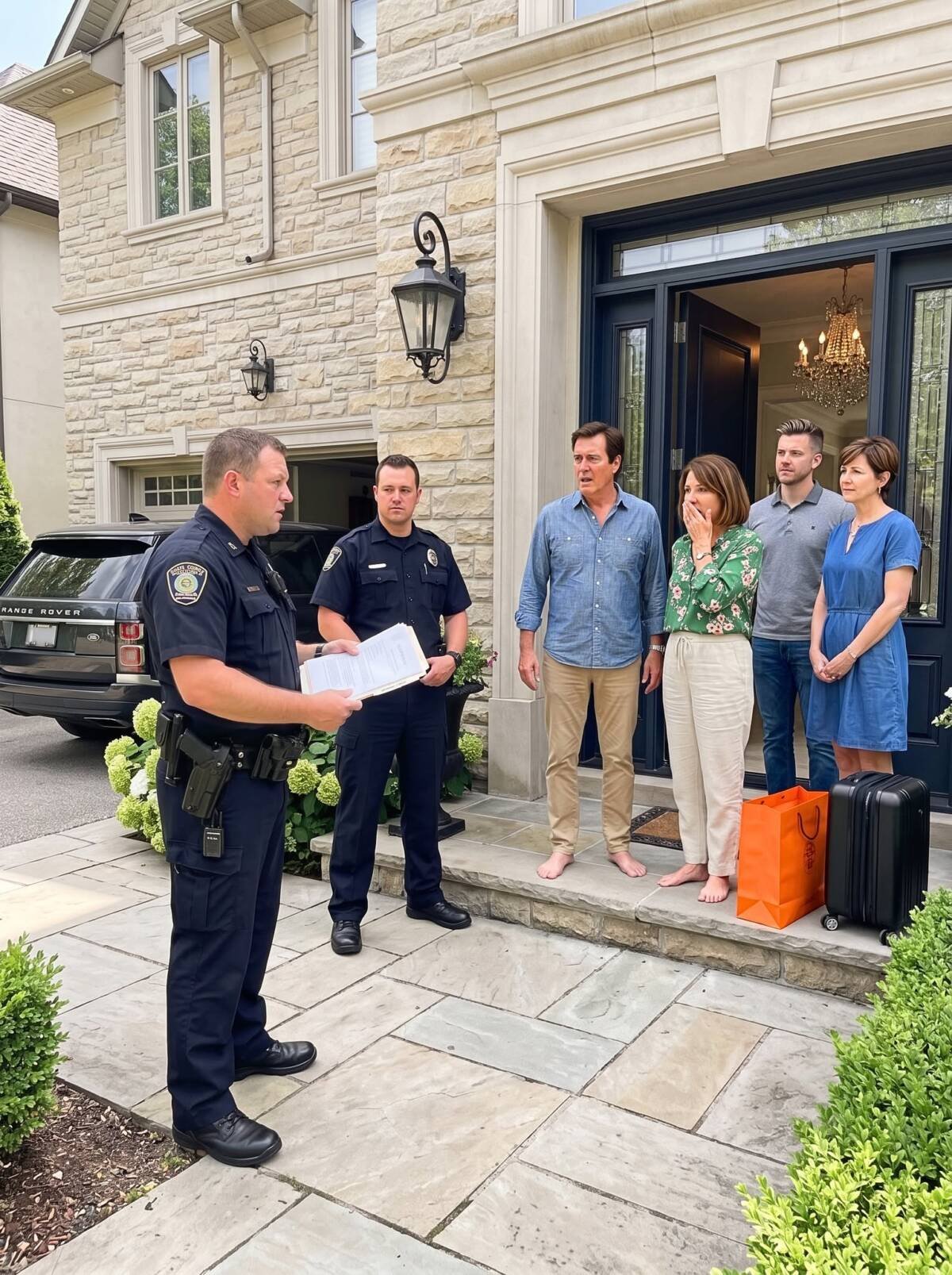
And Daniel had no idea that I was already inside the foyer—accompanied by Margaret, a county court officer, and a detective from the financial-crimes unit.
Daniel dropped his suitcase on the stone steps and began hammering on the glass pane beside the front door.
“Mom! Open the door!”
I pressed the intercom button and looked straight at him through the glass. “State your business.”
His face twisted with disbelief. “I live here!”
“No,” I replied calmly. “You were permitted to stay here while assisting me. That permission has been revoked.”
Kendra pushed past him and stepped up to the intercom. “Our things are still inside!”
Margaret stepped forward and spoke clearly into the mic. “Every item has been packed and inventoried. It will be delivered to the address listed on your temporary protective order.”
Daniel spun toward her voice. “Protective order?”
The court officer stepped out through the side gate and handed Daniel a thick manila envelope. He tore it open, scanning the first page before looking back at the house in shock.
“This is insane!” he shouted. “She’s disabled! I manage everything for her!”
The financial-crimes detective stepped up beside the court officer. “That claim is exactly why we need to talk about forged signatures, attempted property fraud, and forty-eight thousand dollars in unauthorized wire transfers.”
Daniel pointed frantically toward the glass. “She gave me permission!”
I turned the deadbolt and cracked the front door open—leaving the heavy brass security chain firmly latched between us. Daniel stood just feet away, close enough that I could see the panic cracking through his anger.
“Did I give you permission to sell my wheelchair?” I asked quietly.
He froze.
“Did I give you permission to leave me trapped upstairs?”
His jaw clenched. “It was only for a few days.”
“You set water on the floor where I had to crawl for it.”
Kendra grabbed his arm sharply. “Daniel, shut up!”
Margaret raised her phone slightly into view. “This conversation is being recorded.”
That was the moment the color drained from Daniel’s face. Every excuse he offered was turning into another piece of evidence. For the first time in three years, he looked genuinely afraid.
“Mom,” he whispered, his voice breaking. “Please. We’re family.”
I thought of my wheelchair rolling down the driveway. I thought of Kendra’s printed message about putting me somewhere cheap. I thought of Daniel holding out his hand for my debit card before walking out the door.
“Family does not turn a person’s body into a prison,” I said.
As the detective instructed them to step back from the property line, the partnership between Daniel and Kendra shattered on the spot. Within minutes, Kendra was insisting the entire financial scheme had been Daniel’s idea, while Daniel fired back that she had drafted the paperwork and pushed him into it.
Loyalty had been easy when they thought a fortune was waiting at the finish line. The moment consequences arrived, they were eager to throw each other overboard.
A House Without Stairs
The criminal investigation lasted seven months. Faced with bank logs, mirrored hard drives, forged signature drafts, and the recorded phone call, Daniel had nowhere left to hide.
He ultimately pleaded guilty to financial exploitation of a vulnerable adult, forgery, and grand theft. The judge handed down a prison sentence followed by strict probation, along with a court order requiring full financial restitution.
Kendra avoided prison by cooperating with prosecutors, though investigators proved she had actively assisted in preparing fraudulent documents. The state licensing board revoked the professional credential her career depended on. Separately, the trust’s civil attorneys recovered every cent—the $48,000 wire, the canceled travel charges, and the full replacement value of my custom wheelchair.
Getting the money back was straightforward. Healing from the realization of how easily my own son had stopped seeing me as a human being took much longer.
A year later, I sold the big two-story house and moved into a sunlit, single-story home overlooking a quiet lake. It has wide hallways, roll-in showers, lowered cabinets, and a smooth stone path winding all the way down to the garden.
There are no stairs.
My new custom wheelchair fits me like a glove, and for the first time in years, I move through every room of my home without waiting for anyone’s permission or schedule.
Through the trust, I also established a small charitable foundation with a single mission: providing emergency mobility equipment to disabled adults whose relatives or caregivers have sold, withheld, or damaged the chairs they depend on.
The very first chair we delivered went to a retired teacher whose niece had left her stranded indoors for months. When the new chair arrived and she rolled herself out onto her front porch into the afternoon sun, she broke down crying.
Sitting beside her in my own chair, I cried too.
Daniel had understood the resale price of my wheelchair. He had never understood its human value.
From prison, he began sending letters. The first few were filled with excuses—money stress, Kendra’s influence, bad timing. Later, the excuses softened into apologies. Eventually, the apologies turned into polite requests for money to help him “start fresh” once he was released.
I left almost all of them unanswered.
Then one envelope arrived in which Daniel mentioned the family trust again—writing that he finally understood why Thomas and I had protected it so carefully, and asking if I might release just enough funds to help him rebuild his life.
That time, I decided to write back.
I placed a crisp photocopy of the trust’s protection clause inside an envelope—the exact provision he had once mocked as meaningless paperwork for old people, and the exact clause that had frozen his world before his plane ever left the tarmac.
At the bottom of the page, I wrote two sentences in neat black ink:
You were right that I did not go anywhere.I was waiting for you to leave.
I sealed the envelope and set it by the front door for the mail carrier.
Daniel had believed my wheelchair was proof that I was trapped. He had believed my dependence made me weak, my age made me easy to manipulate, and my life’s work was simply an inheritance waiting for him to claim.
He was wrong on every count. My legs may never carry me through another doorway—but nobody will ever again decide for me which doors I am allowed to open.
Do you think Evelyn did the right thing by cutting Daniel off completely, or would you have given your child a second chance after prison? Share your thoughts in the comments below, and pass this story along to someone who needs a reminder that independence and dignity are never for sale.