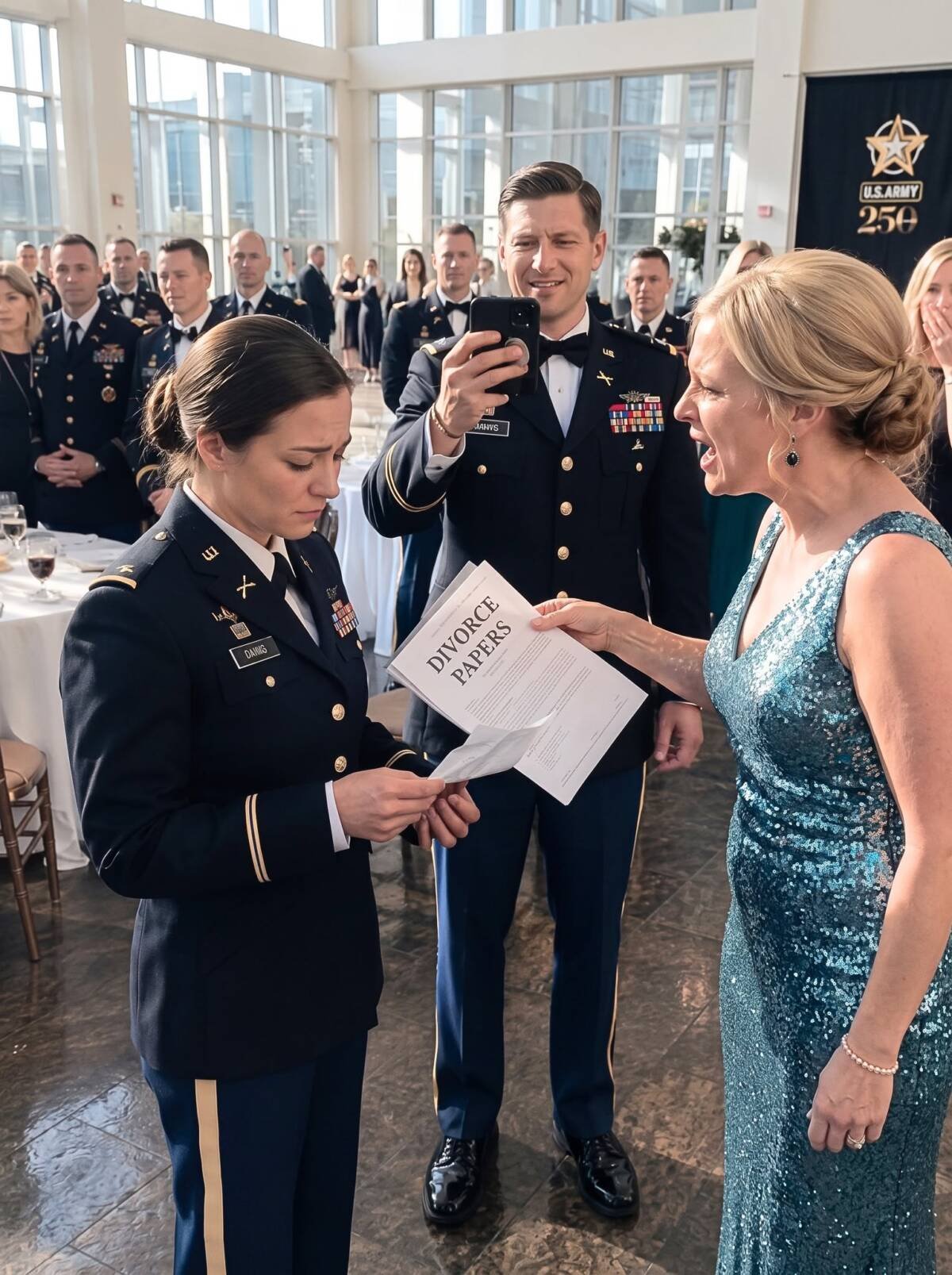
At 8:12 on the morning of my parents’ fortieth wedding anniversary, my phone lit up on the kitchen counter of my Cambridge apartment. I was wearing an old gray sweatshirt—the exact one my mother had once called “proof that I had given up”—and pouring my first cup of coffee when I read the message.
“Don’t come tonight. Only high-society guests will be there. We don’t want things to feel awkward.”
I didn’t call to argue. I didn’t ask for an explanation. I simply typed one word back—“Understood.”—and prepared to spend a quiet Saturday evening alone.
I had no idea that less than eleven hours later, my mother would drop her champagne glass in the middle of a crowded Boston ballroom, my father would be desperately demanding my presence, and a glossy booklet sitting on their banquet tables would expose a betrayal far worse than an uninvited text message.
The Daughter Who Never Fit the Frame
My name is Hannah Reed. At thirty-six, unmarried, and deeply absorbed in my work, I had never fit the polished portrait my parents liked to hang in front of their friends. In the version of my life they casually shared at country club dinners, I was still doing “computer work for some little medical company” somewhere across the river.
My younger sister, Olivia, was the daughter they preferred to display. She had married a prominent cardiologist, lived in a restored brownstone in Beacon Hill, wore tailored neutrals that never wrinkled, and knew every unspoken rule of Boston’s social circles. Whenever my parents hosted a dinner or attended a charity gala, Olivia was the one standing beside them in the photographs.
Their fortieth anniversary was supposed to be their crowning moment. They had booked the grand ballroom at Boston’s Ashford Hotel for two hundred guests, complete with tiered champagne displays, white floral centerpieces, and a live string quartet. For weeks, my father had talked about the event with unmistakable pride, calling it “the room where people finally see what we built.”
Evidently, I was not part of that picture.
When I sent my one-word reply that morning, I felt a familiar sting, though not surprise. I had spent years learning that my parents measured affection by utility and optics. The last time I had shared good news with them—a major promotion years earlier—my father’s first response hadn’t been congratulations. It had been to ask how much money I could lend Olivia for a kitchen renovation.
That conversation had taught me a quiet lesson: if I ever built something truly meaningful, I needed to keep it out of their reach.
The 6:47 PM Phone Call
By early evening, the rain had started tapping against my apartment windows. I had ordered takeout, opened a technical report, and settled onto the couch. At 6:47 PM, my phone rang. Olivia’s name flashed across the screen.
I almost let it go to voicemail. When I finally answered, the background noise was unmistakable—the low hum of two hundred voices, the clinking of glassware, and the faint swell of violins. Above it all, Olivia’s voice was trembling.
“Hannah, why did you hide this from the family?”
“Hide what?” I asked.
“Turn on Channel Seven. Right now.”
I reached for the remote and switched on the television. The local evening news was running a business segment, and filling the screen was a recorded interview I had given earlier that afternoon. Beneath my face, bold white letters scrolled across the bottom banner:
NORTHSTAR MEDICAL ROBOTICS ANNOUNCES $118 MILLION PARTNERSHIP
The anchor was explaining how Northstar—a company I had founded nine years earlier in a cramped, rented workshop behind a suburban rehabilitation clinic—had just secured a national distribution agreement with one of the largest hospital networks in the country.
My family knew I worked at Northstar. What they didn’t know was that I had built it from the ground up, survived three near-bankruptcies to keep it alive, and still held the controlling interest. Keeping my ownership private had never been about secrecy for its own sake; it had been about survival. It was the only way to build a company without every milestone turning into a family financial opportunity.
On the screen, the anchor called me “one of Boston’s most closely watched medical-technology founders.”
On the other end of the line, Olivia went silent for several seconds.
“Mom just dropped her glass,” she whispered.
Before I could respond, I heard my father’s voice cut through the background noise, sharp and urgent.
“Give me the phone.”
There was a brief scuffle, and then my father was on the line. The man who had excluded me from his anniversary twelve hours earlier suddenly sounded frantic.
“Hannah, get dressed and come to the Ashford right now.”
“You told me not to come,” I said calmly.
“This is different.”
“No,” I replied. “It’s exactly the same.”
The Booklet on the Ballroom Table
Before my father could push further, my phone buzzed with an incoming text from Olivia. I pulled the phone away from my ear and opened the photo she had just sent.
Resting beside a half-empty champagne flute on a white tablecloth was a heavy, glossy investment booklet. Across the cover, printed in gold foil, were the words:
REED CAPITAL DEVELOPMENT — STRATEGIC PARTNER: NORTHSTAR MEDICAL ROBOTICS
My stomach dropped. I had never discussed, reviewed, or approved any partnership between my company and my father’s real estate firm.
I ended the call with my father immediately and dialed Maya Collins, Northstar’s general counsel. In six years of working together, Maya had taught me one rule above all others: panic only makes legal and financial crises more expensive.
“Send me the photograph,” Maya said the moment I explained what I was looking at.
Three minutes later, she called back. Using a clearer set of photos Olivia had quietly snapped from the table, Maya broke down what the booklet actually claimed. It presented Northstar Medical Robotics as the anchor investor in a luxury senior-living development my father had been trying to finance outside Boston. It cited a minimum $2 million commitment and strongly implied that I had personally authorized the arrangement.
None of it was true.
Minutes later, Olivia called again, her voice tighter than before.
“People are asking questions,” she said. “Dad told everyone earlier tonight that you were arriving late to make a special announcement.”
Everything clicked into place. My father hadn’t called because he was suddenly proud of me. He had called because his story was unraveling in real time.
“Did you know about the booklet?” I asked her.
There was a painful pause on the other end.
“I knew he was using your company’s name,” Olivia admitted quietly. “I thought you had agreed.”
Before I could process that, my father called back from his own phone. He skipped the apologies and went straight to damage control, insisting that nothing had formally closed and that I could fix the entire situation simply by walking into the ballroom, shaking a few hands, and telling investors we were “exploring” the project.
“We aren’t exploring anything,” I told him.
“You have a hundred and eighteen million dollars!” he snapped.
“No,” I said evenly. “My company has a national distribution partnership valued at that amount. That is not personal cash sitting in my checking account.”
Instead of concern, his voice hardened with irritation. “You’re embarrassing us.”
“You excluded me this morning because I embarrassed you,” I reminded him.
Then my mother took the phone, switching to the soft, pleading tone she always used when she wanted me to back down.
“Hannah, there are very important people here tonight,” she said. “Your father has spent months building these relationships. Please don’t destroy this evening just because your feelings are hurt.”
I looked back at the text message from 8:12 AM, still sitting at the top of my screen.
“Did either of you ever plan to tell me you were using my company?” I asked.
Silence stretched across the line before my mother answered.
“We were going to explain after the commitments came in.”
The Signature I Never Wrote
That single sentence confirmed this was far beyond an unauthorized brochure. Seconds later, Maya called back with an urgent update. Through back-channel calls with the development’s financial contacts, she had learned that one investor had already wired $400,000 into escrow after reviewing the booklet. A second had signed a formal letter of intent. Both documents explicitly referenced Northstar’s supposed backing.
“Do not go to that hotel,” Maya ordered. “Do not say a single word that could be interpreted as confirming or even considering this deal. Stay home and let me handle the legal side.”
When I relayed Maya’s instructions to my parents, my father exploded. In his mind, the crisis wasn’t that he had misrepresented a $118 million medical-tech company to solicit investor money—it was that I refused to cover for him.
“You would let your own father lose everything over paperwork?” he shouted.
Before I could answer, I heard Olivia gasp in the background. A guest had just handed her another sheet from the investor packet. Seconds later, another photograph arrived on my phone.
I opened it and felt the air leave the room.
It was a formal approval page stating that I had personally authorized Northstar’s investment in Reed Capital Development. At the bottom was my signature—convincing enough to fool anyone who didn’t know my handwriting, yet unmistakably forged.
Directly beneath it, on the line marked Witness, was my mother’s name.
In that moment, the insulting text message from that morning stopped mattering. The ballroom, the champagne, the string quartet—none of it mattered anymore. This was no longer a family slight.
It was evidence.
The Collapse of the Ballroom
I forwarded the signature page to Maya immediately. Within the hour, Northstar’s legal team moved with surgical precision.
Maya contacted the management of the Ashford Hotel and issued a formal preservation notice for all security footage covering the ballroom, entrances, registration tables, and event staff. She also requested that the event coordinator secure copies of every investor packet distributed that evening so no pages could quietly disappear.
Simultaneously, Maya notified the escrow agent handling the development funds that Northstar Medical Robotics had never authorized any investment in Reed Capital Development and demanded an immediate freeze on any disbursement. The $400,000 remained locked in escrow. The second investor was formally notified that Northstar disputed every representation made in the booklet.
When my father called again around 9:00 PM, his anger had vanished, replaced by the smooth, controlled voice he used whenever he wanted to reframe a disaster as a minor misunderstanding.
“Hannah, we can still straighten this out,” he said.
“There is a forged signature on your investor packet.”
“Nobody forged anything,” he replied quickly. “It was preliminary. Just a placeholder to reassure people until the final paperwork was ready. Nobody has lost a dime.”
“Four hundred thousand dollars is sitting in escrow because someone believed my company was backing your project,” I said.
“You’re making this much bigger than it needs to be.”
“No,” I answered. “I think you were counting on me making it smaller.”
When my mother came back on the line, she didn’t bother denying it. Instead, she leaned on guilt.
“Your father was desperate, Hannah. The project has been struggling for months. We thought once you understood how much was at stake, you would agree. You always help family.”
“And that made you think you owned my signature?”
She had no answer for that.
By 9:30 PM, the anniversary celebration had effectively collapsed. The string quartet kept playing, and the champagne towers still sparkled under the chandeliers, but the energy in the room had soured. Small groups of guests were stepping into the hallway to call their attorneys, while my father stood near the bar trying to explain why the founder of his “strategic partner” had never walked through the doors.
I stayed in my apartment. For years, whenever my family created a crisis, I had been the one expected to cross the city, write the check, and quietly absorb the fallout. That night, for the first time, I let the consequences stand.
The Morning After
The following morning, my parents and Olivia arrived at my building. I didn’t invite them upstairs. Instead, I met them in the ground-floor conference room with Maya seated beside me and copies of the investment booklet spread across the table.
With no room left to maneuver, my father finally told the truth. Rising construction costs had driven original backers away from his luxury senior-living project. Desperate to keep it afloat, he had poured in most of his retirement savings and borrowed heavily against my parents’ home. When industry rumors began circulating about Northstar’s massive hospital partnership, he saw a lifeline.
“You could have asked me,” I said.
“You would have said no,” he replied, staring at the table.
“So you already knew my answer.”
He hired a marketing consultant to design the glossy booklets, but the signature page required something more personal. My mother quietly admitted she had pulled an old copy of my signature from family trust documents, convincing herself it was only temporary—that I would forgive them once I saw how much my father stood to lose.
Beside them, Olivia began to cry. She admitted she had helped curate the anniversary guest list knowing many of the attendees were prospective investors, though she swore she had never seen the forged signature page.
“But you knew they were using Northstar,” I said.
“I thought you had agreed.”
“You never asked me.”
She lowered her eyes. “No.”
The anniversary party had never been a celebration of forty years of marriage. It had been a high-society fundraising pitch—one where they had deliberately excluded the daughter they found socially inconvenient while using her company, her reputation, and her fabricated approval to impress the room.
Northstar issued a formal public statement confirming it had no financial or strategic relationship with Reed Capital Development. The $400,000 in escrow was returned to the investor, and the letter of intent was withdrawn. Through Maya, the matter was resolved via civil channels: full reimbursement of legal costs and a formal written acknowledgment that my authorization had never existed.
Without new financing, my father’s development collapsed. Over the next several months, my parents were forced to sell their Cape Cod vacation condo and the development parcel itself to cover their debts. The curated, high-society lifestyle they had spent decades projecting shrank almost overnight.
The People Who Were There Before the Headline
Months passed before Olivia offered a real apology. She didn’t apologize for the phone call on the night of the anniversary; she apologized for the years leading up to it.
“I knew they treated you differently,” she told me over coffee one afternoon. “I just liked being the daughter they were proud to display.”
It was an honest confession, and it hurt—but it was also the first real thing she had said to me in years. Slowly, we began to rebuild a relationship on new terms. One evening, she asked why I had never told any of them that I founded Northstar.
“Because I wanted one thing in my life that belonged to me before it became useful to everyone else,” I told her.
“I wish you had trusted me,” she said softly.
“I wish you had given me a reason to.”
Exactly one year after my parents’ anniversary party, Northstar Medical Robotics opened a new rehabilitation center outside Boston. There were no champagne walls, no string quartets, and no guest list engineered to impress wealthy strangers. Instead, I invited the engineers who had spent sleepless nights debugging prototypes, the physical therapists who had tested our early machines, and the patients who had trusted us long before a news anchor ever said our name.
My parents were not invited.
When my mother found out, she called me, her voice filled with genuine disbelief.
“Are you really excluding us?”
Her question echoed the text message I had received exactly one year earlier.
“No,” I said calmly. “I’m just choosing the people who were there before the headline.”
She stayed silent for a long moment. After a few seconds, I ended the call. There was nothing left to argue about.
Standing inside that bright, crowded rehabilitation center, surrounded by people who had believed in my work when it was still just an idea in a rented workshop, I realized something I had spent thirty-six years trying to understand.
Losing my parents’ approval hadn’t left the emptiness I once feared. Instead, it had made room for the people who valued me before there was a $118 million headline attached to my name.
A year earlier, being told I wasn’t good enough for their ballroom would have made me wonder what I needed to change to finally earn a seat beside them. Now, I understood the truth they had unintentionally taught me:
A seat at someone else’s table means very little when you’ve spent your entire life building one of your own.
What would you have done if you were in Hannah’s shoes? Would you have exposed the forged signature immediately, or tried to handle it quietly within the family? Share your thoughts in the comments below.