When my mother calmly suggested that I lock my twelve-year-old daughter upstairs so forty anniversary guests could drink champagne beneath her bedroom, I didn’t yell. I didn’t cry. I didn’t even try to argue anymore.
Something inside me simply went completely quiet.
My daughter, Sophie, had been home from the hospital for exactly nine days. Before that, seven months of our lives had vanished into sterile rooms, surgical masks, daily blood draws, and terrified conversations with oncologists after her leukemia stopped responding to standard treatment. She had survived a grueling bone-marrow transplant, and her doctors had been crystal clear: her immune system was starting from zero. A single routine virus carried in by a crowd could put her right back in the ICU.
My parents didn’t want to hear it. They had already sent invitations for their fortieth anniversary—using my twenty-three-acre Oregon farmhouse as the venue without ever asking my permission. When I refused, my mother told me to just lock Sophie in her room with a tablet and some snacks.
So I calmly told her, “Fine.”
She hung up believing she had finally won. She had no idea that by the time their trucks, florists, and rental vans rolled up to my front gate that Saturday morning, the locks would already be changed—and a county sheriff’s deputy would be waiting to greet them.
Nine Days Home
To anyone who hadn’t lived through the last seven months with us, Sophie might have looked almost like any other twelve-year-old girl. She was thinner than before, her skin still carried a pale, translucent quality, and her dark hair was only beginning to grow back in soft, uneven tufts.
Still, she was home. And after months of sleeping in vinyl hospital recliners listening to the rhythmic beep of IV pumps, having her under our own roof felt like a miracle.
Our farmhouse sat on twenty-three quiet acres outside Mill Creek, Oregon—white clapboard siding, a forest-green metal roof, a wide wraparound porch, and a weathered red barn tucked behind the pasture. My late husband, David, and I had bought the property fourteen years earlier, before Sophie was born. After David died in a car accident five years ago, well-meaning acquaintances often assumed the farm must feel too big and too lonely for just the two of us.
They never understood. The farmhouse was the one place on earth where Sophie and I never felt like our family had disappeared.
My parents loved the farm, too. Over the years, however, their fondness for the property had quietly curdled into entitlement. My mother, Diane, treated my wraparound porch and red barn like her personal event venue—hosting graduation lunches, Thanksgiving photo shoots, my father’s retirement dinner, and my sister Rachel’s engagement party.
Most of the time, I said yes.
That had been my mistake. When you say yes often enough to people who don’t respect boundaries, they eventually stop seeing generosity and start assuming ownership.
Three weeks before Sophie’s discharge, my mother called while I was sitting beside Sophie’s hospital bed, watching her sleep.
“Your father and I have decided where we’re hosting our fortieth anniversary,” Mom announced brightly.
“Where?” I asked, lowering my voice so I wouldn’t wake Sophie.
“The farm.”
At first, I assumed she meant a quiet family dinner months down the road, once Sophie’s blood counts had stabilized. “That could be lovely once Sophie is stronger.”
“No, honey. August fifteenth.”
I glanced at the calendar app on my phone, and my stomach dropped. “Mom, that’s twelve days after she comes home.”
“I know.”
“No.”
She let out a light, dismissive laugh, as if I were joking. “You haven’t even heard what I’m planning. Forty people. A full caterer. A white tent near the barn. Live acoustic music.”
I actually pulled the phone away from my ear to stare at it. “Forty people?”
“Well, maybe forty-two.”
“Absolutely not.”
A sharp silence fell on the line before her tone turned ice-cold. “Excuse me?”
“Sophie cannot be around forty people less than two weeks after a bone-marrow transplant,” I said firmly. “Her doctors gave us strict isolation protocols.”
“They’ll be downstairs and outside,” Mom replied impatiently.
“That isn’t how germs—or houses—work.”
She slipped effortlessly into the patronizing voice she had used since I was a teenager whenever I stood in the way of something she wanted. “Oh, Claire. You’ve become unbelievably anxious about everything.”
“Her transplant team is anxious about infection, too.”
“Well, they don’t have to live.”
My fingers tightened around the phone. “Neither do forty anniversary guests.”
“This is our fortieth, Claire.”
“And Sophie is twelve.”
“What does that have to do with anything?”
Everything. Instead of arguing in circles, I repeated the only sentence that mattered. “You cannot host the party at my house.”
Mom exhaled a theatrical sigh. “We’ve already sent out the invitations. The save-the-dates went out weeks ago.”
“You never asked me.”
“I didn’t think I had to,” she snapped. “It’s family property.”
“No, Mom. It’s my property.”
Immediately, she brought up every fence post my father had helped mend and every afternoon he had spent helping repaint the barn trim—conveniently forgetting that I had bought every gallon of paint, paid for every board, and insisted on compensating him for his time.
“We have relatives flying in,” she said coldly. “Do you have any idea what it would cost to change venues now?”
“Probably less than another week in pediatric intensive care.”
She hated that answer. “You are being wildly dramatic.”
“Sophie just had a bone-marrow transplant.”
“I know what she had.”
“Then act like it.”
Mom hung up on me, and for a few naive days, I hoped that was the end of it.
“Lock Her Upstairs”
Four days later, we brought Sophie home.
When I rolled her hospital wheelchair up beside our front porch, she looked up at the white siding and the window of her upstairs bedroom, and tears immediately spilled down her cheeks.
“I thought I’d never sleep in my own bed again,” she whispered.
I knelt beside her chair and kissed the top of her head. “You’re sleeping there tonight.”
For the first week, she mostly stayed in her room or sat bundled in a blanket on the porch when the Oregon afternoon was mild. She watched the chickens scratch around the yard and kept a running notebook list of everything she planned to eat the day—in her exact words—“the doctors finally stop ruining everything.”
Sitting at number one on her list, underlined twice, were gas station nachos.
I told her even healthy people should be legally afraid of gas station nachos. She laughed—a real, bright, breathless laugh that sounded like the best music I had ever heard.
Then came Thursday morning—two days before my parents’ anniversary.
I was washing dishes when a crisp white catering van crunched up the gravel driveway. A man in a neat polo shirt stepped out holding a clipboard and walked up to the porch.
“Mrs. Bennett?” he asked politely.
“That’s me.”
“I’m here to do a quick walkthrough and confirm gate access for Saturday.”
My stomach sank. “Access for what?”
“The Carter fortieth anniversary.”
My parents were Diane and Robert Carter.
“There is no Carter anniversary event happening here,” I said evenly.
The man blinked, glancing down at his clipboard. “I have a signed contract right here.”
“With whom?”
“Diane Carter.”
“She’s my mother. And she does not own this property.”
His polite smile vanished. I asked to look at the agreement, and what I saw made my jaw tighten. My mother hadn’t paused for a single second after our phone call. She had booked a three-course buffet for forty guests, banquet tables, linens, a portable bar, and two servers—all listing my farmhouse address as the venue.
Down at the bottom, on the line labeled Property Contact, she had written four words that almost made me laugh out loud:
Diane Carter — family owner.
I didn’t raise my voice at the caterer. I simply took clear photos of the paperwork with my phone and calmly explained that no vendors would be permitted onto the property Saturday. He apologized profusely, and I assured him none of this was his fault.
Exactly one hour later, my phone rang.
“You embarrassed me in front of my caterer!” Mom exploded the second I answered.
“You lied to a vendor and called yourself the owner of my home.”
“Claire, stop hiding behind technicalities!”
Apparently, a legally recorded property deed was now a technicality.
“The party is not happening here,” I said.
“Yes, it is! You cannot cancel forty guests two days before our anniversary!”
“You invited forty guests to a home you don’t own.”
Her voice rose to a sharp pitch. “After everything we have done for you!”
Through the kitchen doorway, I could see Sophie curled up asleep on the living room sofa beneath one of David’s old flannel quilts.
“Then do one more thing,” I said quietly. “Protect your granddaughter.”
The line went silent for two seconds. For one fleeting heartbeat, I thought I had finally reached her.
Then she spoke.
“Lock her upstairs.”
I genuinely thought I had misheard her. “What did you just say?”
“Put Sophie upstairs,” Mom repeated coldly. “Lock her bedroom door if you’re so paranoid. Guests can stay downstairs and outside. She’s twelve, Claire—give her a tablet and some snacks. She’ll survive one afternoon.”
Survive.
After seven months of watching my child fight tooth and nail just to stay alive, my mother was using the word survive to explain why her party mattered more than my daughter’s immune system.
“You want me to lock my immunocompromised child in her bedroom while forty people use our kitchen, hallways, and bathrooms?”
“You’re twisting my words. She’s not dying, Claire.”
I looked back at Sophie sleeping beneath her father’s quilt, her dark eyelashes resting against cheeks that were still far too pale. And in that exact second, I realized I was done trying to make my mother understand.
“Fine,” I said calmly.
Mom stopped mid-breath. “What?”
“You heard me. Fine.”
Immediate, smug relief washed into her voice. “I knew you’d calm down once you thought about it. Guests arrive at two on Saturday. Your father and I will be there around eleven to set up.”
“Okay.”
“I love you, honey.”
“Sure.”
I ended the call. My mother thought she had finally worn me down. What she didn’t realize was that the moment she told me to lock Sophie upstairs, I had stopped negotiating—and started making phone calls.
Changing the Locks
My first call was to Sophie’s transplant coordinator, who confirmed in writing that hosting forty guests inside the house directly violated Sophie’s post-transplant safety protocols.
My next three calls were to the caterer, the rental company, and the acoustic musician, notifying each of them that no event had been authorized at my address.
My final call was to Melissa Grant, the attorney who had handled David’s estate.
“Do your parents hold any ownership interest in the farm?” Melissa asked briskly.
“None.”
“Any lease or recorded easement?”
“No.”
“Do they have a key?”
I hesitated. Both of my parents still had spare keys I had given them years ago for emergencies. “Yes.”
“Revoke permission and demand the keys back in writing immediately,” Melissa said.
Within ten minutes, I sent an identical written notice to both my mother and father via text and email. It left zero room for interpretation: the anniversary party was unauthorized, they no longer had permission to enter my property without my express consent, all spare keys were to be returned, and no guests or vendors would be allowed past the gate.
Mom called back instantly. I let it ring straight to voicemail.
Dad replied by text.
Stop being ridiculous. We are your parents. We will be there Saturday.
Fifteen minutes later, a second message lit up my screen: I am not asking permission to visit my daughter’s house.
I forwarded screenshots of every message to Melissa, who told me to save everything. This was no longer a family squabble; my parents had been formally notified that they did not have permission to enter my property, and they were putting in writing that they intended to trespass anyway.
On Friday afternoon, my sister Rachel called, immediately treating the chaos as a mess I was obligated to clean up.
“You need to fix this, Claire. Mom is losing her mind. She already paid deposits.”
“She paid deposits without permission.”
Rachel sighed heavily. “Can’t Sophie just stay somewhere else for the afternoon?”
I actually laughed out loud. “You want the twelve-year-old who just came home from a bone-marrow transplant to leave her own house so Mom can pour champagne in it?”
“You don’t have to make it sound so dramatic. It’s one day.”
“It’s one day for Sophie, too.”
“You always have to make everything about yourself,” Rachel snapped.
I hung up. Ten minutes later, my driveway security camera pinged my phone. Dad’s pickup truck was rolling up toward the house.
From inside the kitchen, I watched him climb the porch steps and slide his old brass key into the front deadbolt. It didn’t turn—because a locksmith had already replaced every exterior lock on the house that morning. Instead of leaving, he rattled the knob harder, frowned, and started walking around the porch toward the side door.
I stepped out onto the front porch. “Dad.”
He froze, turning back with his face flushing crimson. “You changed the locks?”
“Yes.”
“You gave me that key!”
“Years ago. And yesterday I revoked permission.”
He stared at me in genuine disbelief. “You’re really doing this over one party?”
“I’m doing this because neither of you knows how to hear the word no.”
He gestured broadly at the farmhouse. “We helped you keep this place running after David died!”
“And I appreciated your help,” I said evenly. “I also paid for the materials and your labor, and I pay the mortgage, taxes, and insurance. Helping me does not put your name on my deed.”
His jaw locked. “We’re coming Saturday. You can’t stop forty guests from showing up.”
That sentence made my next move effortless. I raised my phone, hit record, and pointed it calmly toward him. “Are you stating that you intend to enter my property tomorrow after I have explicitly told you not to?”
His eyes widened. “You’re recording your own father? You’ve lost your mind.”
“Answer the question.”
Without another word, he pivoted, marched back to his truck, and sped down the gravel drive.
Ten minutes later, I called the county sheriff’s non-emergency line. I didn’t exaggerate or ask for anyone to be arrested. I simply laid out the facts: I was the sole owner of the property, an unauthorized event for forty people had been scheduled there without my consent, my parents had stated in writing and in person that they intended to come anyway, and my twelve-year-old daughter was recovering from a bone-marrow transplant inside the house.
That afternoon, I drove to the sheriff’s substation with my ID, property deed, security footage, text screenshots, and Melissa’s letter. Everything was logged officially, and a deputy contacted my parents to formally advise them that they did not have permission to enter the farm.
Even then, Mom couldn’t stop. Late Friday night, one more text arrived from her:
You won’t humiliate us in front of forty people. We’ll discuss this after the party.
I didn’t reply.
Saturday at the Front Gate
Saturday morning, Sophie woke up shortly after eight and immediately asked if Grandma was coming.
“No party,” I promised her softly.
Relief washed across her face—followed almost instantly by a flicker of guilt. “Is Grandma mad at me?”
“No, sweetheart.”
“But if I hadn’t gotten sick—”
“Stop right there,” I interrupted gently, sitting on the edge of her bed. “This is your home. You never apologize for needing it to be safe.”
Sophie pulled her blanket up to her chin, hesitating. “Then why did Grandma say I’m ruining their anniversary?”
My blood went cold. “When did she say that?”
“She texted me last night.”
I held out my hand. Sophie passed me her phone, and there on the screen were two messages from my mother sent at nine o’clock the night before:
I’m sorry your mother has decided nobody can celebrate because of your medical situation. We love you, but forty years of marriage only happens once.
Hopefully when you are older you will understand compromise.
I stared at the screen in stunned silence. My mother had bypassed me entirely to guilt-trip a sick twelve-year-old child.
I took screenshots of both texts and blocked my mother’s number on Sophie’s phone.
“Am I being selfish, Mom?” Sophie asked quietly.
“No,” I said firmly. “They are angry because they were told no, and they decided the word no didn’t apply to them. That has nothing to do with you.”
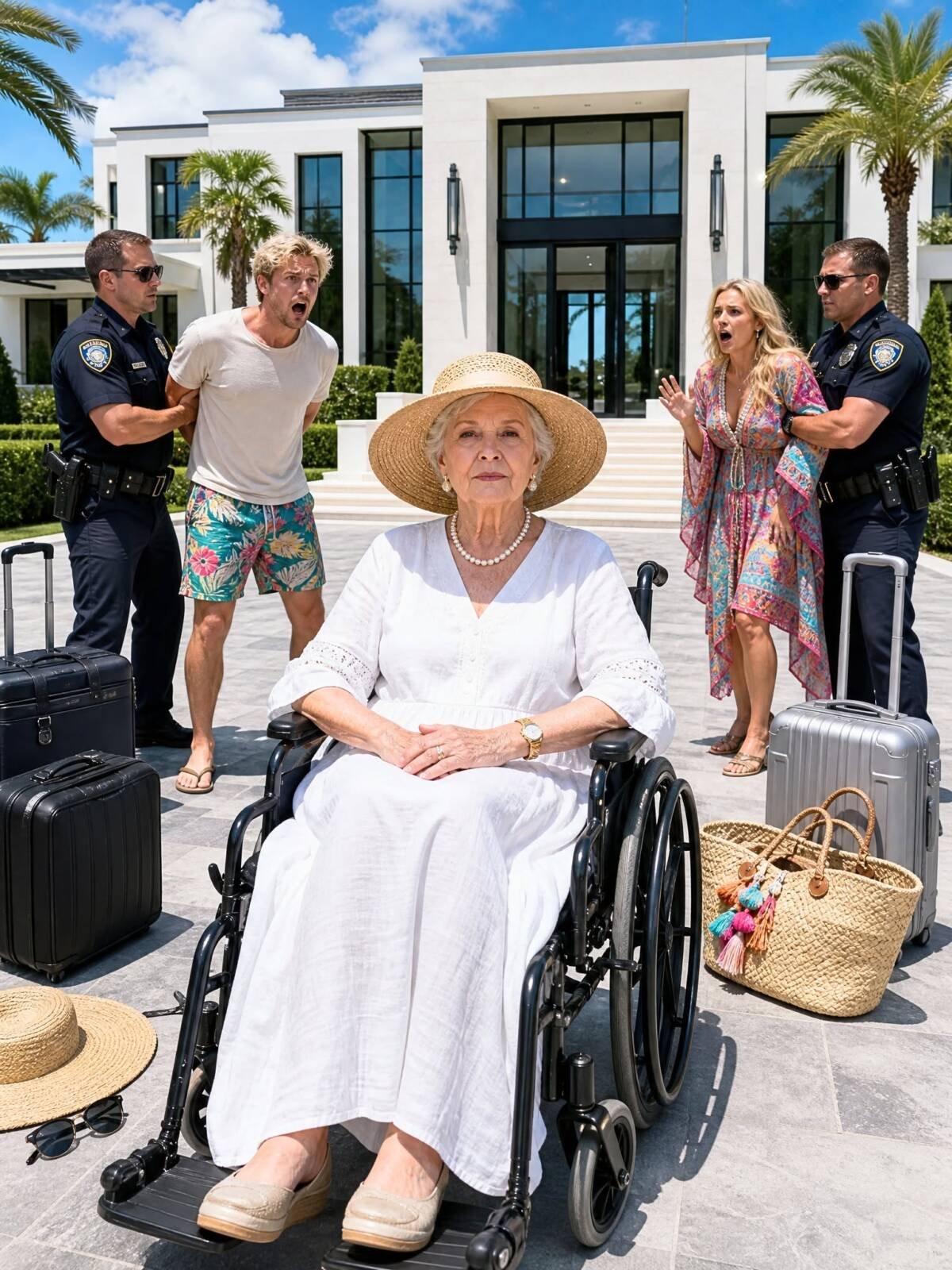
At 10:30 a.m., a county sheriff’s patrol SUV rolled up to the front gate. Deputy Aaron Cole stepped out and stationed himself calmly beside the entrance while a second unit parked down the county road.
At 10:53, Dad’s pickup appeared with Mom in the passenger seat, followed closely by Rachel’s SUV, a florist’s delivery van, and a box truck loaded with folding chairs.
Through the security monitor, I watched Dad brake sharply at the sight of the patrol vehicle. Mom jumped out first and marched straight toward Deputy Cole while Dad followed slowly behind her.
Thirty seconds later, my phone rang.
“What have you done?!” Mom shrieked. “You called the sheriff on your own parents?!”
“I told you the event was canceled.”
“You said fine!”
“I said fine after you told me to lock Sophie upstairs,” I replied calmly. “Then I sent you written notice revoking permission, and the sheriff’s office called you yesterday.”
“There are forty people on their way! Tell this man to open the gate!”
“No.”
I heard rustling as Dad took the phone from her hand. His voice dropped into the tired, authoritative tone he had always used to bring me back in line.
“Claire, this is enough. This deputy says we’re trespassed from our own daughter’s farm. Are you really going to destroy this family over a party?”
“No, Dad. You told me you were coming regardless of my permission.”
“Your mother is crying out here.”
I glanced up the staircase. Sophie was sitting quietly on the top step, hugging the worn stuffed fox she had carried through seven months of chemotherapy.
“My daughter cried last night,” I said, my voice shaking for the first time all week, “because Mom texted her directly and told her she ruined your anniversary.”
The line went dead silent.
“What?” Dad whispered. “Diane texted Sophie?”
“You didn’t know?”
I heard him pull the phone away from his ear. “Diane?” Muffled arguing echoed in the background before he came back on the line. “Send me the messages.”
I hung up and texted him the screenshots.
On the security monitor, I watched my father stand beside his truck, staring down at his phone while my mother talked frantically beside him. Slowly, the florist’s van and the chair truck backed out and turned down the road.
Then, for the first time in the entire ordeal, Dad stepped several feet away from Mom.
At 11:17, he called me back.
“Did Sophie read all of that?” he asked quietly.
“Every word.”
“I’m sorry, Claire. I didn’t know she messaged her.”
“You knew she told me to lock Sophie upstairs, Dad. You were on speakerphone.”
He didn’t try to defend himself. “What do you want me to do?”
“Leave the property.”
A long, heavy silence stretched across the line. Then, finally, came the one word I had been waiting weeks to hear.
“Okay.”
Dad called the forty guests himself and moved the anniversary dinner to a local banquet hall owned by an old friend. Mom told everyone there had been a “family emergency.” In a way, she wasn’t lying—she was just wrong about what the emergency actually was.
The Farm Was Never Theirs
I thought the locked gate and the sheriff’s visit would end it. By Sunday evening, Rachel called and proved how wrong I was.
“Mom is telling everyone you’re trying to steal the farm from them,” Rachel said flatly.
I blinked. “Steal my own farmhouse?”
“She says Dad put years of sweat equity into that place and they always understood it was the family farm—that it would stay in the family for everyone to use.”
“It is in the family,” I said. “Sophie and I own it.”
After hanging up, I called Melissa again. She suggested we pull a full check on the property address just to be safe. The deed, mortgage, tax records, and insurance were airtight—my parents’ names appeared nowhere.
Then Melissa paused, her eyes narrowing at her laptop screen.
“Claire… did you ever authorize your mother to register a business at your address?”
“What? No.”
She turned the screen toward me. Months earlier, Diane had registered a boutique event-planning LLC with the state—listing my red barn and farmhouse as her operating venue. Worse, Melissa pulled up an active promotional webpage featuring glossy photos of my porch, my pasture, and my barn, advertised as a “private rustic family estate available for intimate celebrations.”
Sitting on the porch steps in the corner of one of the promotional photos was Sophie, two years earlier.
My stomach turned. My mother hadn’t just gotten comfortable hosting family dinners at my house. She had been preparing to rent out my home—and using a photo of my daughter to market it.
Melissa drafted formal cease-and-desist notices immediately, archiving every webpage and business filing before Mom could delete them.
Two days later, Dad called and asked—for the first time in his life—if he could come over alone to talk. When he arrived, he stopped at the bottom of the porch steps and waited until I invited him up.
“I didn’t know about the business,” he said quietly, staring out toward the red barn. “I didn’t know she was advertising your place. I should have.”
He admitted that for years, whenever Mom called the farm “our place” or made plans without asking me, he had let it slide because challenging her was exhausting.
“It was easier,” he admitted softly.
“Look where easier got us,” I replied.
He nodded, reached into his pocket, and placed his old brass house key neatly on the porch table. It didn’t fit the new locks anymore, but setting it down still meant something.
When Melissa’s cease-and-desist letter reached Mom the following week, she called in a fury, insisting she had never actually booked a paying client and had planned to “ask me when she had a real booking.”
“So you were going to take someone’s deposit first and ask me afterward?” I asked calmly. “You called yourself an owner on a vendor contract. You registered a business at my address. You advertised my barn.”
“I didn’t think you would mind,” she whispered, her certainty finally cracking.
“That sentence is the entire reason we’re here.”
Gas Station Nachos and a Real Apology
Boundaries don’t magically heal relationships overnight. For months afterward, Mom and I barely spoke. Dad called once a week, always asking before stopping by and always knocking on the front door instead of walking in. Even Rachel eventually admitted she had started noticing how often Mom made plans for her life without asking.
Meanwhile, Sophie grew stronger every week. Her blood counts climbed. Color returned to her cheeks. Her dark hair grew back thicker than before.
On the afternoon her oncologist finally cleared her to relax her strictest dietary restrictions, Dad asked if he could stop by. He waited patiently at the front gate until I buzzed him in, walking up to the porch carrying a brown paper bag.
Inside were two steaming, gloriously terrible orders of gas station nachos.
Sophie’s face lit up like Christmas morning. “Grandpa!”
“Your mother claims these are medically irresponsible,” Dad said with a grin.
“She’s dramatic,” Sophie teased.
For the first time in months, the three of us sat on the porch and laughed.
Nearly a full year passed before my mother finally texted me. She didn’t announce her arrival. She didn’t send a vendor ahead of her.
She asked.
Would it be alright if I came by Sunday afternoon to see Sophie?
I stared at the screen for a long time before replying: Yes. Two o’clock. Just you.
At two o’clock sharp, Mom pulled up to the gate and waited. When Sophie stepped out onto the porch—healthy, smiling, her dark hair brushing her shoulders—Mom burst into tears, and Sophie wrapped her arms around her grandmother first.
Later, while Sophie was showing Dad photos inside, Mom stepped up beside me on the porch.
“I’m sorry, Claire,” she said quietly. “For the party. For texting Sophie. For acting like your home belonged to us.”
It was the first apology she had ever given me that didn’t have the word but attached to it.
“I think I got so used to this place feeling like home,” she added, looking out toward the red barn, “that I forgot feeling at home somewhere doesn’t make it yours.”
“Thank you,” I said honestly.
“Do you think you’ll ever trust me again?”
“Maybe. It’s going to take time.”
She nodded once. “Okay.”
By the following summer, Sophie was healthy enough to host a small gathering of her own—twelve people she personally chose for her thirteenth birthday. Mom brought a homemade cake. Dad fixed a loose porch board after asking my permission first. Nobody invited an extra guest.
That evening, after the last car pulled down the gravel driveway, Sophie stopped at the bottom of the stairs and looked up toward her bedroom.
“Remember when Grandma wanted you to lock me up there?” she asked.
“I remember.”
She smiled, then turned serious. “Thanks for not doing it, Mom.”
I pulled her into a tight hug. “Never thank me for that. Keeping you safe is my job.”
Standing in the quiet kitchen after she went upstairs, I realized the farmhouse had never stopped being a family home. It had simply stopped being a place where being family meant nobody needed permission. And the person who taught me how to hold that line wasn’t my mother, my father, or my attorney—it was my twelve-year-old daughter, who had fought far too hard to come home for me to ever let anyone tell her to hide upstairs once she finally got there.
Would you have called the sheriff on your own parents to protect your child, or tried to handle it another way? Share your thoughts in the comments below, and pass this story along to someone who needs a reminder that real boundaries are an act of love.