“We’re Ready to Forgive You.”
My mother stood on my porch for the first time in fifteen years, holding a casserole and smiling as though she had never watched my father throw me out into the rain.
My four-week-old daughter was asleep against my chest when Mom opened her arms toward her.
“We’re ready to forgive you,” she announced.
For a moment, I honestly thought I had misheard her.
Forgive me?
She had not apologized for abandoning me. She had not acknowledged that she and Dad had spent fifteen years pretending I no longer existed. She had not even asked how I had survived after being forced to leave home at nineteen with a suitcase, a box of nursing-school textbooks, and nowhere to sleep.
Instead, she had brought dinner and expected me to welcome her into my home as though the past were nothing more than a minor misunderstanding.
“Forgive me for what?” I asked.
Her smile faltered.
“You know what I mean, Colleen. We’ve all made mistakes.”
Then she noticed the brass nameplates beside my blue front door.
SILAS CALLAHAN.
COLLEEN CALLAHAN.
The smile disappeared from her face.
That was when I understood that fifteen years had passed, but something fundamental had not changed.
My mother still could not accept the name I had chosen.
What she did not know was that the man she had once considered beneath our family had recently saved my father’s life.
And neither of my parents understood that the daughter they had discarded was about to discover she owned more of their family business than they had ever intended to admit.
They had come looking for forgiveness.
What they really needed was my signature.
And the secret behind that signature would expose a betrayal that had been building for years.
Part 1: The Night My Father Threw Me Out
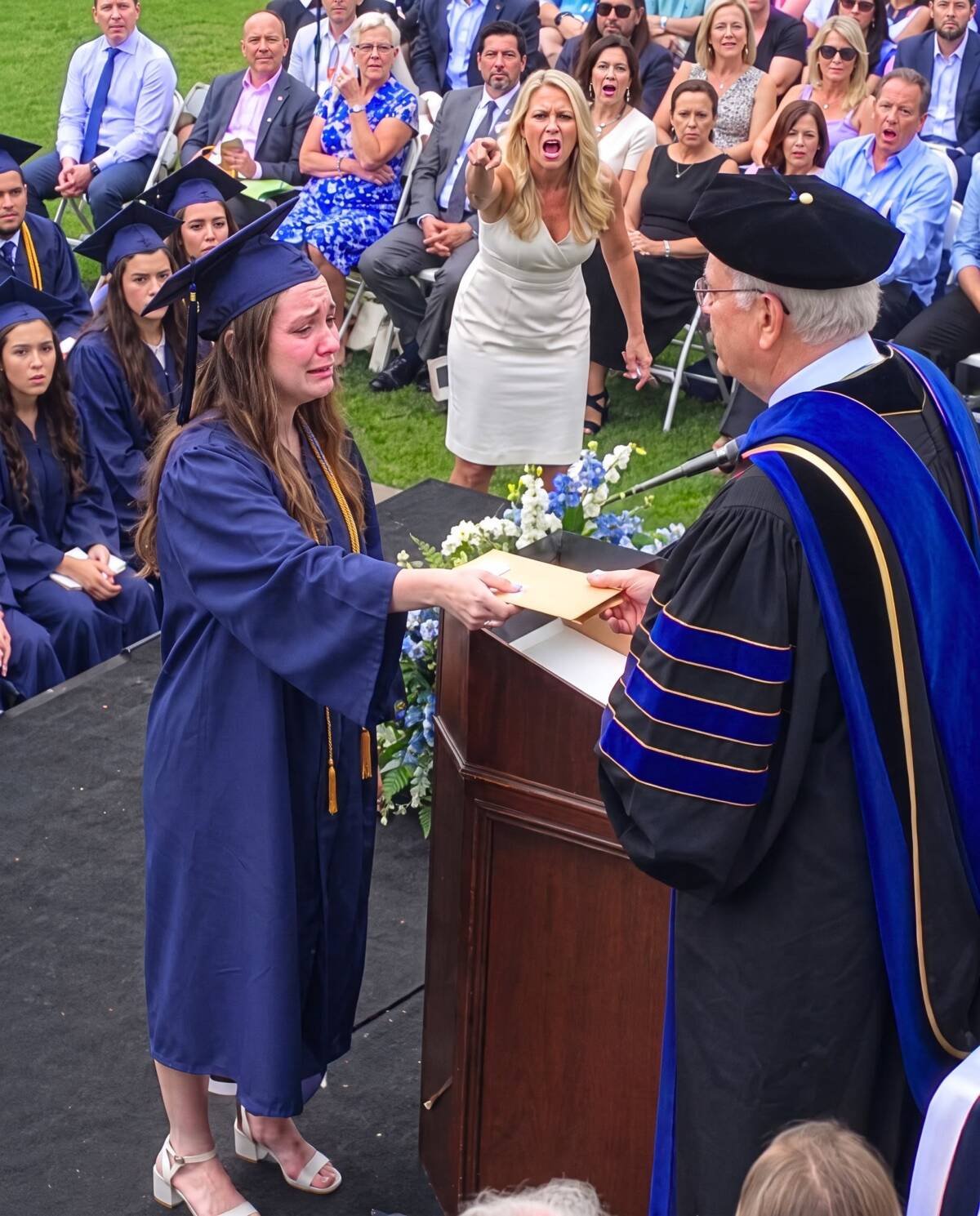
I was nineteen when my father decided that marrying Silas Callahan would be the greatest humiliation our family could suffer.
Silas was twenty-one. He drove an old pickup truck, came from a working-class family, and believed that broken things deserved to be repaired rather than thrown away.
He was also the kindest person I had ever known.
None of that mattered to my father.
In the Whitfield family, appearances were everything. My father, Richard Whitfield, had built his identity around the family’s insurance agency, its commercial property, and the reputation he believed our surname commanded in the community.
He expected me to marry someone who would strengthen that reputation.
Instead, I fell in love with a man who measured success by whether he had done the right thing, even when nobody was watching.
When I told Dad that Silas and I intended to marry, he stared at me as though I had announced that I planned to destroy everything he had spent his life building.
“No daughter of mine marries trash.”
I remember how cold the room felt, even though the heat was running.
I tried to explain that Silas had never disrespected him, never asked me for money, and never pretended to be something he was not.
Dad refused to listen.
“You want to be a Callahan? Go be one.”
Then he threw my suitcase onto the lawn.
My nursing-school textbooks followed. They landed in the wet grass as rain hammered against the windows.
I looked toward the stairs, where my mother stood in her robe.
I waited for her to intervene.
I waited for her to tell Dad that I was his daughter, that he could be angry without destroying my life, that a disagreement about marriage was not a reason to send a nineteen-year-old girl into the night.
Mom said nothing.
She simply watched.
That silence hurt almost as much as Dad’s words.
I left the house with tears running down my face, trying to gather my books before the rain ruined them completely.
About twenty minutes later, Silas found me.
He had heard enough from a mutual friend to know something had happened. When he saw me standing beside my suitcase, soaked through and shaking, he did not ask what I had said to upset my father.
He took off his jacket and wrapped it around my shoulders.
“Come on,” he said gently. “We’ll figure it out.”
And we did.
For eight months, we slept on a foldout couch in his father’s duplex. I worked diner shifts while finishing nursing school, and Silas stretched every paycheck as far as it could go.
Some nights, dinner meant peanut-butter sandwiches. Other nights, we counted our money at the kitchen table and decided which bill could wait another week.
We were young, tired, and often frightened about what came next.
But I never had to wonder whether Silas would turn his back on me when life became inconvenient.
Over time, the life my father predicted would collapse became something solid.
I became a neonatal intensive care unit nurse. Silas joined the fire department and eventually became a captain. We bought a modest white-sided house with a blue front door and paid off the mortgage ahead of schedule.
We built our life without my parents’ money, influence, or approval.
There were painful years, too.
We endured one miscarriage that I mostly grieved in private. I learned how to care for critically ill newborns at work while quietly carrying the grief of the child I had lost.
Then, after years of hoping, our daughter was born.
We named her Ren.
The first time I held her, something inside me changed.
I finally understood that loving a child was not supposed to be a reward for obedience. A child did not have to choose the right career, marry the right person, or protect a parent’s reputation to deserve a place in the family.
There was nothing Ren could become that would make me erase her from my life for fifteen years.
That realization made my mother’s appearance on the porch even more disturbing.
She had missed my graduation, my wedding, my professional milestones, my pregnancy, and every birthday in between.
Now she expected to hold my newborn daughter as though biology automatically entitled her to a relationship.
“She’s my granddaughter,” Mom insisted when I stepped back to keep her from touching Ren.
“You’ve known she existed for four weeks.”
“That doesn’t change what she is.”
“No,” I replied. “But it doesn’t change what happened, either.”
Mom looked offended, as though I had broken an unspoken rule by refusing to make her feel comfortable.
Then her gaze shifted toward the nameplates beside the door.
She stared at Silas’s surname for several seconds.
I knew that expression. I had seen it on my father’s face when he threw me out.
Fifteen years later, the Callahan name still represented everything they believed I had done wrong.
Eventually, Mom explained why she had come.
Dad had suffered a serious cardiac emergency and collapsed at home. He was recovering, but the experience had forced him to think about his family.
“He’s been thinking about you,” she said.
“He had fifteen years.”
Mom did not respond.
She left the casserole and a card on the porch, then told me to call when I was ready to reconcile.
I thought that would be the end of it.
I was wrong.
Within days, relatives began sending messages about forgiveness. People from my childhood church contacted me with reminders that life was short and family should come first.
Their messages followed the same pattern: Dad was getting older, Mom was hurting, and I needed to stop holding on to the past.
According to Mom’s version of events, my parents simply wanted to meet their granddaughter, and I was refusing because I remained angry about something that had happened when I was nineteen.
Fifteen years of silence had been reduced to a disagreement.
The rain-soaked suitcase, the abandoned textbooks, and the mother who watched from the stairs had disappeared from the story.
Then Mom appeared at my hospital.
I was carrying Ren through the corridor after introducing her to several coworkers when Mom approached us with another casserole.
She reached toward my daughter in front of everyone.
When I stepped away, her expression crumpled.
“You won’t even let your own mother hold her grandchild?”
People turned to look.
That was when I understood that this was not an honest attempt at reconciliation.
Mom was using the presence of other people to pressure me into surrendering a boundary she had never respected.
She believed public embarrassment would accomplish what fifteen years of silence had not.
She still thought I was the frightened nineteen-year-old girl standing in the rain.
She had no idea who I had become.
That night, after Ren fell asleep and Silas left for an overnight shift, I opened the top drawer of my nightstand and took out the final letter my grandmother, Ruth Whitfield, had sent me before she died.
Nana Ruth had been the only member of my family who maintained a quiet connection with me after I was disowned. She sent anonymous birthday cards, occasional financial help, and flowers when I graduated from nursing school.
She never demanded that I forgive my parents.
She never insisted that I return home.
One sentence from her final letter had stayed with me for years.
“People like that don’t come back when they love you. They come back when they’ve lost everything else and need somewhere to put their hands. You don’t owe them the door.”
I had always understood those words emotionally.
That night, however, I noticed something unusual about the envelope.
One corner felt thicker than the rest.
I carefully separated the paper lining.
A small brass key fell into my palm.
I was still examining it when someone knocked downstairs.
I checked the porch camera.
My brother, Grant, was standing outside.
I had not seen him in fifteen years.
When I opened the door, he did not greet me or ask about my daughter.
He looked straight at me and said, “You shouldn’t sign anything Mom gives you.”
Part 2: The Million-Dollar Signature
Grant looked older than I remembered. His expression was tense, and he seemed more concerned with the house around him than with the fact that he was standing in front of a sister he had not seen in fifteen years.
I let him inside.
We sat at the kitchen table while Ren slept nearby.
“What are you talking about?” I asked.
Grant explained that the Whitfield Insurance Agency, the business my father had treated like a family dynasty throughout my childhood, was drowning in debt.
“The agency owes almost nine hundred thousand dollars,” he said.
I stared at him.
“How?”
“Dad made bad decisions. Then he kept borrowing money to fix the problems caused by the previous loans. The commercial building is collateral, and the house has liens against it.”
I still did not understand why my mother had suddenly remembered she had a daughter.
Then Grant looked toward the hallway.
“They need your signature.”
“Why mine?”
He removed a thick envelope from his jacket and placed it on the table.
Inside was a personal guaranty worth $1.24 million.
My full legal name appeared at the top.
At the bottom was a signature that looked almost exactly like mine.
Almost.
The spacing, the slant, and the shape of the letters were convincing enough to fool someone unfamiliar with my handwriting.
But I knew I had never signed it.
“I didn’t authorize this.”
“I know,” Grant replied.
I looked up.
“How can you be so certain?”
He hesitated.
Then he told me something I had never known.
Nana Ruth had left me fifty-one percent of the Whitfield Insurance Agency.
I initially thought he was mistaken.
“No. Dad controlled the business.”
“Not all of it.”
According to Grant, Nana and my grandfather had founded the agency. Nana retained control over a substantial portion of its original shares, and after Dad threw me out, she changed the trust governing her ownership.
She transferred a controlling interest into my name.
My father had never told me.
Years later, documents were filed claiming that I had voluntarily transferred those shares back to him.
That signature had also been forged.
Now the bank had discovered inconsistencies in the company’s records. The refinancing depended on treating the old stock transfer as legitimate, and the bank wanted my signature ratifying the transaction.
If I signed, I could effectively validate a transfer I had never approved.
“They want you to make everything look legal,” Grant explained. “Without your signature, the refinancing could fall apart.”
I stared at the document, trying to process the implications.
My mother had arrived at my house claiming that she wanted to repair our relationship.
My father was supposedly reflecting on his life after nearly dying.
Meanwhile, someone had forged my signature on a million-dollar financial obligation.
“So Mom didn’t come because Dad nearly died,” I said.
Grant lowered his eyes.
“She came because the bank froze the refinancing four days after he collapsed.”
For fifteen years, my parents had behaved as though I did not exist.
The moment my name became financially useful, they wanted reconciliation, church involvement, forgiveness, and access to my daughter.
I looked at the brass key in my hand.
“What does this open?”
Grant shook his head.
“I’ve never seen it before.”
Three mornings later, I discovered another connection between my family and the life I had built without them.
Silas was making pancakes while Ren slept nearby. I had spent much of the night reviewing public records connected to the insurance agency when I came across the report concerning Dad’s cardiac arrest.
The address was familiar.
I turned toward my husband.
“Which crew responded to the cardiac call on Sycamore Street?”
Silas stopped moving.
“That was my crew.”
I stared at him.
“You were there?”
“Yes.”
He explained that he had not recognized the address until he entered the kitchen.
Dad was unconscious. Mom was panicking, and Dad had no pulse.
Silas did not hesitate.
He performed CPR, used the defibrillator, administered medication according to protocol, and continued working until Dad’s heart started again.
The man my father had once called trash had been the one kneeling on his kitchen floor, fighting to keep him alive.
“Why didn’t you tell me?”
Silas looked toward Ren.
“You had just given birth. You were exhausted, and I didn’t want his emergency becoming another way your family entered our home.”
That answer hurt in a way I could not immediately explain.
Silas had every reason to resent my father.
Instead, he had treated him as he would any other person whose life depended on emergency medical care.
“What did Dad say when he recognized you?” I asked.
Silas was quiet for a moment.
“He said my name.”
I felt my throat tighten.
“Silas?”
He shook his head.
“Callahan.”
Fifteen years after refusing to speak that name with anything but contempt, Dad had whispered it from a hospital stretcher after Silas brought him back.
The following week, Pastor Nylin arranged a family meeting.
My parents arrived believing we were finally going to discuss reconciliation.
They had no idea I was bringing the forged guaranty with me.
And I was finally ready to ask what they had really come back for.
Part 3: The Family Meeting That Exposed Everything
The meeting took place at our old church.
Mom and Dad arrived expecting a peaceful discussion about healing old wounds. Mom brought tears, Dad brought his cane, Aunt Deborah sat beside them, and Grant stayed near the back of the room.
I walked in alone.
Mom began speaking before I had even settled into my chair.
“We forgive her for everything, Pastor. We only want our daughter back.”
I looked directly at her.
“For everything?”
She blinked.
“What exactly are you forgiving me for?”
Dad shifted uncomfortably, but I did not allow him to redirect the conversation.
For fifteen years, my parents had described my departure as though I had abandoned them. The truth was that Dad had thrown me out, and Mom had watched.
“You removed me from this family,” I said. “I didn’t run away.”
Then I turned toward my father.
“Say his name.”
Dad frowned.
“What?”
“My husband. Say his name.”
His jaw tightened.
For fifteen years, Silas had been “that man,” “that Callahan,” or simply an insult. My father had treated his name as something beneath the dignity of our family.
“His name is Silas Callahan,” I said.
Dad stared at me.
“And when your heart stopped in your kitchen, Silas Callahan was the man who brought you back.”
The room went silent.
Aunt Deborah turned toward Dad.
“Is that true?”
He lowered his eyes.
“Yes.”
I waited.
Finally, he looked up.
“Silas Callahan saved my life.”
Hearing those words did not repair fifteen years of damage.
But it proved something I had long suspected: my father had always been capable of saying Silas’s name.
He had simply refused to do so until his own life depended on the man he despised.
Then I placed the forged guaranty on the table.
Pastor Nylin looked down at it.
“What is this?”
“My signature,” I replied. “Except I never signed it.”
Mom’s expression changed before Dad’s did.
Dad turned toward her.
“Margaret.”
That single word told me more than either of them intended.
“You knew?” I asked.
Dad looked exhausted.
“I knew about the shares.”
“The forged transfer?”
He said nothing.
“That means yes.”
Mom abruptly stood and insisted that the matter was private family business.
I reminded her that she had already made our private life public by sending relatives, church members, and people from our community to pressure me into reconciliation.
“You can’t demand public forgiveness while hiding private misconduct,” I told her.
Grant finally stepped forward.
He explained that the bank would not approve the refinancing unless I formally ratified the old stock transfer. Without my signature, the agency’s financial structure could unravel.
Then he placed another stack of documents on the table.
The records showed dozens of payments to a company called Hawthorne Consulting.
Dad stared at the pages.
“What is Hawthorne Consulting?”
Mom did not answer.
Grant claimed he had discovered the payments after Dad’s collapse.
His explanation sounded organized and convincing, but something about his delivery bothered me. He seemed nervous rather than angry, as though he were reciting a story he had prepared in advance.
“How long have you known?” I asked him.
He hesitated.
That pause was enough to make me suspicious.
I reached into my pocket and felt Nana Ruth’s brass key pressing against my palm.
Suddenly, Grant’s convenient arrival, his documents, and his carefully arranged explanation did not feel nearly as trustworthy as they had at first.
“I’m done,” I said.
Mom called after me as I walked toward the door.
“Colleen!”
I turned.
“You wanted me back inside the family,” I said. “You should have made sure there wasn’t a fire inside it first.”
The next morning, I called the law firm listed on Nana Ruth’s old correspondence.
When I gave the receptionist my name, she went silent before transferring me to a senior partner.
“Mrs. Callahan,” he said, “we’ve been waiting almost eleven years for you to call.”
I looked at the brass key on my desk.
For the first time, I began to wonder whether Nana had understood exactly what my family would eventually become.
The key opened a safe-deposit box she had arranged before her death.
Inside were original trust documents, stock certificates, letters, and a small digital recorder wrapped in one of her scarves.
Her note was waiting on top.
“If you’re opening this, someone finally needed something badly enough to remember you exist.”
I sat down and pressed play.
Nana’s voice filled the room.
She explained that she had changed the trust after discovering irregular accounts, false vendors, and missing money inside the Whitfield Insurance Agency.
At first, she had suspected my father.
Then she had begun to suspect my mother.
Near the end of the recording, her voice became slower and more deliberate.
“Colleen, do not trust the person who brings you the truth too easily.”
My stomach tightened.
Then she continued.
“Your brother learned very young that honest people hesitate. Liars arrive prepared.”
I thought about Grant standing on my porch with documents ready to explain everything.
He had brought me enough truth to make his story believable.
He had also given me just enough information to direct my anger toward our parents.
For the first time, I realized that my parents might not be the only people trying to use me.
And within forty-eight hours, a forensic accountant would reveal how much Grant had been hiding.
Part 4: The Brother Who Brought Me Half the Truth
The investigation began with the payments to Hawthorne Consulting.
Within forty-eight hours of listening to Nana Ruth’s recording, my attorney and a forensic accountant had traced the company through two shell companies and an LLC registered under Grant’s wife’s maiden name.
The payments I had seen at the family meeting were not evidence Grant had uncovered after Dad collapsed.
They were part of a system he had quietly built over more than a decade.
According to the financial records, Grant had started by taking small amounts from the Whitfield Insurance Agency. As he became more confident that no one would question him, the amounts increased.
Whenever Dad noticed cash-flow problems, Grant blamed market losses, poor investments, or temporary business setbacks.
Then he positioned himself as the person capable of fixing the problems he had helped create.
The forged documents were part of the same scheme.
Grant had prepared paperwork falsely transferring my controlling shares back to Dad. When the agency later needed refinancing, he forged my signature again on a personal guaranty worth more than $1.2 million.
Mom knew that some of the documents were questionable.
Dad knew I had never willingly surrendered my shares.
Yet both had allowed Grant to handle the problem rather than contact the daughter they had disowned.
Their reasons were painfully ordinary: pride, fear, and the humiliation of admitting they needed me.
The investigation also uncovered a troubling detail about Dad’s cardiac arrest.
A neighbor’s doorbell camera showed Grant leaving my parents’ house only minutes before Mom called 911.
That discovery did not, by itself, establish that Grant had caused Dad’s collapse. But it raised additional questions about his movements and his knowledge of what had happened inside the house.
When I confronted him, we met in the agency’s conference room.
My attorney sat beside me. Silas waited outside.
Grant leaned back in his chair, behaving as though everything he had done could still be explained away.
“You think Nana made you some kind of hero?” he asked.
“No.”
“You got to leave, Colleen. You escaped Dad’s expectations, Mom’s control, this business—all of it. Everything landed on me.”
I stared at him.
“So you stole from them?”
“I took what I was owed.”
His answer told me more than any spreadsheet could.
I had spent years believing that my brother had simply chosen our parents over me.
Now I understood that he had also chosen to profit from the family they had built.
“Why did you come to me?” I asked.
For the first time, his expression changed.
We had finally reached the part of his plan he had hoped I would never understand.
The agency was not actually beyond saving. Its commercial property alone was worth more than the debt, and my controlling ownership interest remained legally significant.
If I had signed the ratification documents Grant brought to my house, the refinancing would have proceeded while my fifty-one percent ownership quietly disappeared.
Afterward, Grant intended to sell the commercial building and the agency’s book of business.
He planned to pay off the bank, give my parents enough money to keep them quiet, and walk away with nearly $2 million.
“You knew Mom would pressure me,” I said.
Grant gave a humorless smile.
“I knew she couldn’t help herself.”
“And you knew I’d believe the worst about them.”
“You had fifteen years of evidence.”
That was the cruelest part.
He was right.
My parents had treated me badly enough that Grant barely needed to invent a reason for me to distrust them. He only had to present the pieces that made them look guilty and trust that my history would fill in the rest.
“You were the one who told Mom to get me back into the family.”
Grant did not answer.
He did not need to.
Three weeks later, police arrested him.
The charges included bank fraud, forgery, and embezzlement. As investigators examined the company’s records, they discovered that my parents were not innocent bystanders.
Dad had signed false corporate resolutions.
Mom had knowingly notarized at least one document she knew I had never signed.
Grant had designed the scheme, but my parents had helped keep it alive.
Their fear of losing the business had become more important than their responsibility to tell the truth.
They had spent fifteen years refusing to acknowledge me as their daughter, then expected me to risk my financial future to protect them.
I had no intention of doing that.
Two months later, Dad came to my house alone.
He stood on the same porch where Mom had first arrived with a casserole and announced that they were ready to forgive me.
This time, he looked older, smaller, and far less certain of what he deserved.
“I owe Silas my life,” he said.
“Yes.”
“And I owe you…”
He stopped.
I did not help him finish.
“I owe you an apology.”
I waited.
“For throwing you out. For what I called him. For making love something you had to earn.”
That last sentence hurt because it was the first time Dad seemed to understand what he had actually done.
“I was wrong about Silas Callahan.”
The door opened behind me, and Silas stepped outside holding Ren.
Dad looked from my husband to my daughter.
For a brief moment, I saw hope in his face.
“You can’t have fifteen years back,” I told him.
“I know.”
“And saying sorry doesn’t give you access to Ren.”
“I know.”
I let the silence settle between us before adding one more thing.
“Maybe someday she’ll know you. If you earn it.”
Dad nodded.
Then he looked directly at Silas.
“Captain Callahan. Thank you for saving my life.”
Silas adjusted Ren gently in his arms.
“I didn’t do it for you,” he replied. “I did my job because that’s who I am.”
Dad nodded slowly.
“I understand.”
For the first time, I believed he might.
But Nana Ruth had left one final secret behind.
And it was about the Callahan family.
Part 5: The Secret That Changed Everything
Several weeks after Grant accepted a plea agreement, Nana Ruth’s attorney called with news of one final document inside the trust.
By then, I had learned not to underestimate my grandmother’s ability to prepare for truths the rest of the family preferred to bury.
The letter confirmed that Grant’s conviction had invalidated several fraudulent transactions and that the transfer of my shares had never been legally completed.
I still owned fifty-one percent of the Whitfield Insurance Agency.
Dad retained twenty-four percent, while the remaining shares were divided between Grant’s seized interest and a family trust.
Then I reached the part of the letter that explained why Nana had chosen me.
“I did not leave you this business because I expected you to run it,” she had written. “I left it because when your father threw you out, he wanted you to believe he had taken your future with him. I wanted you to know he never had that power.”
I had to stop reading.
For years, I had believed that losing my family meant losing the future I might have had if I had stayed.
Nana had understood something my father never did.
He could take away my home, but he could not decide what my life would become.
The final pages revealed an even deeper connection involving Silas’s father, Patrick Callahan.
Years earlier, when Nana first noticed suspicious vendors and missing money inside the agency, she had quietly asked Patrick to help verify whether certain insured properties and claims were legitimate.
Patrick was a maintenance worker who volunteered with the local fire department. He had no stake in Whitfield family politics, and Nana trusted him precisely because he had nothing to gain from the investigation.
He helped her identify some of the first false vendors Grant had created while working summer jobs at the agency.
Before Nana could finish investigating, she became ill.
Dad eventually discovered that Patrick had been examining company records. Rather than consider that Patrick might have been helping his mother, Dad assumed he was trying to expose or blackmail the Whitfields.
That discovery changed my understanding of my father’s hatred toward the Callahan family.
It had never been only about money or social status.
It was also fear.
When Silas and I began dating, Dad panicked because the son of the man who had helped Nana investigate the agency was becoming part of our family.
Somewhere beneath his pride and prejudice, he feared that my relationship with Silas might eventually lead me toward the secrets he desperately wanted buried.
Throwing me out had not only been an attempt to control whom I married.
It had also separated me from a family connection that might have helped me discover what was happening inside the business.
I showed Silas the letter that evening.
“My dad knew?” he asked.
“He helped Nana.”
Silas sat quietly for a long time.
Patrick had died seven years earlier without telling his son what he had done.
The following weekend, Silas searched through his father’s belongings and found an envelope at the bottom of an old metal toolbox.
Nana Ruth’s handwriting was across the front.
Inside was a short note.
“Thank you for protecting my granddaughter before she even knows she needs protecting.”
Silas cried harder than I had ever seen him cry.
The man my family had dismissed as worthless had quietly helped protect both the agency and me long before I understood that either of us needed protecting.
His father had done the same.
Neither man had demanded recognition.
Neither had asked for a reward.
They had simply done what they believed was right.
I thought about Dad throwing my suitcase into the rain. I thought about Silas wrapping his jacket around my shoulders. I thought about Nana sending birthday cards when everyone else had decided I was no longer worth remembering.
For the first time, I understood how different those forms of love really were.
One demanded obedience.
The others offered protection without conditions.
Part 6: The Business I Refused to Let Define Me
Six months later, I made a decision my father would never have expected.
I sold the Whitfield Insurance Agency.
After the fraudulent transactions were investigated and the legitimate obligations were identified, I used the proceeds to satisfy the business’s valid debts. The sale allowed me to resolve the financial situation without signing away the ownership Nana had left me.
I did not want to spend the rest of my life trying to preserve the institution my father had treated as more important than his own daughter.
The agency had represented his ambition, his pride, and his belief that the Whitfield name deserved special treatment.
I had no interest in carrying those beliefs into the future.
My parents sold the large house on Sycamore Street.
Dad moved into a smaller condominium, while Mom temporarily stayed with Aunt Deborah as both began therapy separately.
I did not forgive them because Dad had nearly died.
I did not forgive them because relatives told me life was short.
And I did not forgive them because they had finally lost the power to ignore the damage they had caused.
I had learned that forgiveness, if it ever came, would have to be my decision.
It could not be demanded as the price of belonging.
It could not be used to erase accountability.
And it certainly could not serve as permission to repeat the same behavior.
Silas and I used part of the agency proceeds to establish a charitable fund named after Patrick Callahan and Ruth Whitfield.
The fund provided assistance to families with babies in intensive care and emergency support for firefighters injured in the line of duty.
It was a small way of honoring the two people who had helped protect us without asking for anything in return.
The fund also gave us something meaningful to build from the wreckage of the Whitfield business.
For the first time, the family name was associated with something that had nothing to do with status, wealth, or control.
It was associated with care.
With service.
With helping people who had no way to repay us.
And with the belief that a person’s worth could never be measured by their bank account or their surname.
A year after Mom first appeared on my porch with a casserole, she returned.
This time, she brought nothing.
No food.
No church members.
No relatives to speak on her behalf.
She stood outside my blue front door and looked nervous.
“I drove here three times before I finally had the courage to knock,” she said.
I waited.
“I’m sorry.”
Two words.
Fifteen years late.
But finally, they were the correct words.
“For what?” I asked.
Her eyes filled with tears.
“For standing on those stairs.”
I felt something tighten in my chest.
For years, my mother had described that night as though the family had experienced a disagreement and everyone had made mistakes.
She had spoken about the past without naming what she had done.
Now she was finally acknowledging the moment I remembered most clearly.
“I watched your father put you out,” she said, “and I chose being his wife over being your mother.”
I did not look away.
“Yes.”
“I can’t undo that.”
“No.”
Mom nodded.
She did not ask to hold Ren.
She did not demand forgiveness.
She did not tell me that she was getting older or that she deserved another chance.
Instead, she turned toward the driveway as though she understood that the conversation was over.
Then I called her name.
Ren was toddling behind me with a stuffed rabbit in her hands.
Mom turned back, but she did not reach for her.
That small act of restraint mattered more than every casserole, church card, and speech about family she had brought before.
“Five minutes,” I said.
Mom looked at me.
“On the porch.”
She nodded.
“Five minutes.”
We sat outside with Ren on my lap.
Nobody pretended that fifteen years could be repaired in one conversation. Mom was not suddenly restored to my life, and I was no longer the nineteen-year-old daughter waiting for someone else to decide whether I belonged.
We talked about ordinary things.
Ren’s favorite toys.
The flowers growing beside the steps.
The weather.
There were long pauses, and some of them were uncomfortable.
But for once, Mom did not try to fill the silence with excuses.
She did not demand more time.
She did not reach for what I had not offered.
Eventually, Ren noticed the brass nameplate beside the door.
She reached toward it with one small hand.
CALLAHAN.
Mom followed her gaze.
I remembered how her expression had changed the first time she saw that name.
She had believed becoming a Callahan meant I had chosen the wrong family.
She had believed that by leaving the Whitfields, I had abandoned everything that made me who I was.
She had been wrong.
The Whitfields gave me my blood, but Silas gave me shelter when I had nowhere to sleep.
Patrick protected me before I understood the danger.
Nana Ruth reached across years of silence to leave me a choice.
And Ren taught me that real love never requires a child to earn the right to stay.
Mom looked at my daughter.
“What’s her full name?” she asked.
I smiled.
After everything that had happened, she had never actually asked.
“Ren Ruth Callahan.”
Mom went completely still.
“Ruth?”
“After Nana.”
This time, when tears rolled down her face, I believed them.
Silas appeared in the doorway, and Ren immediately toddled toward him.
He lifted her into his arms while Mom looked at the three of us, at Ruth’s namesake, and at the surname beside the door she had once despised.
I could not tell whether Mom was thinking about the life she had missed or the person Nana had been.
Perhaps she was thinking about both.
For the first time, she seemed to understand that the family she wanted back could not be recreated by pretending the past had never happened.
It would have to be built differently.
And whether she would ever become part of it again was no longer a decision she could make for me.
It was mine.
Conclusion: He Thought He Was Punishing Me. He Was Showing Me the Way Home.
Fifteen years earlier, my father had thrown my suitcase onto the lawn and told me that if I wanted to become a Callahan, I should go be one.
He thought he was giving me a punishment.
He believed that losing the Whitfield name, the family business, and my place in his house would teach me to regret choosing Silas.
For a long time, I believed that night had taken something from me that I would never recover.
I had lost my parents during the years when I needed them most.
I had missed the ordinary moments that other daughters took for granted: family dinners, celebrations, advice, and the comfort of knowing there was somewhere to turn when life became difficult.
No amount of money could return those years.
No apology could make the rain disappear from my memory.
But time had taught me something my father had never understood.
A family is not made trustworthy by its surname.
A parent does not earn respect simply by demanding it.
And love is not real because someone insists that it is.
Love is what Silas showed me when he found me standing in the rain and helped me rebuild my life.
It is what Patrick did when he helped Nana investigate the agency without asking for recognition.
It is what Nana left behind when she gave me the means to protect my future.
It is what I felt holding Ren for the first time, knowing that no mistake, disagreement, or choice she made would ever cause me to throw her away.
My parents returned because they needed something from me.
They needed my signature to protect their business, my silence to conceal their mistakes, and my forgiveness to make their lives feel whole again.
But the greatest thing I discovered was that I no longer needed their approval to feel whole myself.
I could choose to leave the door closed.
I could choose to open it a little.
And I could insist that anyone who wanted to enter my life respect the boundaries I had spent years learning to protect.
My mother had five minutes on the porch.
That was not the end of the story, but it was a beginning that belonged to me.
I did not know whether she would ever become the mother I had needed at nineteen. I did not know whether Dad would continue doing the difficult work of accepting responsibility for what he had done.
I only knew that neither of them could decide my worth anymore.
The name beside my front door was not a declaration of war against the Whitfields.
It was a reminder of the life I had built.
A life made possible by people who loved me when loving me was inconvenient.
A life in which my daughter would never have to stand in the rain, wondering whether her own family wanted her.
And every time I looked at that brass nameplate, I remembered the words my father had shouted fifteen years earlier.
“If you want to become a Callahan, go be one.”
He thought he was giving me a punishment.
He had no idea he was giving me directions home.
What would you have done in Colleen’s place? Would you have given her parents another chance, or would fifteen years of silence have been too much to forgive? Share your thoughts in the comments, and share this story with someone who believes that love should never come with conditions.