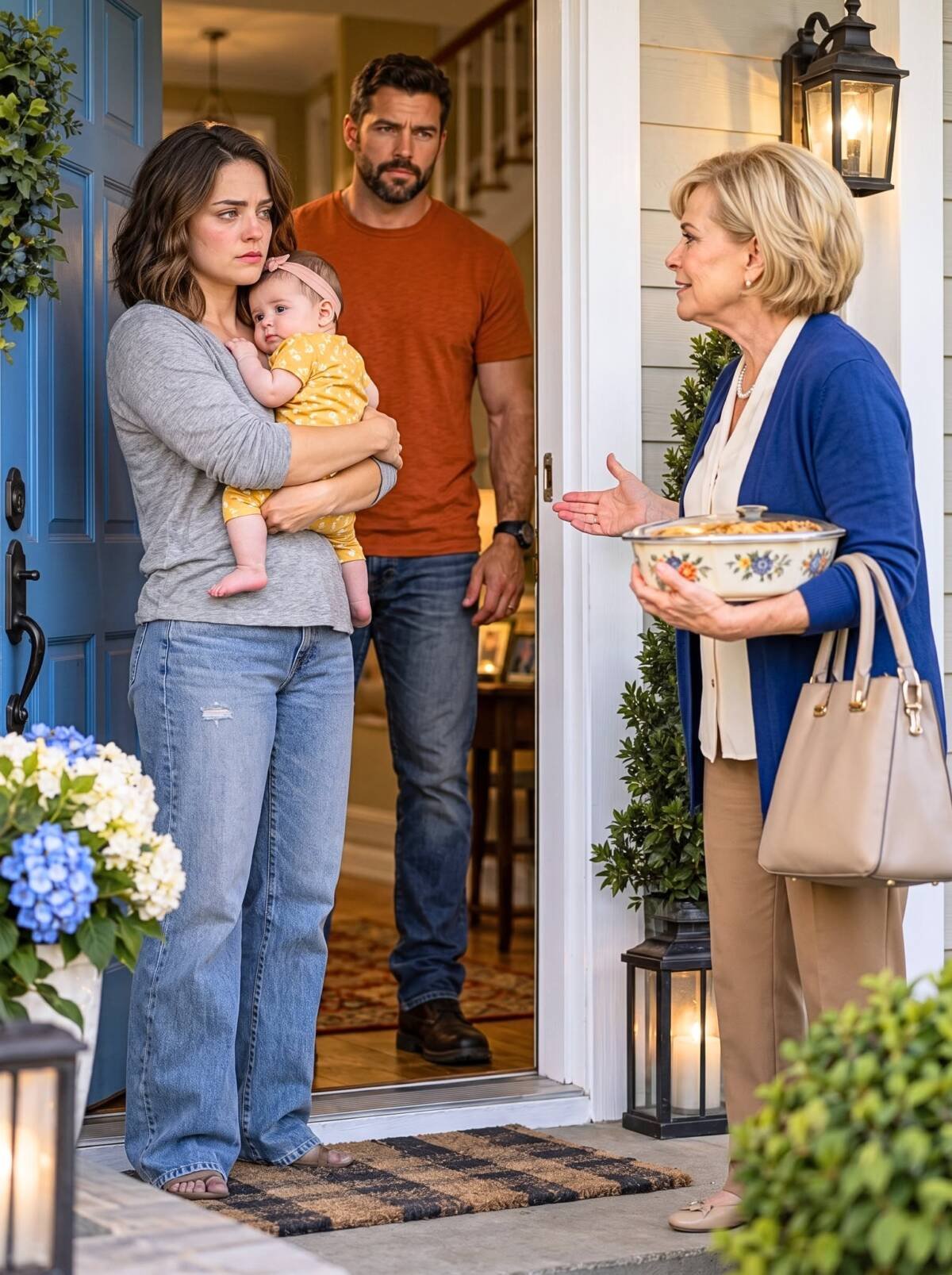
When my mother texted me, “Skip my birthday. We need a break from your kid,” I didn’t argue. I turned the car around, took my three-month-old daughter home, and stopped trying to earn a place in a family that seemed embarrassed by my life. Two weeks later, a photograph from a luxury Montana lodge exposed something I could no longer ignore: My family wasn’t upset that we had missed Thanksgiving. They were upset that I had found happiness without them.
The Birthday Text That Changed Everything
My mother’s message arrived while my three-month-old daughter, Maisie, was asleep in the back seat.
I was already halfway from Seattle to Portland, having spent hours on the road because I still believed that showing up for family mattered—even when doing so required considerable effort.
Then my phone lit up.
“Skip my birthday. We need a break from your kid.”
I pulled into the next rest stop, parked beneath a bare winter tree, and read the message again.
And again.
There was no apology, no explanation, and no attempt to soften the words. My mother had made her position perfectly clear: My daughter was not welcome at her birthday celebration.
The words that hurt the most weren’t skip my birthday.
They were your kid.
My mother wasn’t talking about her granddaughter, a three-month-old baby who had done nothing wrong. She was talking about Maisie as though she were an inconvenience attached to me, a problem the family had to tolerate whenever I wanted to participate in their lives.
I stared at the screen while trucks rumbled past on the highway. Behind me, Maisie stirred in her car seat before settling back into sleep.
I had spent years accommodating my family. I had rearranged my schedule, answered late-night calls, helped with financial emergencies, and made myself available whenever someone needed something.
Even after becoming a single mother, I continued behaving as though my place in the family depended on how useful I could be.
I was 27, and everyone knew me as the dependable daughter.
When my brother, Kyle, needed money for a business venture that never really took off, I gave him $3,000. When my sister, Brinn, needed help paying for her wedding, I covered the flowers and photographer.
The previous year, when my parents needed their roof repaired, I quietly transferred $5,000 to help cover the expense.
I never posted about those contributions online. I never demanded public recognition or reminded anyone of what I had done.
Helping my family had become so normal that I rarely questioned it.
I simply assumed that when someone you loved needed help, you showed up.
Apparently, that principle worked only when I was the person providing something.
The moment I needed my family to make a little room for me and my baby, I was suddenly asking too much.
I Finally Stopped Explaining Myself
For a few minutes, I considered calling my mother.
The old instinct was immediate.
I could explain that Maisie was still tiny, that I would keep her close, and that I wouldn’t stay long. I could promise to leave early if she cried. I could reassure everyone that I would do everything possible to make the evening comfortable.
I could apologize for bringing my daughter into a world where other people apparently considered her presence an inconvenience.
Then I realized how exhausting that sounded.
Why was I preparing to defend a three-month-old baby for existing?
Why was I about to negotiate for permission to attend a family birthday with my own child?
And why had I spent so many years believing that love was something I had to earn through favors, money, and endless accommodation?
I opened the message and typed a short reply.
“Understood. Hope you have a nice birthday.”
That was all.
No argument. No accusation. No long explanation.
I turned the car around and began the four-hour drive back to Seattle.
As the miles passed, memories surfaced that I had previously dismissed as isolated incidents.
I remembered the money I had sent when Kyle was struggling. I remembered rearranging my life to help Brinn with her wedding. I remembered transferring money for my parents’ roof without asking when they would repay me.
I remembered how quickly everyone contacted me when something went wrong—and how rarely anyone asked whether I needed help myself.
I had spent years confusing being needed with being loved.
That realization hurt more than the birthday message.
By the time I arrived home, I was emotionally exhausted. I carried Maisie inside, settled her into her familiar surroundings, and tried to convince myself that I was overreacting.
But I wasn’t.
Something fundamental had changed.
For the first time, I had chosen not to chase my family’s approval.
And I had a feeling they would notice.
The Conversation That Made Me See the Truth
That evening, my best friend, Vanessa, called.
She knew something was wrong almost immediately.
When she asked what had happened, I told her about the text, the long drive, and the moment I had pulled over to read my mother’s words.
I tried to sound composed, but my voice broke halfway through the explanation.
Vanessa listened without interrupting.
Then she said something I had been avoiding for months.
“They’re treating you differently because you’re a single mom. You know that, right?”
“I know,” I whispered.
Maisie’s father, Derek, had disappeared before she was born. He had decided that fatherhood wasn’t for him, leaving me to navigate motherhood without the partner I had once expected to have beside me.
I was learning how to care for a newborn, manage my responsibilities, and rebuild my life while dealing with the emotional weight of being abandoned by someone who had promised to be there.
Instead of supporting me, my family had grown noticeably colder.
My mother had once told me that I had “chosen this situation,” as though becoming a mother without a partner meant I deserved less compassion.
I had tried to ignore those comments. I told myself that my family needed time to adjust, that everyone was stressed, and that eventually things would return to normal.
But the birthday message made it impossible to keep pretending.
My daughter had become a symbol of a life my family disapproved of, and I had been working far too hard to convince them that we were still worthy of belonging.
That night, I stood beside Maisie’s bassinet and watched her sleep.
Her tiny fists were curled near her face, and her breathing was soft and steady. She had no idea that her grandmother had asked us to stay away.
She had no idea that I was questioning relationships I had trusted my entire life.
Looking at her, I understood something with a clarity I had never experienced before.
I could not control how my family treated me.
But I could decide what kind of treatment I was willing to accept.
I could not make them appreciate my daughter.
But I could refuse to teach her that she needed to earn affection by making herself smaller.
I could not force my family to become the people I wanted them to be.
But I could stop sacrificing my peace while waiting for them to change.
My mother’s birthday came and went without a gift, a card, or a phone call from me.
For the first time in my life, I simply did not show up.
And my family didn’t contact me either.
Nobody asked whether the drive had been difficult. Nobody checked on Maisie. Nobody asked why I had turned around or whether the message had hurt me.
Their silence was painful, but it also revealed something I had spent years refusing to acknowledge.
Perhaps they didn’t miss me as much as I had believed.
Perhaps they missed the things I did for them.
I didn’t know yet how much that realization would change my life.
Then Thanksgiving approached.
And someone outside my family offered us something I had almost forgotten how to accept.
A genuine invitation.
Two Weeks Later, I Found the Family I Didn’t Know I Needed
Thanksgiving week arrived without a single invitation from my relatives.
There was no message asking what Maisie and I were doing, no discussion about holiday plans, and no attempt to repair the damage caused by my mother’s birthday text.
I had spent years assuming that family holidays were obligations we all shared.
Now I was beginning to understand that those traditions had never guaranteed that I was truly welcome.
A week before Thanksgiving, Vanessa called while I was holding Maisie against my shoulder.
“Okay, don’t freak out,” she said.
“I haven’t even heard the news yet, and I’m already worried.”
Vanessa laughed and explained that her friend Lauren had rented a private lodge in Montana for Thanksgiving. Lauren owned a successful luxury wellness company and had arranged the trip for a small group of friends.
At the last minute, two couples had canceled.
Lauren had offered Vanessa, Maisie, and me the opportunity to join the group. She would cover the trip, including the arrangements needed to get us there.
My first reaction was to refuse.
I wasn’t accustomed to receiving generous offers without feeling that I would eventually owe someone something in return.
I had become so used to being the person who helped that accepting help felt uncomfortable.
Then Vanessa told me what Lauren had said.
“She specifically said babies are welcome.”
I sat quietly for a moment.
Babies are welcome.
It was such a simple statement, but it affected me more than I expected.
Nobody was asking me to leave Maisie behind. Nobody was suggesting that I attend alone or arrange childcare so the adults could enjoy themselves.
Nobody was treating my daughter as a problem to be solved.
She was welcome.
And so was I.
For the first time in weeks, I felt a little excitement about the holidays.
“Okay,” I finally said. “Let’s do it.”
A Thanksgiving Without Judgment
The lodge was more beautiful than anything I had imagined.
It stood beside a frozen lake surrounded by snow-covered pine trees. Warm light glowed through the windows, and the peaceful landscape looked like something from a holiday movie.
Lauren and her husband, Marcus, were there with their two-year-old son. Vanessa joined us, along with Lauren’s business partner, Simone, and Simone’s girlfriend, Beth.
The group welcomed us without making a production of it.
Lauren greeted Maisie with genuine excitement and asked whether she could hold her. Nobody rolled their eyes when the baby fussed. Nobody complained when I needed to prepare a bottle or adjust my plans around her feeding schedule.
When Maisie became restless, people offered to help.
When I needed a few quiet minutes, nobody made me feel guilty.
I had not realized how much tension I had been carrying until I found myself in a room where I didn’t need to defend my daughter’s existence.
The difference was extraordinary.
At home, I had been replaying my mother’s words and wondering how I could have handled the situation differently.
At the lodge, I began to question why I had spent so much time trying to satisfy people who seemed unwilling to meet me halfway.
I had been treating my family’s approval as something essential to my happiness.
Yet here I was, surrounded by people who had no obligation to include me, and they were treating me with more consideration than some of my closest relatives had shown.
That realization was both comforting and heartbreaking.
The Dinner That Reminded Me What Family Could Be
Thanksgiving dinner was warm, relaxed, and wonderfully ordinary.
A private chef prepared roasted turkey, mashed potatoes, vegetables, and homemade cranberry sauce. Everyone gathered around the table, talking about work, children, travel, and the small things that made the year memorable.
There were no arguments about whether Maisie was welcome.
No one complained that I had brought a baby.
No one suggested that my circumstances made me less deserving of a seat at the table.
At one point, we went around the room sharing what we were grateful for.
When it was my turn, I looked down at Maisie.
She was sleeping peacefully in her carrier beside me.
I thought about the birthday message. I thought about the long drive back to Seattle, the silence that followed, and the uncertainty I had felt about the holidays.
Then I looked at Vanessa and the people who had welcomed us.
“I’m grateful for friends who became family when I needed it most,” I said.
Vanessa reached beneath the table and squeezed my hand.
Lauren lifted her glass.
“To chosen family.”
Everyone raised their glasses.
It wasn’t a dramatic moment, but I felt something inside me begin to heal.
I was no longer the daughter trying to prove she was useful enough to deserve an invitation.
I was a mother enjoying a holiday with people who wanted us there.
For the first time since Maisie’s birth, I felt like more than a single mother trying to hold everything together.
I felt like myself.
Before we left Montana, I took a photograph of the lodge reflected against the frozen lake. The sky was painted in soft pink and gold, and the trees stood quietly along the shoreline.
I posted the picture online with one word.
Grateful.
I didn’t tag anyone. I didn’t mention the cost of the trip or explain how we had received the invitation.
I simply shared a moment that had made me happy.
I had no idea that one photograph would set off another family conflict.
The Photograph That Changed My Family’s Attitude
Two days after Thanksgiving, my phone began filling with messages.
The first came from my mother.
“Why didn’t you tell us you were going there?”
I read it twice.
Not, “How was your Thanksgiving?”
Not, “Did Maisie enjoy the trip?”
Not even, “I’m sorry we didn’t make plans with you.”
Instead, my mother wanted to know why I had not told her about the lodge.
Before I could respond, another message arrived.
Brinn accused me of spending money on a luxury vacation while other people were struggling.
Kyle said I had apparently become too good for the family.
My father complained that my mother was upset because I had kept my plans secret.
I sat on the couch, staring at the screen.
They had not invited us to Thanksgiving.
They had not asked where we would spend the holiday.
They had not made any effort to include us after my mother told me to skip her birthday.
Yet somehow, my decision to accept an invitation from friends had become a family offense.
I had not hidden a family gathering from them.
I had accepted an invitation they had never offered.
And now they were angry that I had enjoyed myself without them.
Then my mother sent another message.
“I saw that lodge online. Those places cost thousands per night. If you have that kind of money, remember your family. We could really use help with the property taxes this year.”
I felt my disbelief turn into anger.
There it was.
Not concern.
Not regret.
Not an acknowledgment of the birthday message that had sent me driving back to Seattle with my baby.
A request for money.
My mother had seen a photograph of me enjoying a holiday with friends and immediately assumed I had spent a fortune on the experience.
She hadn’t considered that someone might have invited us because they cared.
She hadn’t wondered whether I had needed the break.
She hadn’t asked whether I was doing okay.
She had simply decided that if I appeared to be enjoying something nice, I should redirect my resources toward my family.
The same family that had told me to stay away.
For years, I had given money because I wanted to help. I had never thought of those contributions as a way to purchase affection.
But the messages made me question whether my relatives had grown so accustomed to my generosity that they no longer recognized it as a choice.
They had started treating my willingness to help as an obligation.
And when I stopped providing what they expected, they treated my independence as betrayal.
That was the moment I knew I couldn’t continue pretending everything was normal.
I opened the family group chat.
This time, I was going to tell them exactly what I thought.
The Message I Had Been Afraid to Send for Years
I stared at the group chat for several minutes.
My mother was upset. Brinn was accusing me of being selfish. Kyle was questioning my loyalty. My father wanted everyone to stop arguing.
The old version of me would have tried to calm things down.
I would have explained the trip, defended my intentions, and reassured everyone that I still cared about them.
I might even have offered money to prove that I wasn’t abandoning the family.
But I had spent the past two weeks learning something important.
I didn’t have to sacrifice my peace to make other people comfortable.
I began typing.
“I didn’t pay for that trip. A friend invited me because she actually wanted Maisie and me there.”
I paused, then continued.
“You didn’t invite us to Thanksgiving. You didn’t ask what we were doing. You didn’t check on us after telling me to skip Mom’s birthday because you needed a break from my baby.”
My hands were trembling, but I kept going.
“Now you’ve seen a photograph of us somewhere beautiful, and suddenly everyone wants an explanation. The first thing Mom did was ask me for money.”
I reread the message.
For years, I had been afraid that speaking honestly would destroy my relationships with my family.
Now I wondered whether the relationships had been healthy in the first place.
I added one final paragraph.
“I’m done being your ATM. I’m done trying to earn a place in this family. Maisie and I deserve better than this.”
Then I pressed send.
The message appeared in the chat, and for a few seconds, I simply stared at it.
My heart was racing.
I expected an immediate explosion, and I wasn’t disappointed.
The notifications began arriving almost at once.
Mom accused me of disrespecting the family.
Brinn called me dramatic.
Kyle insisted I was treating them like terrible people over one misunderstanding.
Dad said Mom was crying and deserved an apology.
For a moment, I felt the familiar urge to take everything back.
I could apologize. I could soften my words. I could explain that I was emotional and hadn’t meant to hurt anyone.
I could make the tension disappear.
Then I heard Maisie make a sleepy sound from her bassinet.
I looked at her and remembered why I had finally spoken up.
I wasn’t simply protecting myself from a family argument.
I was deciding what kind of treatment I would allow my daughter to witness as she grew up.
I wanted Maisie to understand that love did not require her to accept humiliation.
I wanted her to know that she could care about people without allowing them to take advantage of her.
And I wanted her to grow up believing that she deserved respect, even when the people withholding it were relatives.
I placed my phone face down on the coffee table.
For the rest of the afternoon, I played with Maisie, gave her a bath, and sang the ridiculous songs that made her smile.
The family group chat continued lighting up.
I didn’t respond.
Forty-Three Messages and One Important Realization
By the time I checked my phone that evening, forty-three messages were waiting.
The arguments had become increasingly personal.
Mom accused me of turning against the family.
Brinn said I was making everyone look bad.
Kyle insisted that my financial help had always been voluntary and that I had no right to bring it up now.
Dad continued asking me to calm down and stop upsetting Mom.
Then Vanessa called.
She told me that Brinn had contacted Lauren privately, asking how much the lodge cost and whether I had manipulated my way into the invitation.
I was stunned.
Lauren had invited me because she wanted us there. She had offered us a place to spend Thanksgiving without asking for anything in return.
Yet my sister had apparently decided there had to be something suspicious about someone treating me kindly.
I began to recognize a pattern.
When I was helping my family, my generosity was normal.
When I needed understanding, I was asking too much.
When I was excluded, I was expected to accept it quietly.
But when I found happiness somewhere else, I was accused of being selfish.
My family seemed comfortable with me as long as I remained in the role they had assigned me: the dependable daughter who could be counted on to solve problems, provide financial assistance, and smooth over conflicts.
The moment I stepped outside that role, everyone became uncomfortable.
I didn’t know whether they understood what they were doing.
But I knew I could no longer keep pretending it wasn’t happening.
Over the following days, the messages gradually slowed.
I didn’t send another explanation.
I didn’t ask anyone to agree with me.
I simply stopped participating in the argument.
For the first time, I allowed other adults to manage their own feelings without making those feelings my responsibility.
And slowly, the silence that followed began to feel less like punishment and more like peace.
My Father Called Three Weeks Later—and Finally Told the Truth
Three weeks after I sent the message, my father called.
“Jenna, can we talk? Just you and me.”
I almost let the call go to voicemail.
Part of me was afraid that he wanted to persuade me to apologize to Mom. Another part worried that he was about to ask for money.
But something in his voice sounded different.
“I’m listening,” I said.
Dad explained that he had spoken with Uncle Frank, a therapist who had known our family for years.
According to Dad, Frank had been direct about the way they had treated me since Maisie was born.
“He said we’ve been treating you terribly. Especially since Maisie was born.”
I went completely still.
I had spent weeks wondering whether I had overreacted, whether I should have handled the situation differently, and whether my message had been too harsh.
Now my father was acknowledging the very thing I had struggled to explain.
He admitted that the family had told me not to attend Mom’s birthday, failed to invite me to Thanksgiving, and then reacted with resentment when I found somewhere else to spend the holiday.
He also acknowledged that their response to the Montana photograph had been unfair.
“We should have been happy you had a good Thanksgiving,” he said. “Instead, we got angry because you hadn’t told us about it.”
For the first time, I heard someone in my family describe what had happened without immediately turning my reaction into the problem.
I took a slow breath.
“That’s what hurt, Dad. You didn’t invite us. You didn’t ask about us. But when I found somewhere I was welcome, suddenly I was doing something wrong.”
“I know,” he replied. “And it wasn’t fair.”
Then he admitted something else.
He had finally reviewed the financial help I had provided over the years.
He mentioned Kyle’s $3,000, the wedding expenses I had covered for Brinn, and the $5,000 I had transferred for the roof.
“You’ve been supporting us while raising a baby alone,” he said. “And we’ve been ungrateful.”
I didn’t know what to say.
I hadn’t expected the money to become the center of the conversation. In fact, the financial contributions were only part of the problem.
I had wanted my family to care about me when I had nothing to offer.
I wanted them to ask whether I was tired, whether I needed help, and whether my daughter was doing well.
I wanted to feel like a daughter and a sister, not an emergency fund.
“Dad, I can’t go back to how things were,” I said. “I can’t keep proving myself to everyone.”
“I understand,” he replied. “We need to change. We need to do better.”
It was the first time I had heard him say those words without immediately adding a request or an excuse.
When we hung up, I sat quietly beside Maisie’s bassinet.
For the first time in weeks, I allowed myself to feel a little hopeful.
But I also understood that one honest conversation couldn’t erase years of expectations.
My father had acknowledged the problem.
Now the rest of my family would have to decide what to do about it.
An Apology Was Only the Beginning
Over the following weeks, Dad began calling every few days.
The conversations were different from what I had grown accustomed to.
He didn’t ask for money. He didn’t bring up the property taxes. He didn’t ask me to intervene in a problem involving Kyle or Brinn.
Instead, he asked how Maisie was sleeping, whether she had started doing anything new, and whether I was getting enough rest.
Sometimes he called simply to hear how our day had gone.
Those conversations were small, but they mattered.
I had spent so long being the person everyone contacted when something went wrong that it felt unusual to receive a call without an expectation attached.
My mother eventually sent a short apology.
She admitted that she had not been there for either of us and said she regretted the birthday message.
Brinn mailed Maisie a baby outfit with a note acknowledging that she had behaved like a terrible aunt.
Kyle took longer.
Eventually, he called on a video chat and admitted that he had become accustomed to treating me as a financial safety net.
“I just assumed you’d always help,” he said.
“That was part of the problem,” I replied.
He didn’t argue.
I appreciated their apologies, but I also knew that words alone weren’t enough.
Anyone can say the right thing when a relationship is at risk.
What mattered was whether their behavior would change after the emotional moment passed.
I had no intention of returning to the old arrangement simply because everyone was suddenly saying they were sorry.
If we were going to rebuild our relationships, they would have to be different.
I wasn’t going to keep providing money to secure affection.
I wasn’t going to accept invitations that came with conditions designed to make my daughter feel unwelcome.
And I wasn’t going to apologize for being a mother.
My family would have to learn how to respect those boundaries.
Christmas Eve: My Father Showed Up Without Asking for Anything
By Christmas Eve, Dad had decided to drive from Portland to Seattle.
He arrived alone, carrying groceries and a small gift bag.
When I opened the door, he looked uncertain, almost as though he wasn’t sure he still belonged in my home.
“I didn’t know what babies need,” he said, lifting the grocery bags slightly. “So I brought groceries.”
For the first time in weeks, I laughed.
“Groceries are perfect.”
He came inside and placed the bags on the kitchen counter.
We talked about ordinary things. The weather. His drive. How quickly the year seemed to have passed.
Then Maisie stirred in her bassinet.
Dad looked toward her, but he didn’t immediately reach for her.
“Can I hold her?”
The question was simple.
Yet it mattered.
He was asking rather than assuming.
I lifted Maisie carefully and placed her in his arms.
At first, his body was stiff with nervousness. He adjusted his grip, looked down at her, and waited until she settled against his chest.
Then his expression changed.
“She’s beautiful,” he whispered.
His eyes filled with tears.
He looked at me, still holding my daughter, and said something I had needed to hear for a long time.
“And you’re an amazing mother. I’m sorry it took me so long to see it.”
I felt my own eyes sting.
Part of me wanted to accept the moment as proof that everything was finally going to be okay.
But another part of me remembered the drive back from Portland, the birthday message, the silence, and the accusations that followed the Thanksgiving photograph.
I could appreciate my father’s apology without pretending the past hadn’t happened.
“Dad, this can’t go back to how it was,” I told him. “You don’t get to disappear when it’s inconvenient and then come back whenever you want a warm family moment.”
He nodded.
“I understand.”
I also made my financial boundary clear.
“If you and Mom need help, you can ask me respectfully. But I may say no, and I need you to accept that. No more hints about bills. No more emergencies that automatically become my responsibility.”
“Okay,” he said.
There was no argument.
No claim that family members were supposed to help each other regardless of circumstances.
No reminder of what my parents had done for me when I was younger.
We ordered takeout and ate from paper plates while Dad asked about Maisie’s routine.
He listened when I explained how I organized her day. He didn’t criticize my choices or offer unsolicited opinions about how I should raise her.
Before leaving, he kissed her forehead and apologized again.
This time, he didn’t ask me to forgive him.
He simply acknowledged that he had been wrong.
That difference mattered.
My Mother’s Christmas Call
The next morning, Mom called.
Her voice sounded smaller than I remembered.
She wished me a Merry Christmas and asked whether Maisie had enjoyed her first holiday season.
Then she brought up the birthday message.
“I was wrong,” she said. “About the message. About all of it.”
I let her continue.
She admitted that the situation surrounding Maisie’s birth had made her uncomfortable, and instead of examining her own feelings, she had allowed that discomfort to become rejection.
It wasn’t an excuse.
But it was the first explanation she had offered that didn’t blame me or my daughter.
I asked her a question I had been carrying for months.
“Why did you say you needed a break from my baby?”
There was a long silence.
“Because I was handling everything badly,” she finally said. “And instead of admitting that, I made it your problem.”
I looked toward Maisie, who was resting in her bassinet.
“Maisie isn’t a problem, Mom. She’s a person.”
“I know,” Mom replied quietly. “I know that now.”
I wanted to believe her.
But I also told her that an apology didn’t mean everything would immediately return to normal.
She wouldn’t automatically receive unlimited access to my daughter.
She wouldn’t be able to insult my choices and expect me to overlook them.
And I wouldn’t resume giving money simply because we were speaking again.
“If we’re going to have a relationship, it has to be different,” I said.
Mom agreed.
For the first time, I didn’t feel responsible for making the conversation comfortable.
I had said what I needed to say.
She had heard it.
Now we would see what happened next.
New Year’s Day: A Different Kind of Family Gathering
On New Year’s Day, my family came to my apartment.
They brought groceries rather than requests, and nobody mentioned money.
Dad held Maisie first.
Mom waited for my permission before taking her.
When Maisie smiled in her grandmother’s arms, Mom began crying quietly.
I couldn’t tell whether she was overwhelmed by the moment, regretful about the time she had lost, or simply emotional about seeing her granddaughter.
Perhaps it was a little of everything.
Brinn admitted that some of her resentment had come from jealousy.
She had been so focused on her own expectations that she hadn’t stopped to consider what I was experiencing as a new mother.
Kyle acknowledged that he had treated my willingness to help as something he could depend on indefinitely.
Neither conversation erased the past.
But both showed that my family was beginning to recognize the difference between generosity and obligation.
I listened without rushing to reassure them that everything was forgiven.
I didn’t want an emotional reunion to become another excuse for ignoring the underlying problem.
Still, as the afternoon passed, I noticed small changes.
People asked before making assumptions.
They listened instead of interrupting.
Nobody complained when Maisie needed attention.
And when I said I was tired, my father offered to help rather than suggesting I should simply manage better.
It wasn’t perfect.
But it was different.
After everyone left, I sat on the couch with Maisie sleeping against my chest.
I looked at the photographs from the day and thought about the family I had once believed I needed to preserve at any cost.
That family had been built around my willingness to accommodate everyone else.
The version I was beginning to see had to be built on something different.
Mutual respect.
Honesty.
And the understanding that love couldn’t be demanded simply because we shared a last name.
For the first time, I wasn’t trying to restore the past.
I was deciding whether we could build something healthier.
The Real Test Came When My Mother Asked for Money Again
The holidays passed, and ordinary life resumed.
Dad continued calling regularly.
Mom began texting once a week to ask about Maisie.
Brinn offered practical help, and Kyle occasionally checked in without asking for anything.
The changes were small, but I began to understand that trust is rebuilt through ordinary behavior rather than dramatic apologies.
Anyone can behave well during an emotional reunion.
Consistency is what matters when there is nothing to celebrate.
Then, several months later, Mom called one afternoon sounding anxious.
“Jenna, your father and I are short on the property taxes.”
For a moment, I felt the old reflex return.
I knew exactly how the conversation would have unfolded before.
I would have asked how much they needed. I would have opened my banking app. I would have started calculating what I could transfer without disrupting my own expenses.
I would have convinced myself that helping was the easiest way to keep everyone happy.
Instead, I looked at Maisie playing nearby.
Then I remembered the promise I had made to both of us.
“No,” I said. “I’m not paying your taxes.”
The silence on the other end of the line was immediate.
“But we’re scared,” Mom replied.
“I understand. But being scared doesn’t make me responsible for fixing it.”
I expected anger.
I expected accusations about how family members were supposed to support each other.
I expected another conversation about how much I had changed.....