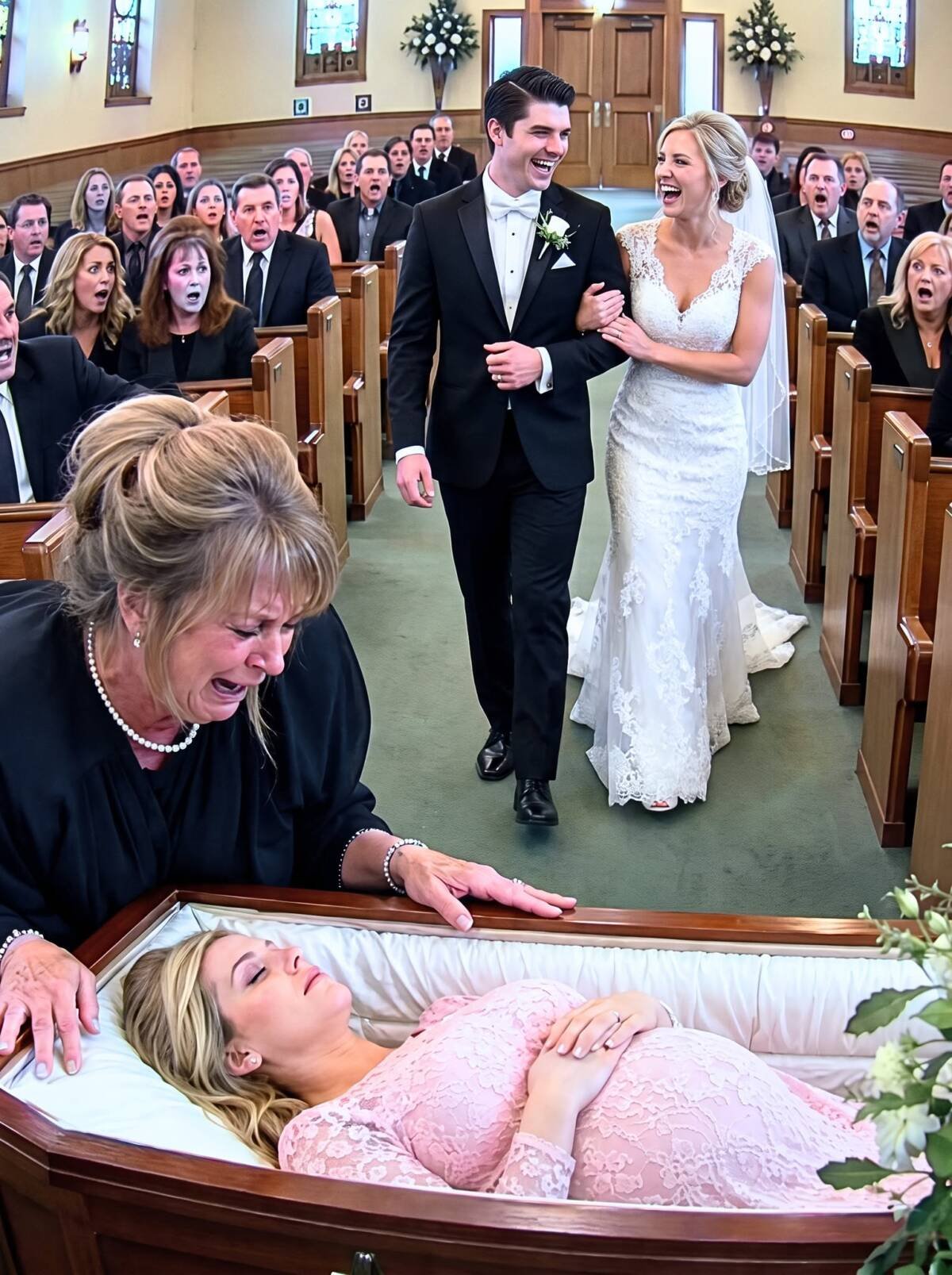
When Ethan sent a neon-lit photo of himself marrying his coworker in Las Vegas, he expected his wife of six years to crumble into hysterics on the living room floor. He completely forgot two critical facts: she was a commercial construction project manager trained to dismantle disasters without flinching—and his name had never been put on the deed to the house.
The Silence at 2:47 A.M.
The house felt unusually still at 2:47 in the morning. Outside, the suburban street was dark save for the pale orange glow of a single streetlight filtering through the living room blinds. I had fallen asleep on the sectional sofa again—a fleece throw twisted around my legs, an empty mug of chamomile tea sitting on a coaster on the coffee table—while my husband, Ethan, was two thousand miles away in Las Vegas for another “mandatory regional conference.”
It was his third conference in six months. The first had been in Scottsdale, the second in Miami, and now four days on the Strip. Each time, he had packed his best tailored shirts, kissed my forehead on his way out the door, and promised he would make it up to me with a weekend getaway as soon as the quarter closed. And each time, I had told myself that the growing, quiet distance between us was just the normal exhaustion of two busy people in their thirties, and that the silence in the house would vanish the moment his flight landed back home.
I was thirty-four years old and had been married to Ethan for six years. We had met at a downtown networking mixer when I was twenty-seven—me in a navy blazer with a stack of site blueprints still sitting in the trunk of my car, him holding a gin and tonic and effortlessly holding the attention of five people at once.
By profession, I was a senior project manager for a regional commercial construction firm. My entire career revolved around structure, logistics, and crisis mitigation. When a steel shipment stalled at the port, when a subcontractor walked off a job site, or when a city inspector flagged a zoning issue forty-eight hours before a deadline, people didn’t call me to panic with them. They called me to look at the numbers, identify what was salvageable, cut what was bleeding money, and keep the building standing.
Without ever consciously deciding to, I had brought that exact same mindset home to my marriage.
I believed long-term relationships required steady maintenance, quiet compromise, and constant micro-adjustments. What I hadn’t been willing to admit to myself was that, over the course of six years, I had become the sole contractor doing the maintenance while Ethan simply walked through the finished rooms and enjoyed the view.
Ethan was charming, outgoing, and naturally gifted at making any dinner party feel like a celebration. People loved him within five minutes of meeting him. What they didn’t see—and what I had spent years making excuses for—was that he had grown deeply accustomed to treating effort as something other people provided for him.
My phone vibrated sharply against the couch cushion beside my cheek, jolting me out of a shallow sleep. I blinked into the dark, reached blindly for the screen, and expected to see a blurry photo of a casino lobby or a quick text saying his morning flight had been pushed back.
Instead, the screen lit up with a photograph.
Ethan was standing beneath the buzzing pink and white neon lights of a Las Vegas wedding chapel. Pressed tightly against his side, one hand splayed proudly across his chest, was Rebecca—a woman from his marketing department.
I knew Rebecca. Two years ago, she had attended our housewarming party, sat at my dining room table eating the lasagna I had spent four hours making from scratch, and leaned over her wineglass to tell me how incredibly fortunate I was to have a man like Ethan.
In the photograph, both of them were grinning wildly, holding up matching decorative marriage certificates.
Two seconds later, Ethan’s message dropped beneath the image.
“Just married Rebecca. Been sleeping with her for eight months. You’re boring and pathetic. Enjoy your sad little life.”
I read the message twice. Slowly, I sat up, swung my legs off the couch, and set the phone flat on the coffee table. I stared at the dark ceiling for five full seconds, waiting for the sobs to hit my chest, waiting for the nausea or the urge to throw the phone straight through the drywall.
Neither came.
Something much colder, cleaner, and infinitely sharper arrived before the grief ever could: absolute clarity.
For six years, I had cooked in that kitchen, sanded and stained the cedar back deck by myself over a blistering July weekend, negotiated our mortgage refinance, filed our joint taxes, managed every contractor who ever stepped onto the property, and painted the guest rooms in shades of gray Ethan picked out while he watched a football game from the hallway. He had looked at the woman quietly holding his entire life together and mistaken her reliability for docility—assuming I was small enough, soft enough, and desperate enough to discard with a cruel midnight text.
What Ethan had forgotten was the most basic rule of any operation: the person responsible for keeping the entire building running is also the only person who knows where every single shutoff valve is located.
I knew the heartbreak would catch up to me eventually. It always does. Tonight, however, I wasn’t mourning a marriage. I was closing out a failed contract.
I picked up the phone, tapped the reply bar, typed a single word, and hit send.
“Cool.”
The Midnight Audit
I placed my phone facedown on the coffee table and sat in the quiet dark for three minutes, letting my pulse drop back to its normal resting rate. Ethan was clearly sitting in a Vegas hotel suite waiting for twenty missed calls, tearful voicemails, and frantic paragraphs begging him to explain how he could do this to me. Instead, his 2:47 a.m. text had just handed me the cleanest, most undeniable timeline I could have asked for.
At 3:02 a.m., I walked into my home office, turned on the desk lamp, and opened our banking portal on my laptop.
When Ethan and I got married six years ago, he had been digging himself out of a tangle of old credit card debt from his twenties. Because my credit score was pristine and my income was steady, I had set up our joint checking and savings accounts with myself as the sole primary account holder, adding him as an authorized user. At the time, it had been a purely practical arrangement—something we never bothered to revisit.
Now, it was the only firewall I needed.
Before I moved a single dollar, my eyes caught something on the transaction ledger that made my jaw tighten. Over the past eight months, there were dozens of small, unremarkable transfers—$280 here, $350 there, $390 two weeks ago—all routed to an external online bank account I didn’t recognize. Every single transfer had been kept neatly under $400 so it wouldn’t trigger my automated high-withdrawal alerts.
My stomach turned cold, but my hands stayed steady. I downloaded the last twelve months of bank statements as PDFs and saved them to a new folder on my desktop labeled Dissolution.
Then, with four calm clicks, I transferred the remaining balance of our joint accounts straight into my private pre-marital savings account.
At 3:09 a.m., I dialed the bank’s twenty-four-hour automated line and canceled both credit cards linked to the joint account, reporting unauthorized spousal use and revoking Ethan’s authorized-user status effective immediately. I wasn’t acting out of blind rage; I was securing assets and revoking site access from a subcontractor who had just breached his agreement.
At 3:15 a.m., I systematically changed every single password Ethan knew. The home security alarm. The smart-lock app. The garage keypad PIN. The utility portals. The home Wi-Fi. Even the streaming accounts.
Next, I knelt beside the bottom drawer of my filing cabinet, unlocked the fireproof lockbox, and pulled out the heavy cream-colored folder containing the property deed. I unfolded it under the warm circle of the desk lamp and confirmed the one critical detail Ethan had clearly forgotten during his eight-month romance.
I had purchased this house fourteen months before I ever met him. The deed was—and had always remained—solely in my name. Over the years, we had talked casually about adding him to the title, yet the paperwork always got pushed to “next month” whenever work got busy, until I eventually stopped thinking about it altogether.
At 3:30 a.m., I picked up my phone and called a twenty-four-hour emergency locksmith.
“I need every exterior deadbolt and handle on a three-bedroom colonial replaced,” I told the dispatcher calmly. “Front door, back patio, side entry, and the interior garage door. I’ll pay double the emergency rate. Now.”
Forty minutes later, a tired-looking man in a heavy canvas jacket stepped onto my front porch carrying a battered steel toolbox. He didn’t ask why a woman in sweatpants was changing all her locks at four in the morning. He simply drank the black coffee I handed him, worked quickly and quietly under the porch light, and handed me a shiny new set of brass keys just as the eastern horizon began turning a pale, washed-out gray.
By sunrise, Ethan no longer had physical access to the home belonging to the woman he had just mocked from a Las Vegas wedding chapel.
The 8:00 A.M. Knock
At 8:00 a.m. sharp, heavy, rhythmic pounding shook my front door.
I had been sitting at the kitchen island sipping my second cup of coffee, making a neat bulleted list of divorce attorneys to call at nine. I walked to the foyer, peered through the peephole, and saw two uniformed police officers standing on my welcome mat.
Apparently, Ethan’s morning flight had just landed—or he had called the local precinct straight from the terminal in Las Vegas—claiming that his “unhinged, controlling wife” had illegally locked him out of his own residence and stolen his money.
I unlocked the new brass deadbolt, pulled the door open, and stepped onto the porch still wearing my wrinkled sweatpants from the night before.
“Good morning, officers,” I said evenly.
The older officer—a stocky man in his late forties with graying temples—looked slightly surprised by how calm I sounded. “Good morning, ma’am. We received a call from a Mr. Ethan Brooks claiming he lives at this address and that you’ve changed the locks and refused him entry.”
“I’m his wife,” I replied. “Well—legally, at least. Though he seems to have forgotten that part last night.”
I unlocked my phone, pulled up the 2:47 a.m. text thread, and handed it to the senior officer.
He adjusted his glasses, looked closely at the bright neon wedding chapel photograph, and read Ethan’s message word for word. His younger partner leaned in slightly to see the screen, his eyebrows shooting up toward his hairline.
The older officer slowly handed my phone back to me and let out a long, tired breath.
“He married another woman in Nevada while still legally married to you,” the officer said flatly, shaking his head. “And the deed is in your name?”
“Solely in my name, purchased fourteen months before our marriage. I have the certified copy right inside if you’d like to see it.”
“No need, ma’am,” he said, his tone softening into quiet professional respect. “This isn’t a police matter. It’s a civil—and possibly bigamy—matter. Have a good morning, and call us if he causes a disturbance when he gets here.”
After the squad car backed out of the driveway, I locked the deadbolt, walked upstairs, and slept soundly for two full hours in the dead center of my own bed.
Fourteen Boxes in the Garage
When I woke at ten-thirty, I didn’t waste a minute. I already knew Ethan would show up before evening—not because he felt a shred of guilt, and certainly not because he wanted to apologize, but because walking back through the front door whenever he needed something had worked for six straight years.
I drove to the hardware store, bought twenty heavy-duty moving boxes and three rolls of packing tape, and spent the next three hours methodically clearing every trace of Ethan Brooks out of my house.
I didn’t slash his suits. I didn’t throw his golf clubs onto the front lawn for the neighbors to gawk at. I folded his shirts neatly, wrapped his cologne bottles in newspaper so they wouldn’t shatter, and labeled every single box in thick black Sharpie with the exact precision I used on commercial job sites: Ethan – Clothes. Ethan – Books. Ethan – Golf Gear. Ethan – Electronics. Ethan – Misc.
By 1:45 p.m., fourteen taped boxes sat in two tidy rows inside the garage.
At 2:00 p.m. on the dot, Ethan’s black SUV whipped aggressively into my driveway, tires spitting gravel.
He didn’t come alone. Rebecca climbed out of the passenger seat still wearing a wrinkled black cocktail dress from the night before, oversized sunglasses hiding her eyes. Right behind them, a silver sedan pulled up to the curb, and Ethan’s mother, Margaret, and his younger sister, Lily, marched up the walkway—the full family intimidation squad, clearly expecting to corner me in my foyer and bully me into restoring the comfortable arrangement Ethan had just torched.
Before Margaret’s heels even reached the front steps, I pressed the wall button to raise the garage door and walked out onto the concrete threshold with my arms folded calmly across my chest.
Margaret started shouting immediately, her face flushed red. “What on earth do you think you’re doing, locking my son out of his own home?! You’ve lost your mind!”
Lily rushed up beside her, jabbing a manicured finger in my direction. “You’re standing there like you own the place! You can’t just kick him out because you’re jealous!”
I didn’t raise my voice. I looked straight past both of them to Ethan.
“I do own the place,” I said evenly. “Ethan’s name was never on the deed.”
The silence that dropped over the driveway was instant and absolute.
Margaret’s head whipped toward her son. “Ethan? Tell her she’s lying.”
Ethan didn’t answer. He stared awkwardly at the brick facade of the house, his jaw tight, suddenly unable to meet his mother’s eyes. Beside him, Rebecca slowly lowered her phone and looked at the house, then at Ethan, as if realizing in real time that the comfortable, mortgage-free suburban lifestyle she thought she had just married into had vanished into thin air.
Things unraveled even faster ten minutes later.
Realizing they couldn’t fit fourteen boxes into two passenger cars, Rebecca stepped off to the side of the driveway to reserve a last-minute U-Haul truck on her phone. A moment later, she frowned and tapped the screen harder.
“Ethan,” she called out, her voice tight. “My card just got declined.”
Ethan scoffed, clearly desperate to salvage a shred of dignity in front of his mother. “Here, use mine,” he snapped, pulling out his leather wallet and handing her his credit card.
She punched the numbers in. Three seconds later, the exact same red error screen flashed back at her.
“Declined,” Rebecca said flatly, her eyes narrowing as she looked up at him. “Both of them.”
Watching their faces, the final ugly piece of the puzzle snapped into place: the small, sub-$400 transfers I had seen on the bank ledger at three in the morning. Ethan and Rebecca hadn’t just been having an affair—they had been quietly siphoning money out of my accounts to fund their Las Vegas flights, their hotel suite, and their neon wedding chapel.
“You froze the accounts,” Ethan hissed, taking a sharp step toward the garage. “That’s our money!”
“That was my primary account,” I corrected calmly. “And I have twelve months of bank statements showing every unauthorized transfer you made to fund your little vacation. If you’d like to discuss it with a judge, my attorney will be happy to schedule it.”
With nothing left to argue, they spent the next twenty minutes awkwardly cramming as many boxes as they could into the trunks and back seats of both cars, leaving the rest for a second trip.
Just before climbing into her mother’s sedan, Lily turned back for one final, venomous shot. “You’re going to end up bitter, lonely, and pathetic in this big empty house!” she snapped. “You’re going to regret doing this to him!”
I took one calm step forward onto the driveway—not threateningly, just close enough that she stopped talking mid-breath.
“I have my home. I have my career. I have my freedom. And I don’t have Ethan.” I paused just long enough for the words to land. “That last part is the best part.”
The Story He Couldn’t Control
Within a week of hauling his boxes out of my garage, the smear campaign began.
Ethan, Margaret, and Lily flooded Facebook and Instagram with a coordinated, carefully worded sob story. In their version of reality, I was a cold, obsessive, financially abusive tyrant who had tracked Ethan’s every move and finally driven a warm, devoted husband into the arms of a woman who actually appreciated him.
Acquaintances who hadn’t bothered to text me in three years suddenly left heart emojis and sympathetic comments beneath Ethan’s posts. Two former neighbors sent me nosy private messages thinly disguised as “concern,” asking if I was “getting help for my anger.”
It stung far more than I expected—not because I doubted my own memory of the last six years, but because it revealed how long Ethan had been quietly rehearsing a script where I was the villain, just waiting for the day he no longer needed me.
I didn’t write a frantic three-paragraph rebuttal. I didn’t argue in the comments section.
Instead, I called my longtime friend David, an IT security consultant who understood one universal truth about arrogant people: they become remarkably careless when they assume their digital footprints are invisible.
That evening, David came over with takeout Thai food and sat at my kitchen island. Halfway through dinner, I remembered the old iPad Ethan had left sitting in the nightstand drawer of the guest bedroom—a device he hadn’t touched in months because he had upgraded to a newer model.
Within forty-eight hours, David helped me pull the cached messages from a secondary messaging account Ethan had created using his middle name—an account still quietly logged in on that old iPad.
The thread laid out the entire eight-month affair in excruciating, black-and-white detail.
There were exact dates and dollar amounts of their secret bank transfers. There were messages where Ethan bragged about keeping every withdrawal under $400 so it wouldn’t ping my banking app. There was a detailed timeline of when they planned to fly to Vegas, and—most damning of all—a message from Rebecca sent three weeks earlier, laughing at my expense:
“She’s way too obsessed with managing everything to ever notice what’s happening right under her nose. By the time she figures it out, we’ll already be set.”
She wasn’t entirely wrong about the first part. I had been too busy managing everything.
That night, I took six clean, uncropped screenshots of their messages—complete with dates, timestamps, and their own words—and posted them publicly to my social media profile. I didn’t add a caption. I didn’t write an angry rant. I didn’t tag a single person.....