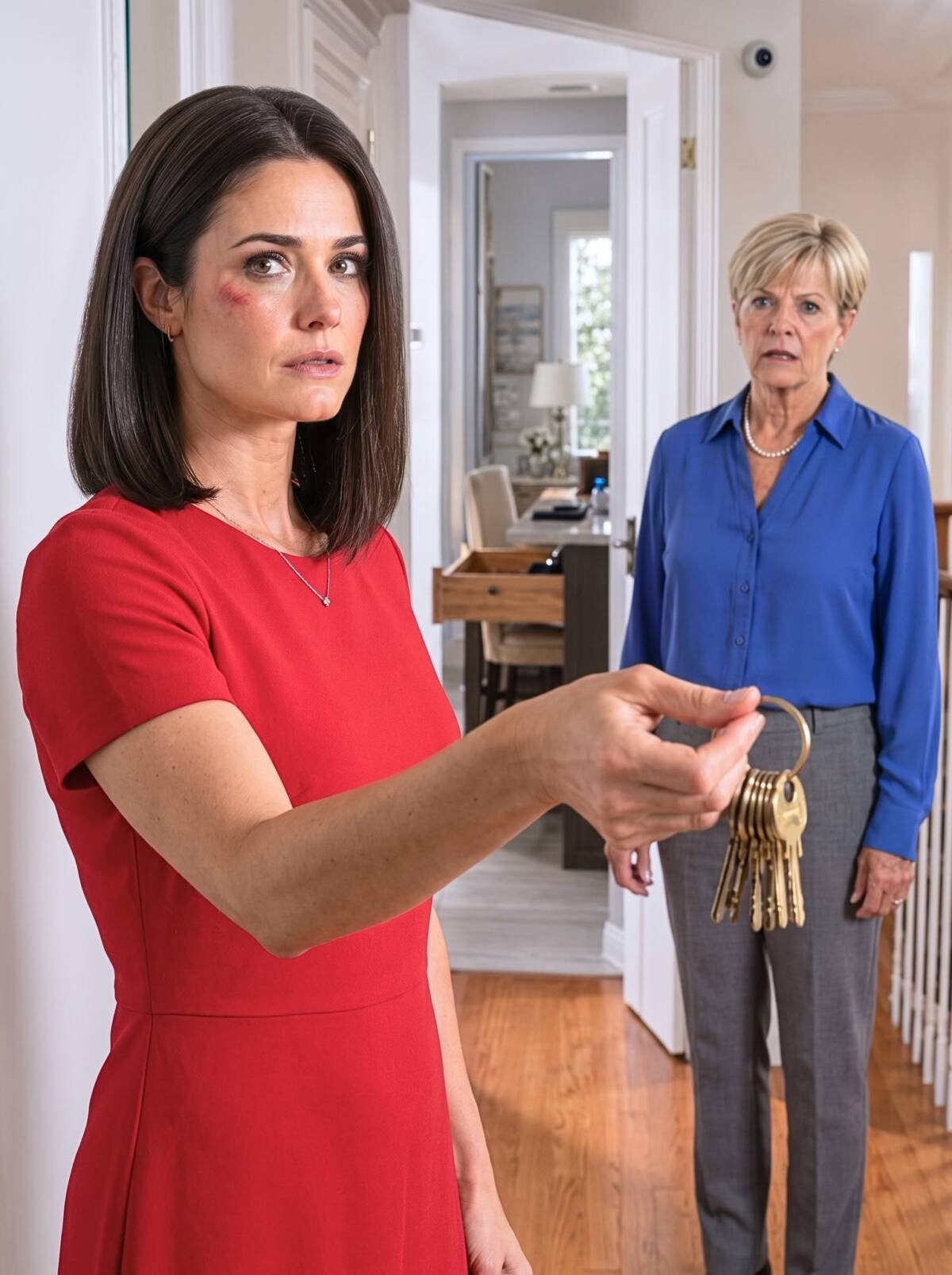
The slap landed with enough force to drive the metal edge of my wedding ring deep into my palm. For several breathless seconds, the grand marble foyer fell completely silent. Six relatives stood frozen around the room, watching my husband hover over me with his hand still half-raised, breathing heavily as though I had somehow forced him to lose control.
Behind him, my mother-in-law, Evelyn, was smiling.
“Get out of here,” Daniel shouted, his voice echoing off the high ceilings. “You don’t raise your voice at my mother in her own house.”
Her own house.
The words would have been almost comical if my cheek weren’t already throbbing with heat. Looking past Daniel’s shoulder, I took in the crystal chandelier, the sweeping curved staircase, and the imported Italian tiles I had personally selected after spending weeks comparing stone samples. They thought they had just thrown me out with nothing. What neither of them understood in that moment was that the mansion, the lifestyle, and Evelyn’s $10,000 monthly allowance had belonged to me all along.
The Architecture of Silence
Above the limestone fireplace hung the formal family portrait Daniel had insisted we commission during our second year of marriage. In the painting, he stood proudly at the center with Evelyn’s hand resting possessively on his shoulder. I had been positioned slightly behind them, angled toward the edge of the frame like a quiet acquaintance who had accidentally wandered into someone else’s photograph.
Standing in the foyer that afternoon, Evelyn dabbed dramatically at the corners of her dry eyes with a silk handkerchief.
“I only told her she should be grateful,” she said, her voice trembling just enough for the relatives to hear. “Some women marry into comfort and immediately forget their place.”
“My place?” I asked quietly.
Daniel stepped closer, dropping his voice to the low, controlled register he always used when he wanted intimidation to sound like reason. “Don’t start.”
He didn’t realize that nothing was starting. Something inside me had just finished.
For three years, I had endured Sunday dinners where Evelyn dissected everything from my wardrobe and posture to my cooking and my worth as a wife. At charity galas, she routinely introduced me as “Daniel’s quiet little wife,” completely unaware—or willfully blind to the fact—that the majority of the donations made under our family name came from accounts I personally controlled.
Whenever guests admired the mansion, Evelyn accepted the compliments as though she had drafted the blueprints herself. Whenever Daniel’s company weathered a difficult quarter, she pulled me aside and warned me not to burden him with financial questions, insisting that a man carrying such heavy responsibilities deserved absolute peace at home.
In Daniel’s family, peace had always been a polite word for my silence.
The Afternoon Tea That Broke the Illusion
That Saturday afternoon, six relatives had gathered in the formal sitting room for tea while Evelyn held court about her upcoming birthday vacation. Nobody in the room asked how she was funding the trip, because everyone naturally assumed Daniel was footing the bill.
For nearly twenty minutes, Evelyn described the five-star resort, the private chauffeur, the spa appointments, and the new set of designer luggage she planned to buy before departure. Then, setting her porcelain cup down, she turned toward me with a practiced smile and announced that I should consider myself extraordinarily fortunate to have married a man wealthy enough to support “two dependent women.”
I met her eyes and asked her what she meant.
She looked around the room to make sure she had everyone’s attention before explaining that one dependent woman was his devoted mother, and the other was his barren, useless wife.
Not a single person in the room spoke up. A cousin suddenly found the bottom of her teacup fascinating. An uncle stared intently at the fringe of the Persian rug. Daniel didn’t even look up from his phone, as though watching his wife be humiliated in front of his family wasn’t worth interrupting whatever email he was reading.
For three years, I had swallowed insults like that because I believed keeping the peace was how you protected a marriage. Sitting in that quiet room, the truth finally came into focus: my silence had never protected the marriage. It had only protected the people who were hurting me.
So I laughed.
It wasn’t loud, and it wasn’t theatrical, but it was enough to puncture Evelyn’s performance. She shot up from her armchair, trembling with sudden outrage as though a single quiet laugh were a far greater offense than the cruelty she had just delivered.
“She disrespected me in my own home,” Evelyn declared.
Daniel marched out of the adjacent study. He didn’t ask what had been said. He didn’t look at the uncomfortable faces of his relatives. He simply accepted the first version of events his mother offered, crossed the marble foyer in four strides, and slapped me in front of everyone.
Now his handprint burned across my face while the room stayed dead silent. Satisfied that her son had restored the proper hierarchy, Evelyn looked me up and down with open contempt.
“Pack whatever cheap clothes you came with,” she said. “Leave the jewelry, leave the car keys, and leave everything my son paid for.”
I stared at her long enough for the smug certainty on her face to become almost embarrassing.
The Paper Trail They Ignored
What Evelyn never knew was that the $10,000 deposited into her bank account on the first Monday of every month had never come from Daniel. The transfers passed through his business account for one reason only: early in our marriage, I had agreed to let him present the money as though he were the one supporting her.
At the time, the arrangement had seemed harmless. Daniel was working to get his company off the ground, Evelyn had expensive tastes, and I already had substantial independent income from an investment portfolio and commercial real estate holdings I had inherited and expanded long before our wedding. Daniel told me his mother would feel deeply humiliated if she knew her daughter-in-law was financing her lifestyle.
I thought protecting Evelyn’s pride would buy harmony for our family. Instead, the arrangement slowly convinced both of them that my money magically became Daniel’s the moment it passed through an account with his name on it.
The mansion was the most obvious example.
When the estate first hit the market, Daniel wanted it desperately, but his company’s balance sheet wasn’t strong enough to qualify for the purchase. My holding company bought the property outright instead. At closing, Daniel signed a formal occupancy acknowledgment confirming that my holding company owned the mansion and that the property was not a gift to either him or Evelyn. He had waved it off as routine legal paperwork and never even asked for a copy.
Over the next three years, Daniel began referring to the estate as his house. Evelyn went a step further—she called it hers.
Standing in the foyer, Daniel glared at me impatiently. “Why are you still standing there?”
I bent down and lifted my purse from the console table. As I straightened, I saw the thin red line across my palm where my wedding ring had broken the skin.
“Because I wanted to remember this moment clearly,” I said.
Evelyn let out a sharp scoff. “For what, your diary?”
I looked directly into my husband’s eyes.
“No,” I replied. “For court.”
Then I turned and walked out.
The heavy mahogany front door clicked shut behind me with the same solid, expensive sound that had once made the house feel safe. I climbed into my car in the circular driveway and sat behind the wheel for two full minutes, waiting for the adrenaline to fade and my hands to stop shaking.
Evelyn’s next $10,000 allowance transfer was scheduled to process on Monday morning. I opened my banking app and canceled it.
I didn’t touch Daniel’s payroll, utilities, or legitimate business expenses. I stopped one voluntary transfer: the monthly payment my company had been making to fund Evelyn’s lifestyle. Next, I forwarded the mansion’s property file, the closing agreement, and three years of transfer records to the attorney I had quietly consulted two weeks earlier.
I hadn’t originally hired her out of spite, or even because I was certain I was leaving. I had called her after Daniel casually remarked during dinner that women who married well shouldn’t ask too many questions about money. The comment had unsettled me, considering that nearly every major asset supporting our household had come from work and investments I had built myself. My attorney had advised me to organize my records, just in case.
Now, everything was ready.
My phone started ringing before I reached the iron gates at the end of the driveway. Daniel’s name flashed across the screen. I let it ring twice before answering on speaker.
Evelyn’s voice tore through the car first. “Turn it back on! Right now!”
There was a brief scuffle as Daniel took the phone from her. “You can’t just cut off Mom’s money because you’re upset.”
I almost smiled. “Mom’s money?”
Silence dropped over the line.
Calmly, I explained that the monthly transfer had always been voluntary, that it originated from my holding company, and that it had only routed through his account to spare his pride. When Daniel immediately accused me of twisting the facts, I told him to open the email I had just sent him.
I heard the rustle of papers—or the clicking of his laptop—on the other end.
“You put the house under some holding company,” he said, his tone turning defensive. “That doesn’t mean anything. We’re married.”
“It means you signed an occupancy acknowledgment before we ever moved a single box inside,” I replied.
The silence that followed felt entirely different from the silence in the foyer. This time, Daniel wasn’t waiting for his mother to tell him how to react. He was reading.
In the background, Evelyn demanded to know what the document said, but Daniel didn’t answer her. He had reached the signature page—the one bearing his own name directly beneath a clause stating that the mansion belonged solely to my company and had never been gifted to him or his mother.
“You planned this,” he whispered.
“No,” I said. “I documented it.”
For the first time in our marriage, Daniel apologized without immediately explaining how his behavior had been my fault. Even then, however, his voice sounded less like remorse and more like a business negotiation. He proposed that I restore Evelyn’s allowance, allow her to stay in the mansion, and keep the slap private. If I agreed, he insisted we could resolve everything quietly as a family.
I glanced at the red mark swelling across my cheek in the rearview mirror.
“You made it public when you hit me in front of six people.”
I ended the call and drove straight to my attorney’s office.
By the time I sat down across from her desk, Daniel had already sent a lengthy text message claiming the mansion had been promised to him as a marital gift. Without saying a word, my attorney opened the closing binder and turned to the final page.
Daniel’s signature wasn’t the only one there. Beneath it was the signature of a witness: Daniel’s uncle—one of the exact relatives who had been sitting in the foyer when Daniel struck me.
Years earlier, Daniel had insisted his uncle attend the closing because he trusted family more than strangers. Now, the man who had witnessed Daniel acknowledge my company’s ownership of the mansion had also witnessed him slap me and order me out of it.
My attorney looked up at me. “Do you think his uncle will tell the truth?”
I thought of the way the older man had stared silently at the rug while Evelyn called me useless.
“I don’t know,” I admitted.
The financial records could prove who owned the house and where the money came from. What no spreadsheet could tell me was whether anyone in Daniel’s family would finally choose the truth when telling it became uncomfortable.
The Witness Who Finally Found His Voice
That night, I checked into a quiet hotel downtown and sat alone with an ice pack pressed against my cheek. My wedding ring sat on the nightstand beside my phone. Daniel called eleven times and Evelyn called seven, yet not a single voicemail asked whether I was okay.
Daniel’s messages focused entirely on damage control. He complained that Evelyn was panicking, that the relatives were confused, and that my sudden departure was making the family look unstable. Evelyn’s voicemails were even more direct: two of them demanded that I reinstate her monthly allowance before the deposit for her birthday resort came due.
The next morning, a massive bouquet of white roses arrived at my attorney’s office with a handwritten card: Come home so we can fix this privately.
I didn’t take them. I photographed the card, added it to our file, and instructed my attorney to handle all communication moving forward. We filed for temporary orders covering the mansion, financial accounts, and contact while the divorce proceeded. I had no interest in spectacle or public revenge; I simply wanted distance, clean records, and legal boundaries strong enough to ensure neither of them could use the house or money as leverage.
The first hearing took place in a plain courtroom under harsh fluorescent lights. Daniel arrived in a tailored dark suit, with Evelyn seated beside him wearing the wounded, composed expression she usually reserved for charity luncheons.
Daniel’s attorney argued that the mansion was our marital home and that Daniel had always believed it was a shared asset. My attorney didn’t bother with theatrics. She placed the deed, corporate records, closing documents, and the signed occupancy acknowledgment into evidence.
Daniel admitted the signature was his—then claimed he hadn’t understood what he was signing.
The judge asked if anyone had witnessed the execution of the document.
Daniel’s uncle was called to the stand.
He walked forward slowly, his shoulders slightly hunched. For a tense moment, I braced myself for him to protect his nephew. Family loyalty had kept everyone quiet in that foyer, and I had no reason to believe a courtroom would suddenly make courage easier.
Then he began to speak.
Under oath, he testified that he had watched Daniel read the occupancy acknowledgment carefully before signing it. According to him, Daniel knew with complete certainty that my holding company owned the estate. Then he added a detail I had never heard before: at the closing table, Daniel had laughed and joked that he didn’t care whose company name was on the deed, because everyone would assume the mansion belonged to him anyway.
Daniel whipped his head toward his uncle in disbelief. Evelyn hissed his name like a warning.
Her brother-in-law didn’t flinch.
He admitted to the judge that he had stayed silent in the foyer after Daniel slapped me because he was ashamed and afraid of becoming the family’s next target. Then, clearly and without hesitation, he confirmed every detail of what had happened that afternoon: Daniel had struck me, and he had ordered me out of the house.
His testimony didn’t instantly settle every financial detail of the divorce. Daniel still had the legal right to make claims regarding marital contributions and shared expenses through the standard process. But two facts were now permanently on the record: the ownership documents had never been a secret, and the slap had never been a private misunderstanding.
Temporary control of the mansion remained with my holding company, and Daniel was bound by the court’s orders regarding access and contact. Evelyn wasn’t thrown onto the street—she was given a reasonable window to pack her belongings and arrange new housing.
What vanished overnight was the illusion that she had any authority over a house she never owned.
The Quiet Collapse of a Borrowed Lifestyle
Evelyn’s monthly allowance never resumed.
Without the $10,000 transfer, she canceled her birthday vacation, let go of her private driver, and eventually sold several designer handbags to cover her expenses. She told anyone in the family who would listen that I was cruelly punishing an older woman over a minor disagreement.
The bank records told a simpler story. For three years, every deposit had been documented as voluntary family support from my company. There was no contract, no debt, and no legal obligation requiring me to fund her lifestyle indefinitely.
Weeks later, Daniel requested one final meeting. We sat across from each other in a sterile conference room with our attorneys waiting nearby. Daniel looked worn down, though the anger beneath his polished exterior hadn’t disappeared—it had just learned to be more careful.
He told me we had built a life together, then accused me of turning legal paperwork into a weapon.
I set my left hand flat on the table. The small cut from my wedding ring had healed, leaving only a faint pale mark across my palm.
“The paperwork did not hit me,” I said.
Daniel looked away. For the first time, he admitted the truth he had spent years hiding from his mother. He had always known the $10,000 allowance came from me. He had let Evelyn believe he was paying for it because she respected him more when she saw him as the wealthy, generous son supporting everyone around him. He had let the relatives believe the mansion was his for the exact same reason.
Every lie had made Daniel look bigger. And every lie had made me disappear a little more.
Finally, he asked the question I knew was coming: was there any way back?
I thought about the years I had spent excusing disrespect as stress, disguising cruelty as family tension, and calling my own erasure patience. Then I pictured the foyer, and the split second it took for Daniel to raise his hand because his mother claimed I had disrespected her.
“No,” I said.
The divorce didn’t end with a dramatic television moment. It unfolded over months of appraisals, financial disclosures, negotiations, and signed agreements. Because the mansion belonged to my holding company, it remained under company control while the remaining marital assets were divided cleanly. Daniel’s business stayed open, but for the first time, it had to survive on its own revenue and credit without my quiet financial cushion propping up his image.
Evelyn eventually moved into a modest rental and continued telling relatives that I had stolen her home. I never bothered correcting her. You cannot steal a house from someone who never owned it.
Months later, once the legal dust settled, my company decided to sell the mansion. Before the real estate photographer arrived, I walked through the empty rooms one last time. The crystal chandelier still glittered above the foyer, but the massive family portrait was gone from above the fireplace, leaving only a pale rectangle on the painted wall.
Standing on the Italian tile, I thought about the woman who had lived here. She had owned the house, financed the family, and protected everyone’s pride—yet she had somehow convinced herself she needed permission to speak.
I opened the front door, walked out, and didn’t look back.
The Life I Stopped Paying to Keep
Selling the mansion turned out to be far easier than letting go of the version of myself who had lived inside it.
Offers came in quickly, and when the sale closed, I felt relief rather than grief. I bought a smaller, sunlit house several miles away. It had no marble foyer, no sweeping staircase, and no formal sitting room built for people who cared more about appearances than honesty. Every room felt unmistakably mine.
My first night there, I ate takeout at the kitchen counter surrounded by unpacked boxes. Nobody criticized the meal, demanded money, or reminded me how lucky I was to belong to their family. For the first time in years, silence felt like peace instead of a requirement.
Several months after the divorce was finalized, Daniel reached out through my attorney to ask for a brief conversation. With nothing left to negotiate, I agreed to meet him at a quiet café on a weekday afternoon.
Without the luxury watch and custom suits, Daniel looked smaller—not physically, just stripped of the effortless certainty he used to wear. After a few minutes of small talk, he asked the question he had clearly come to ask.
“Did you ever love me?”
“Yes,” I answered honestly.
His jaw tightened. “Then how could you walk away so easily?”
“It wasn’t easy,” I said.
He stared down at his coffee. “It looked easy.”
“That’s because you only paid attention on the day I left,” I told him. “You never noticed the years I spent trying to stay.”
He didn’t argue. Quietly, he admitted that because I was financially independent and composed, he had convinced himself I could absorb more disrespect than other people.
“You always seemed so strong,” he said.
“That wasn’t permission.”
“I know that now.”
This time, his apology came with no conditions attached. “I’m sorry I hit you. And I’m sorry I let Mom treat you the way she did.”
I believed he regretted it. But regret and reconciliation are two very different things, and I had finally stopped treating someone else’s remorse as an obligation to let them back into my life. Before we parted, Daniel mentioned that Evelyn still blamed me for everything—still insisting the house had been hers and that she was entitled to the allowance.
I never spoke to Evelyn again. Eventually, even the secondhand updates from relatives faded away.
Of all the family members who had watched the slap in silence, Daniel’s uncle was the only one whose apology I accepted without hesitation. He didn’t make excuses or ask me to pretend his fear was understandable.
“I should have stood up when he hit you,” he told me simply. “You were the one standing there alone. I’m sorry.”
About a year after the divorce, I received an invitation to the same annual charity gala Daniel and I had attended for years—only this time, it was addressed solely to me. I wore a simple black dress and arrived alone. Before dinner, one of the event organizers approached me and thanked me personally for the years my foundation had quietly supported their program.
“We can make sure you get public recognition tonight,” she offered with a smile.
I thought of Daniel soaking up applause for donations funded by my accounts, and Evelyn standing beside him telling strangers how lucky I was. Then I realized I didn’t need a spotlight to rewrite the past.
“No,” I said. “Quiet is fine.”
This time, the silence was my choice.
Conclusion
Two years later, I still live in my smaller house. The kitchen counter is usually cluttered, the furniture doesn’t match like a magazine spread, and nobody has ever mistaken it for a mansion. I love every inch of it.
There is only one framed photograph hanging in my hallway. It isn’t a formal family portrait; it’s a candid shot of me standing barefoot on a beach six months after the divorce, laughing at something just outside the frame.
The first time Daniel’s uncle stopped by to visit, he paused in front of that photo.
“You look different,” he observed. “Happier?”
I thought about it for a second. “Visible.”
People often assume that losing the mansion or the $10,000 allowance was the hardest blow for Daniel and Evelyn. They’re wrong. A house is just property, and money is just money. What they truly lost was the woman who had spent years making their lives effortless while asking for almost nothing in return.
Daniel’s slap didn’t end our marriage—it simply exposed what had been happening quietly for years. They thought they had thrown me out of their house. Instead, they handed me back my life. And this time, nobody else gets to put their name on it.
What would you have done in her shoes? Did she handle the situation the right way, or should she have spoken up years earlier? Share your thoughts in the comments below—and if this story resonated with you, pass it along to someone who needs a reminder to never shrink themselves to keep the peace.