The smell of burning skin reached me before the pain did.
My husband, Dominic, had one hand locked around my wrist and the other braced against the kitchen counter as he forced my palm toward the glowing burner.
“Maybe now you’ll learn not to ruin my dinner,” he whispered.
I screamed.
The skillet slipped from the counter and crashed onto the kitchen floor. Overcooked steak and hot grease scattered across the tiles, but Dominic didn’t seem to notice. He held my hand against the heat for another terrifying second before finally releasing me.
I collapsed.
Across the kitchen, my mother-in-law, Victoria, looked at me, took another sip of wine, and laughed.
“Maybe now she’ll learn her place.”
My father-in-law, Arthur, remained in the living room, watching television.
He didn’t call for help.
He didn’t get up.
He simply turned the volume higher.
What they didn’t know was that I wasn’t reaching for a bandage.
I was reaching beneath the kitchen counter.
Three weeks earlier, I had installed a concealed camera disguised as a charging port beneath the marble island. Every recording was automatically backed up to an encrypted server.
And that night, for the first time, I activated the emergency system.
I pressed the hidden switch three times.
Within seconds, the evidence was no longer inside our house.
It was already on its way to the police.
And Dominic had no idea that the final mistake he made would be recorded from beginning to end.
The Night He Thought I Would Finally Obey
For eighteen months, Dominic had slowly transformed our home into a place I was afraid to breathe in.
At first, the abuse had been verbal.
He criticized everything I did.
The way I cooked.
The way I dressed.
The people I spoke to.
The amount of money I spent.
Even the way I laughed.
Then came the financial control.
Dominic insisted that all our accounts should be under his name because, as he repeatedly reminded me, he was “better with money.”
Eventually, I couldn’t access our household finances without asking him.
Then came the threats.
Then the bruises.
Whenever I tried to explain what was happening, Victoria told me I was exaggerating.
“Every marriage has problems,” she would say.
Arthur had an even simpler response.
“That’s between you and your husband.”
They had created a family system in which Dominic could do almost anything and still expect everyone around him to protect him.
But I had begun quietly protecting myself.
My grandmother had left me a trust before she died. A substantial portion of the money used to purchase our house had come from that trust.
Dominic liked telling everyone the house belonged to him.
He liked telling me the same thing.
But legally, the situation was far more complicated.
There was something else Dominic depended on even more than the house.
His company depended on software I had designed.
I had written and maintained the accounting system used by his construction business. I knew how the company tracked invoices, payments, contracts, payroll, and financial transfers.
And several months before that night, I had begun noticing irregularities.
Payments that didn’t make sense.
Invoices that had been altered.
Transfers moving through unfamiliar companies.
Documents carrying signatures that didn’t look right.
I didn’t confront Dominic.
Not yet.
I started documenting everything.
Then, three weeks before the stove incident, Dominic shoved me into a pantry during an argument.
I hit the wall hard enough to leave a bruise across my shoulder.
That was the night I stopped believing he would eventually change.
I began preparing to leave.
I also installed the camera.
It was small enough to look like an ordinary charging port beneath the kitchen island.
The device was connected to a secure cloud system and configured to preserve recordings remotely.
I had also arranged an emergency protocol with Detective Chloe Park, a domestic violence investigator who had been helping me plan a safe exit.
If I activated the system in an emergency, the camera would preserve the footage and transmit an alert containing my location.
I hoped I would never have to use it.
Then Dominic put my hand on the stove.
And I knew.
I pressed the switch.
Once.
Twice.
Three times.
A tiny blue light blinked beneath the counter.
Then disappeared.
Dominic didn’t notice.
He was too busy enjoying the fear in my eyes.
He grabbed my hair and pulled me upright.
“You’re going to clean this mess,” he said. “Then you’re going to cook another steak.”
I held my burned hand against my chest.
“Please…”
“Stop performing.”
Victoria laughed.
“She always does this. She wants everyone to feel sorry for her.”
Arthur didn’t even look away from the television.
Dominic smiled at his parents.
“See? She’s finally learning.”
For months, I had lowered my eyes whenever he spoke like that.
That night, I didn’t.
I looked directly at him.
Because for the first time, I knew something he didn’t.
Every word he had spoken was being preserved.
Every threat.
Every movement.
Every sound.
And every second of what had happened in that kitchen.
Then I heard something outside.
Sirens.
At first, they were distant.
Then they grew louder.
Dominic stopped smiling.
Part 2: The Evidence They Never Saw Coming
The sound of sirens reached the house.
Dominic turned toward the kitchen window.
Blue lights reflected across the parked cars outside.
For the first time that evening, his expression changed.
He released my wrist.
“What did you do?”
I didn’t answer.
Dominic grabbed my phone from the counter and threw it against the wall.
The screen shattered.
He kicked the broken device beneath a cabinet.
Then, almost immediately, he began constructing a new version of reality.
“She called the police,” he told Arthur.
Arthur finally stood.
“Then what do we say?”
Dominic looked toward me.
“We say it was an accident.”
Victoria understood immediately.
“She slipped,” she said.
Dominic nodded.
“She’d been drinking.”
I stared at them.
They were creating a story.
A story they expected the police to believe.
Victoria poured wine onto the floor beside me.
“There,” she said. “Now it looks like she fell.”
Dominic wiped the stove.
Arthur picked up the broken pieces of my phone.
“Get rid of these,” Dominic ordered.
Arthur hesitated.
Then he placed the pieces in a trash bag.
The pounding on the front door began.
“Police! Open the door!”
Dominic straightened his shirt.
Then he looked at me.
“If you accuse me, I’ll tell them you attacked my mother.”
He stepped closer.
“Three witnesses against one unstable wife.”
His voice dropped.
“Who do you think they’ll believe?”
I said nothing.
The pounding became louder.
Finally, Arthur opened the door.
Four officers entered the house.
They were wearing body cameras.
Behind them was Detective Chloe Park.
Dominic immediately switched into performance mode.
“Thank God you’re here,” he said. “My wife had another episode.”
Victoria nodded.
“She burned herself.”
Arthur added, “She was throwing things around.”
Dominic looked at the officers with an expression of exaggerated concern.
“We were trying to calm her down.”
Chloe didn’t respond immediately.
She looked at me.
We had agreed months earlier on one sentence I would use if I was in immediate danger.
I forced the words through the pain.
“I’m sorry dinner was disappointing.”
Chloe’s expression changed.
That was the signal.
One officer moved between Dominic and me.
Another separated Victoria and Arthur.
Dominic immediately became angry.
“What is this?”
Chloe took out her phone.
“Would you like to hear what actually happened?”
Dominic stared at her.
She pressed play.
His own voice filled the kitchen.
“Maybe now you’ll learn not to ruin my dinner.”
Then came the sound of my scream.
Then Victoria’s laughter.
“Maybe now she’ll learn her place.”
Arthur’s television could be heard clearly in the background.
Dominic’s face went pale.
He looked toward the counter.
Then toward the kitchen island.
Then back at Chloe.
“What is that?”
Chloe didn’t answer.
She simply continued playing the recording.
Dominic lunged toward her.
Two officers immediately restrained him and pushed him against the refrigerator.
“Don’t move.”
The handcuffs clicked around his wrists.
Victoria began shouting.
“That recording is illegal!”
Arthur demanded a lawyer.
Dominic continued struggling.
“That camera belongs to me!”
Chloe finally looked at him.
“That’s not your biggest problem tonight.”
The ambulance crew entered the house.
One paramedic carefully examined my hand.
I could barely feel my fingers.
Chloe knelt beside me.
“You’re safe now.”
Those words were almost impossible to believe.
But for the first time in eighteen months, I wanted to believe them.
Dominic twisted around to look at me.
“This house belongs to me!”
I met his eyes.
“No, Dominic.”
My voice shook, but I didn’t look away.
“It never did.”
Part 3: The Camera Captured More Than the Assault
The hospital lights were painfully bright.
Doctors treated the burns across my palm and fingers while nurses monitored my condition.
The physical pain was intense.
But something else was happening in the hallway outside my room.
The evidence was being collected.
A forensic technician retrieved the recordings from the encrypted server.
The footage showed the assault.
But it also captured everything that happened immediately afterward.
Dominic destroying my phone.
Victoria pouring wine onto the floor.
Arthur helping create the false story.
Dominic instructing his parents to tell police that I had fallen.
And then, most importantly, the conversations that followed.
The camera had been operating in motion-detection mode for days.
It had captured more than I expected.
Chloe returned to my room later that night.
She sat beside the bed.
“We found something else.”
She opened a folder on her tablet.
The recordings contained conversations between Dominic and Arthur about company finances.
They discussed moving money through shell companies.
They talked about hiding assets.
They discussed transferring funds before an anticipated bankruptcy filing.
Then came another conversation.
Victoria’s voice.
She was discussing documents connected to a home-equity loan.
Documents containing my supposed authorization.
Except I had never authorized the loan.
And the signature wasn’t mine.
Chloe looked at me.
“Did you know about this?”
“I suspected something,” I said.
“How much?”
“Not enough.”
She nodded.
“You do now.”
The assault had exposed something much larger than domestic violence.
It had uncovered a financial fraud scheme.
The Woman They Thought They Could Silence Had Kept Records
Dominic had made one critical mistake.
He had underestimated the person who understood his company’s financial system.
Me.
Months earlier, I had noticed unusual changes inside the accounting software I had designed.
I didn’t alter anything.
I didn’t interfere with the company’s operations.
I simply preserved legitimate audit records showing when information had been changed, by whom, and from which authorized accounts.
The records contained timestamps.
Payment histories.
Invoice changes.
Authorization logs.
And financial transfers.
Now those records were in the hands of investigators.
My attorney, Sophia Sterling, arrived the following morning.
She brought another set of documents.
“These are going to the prosecutor,” she told me.
I looked through them.
My grandmother’s trust documents.
Property records.
Financial statements.
Corporate records.
Audit logs.
And evidence related to the alleged fraudulent transactions.
Dominic had spent months telling me I had nothing.
He was wrong.
I had documentation.
And documentation doesn’t become afraid when someone raises his voice.
The Courtroom
Dominic was charged with aggravated assault, coercive control, destruction of evidence, and witness intimidation.
Victoria and Arthur faced separate charges connected to the alleged conspiracy, obstruction, and financial fraud.
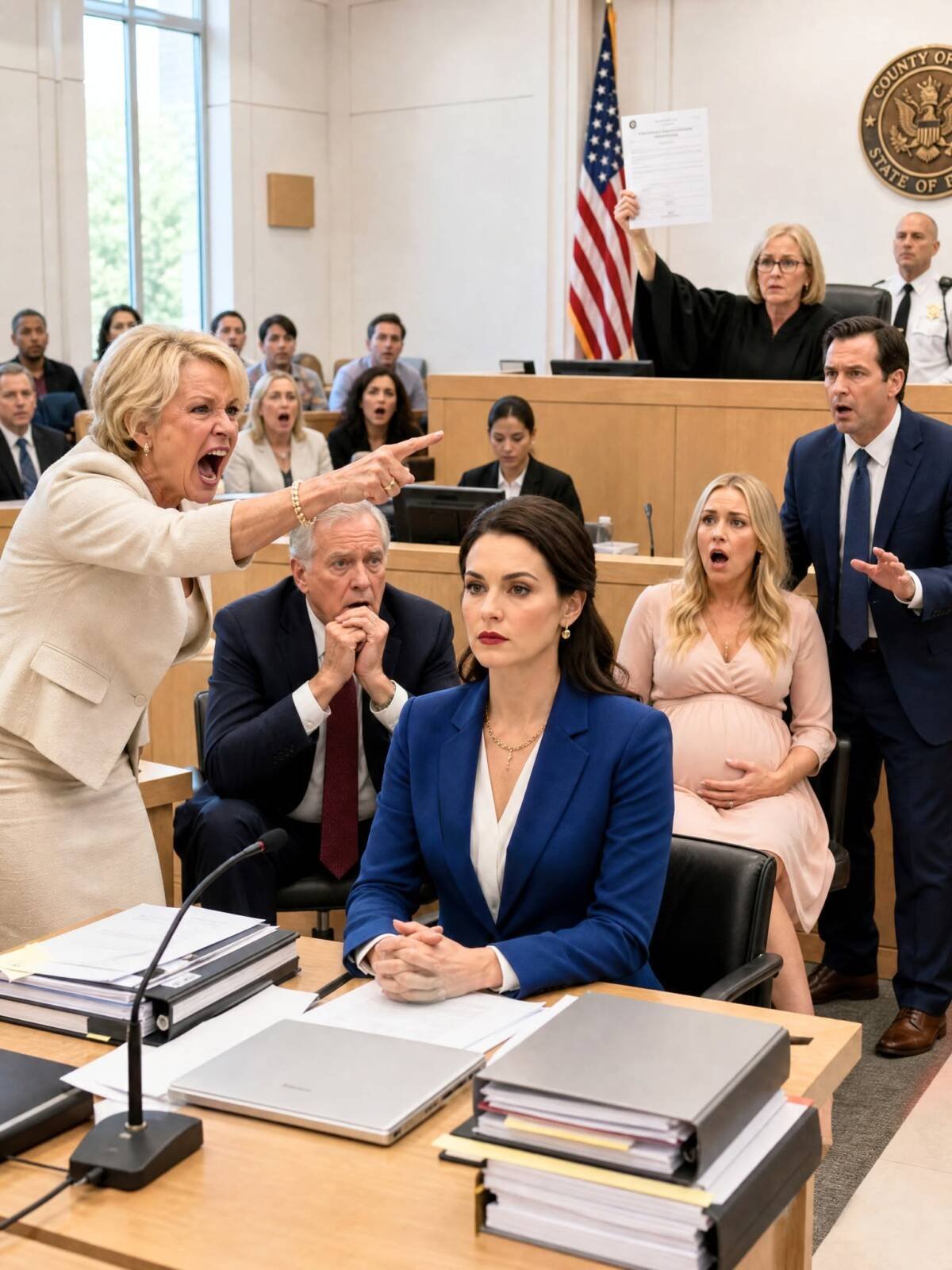
At the preliminary hearing, Dominic still believed he could intimidate me.
When I entered the courtroom, he stared across the room.
Then he silently mouthed:
“You’ll regret this.”
My attorney noticed.
She didn’t react.
Instead, she opened a silver laptop.
The prosecutor reviewed the evidence.
Dominic’s attorney requested leniency.
They argued that the incident had been exaggerated.
They suggested that the assault was an isolated event.
They suggested that the financial irregularities were misunderstandings.
But the evidence told a different story.
The recordings showed what happened in the kitchen.
The financial records showed what had been happening behind the scenes.
The court also reviewed evidence connecting the alleged fraudulent transactions to Dominic’s company.
The defense could not explain everything away as an accident.
There were too many records.
Too many timestamps.
Too many conversations.
Too many pieces of evidence pointing in the same direction.
Dominic’s confidence began disappearing.
“She Destroyed My Life Over a Steak”
At the final sentencing hearing, Dominic stood before the judge wearing a gray jail uniform.
He looked nothing like the man who had once walked through our house as though he owned every room.
His attorney asked the court to consider a plea agreement.
Then Dominic spoke.
“I made one mistake.”
He looked toward me.
“She destroyed my life over a steak.”
The courtroom became silent.
I slowly stood.
My injured hand still carried visible scars.
I rested it beside the files my attorney had prepared.
“No,” I said.
“You destroyed your own life when you believed pain would make me obedient.”
Dominic stared at me.
I continued.
“The steak didn’t destroy your life.”
I looked toward the judge.
“It simply gave the camera something to record.”
No one spoke.
The Consequences
Dominic was sentenced to eight years in prison following his convictions for the offenses brought against him.
Arthur received a three-year sentence and was permanently barred from receiving public contracts following the financial misconduct established in court.
Victoria received probation, restitution requirements, and an eighteen-month sentence related to her role in the fraudulent loan scheme.
The court also recognized my legal interest in the property and issued a long-term protective order.
The house was eventually sold.
I couldn’t stay there.
Every room carried a memory.
The kitchen.
The marble island.
The stove.
The television in the living room.
The place where I had once believed I was supposed to feel safe.
I wanted none of it.
I wanted a life that didn’t require me to remember where the cameras were hidden.
So I left.
One Year Later
A year after that night, I stood inside the kitchen of my new home overlooking the coast.
Sunlight came through the windows.
The room was small compared with the old house.
But it was mine.
Nobody controlled the thermostat.
Nobody controlled the bank account.
Nobody demanded an explanation for what I cooked.
Nobody waited for me to make a mistake.
The injuries to my hand had healed significantly.
Some scars remained.
I didn’t try to hide them.
Instead, I built something from what happened.
Using recovered funds and compensation connected to the case, I founded Haven Ledger, an organization designed to help survivors of abuse document financial control, preserve digital evidence, and develop safer exit plans.
Detective Chloe Park attended the organization’s opening.
On the wall behind her was the small black charging port that had once been hidden beneath my old kitchen island.
People often told me that device had saved my life.
They were wrong.
It was only a tool.
The camera didn’t save me.
The evidence didn’t save me by itself.
What saved me was the moment I stopped waiting for the people hurting me to suddenly understand that I deserved better.
I stopped asking them to change.
I started preparing to leave.
I started documenting the truth.
And when the moment came, I made sure the truth could no longer be buried.
The Steak
That evening, I decided to cook dinner.
I took a steak from the refrigerator.
Seasoned it.
Placed it in the pan.
And waited.
For a moment, I found myself staring at the stove.
The same appliance.
The same heat.
A completely different life.
I accidentally left the steak cooking a little longer than I intended.
I laughed.
Then I opened the window.
The smell of grilled meat drifted toward the ocean.
I carried my plate outside and sat down.
There were no angry voices.
No threats.
No footsteps behind me.
No one telling me where I belonged.
I ate slowly.
And for the first time, the silence didn’t feel frightening.
It felt like freedom.
The scar on my hand reminded me of what had happened.
But it no longer defined me.
I had survived the night Dominic thought I would finally obey.
He believed fear would make me smaller.
Instead, it showed me how strong I could become.
The camera captured the moment he thought he had broken me.
But it also captured the moment his carefully constructed world began to fall apart.
And that was the part he never saw coming.
Conclusion
Sometimes the most powerful turning point isn’t a dramatic confrontation.
Sometimes it’s the quiet moment when a person realizes they don’t have to remain where they are being hurt.
Dominic thought control meant ownership.
He thought money meant power.
He thought fear meant obedience.
And he believed that destroying my phone could destroy my voice.
He was wrong.
Because the truth had already been preserved.
And when the truth finally reached the people who could act on it, there was nothing left for him to hide behind.
The house was never really his.
The money was never really his.
And, most importantly, my life was never his to control.
That night began with a ruined steak.
It ended with my freedom.
And today, when I cook dinner, I don’t think about Dominic anymore.
I think about how lucky I am to be standing in my own kitchen, holding a plate in my scarred hand, listening to the ocean outside the window.
No one is shouting.
No one is threatening me.
No one is telling me my place.
Because now, I know exactly where I belong.
With myself.
If this story moved you, share it with someone who may need to hear it.
Sometimes the first step toward freedom is simply believing that you deserve it.