The Six Seconds That Changed Everything
My father had been dead for less than twenty-four hours when my husband announced, in front of our entire family, that my inheritance would finally solve his family’s financial problems.
He did not whisper it. He did not wait until we were alone. He stood in the middle of the church hall, surrounded by mourners who had come to pay their respects, and spoke as though my father’s money already belonged to him.
His mother, Patricia, was standing beside him with a smile that made my stomach turn.
“We can finally move forward with the house,” she announced. “I’ve already found the perfect one. Six hundred thousand dollars, and it has everything we need.”
I looked at my husband, Ethan, waiting for him to realize what he was saying.
My father’s photograph stood behind us, framed by white lilies. People were still holding paper cups of coffee. Several of Dad’s former coworkers had come straight from work to honor a man who had spent his life helping others.
And my husband was discussing how to spend the money I had not yet inherited.
“You told them?” I asked quietly.
Ethan smiled at me with the same expression he used whenever he wanted to make me feel unreasonable.
“Claire, everyone knows your dad left you everything. There’s no reason to pretend we’re struggling anymore.”
I said nothing.
He mistook my silence for surrender.
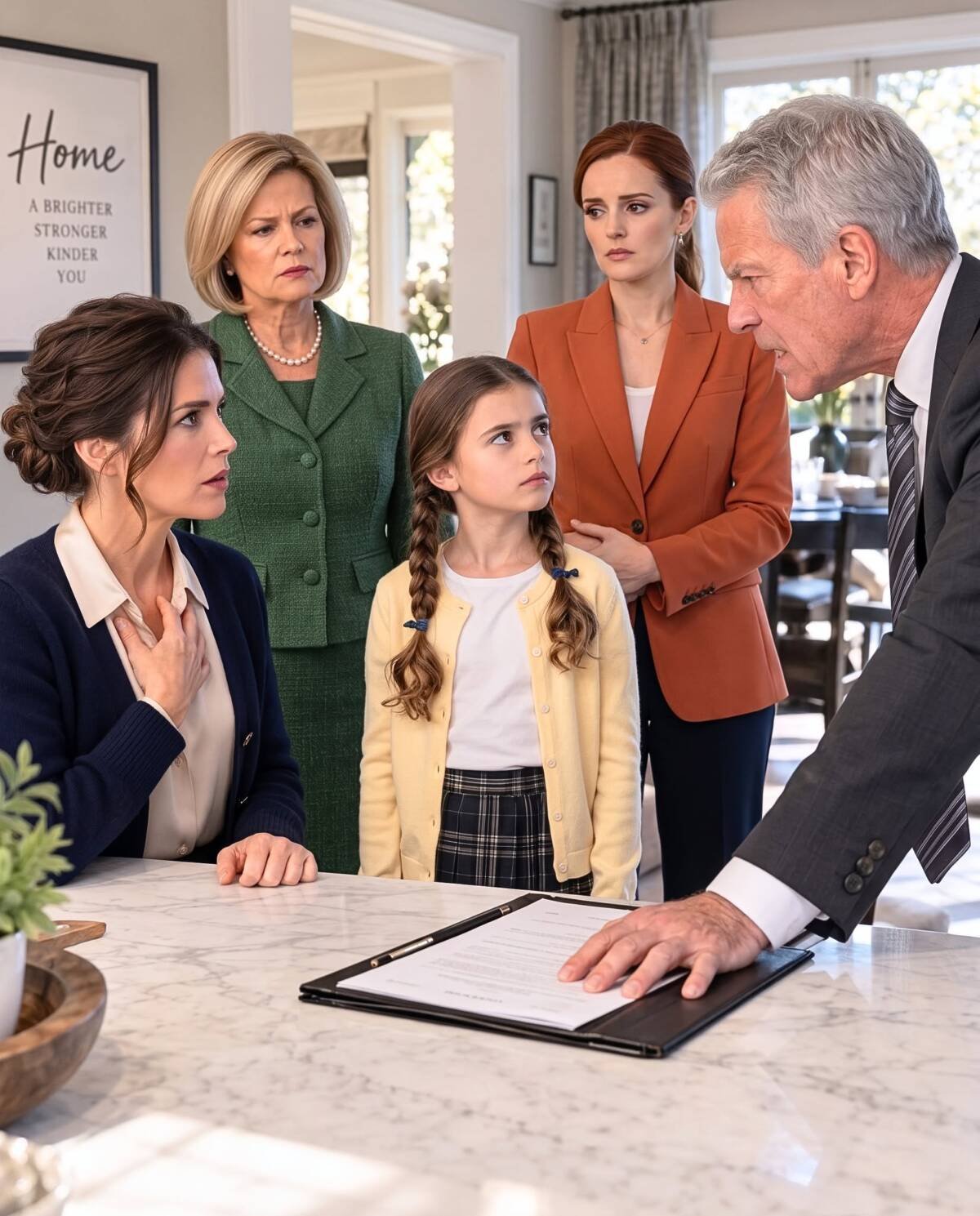
Three days later, I sat in my father’s attorney’s conference room, preparing to hear the final arrangements of his estate. Ethan sat beside me, checking his phone. Patricia had brought a glossy real estate folder containing photographs of the $600,000 house she expected us to purchase.
Then my father’s attorney, Martin Hale, locked the door.
He placed a sealed evidence bag on the table.
Inside was Dad’s old black phone.
“Before we discuss the will,” Martin said, “there’s something Claire needs to hear.”
He connected the phone to a speaker and played a recording made eleven days before my father died.
My father’s voice filled the room.
“You understand that money is Claire’s, Ethan. Not yours.”
My husband went pale.
Then his own voice came through the speaker.
“She’s my wife. What belongs to her belongs to me.”
Dad answered with a sentence that changed the way I understood my entire marriage.
“Not if she knows what you did.”
Ethan shot to his feet so violently that his chair crashed backward.
“Turn that off!”
Martin did not move.
Patricia grabbed Ethan’s sleeve.
“Ethan, don’t.”
I turned toward her.
She was not surprised.
She was afraid.
And that was when my father’s voice came through the speaker one more time.
“I have the documents proving you forged Claire’s signature.”
For twelve years, I had believed I knew the man I married.
In six seconds, I began to understand how wrong I had been.
Part 1: My Husband Had Already Spent an Inheritance I Hadn’t Received
The funeral reception had been intended to bring people together to remember my father, Richard Whitaker.
Dad was the kind of man who remembered the names of grocery store clerks, called friends on their birthdays, and kept a drawer full of handwritten thank-you notes he never seemed to get around to throwing away.
He had worked hard throughout his life, saved carefully, and built a comfortable financial future. But he had never treated money as a measure of someone’s worth.
He believed it was a tool—something that could provide security, create opportunities, and help people when life became difficult.
I was his only child.
Naturally, people had questions about his estate after his death. But I had not discussed the details with anyone beyond his attorney. I was grieving, exhausted, and barely capable of making simple decisions without feeling overwhelmed.
Ethan, however, seemed remarkably comfortable discussing what would happen next.
For months, he had assured me that his consulting business, Mercer Ridge Consulting LLC, was experiencing only temporary financial difficulties.
There had been delays in payments from clients, he said. A major contract had fallen through. A few expenses had piled up unexpectedly.
He had a convincing explanation for everything.
Twice, he had borrowed money from our joint savings account to cover business expenses. Each time, he promised to replace it.
He also insisted that Patricia’s debts were not our responsibility.
His mother had made several poor financial decisions over the years, including refinancing her home and investing in a business venture that never became profitable. Ethan frequently complained about her financial demands, claiming she expected him to rescue her every time something went wrong.
I believed him.
I believed the conversations we had late at night. I believed the explanations he gave when money disappeared from our savings. I believed the man who held my hand when I worried about my father’s declining health.
Now, standing in the church hall, I watched that same man announce that my inheritance would solve his family’s problems.
Patricia opened her real estate folder and showed photographs to two relatives who had stopped beside her.
The house was enormous compared with the home where she currently lived. It had a landscaped front yard, a renovated kitchen, and a large covered porch.
“I’ve already spoken to the agent,” she said. “We just need the funds to clear.”
One of my cousins looked uncomfortable.
“Claire hasn’t even had time to deal with the estate,” she said.
Patricia waved away the concern.
“It’s only a matter of time. There’s no point delaying things when the money is coming anyway.”
Ethan placed a hand on my shoulder.
“See? Everyone’s finally going to be comfortable.”
I stepped away from him.
“You told me your business was struggling temporarily.”
“It is.”
“And you told me your mother’s debts weren’t our responsibility.”
“They aren’t. But that doesn’t mean we can’t help her.”
“With money I haven’t received?”
His smile tightened.
“Why are you making this difficult? We’re married, Claire. We share everything.”
I wanted to ask him why he had never mentioned a $600,000 house before my father died. I wanted to ask why his mother seemed to know so much about an inheritance I had barely discussed myself.
Instead, I looked at Dad’s photograph.
I could almost hear him telling me not to let anyone rush me into making a decision while I was grieving.
So I stayed silent.
Ethan seemed irritated by my refusal to argue. He had always been more comfortable when he controlled the direction of a conversation. If I became upset, he called me emotional. If I asked too many questions, he said I was overthinking things. If I challenged his explanations, he accused me of not trusting him.
Silence, however, gave him nothing to fight against.
That evening, after the last guests had left, he drove us home and spent the entire journey discussing the house.
He described where Patricia would live, which rooms needed redecorating, and how much money would remain after the purchase.
He spoke as though the decision had already been made.
I watched the streetlights pass outside the window.
For the first time in our twelve-year marriage, I wondered whether the man beside me had ever considered my wishes when he talked about our future.
Three days later, I received an answer I had never expected.
Part 2: The Recording My Father Left Behind
Martin Hale’s office occupied the second floor of a quiet building downtown. My father had used him for years, trusting him with business contracts, estate planning, and the legal details he preferred not to handle himself.
The conference room smelled faintly of coffee and old paper.
Ethan sat to my right. Patricia sat across from us, wearing pearls and carrying the real estate folder she had brought to the funeral.
Martin entered with a thick file under one arm.
“Thank you for coming,” he said. “Before we begin, I need everyone to understand that this meeting concerns Richard’s estate and several matters that may have legal consequences.”
Patricia frowned.
“What matters?”
Martin did not answer immediately.
Instead, he walked to the door and locked it.
Ethan stopped bouncing his knee beneath the table.
Martin placed a sealed evidence bag in front of him.
I recognized the black phone immediately.
It had sat beside Dad’s hospital bed during the final week of his life. The screen was cracked near one corner, and a small piece of tape covered the back.
“What is that?” I asked.
“Your father’s phone,” Martin replied. “He left specific instructions concerning a recording stored on it.”
Patricia leaned forward.
“This is highly inappropriate. We’re here to discuss a will, not listen to private conversations.”
Martin looked at her.
“Richard anticipated that someone might object.”
He removed the phone, connected it to a small speaker, and pressed play.
Static crackled through the room.
Then I heard the scrape of a chair and my father’s familiar voice.
“You understand that money is Claire’s, Ethan. Not yours.”
The sound of Dad speaking after his death was so unexpected that I forgot to breathe for a moment.
Ethan shifted in his chair.
“She’s my wife. What belongs to her belongs to me.”
I turned toward him.
He refused to look at me.
Dad continued.
“Marriage doesn’t give you the right to take what isn’t yours.”
“You’re making this more complicated than it needs to be,” Ethan replied in the recording.
“No. I’m asking you a simple question. What happens if Claire refuses?”
A short silence followed.
Then Ethan laughed.
“She won’t refuse. If she does, I have enough to make her look unstable.”
My hands went cold.
I remembered the conversations about my grief. The questions about whether I had slept well. The times Ethan suggested I was becoming forgetful.
At the time, I had believed he was worried about me.
Now those memories felt different.
Dad’s voice came through the speaker again.
“And the signature?”
Ethan’s answer was quieter.
“She won’t know until it’s too late.”
That was when Ethan stood up.
His chair struck the floor with a loud crash.
“Turn that off!”
Martin calmly reached toward the phone.
Ethan took a step forward, but Martin moved the device out of reach.
Patricia grabbed Ethan’s arm.
“Don’t,” she whispered.
Her voice was trembling.
I looked at her.
“Why are you telling him not to stop the recording?”
She said nothing.
Martin allowed the audio to continue.
My father’s voice was clear.
“I have the documents proving you forged Claire’s signature.”
The recording ended.
For several seconds, no one moved.
Then I turned toward my husband.
“What did you do?”
Ethan rubbed his forehead and began pacing beside the table.
“This is ridiculous. Your father misunderstood a business arrangement.”
“What signature?”
“Claire, please. Your father was sick. He was suspicious of everyone.”
Martin opened the folder in front of him.
“Richard was sufficiently concerned to commission an independent forensic accounting review. The findings were delivered before his death.”
Ethan stopped pacing.
Martin removed a document and placed it in front of me.
It showed a home-equity credit line for $185,000, secured against our home.
My name appeared beneath the authorization.
The signature looked like mine.
I had never signed it.
“There’s more,” Martin said.
He placed another document beside the first. It showed that money from the credit line had been transferred to Mercer Ridge Consulting LLC.
Ethan’s company.
I stared at the figures, trying to make sense of what I was seeing.
“How could this happen without me knowing?”
“Your father discovered the application after a bank verification notice was mailed to his address,” Martin explained. “He began investigating and found additional financial accounts connected to your personal information.”
I looked at Ethan.
“You used my name?”
He shook his head.
“I was trying to keep the business alive.”
“With a loan secured against our home?”
“I intended to pay it back.”
“And the money you took from our savings?”
“That was temporary.”
“How much?”
He did not answer.
Martin turned to the next page.
The preliminary investigation identified more than $260,000 in concealed business losses, personal loans, and credit-card debt connected to Ethan’s finances. Some amounts overlapped with the accounts already under review, and the final total remained subject to verification.
I could barely process the numbers.
For months, I had worried about ordinary household expenses while Ethan had been hiding financial problems on a scale I had never imagined.
Then Martin placed one more document in front of me.
It was the purchase agreement for Patricia’s $600,000 house.
My name appeared on the contract as the buyer.
And beneath it was another signature that looked like mine.
I had never seen the document before.
Patricia stood abruptly.
“I assumed Claire had agreed to it.”
I turned toward her.
“You assumed I agreed to buy you a house?”
She looked at Ethan.
He stared back at her with unmistakable anger.
The expression on his face told me more than either of them had said.
Martin explained that the real estate agent had contacted my father after Ethan listed him as the expected source of funds for the purchase. Ethan had represented that a substantial inheritance payment would soon become available.
That discovery had prompted Dad to arrange the recorded conversation.
I looked at the purchase agreement again.
My father had not simply suspected that Ethan wanted access to my inheritance.
He had found evidence that my husband was already acting as though he controlled my money.
And he had done something about it before he died.
Part 3: The Plan to Make Me Look Incapable
Martin played the recording again, this time from an earlier point in the conversation.
Dad asked Ethan what would happen if I refused to sign the paperwork.
Ethan’s recorded response was chilling.
“She won’t refuse. If she does, I have enough to make her look unstable.”
I closed my eyes.
Suddenly, I remembered the small incidents I had dismissed throughout the previous year.
Ethan had encouraged me to see a therapist after my father became seriously ill. He repeatedly asked whether I was taking sleeping pills. He photographed me on evenings when I cried and later told me that I seemed increasingly unable to handle stress.
Sometimes he would ask the same question several times, then suggest that I had forgotten our earlier conversation.
When I became upset, he would tell me that grief was affecting my judgment.
I had assumed he was clumsily trying to help.
Now I wondered whether he had been collecting material to support a story he intended to tell about me.
Martin removed a sealed envelope bearing my name.
“Your father was concerned that Ethan might try to challenge your ability to manage your finances,” he explained. “He wanted you to have independent medical documentation and legal protection.”
I looked at the envelope.
“What does that mean?”
“Richard believed your husband was preparing to portray you as incapable of making financial decisions. He wanted to ensure that any such claim could be evaluated against independent evidence.”....