The contractions were coming every four minutes when I called my husband for the last time.
“Rowan, my water broke. I need you. Please come to the hospital.”
His response was so cold that, for a moment, I wondered whether I had dialed the wrong number.
“Handle it yourself, Phoebe. Stop being so dramatic.”
Then he hung up.
I stood outside the maternity ward, gripping my phone while another contraction nearly brought me to my knees. My husband was celebrating his mother’s sixtieth birthday, and apparently, that mattered more than the birth of our first child.
I had spent five years believing Rowan Hale was the man who would always stand beside me when life became difficult. That night, I discovered how badly I had misjudged him.
But Rowan had made another mistake.
He believed he knew everything about his wife.
He had no idea that the quiet woman he married, the one who preferred secondhand furniture and simple dinners, was the daughter of Gideon Sterling, one of the wealthiest investors in the country.
And when Rowan finally returned home three days later, carrying a birthday gift from his mother, he stopped dead in the doorway.
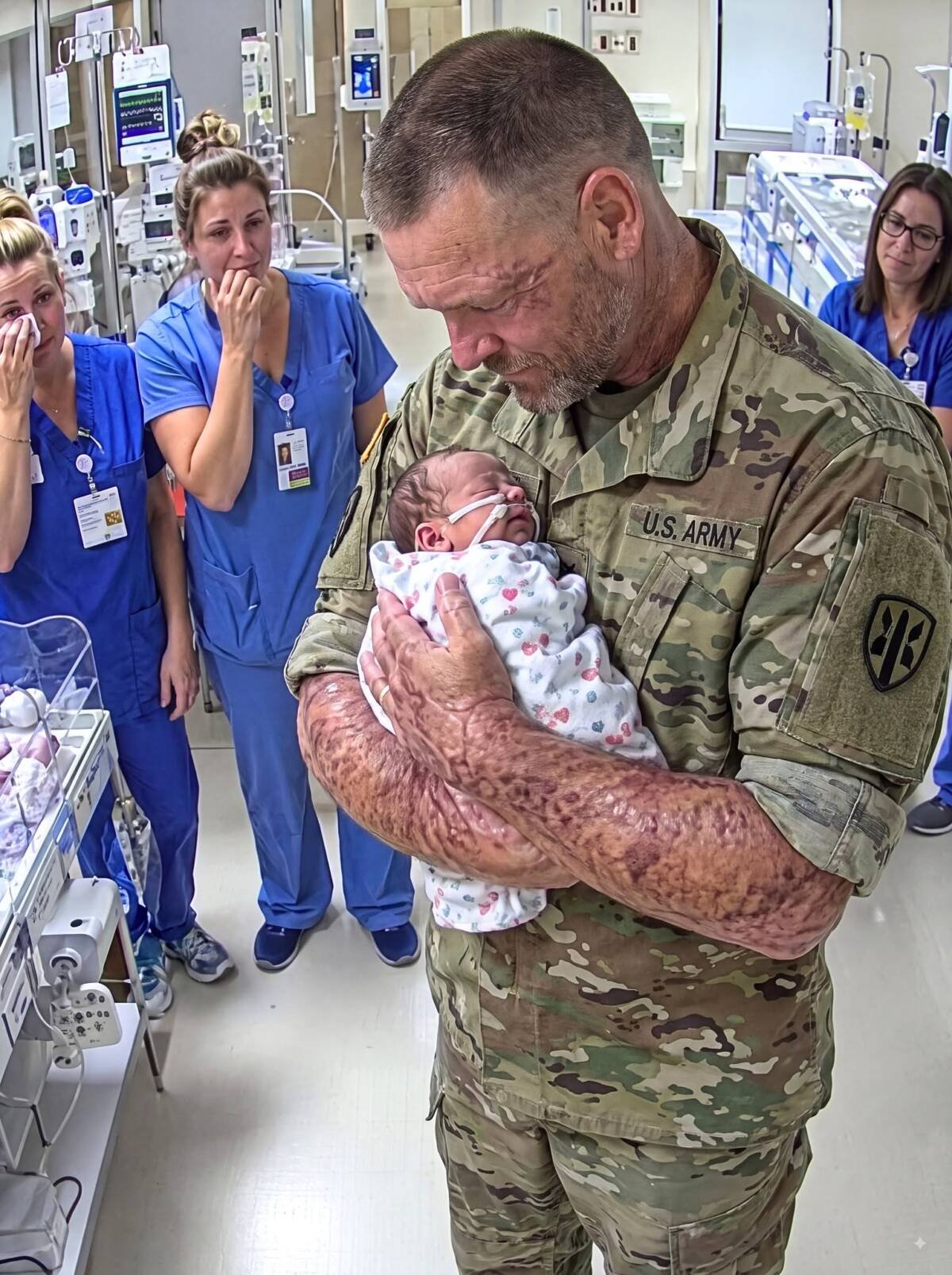
My father was sitting in our living room.
My newborn son was sleeping peacefully in his arms.
And the color drained from Rowan’s face.
PART 1: THE NIGHT MY HUSBAND CHOSE HIS MOTHER
The first contraction hit so hard that I had to grab the wall outside the maternity ward.
I was thirty-eight weeks pregnant, exhausted, frightened, and alone.
My phone trembled in my hand as I called Rowan again.
He answered after several rings.
“What now, Phoebe?”
“Rowan, my water broke. The contractions are four minutes apart. I need you to come now.”
For a moment, I heard nothing but background noise. Music, laughter, and the unmistakable clinking of glasses filled the silence.
Then his mother’s voice came through.
“Tell her women have been giving birth for thousands of years. She doesn’t need to make this a family emergency.”
I closed my eyes.
“Rowan, I’m serious.”
He sighed.
“Mom’s birthday dinner is already underway. You knew this was happening eventually.”
“Eventually?” I repeated. “I’m in labor.”
“Then call a cab.”
Another contraction tightened across my abdomen, and I pressed my free hand against the wall.
“Please. I don’t want to do this alone.”
His voice became sharper.
“Handle it yourself, Phoebe. Stop being so dramatic.”
The call ended.
I stared at my phone, waiting for him to call back.
He didn’t.
For five years, I had defended Rowan whenever anyone suggested that his relationship with his mother, Selina, was unhealthy. I told myself he was simply loyal, considerate, and protective of the woman who had raised him alone.
I had never considered that his loyalty might come at my expense.
A nurse found me leaning against the wall.
“Ma’am, are you okay?”
I shook my head.
“Is someone coming to support you?”
I looked at the dark screen.
“Not my husband.”
She immediately brought a wheelchair and helped me into the maternity ward.
By the time I was admitted, the contractions were coming faster. I tried calling Rowan once more, but the call went unanswered.
At 10:42 p.m., I finally stopped trying.
Instead, I called the one person I had spent nearly two years avoiding.
My father.
“Dad?”
He heard the strain in my voice.
“Phoebe? What’s wrong?”
“My water broke. I’m at the hospital.”
His response came without hesitation.
“Which hospital?”
I told him.
“I’m coming.”
Twenty minutes later, Gideon Sterling walked through the maternity ward doors wearing an old gray coat.
No driver.
No assistant.
No security entourage.
Just my father.
He took one look at me and immediately came to my bedside.
“I’m here.”
I tried to smile, but another contraction made it impossible.
Dad held my hand.
“You don’t have to be brave every second, sweetheart.”
That was when I finally cried.
Not because I was afraid of giving birth.
Because the man who had promised to be beside me had chosen to celebrate a birthday instead.
Fourteen Hours Without My Husband
Labor lasted fourteen exhausting hours.
Dad never left my side.
He held my hand through the contractions, spoke quietly whenever I became frightened, and brought me water whenever the nurses allowed it.
At one point, I apologized for calling him so late.
He looked genuinely offended.
“Phoebe, you’re having my grandson. What exactly did you think I was doing tonight?”
I laughed weakly.
“I don’t know.”
“Then stop thinking.”
At 4:17 a.m., our son was born.
The nurse placed him against my chest, and everything else disappeared.
His tiny fingers curled around mine.
His eyes were barely open.
“Leo,” I whispered.
Dad stood beside the bed, tears running down his face.
“Hello, little man.”
He held Leo carefully, supporting his head with one hand while his other arm cradled the newborn against his chest.
I watched my father become a grandfather.
And somewhere in that moment, something inside me changed.
I no longer wanted to beg Rowan to care.
I wanted to understand why I had spent so long accepting so little.
At 8:13 a.m., my phone finally lit up.
A message from Rowan.
Mom loved the watch I bought her. Coming home Monday. Don’t start another fight.
I read it twice.
Then I took a screenshot.
Three days after our son was born, Rowan finally returned.
He walked through the front door carrying his suitcase and a gift bag from his mother’s birthday weekend.
He stopped immediately.
Dad was sitting in our living room, holding Leo.
Rowan stared at him.
Then he looked at me.
Then back at the man holding his newborn son.
“Phoebe…”
His voice barely came out.
“Why is Gideon Sterling holding my baby?”
Dad slowly lifted his eyes.
“Perhaps you should ask your wife.”
PART 2: THE SECRET THAT CHANGED EVERYTHING
Rowan remained frozen near the doorway.
His suitcase was still in his hand, and the gift bag from Selina’s birthday hung from his wrist.
“Phoebe, what is going on?”
I sat at the far end of the sofa, a blanket covering my legs. I was still recovering from childbirth, but for the first time in days, I felt calm.
“Close the door.”
He obeyed.
His eyes never left Dad.
“I know who that is.”
“I’m sure.”
“Why is Gideon Sterling in our house?”
“Our house,” I corrected.
Something about my tone made him hesitate.
Then I told him the truth.
“He’s my father.”
Rowan stared at me.
“What?”
“Gideon Sterling is my father.”
For several seconds, he appeared unable to process the words.
“You’re telling me…”
“Yes.”
“The Gideon Sterling?”
Dad looked up from Leo.
“Unfortunately, there are several people with my name. But I suspect your wife means me.”
I almost smiled.
Rowan did not.
He looked around our living room as though he had suddenly entered someone else’s house.
The secondhand bookshelf.
The oak dining table.
The old photographs from our honeymoon.
Everything was familiar, yet nothing seemed to make sense to him anymore.
“You told me your father was retired.”
“I said he had stepped back from day-to-day operations.”
“You told me he traveled.”
“He does.”
“You said he was terrible at remembering birthdays.”
Dad raised one eyebrow.
“I have improved.”
Rowan looked at me again.
“Why didn’t you tell me?”
That question was fair.
When Rowan and I met, I was using my late mother’s surname, Vale. I had spent much of my childhood surrounded by wealth, business meetings, and people who treated my father’s money as though it were more important than his daughter’s personality.
After Mom died, I wanted something different.
I wanted a life in which people knew me for myself.
So I kept using her surname.
I lived modestly.
I worked.
I bought secondhand furniture.
And when Rowan made jokes about spoiled trust-fund children, I never corrected him.
I knew I had withheld something important.
But I had never imagined it would become the defining secret of our marriage.
“You lied to me,” Rowan said.
“Yes.”
He seemed surprised that I did not deny it.
“I understand why you’re angry,” I continued. “But that doesn’t erase what happened at the hospital.”
His expression changed.
“I know.”
Dad offered to take Leo outside so we could talk.
Rowan reached out.
“I can hold him.”
It was the first time he had asked to hold our son.
Dad looked at me before carefully placing Leo into Rowan’s arms.
The moment Rowan looked down, his expression softened.
“Hey, little guy.”
He held Leo carefully, almost afraid to move.
For several minutes, he simply stared at him.
I saw the man I had expected to stand beside me during labor.
The man who had spent hours assembling the crib.
The man who had laughed whenever Leo kicked against my stomach.
And that made everything more painful.
Because Rowan had never been cruel every day.
He had simply failed me when it mattered most.
Eventually, he asked why I had hidden my father’s identity.
I explained that I had wanted one relationship untouched by wealth or expectations.
“I wanted you to love me before you knew my last name.”
He lowered his eyes.
“I did.”
“I know.”
Then I asked the question that had been waiting inside me since the hospital.
“Why didn’t you come?”
Rowan said he believed there would be more time.
His mother had told him first labors usually lasted hours.
I reminded him that I had told him my contractions were four minutes apart.
That I had told him my water broke.
That I had begged him to come.
And that he had laughed.
“I should have left,” he whispered.
“Yes.”
“I should have been there.”
“Yes.”
He rubbed his face.
“I don’t know what I was thinking.”
I knew.
“You were thinking your mother would be upset.”
He said nothing.
“And somewhere along the way, avoiding her disappointment became more important than avoiding mine.”
The truth sat between us.
Neither of us tried to deny it.
The First Apology Wasn’t Enough
Rowan stayed in the guest room for the next several days.
He changed diapers.
He warmed bottles.
He sat beside Leo’s bassinet at night, terrified that something might happen if he stopped watching our son.
I watched him quietly.
Part of me wanted to believe that everything could return to normal.
Another part knew that normal was exactly what had brought us here.
One evening, Dad found Rowan in the kitchen.
“Do you think I’m a terrible husband?” Rowan asked.
Dad set down the knife he had been using to slice pears.
“I think you made a terrible decision.”
“That’s all?”
“No.”
Dad looked directly at him.
“I also think Phoebe married you because she believed you were more than your worst decision.”
Rowan swallowed.
“Does she still believe that?”
“That is something only she can answer.”
Later that week, Selina called.
She wanted to apologize.
She admitted Rowan should have left the birthday dinner.
But before the conversation ended, she said something that caught my attention.
“You don’t know everything about what happened.”
I stared at the phone.
“What do you mean?”
Selina hesitated.
Then she said quietly:
“There’s something Rowan hasn’t told you.”
PART 3: THE $480,000 SECRET
The next morning, I began looking through our financial records.
I was a forensic accountant by profession, and something about Selina’s comment had unsettled me.
I knew Rowan had been worried about his mother’s restaurant for months.
I also remembered a bank letter that had arrived earlier in the year, followed by an argument between Rowan and Selina that stopped abruptly when I entered the room.
I searched our filing cabinet.
Inside a folder marked HOUSE—2025, I found a personal guarantee agreement.
The borrower was Mercer & Lane Hospitality Group.
The guarantor was Rowan Hale.
The amount was $480,000.
I read the document twice.
Rowan did not own a hospitality company.
I searched the state business registry.
Mercer & Lane Hospitality Group existed.
And its managing member was Selina Hale.
I immediately called Dad.
“Can you help me understand something?”
He listened as I explained what I had found.
Then he asked me to send him the documents.
By the afternoon, we had discovered something even more troubling.
Selina’s restaurant lease had been approved nine months earlier by Sterling Urban Holdings, one of the commercial-property companies connected to Dad’s business empire.
The lease itself was ordinary.
The unusual part was the personal guarantee.
Rowan’s financial profile had been significantly stronger than the business itself, which had attracted the attention of the company’s legal department.
I called Julian Cross, the regional manager who had approved the application.
“You knew Rowan was my husband?”
“Yes.”
“And Selina was his mother?”
“No.”
Julian explained that legal had reviewed the agreement and found no conflict.
Then he mentioned something strange.
“Someone asked us not to contact Rowan at home.”
“Who?”
“Selina.”
She had instructed the company to send all correspondence concerning the guarantee to her business office.
Her reason?
Rowan’s spouse was experiencing pregnancy-related anxiety.
I stared at the document.
Selina had used my pregnancy as an excuse to keep financial information away from me.
Meanwhile, Rowan had hidden the guarantee because he claimed he wanted to protect me from stress.
That afternoon, I asked Rowan to invite his mother over.
When Selina arrived, I placed the correspondence on the dining table.
Her expression changed immediately.
“You found that.”
“Yes.”
Rowan picked up the document.
He read it slowly.
Then his face hardened.
“Mom, you redirected the notices?”
“I was trying to help.”
“So Phoebe wouldn’t see them?”
“She was pregnant.”
Rowan looked at her.
“She was also my wife.”
Selina insisted she had expected Rowan to explain everything once the restaurant’s finances stabilized.
When I asked what had happened to the original financing, she admitted the project had collapsed.
But she had found another solution.
Rowan looked stunned.
“You told me the project was dead.”
“The original version was.”
We eventually learned that Selina had secured replacement financing through the Sterling Community Development Partnership.
Despite the name, the organization was no longer controlled by Dad.
It had been founded decades earlier by my late mother to help women launch second-career businesses.
Selina had qualified through the normal application process.
She had completed six months of training.
She had met the personal contribution requirements.
And she had passed the review.
Dad nodded when he heard the details.
“Then she earned it.”
For the first time that afternoon, Selina looked genuinely surprised.
The new financing had also released Rowan from the $480,000 personal guarantee.
But when he realized his mother had once again hidden important information from him, his relief turned into anger.
“Why didn’t you tell me?”
Selina looked down.
“Because I was ashamed.”
“Of what?”
“Needing help.”
Rowan stared at her.
“You know the version of me that keeps trying to rescue you.”
She froze.
“I never asked you to rescue me.”
“You didn’t have to.”
Their conversation gradually reached something neither of them had ever said aloud.
Rowan remembered being nine years old, listening to his mother reassure him that everything was fine while she worked two jobs and worried about bills.
He had learned that being a good son meant fixing every problem before she could become afraid.
“I thought I was protecting you,” Selina whispered.
The sentence sounded painfully familiar.
I had spent years doing the same thing.
Protecting people from the truth.
Protecting relationships from difficult conversations.
Protecting myself from rejection.
And somehow, all that protection had become another form of dishonesty.
A Different Kind of Apology
Before Selina left, she turned toward me.
“I’m sorry.”
I looked at her.
“For what?”
“For what happened during labor.”
She admitted that the bank call had frightened her.
She had minimized my childbirth because she wanted Rowan beside her.
“That was selfish,” she said. “I don’t expect forgiveness today.”
I appreciated the apology.
But I wasn’t ready to forgive her.
After she left, Rowan asked whether I forgave him.
“I don’t know.”
He accepted the answer.
For the first time, he didn’t argue.
Over the following weeks, we began marriage counseling.
We opened every financial account.
Every business email.
Every resentment we had avoided discussing.
We were finally beginning to understand that hiding information in the name of protection had nearly destroyed the trust between us.
Two days before Selina’s restaurant opened, she invited us to a private dinner.
The restaurant was beautiful.
During her speech, she thanked the people who had finally loved her enough to stop rescuing her in ways that were hurting everyone.
On the walk home, Rowan stopped beneath the streetlights.
“Leo deserves parents who respect each other,” he said. “Whatever address they live at.”
For the first time, he wasn’t asking me to stay because of appearances, fear, or obligation.
He was giving me the freedom to decide.
I reached out and touched his hand.
“I’m still here.”
He looked at me carefully.
“I know.”
“That means something.”
His fingers closed around mine.
“It means everything.”
We walked the final block holding hands.
We weren’t fully reconciled.
We weren’t completely healed.
But we were finally moving in the same direction.
PART 4: THE LETTER MY MOTHER LEFT BEHIND
One evening, after Rowan and I returned home from Selina’s restaurant dinner, Dad was sitting in the living room with Leo asleep against his chest.
The sight that had shocked Rowan weeks earlier had become familiar.
Dad stood to leave.
An envelope slipped from his coat pocket and landed on the floor.
I picked it up.
My name was written across the front in handwriting I recognized immediately.
“Dad?”
His expression softened.
“I found it two weeks ago.”
Mom had been gone eleven years.
Seeing her handwriting again made my chest tighten.
Dad explained that she had written the letter before she died and instructed him to give it to me only after I became a mother.
“You never opened it?”
“It isn’t mine.”
I carried the envelope upstairs.
On the back, Mom had written one sentence.
For the day you understand that choosing your family is different from losing yourself inside it.
I sat beside Leo’s crib and opened the letter.
It was six pages long.
The handwriting was unmistakable.
The dry humor.
The blunt wisdom.
The little observations that had always made Mom seem to understand me better than anyone else.
She wrote about how fiercely independent I had always been.
And how often I had confused accepting help with losing control.
“I hope motherhood does not teach you to disappear into other people.”
She wrote that love, marriage, and children would all ask something from me.
But none of them required me to become invisible.
Then she addressed something that felt painfully specific to the marriage I was trying to repair.
Perhaps one day you will love someone who disappoints you deeply.
If that happens, do not ask only whether they are sorry.
Ask whether they are willing to become different.
And ask yourself the same question.
I read those words several times.
For weeks, I had been asking whether Rowan deserved forgiveness.
Mom’s letter made me realize that the better question was whether our marriage could become healthier than the one that had brought us to this point.
Rowan found me sitting beside Leo’s crib long after midnight.
He quietly sat on the floor instead of crowding me.
I offered him the final page.
He read it twice.
Then he handed it back.
“She sounds terrifying.”
“She was.”
“Would she hate me?”
“No.”
He looked surprised.
“But she absolutely would have told you that you behaved like an idiot.”
“That seems fair.”
Then Rowan told me he was considering leaving his current job for a smaller firm.
The salary would be lower.
The travel would be reduced.
And he would have more time at home.
I warned him not to change his career simply because he felt guilty.
“I’m not doing it as an apology.”
“Then why?”
“Because I realized I built a life whose priorities I didn’t actually choose.”
That sentence stayed with me.
I realized I had done something similar.
Rowan had spent years responding to his mother’s expectations.
I had spent years resisting my father’s name and everything people assumed came with it.
Both of us had been living around fears we never properly confronted.
“What do you want?” I asked.
“You. Leo. Work I’m proud of. Dinner without checking email twelve times.”
Then he asked me the same question.
“I want my work.”
“I want to be Leo’s mother without becoming only Leo’s mother.”
“I want Dad in our lives.”
Rowan nodded.
“And I want our marriage.”
Hope appeared cautiously in his face.
“But not the old version.”
“No.”
We agreed to continue counseling.
Rowan would remain in the guest room for now.
And we would stop hiding difficult truths from each other in the name of protection.
There was no dramatic reconciliation that night.
Just two exhausted people holding hands on the nursery floor and admitting that rebuilding trust would require more courage than pretending nothing had happened.
Over the following months, Rowan accepted the new job.
Selina learned to respect our boundaries.
Counseling became part of our routine.
We still made mistakes.
But instead of letting them grow into secrets, we began confronting them sooner.
By Leo’s first birthday, Rowan had moved back into our bedroom.
There was no grand gesture.
I simply looked at him one morning and said:
“You could bring your things back if you want.”
“All of them?”
“No, Rowan. Just your left socks.”
He laughed hard enough to wake Leo.
And somehow, that ridiculous joke became the moment our marriage truly started again.
PART 5: THE FAMILY WE CHOSE
By Leo’s first birthday, our lives looked nothing like they had the night Rowan abandoned me at the hospital.
Dad had become a constant presence again.
Selina had learned to respect boundaries.
And Rowan’s new job gave him enough time to become the father he had nearly failed to be.
At Leo’s birthday lunch, Dad and Selina argued over the cake while Rowan carried our son through the garden.
A year earlier, I could never have imagined our families sharing the same table without tension.
Now their differences felt less like threats and more like ordinary imperfections.
After lunch, I noticed a small plaque beneath a young magnolia tree Dad had planted in Mom’s memory.
Eleanor Vale Sterling.
Love leaves room for truth.
I stared at the words.
Dad joined me.
“You used her letter.”
“One sentence.”
He looked almost guilty.
“She wrote that phrase somewhere else.”
“Where?”
“In a note to me.”
I immediately became curious.
“What note?”
Dad smiled.
“Some things are private.”
I slipped my arm through his and leaned against him.
“I missed you.”
His expression softened.
“I missed you too.”
That evening, Rowan and I drove home with Leo asleep in the back seat.
Rain blurred the streetlights.
Rowan kept one hand on the steering wheel and the other resting between us.
I placed mine over it.
“Do you ever think about that day?”
I knew exactly which day he meant.
“Yes.”
“So do I.”
Rowan admitted that for a long time, he had wished he could erase the memory of leaving me during labor.
Now, however, he no longer wanted to forget it.
That day had forced him to confront the person he had become.
“You could have learned those lessons without abandoning me.”
“Definitely.”
I smiled despite myself.
“So I’m not putting it in the gratitude journal.”
“Good.”
Then I finally said the words I had spent more than a year trying to understand.
“I forgive you.”
Rowan glanced toward me but said nothing for several seconds.
“Thank you.”
“I’m not saying what happened was acceptable.”
“I know.”
“And forgiveness doesn’t mean forgetting.”
“I know.”
He squeezed my hand.
“It means I’m done carrying it around every day.”
After another quiet moment, Rowan surprised me.
“I forgive you too.”
“For what?”
“For not telling me who your father was.”
I gave him a look.
“What?”
“I’m trying to decide whether to be offended.”
“Take your time.”
I laughed.
But then I admitted that keeping Dad’s identity secret had been driven by fear.
I had spent years telling myself I was protecting our relationship.
In reality, I was afraid Rowan might love the life attached to my surname more than he loved me.
“And after five years?”
“I should have known better.”
“Yes.”
“I do now.”
By then, we both understood that the greatest secret in our marriage had never been my billionaire father.
It had never been Rowan’s financial guarantee.
The real problem was that both of us had been hiding our fears and calling it protection.
Two Years Later
Two years after Leo’s birth, Rowan came home early carrying a small chocolate cake.
He placed two candles on top.
I looked at them.
“Leo’s birthday cake is tomorrow.”
“I know.”
“Then what is this for?”
“Because two years ago tonight, I made the worst decision of my life.”
I folded my arms.
“This celebration is going in a strange direction.”
He smiled.
“And you made one of the best decisions of yours.”
“What decision?”
“You called your dad.”
Rowan reminded me that one phone call had brought Dad back into my life.
It had eventually connected me with Mom’s foundation.
And it had given our marriage a chance to become something better instead of simply returning to what it had been.
“So this isn’t an anniversary of what I did?”
“Then what is it?”
“An anniversary of what you chose afterward.”
I looked at the man standing across from me.
Rowan was still imperfect.
He was occasionally too eager to solve problems before talking about them.
But he had become meaningfully different.
Mom’s question returned to me.
Was the person who disappointed me willing to change?
Yes.
And so was I.
We cut the cake and sat at the kitchen table in pajamas while Leo demanded his own piece.
There were dishes in the sink.
Laundry upstairs.
Unanswered emails waiting for both of us.
Yet nothing about the moment felt incomplete.
Later that night, Rowan and I stood together in Leo’s doorway, watching our son sleep beneath the soft glow of his night-light.
“I still can’t believe Gideon Sterling was sitting in my living room.”
“You looked terrified.”
“I thought I had accidentally married into an international financial dynasty.”
“You did.”
“That wasn’t reassuring.”
I leaned against him and smiled.
“I’m glad you came home.”
His expression softened.
“I’m sorry it took me three days.”
“I know.”
“And I’m glad your father was there.”
“I know.”
Standing there, I finally understood what Mom had meant in her letter.
Choosing your family did not mean disappearing inside it.
Loving someone did not require pretending their mistakes had never happened.
Sometimes forgiveness meant allowing people to grow instead of defining them forever by their worst decision.
Sometimes happiness was nothing spectacular at all.
Just a husband who learned to come home.
A father who kept his door open.
A grandmother who finally learned to ask before helping.
And a little boy sleeping safely nearby.
For most of my life, I had believed I needed to choose between independence and love.
I finally understood I could have both.
As long as everyone at the table was willing to tell the truth.
CONCLUSION: SOMETIMES THE HARDEST PART OF LOVE IS LEARNING TO CHANGE
Phoebe’s story began with a devastating betrayal.
Her husband chose his mother’s birthday celebration over the birth of their son, leaving her to face one of the most vulnerable moments of her life without the person who had promised to stand beside her.
But the consequences extended far beyond one night in a hospital.
The revelation of her father’s identity exposed years of assumptions, while a hidden financial guarantee uncovered another layer of secrecy within Rowan’s family.
Ultimately, the marriage was not saved by wealth, revenge, or a dramatic gesture.
It was rebuilt through accountability, honest conversations, boundaries, and the difficult decision to change.
Phoebe learned that forgiveness did not mean accepting mistreatment.
Rowan learned that being a good son could never justify failing his wife.
And Selina learned that love without boundaries could become another form of control.
Their story offers a powerful reminder: A relationship cannot survive on apologies alone. It requires people who are willing to confront their mistakes and become better than the versions of themselves who made them.
Sometimes, the most meaningful second chance is not a return to the past.
It is the beginning of something healthier.
What would you have done in Phoebe’s place?
Would you have forgiven Rowan after he abandoned you during labor, or would those three days have permanently changed your marriage?
Share your thoughts in the comments, and don’t forget to share this story with someone who believes that love should always come with respect, honesty, and accountability.
Every family has a story. Sometimes, the truth is what finally brings everyone home.