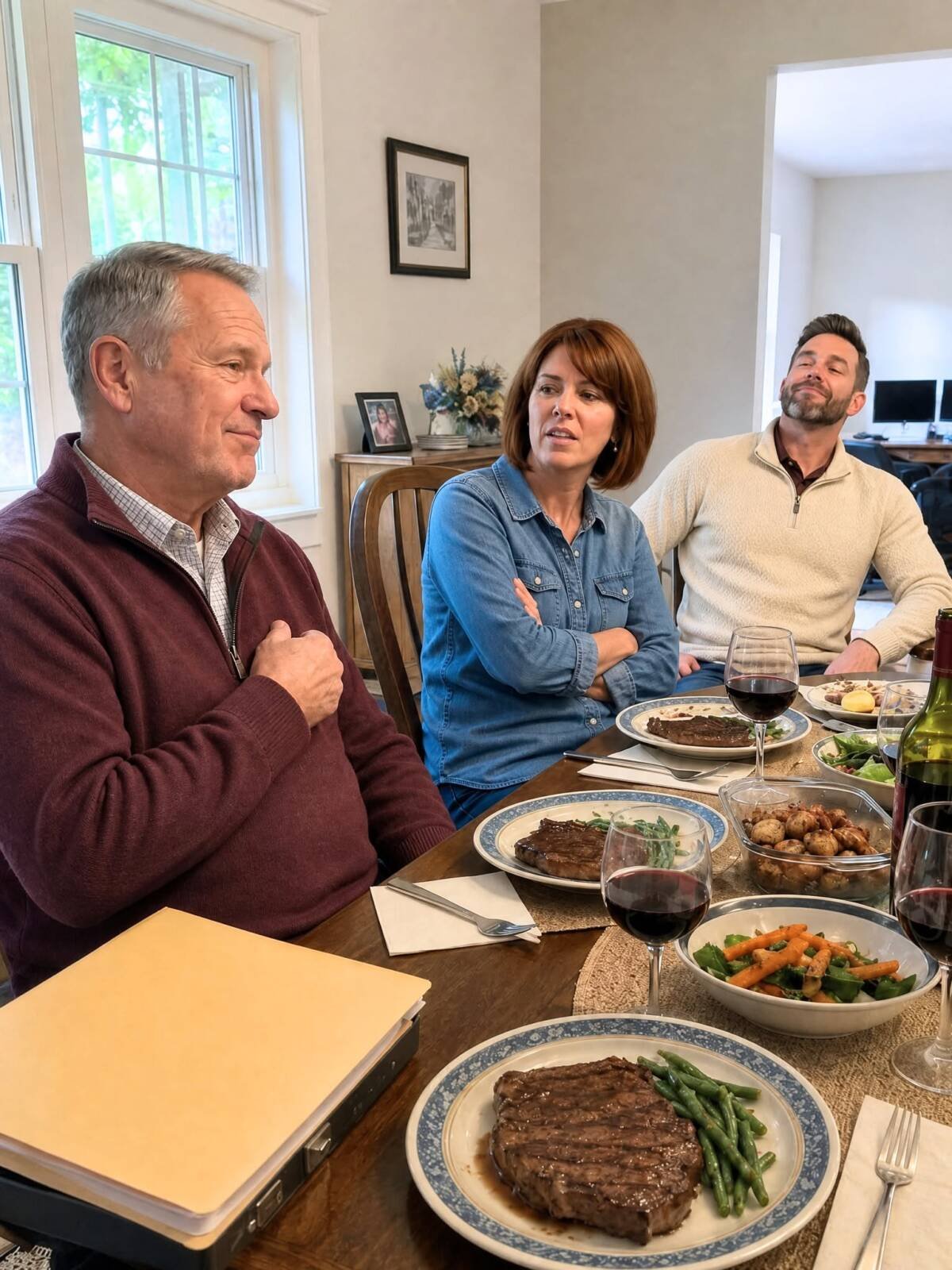
A week before Christmas, Evelyn Vance overheard a conversation she was never supposed to hear.
Her daughter was on the phone, casually discussing plans for the holidays.
“We’ll just leave all eight kids with Mom,” Becca said. “She can watch them while we enjoy a few peaceful days away.”
Evelyn stood silently in her kitchen, a coffee mug in her hand.
Her daughter had not asked whether she was available.
She had not asked whether she wanted to spend Christmas caring for eight children.
She had simply assumed.
For decades, Evelyn had been the person her family relied on whenever something needed to be done. She cooked the holiday meals, bought the groceries, wrapped the presents, prepared the bedrooms, cleaned the house, and watched her grandchildren whenever her children needed a break.
She had always told herself that was what mothers and grandmothers did.
But this time, something inside her finally changed.
Instead of arguing with her daughter, Evelyn made a quiet decision.
She would not be home when the children arrived.
And what happened next forced her entire family to confront just how much they had taken her for granted.
The Quiet Departure
My name is Evelyn Vance. I am 67 years old, widowed, and I have lived alone for several years in a quiet neighborhood where Christmas decorations begin appearing in front yards before Thanksgiving.
Every December, my house became the unofficial headquarters for our family Christmas.
There were always lights around the windows, wreaths on the front door, a large tree in the living room, and enough food in the kitchen to feed an army.
For years, I had been proud of that.
I loved having my children and grandchildren around me.
I loved seeing the house filled with laughter.
I loved watching the grandchildren tear into their presents on Christmas morning.
What I did not realize for a long time was that everyone else had gradually stopped seeing those traditions as something I chose to do.
They had started seeing them as something I was responsible for.
Every year, I paid for the groceries out of my pension. I searched for gifts, wrapped them late into the night, prepared guest rooms, cleaned the house, decorated the tree, planned the meals, and spent days making sure everything was ready.
Nobody forced me to do those things.
At least, not directly.
But over time, expectation became obligation.
And because I rarely complained, everyone assumed I was happy with the arrangement.
The previous Christmas had been particularly exhausting.
My daughter, Becca, and her husband arrived late. My son, Garrick, barely made it before dinner was served.
Everyone ate, laughed, took pictures beside the Christmas tree, and exchanged gifts.
Then, almost as quickly as they had arrived, the adults left.
They had other plans.
I stayed behind with all eight grandchildren.
I spent the evening putting air mattresses on the floors, finding extra blankets, cleaning up wrapping paper, preparing snacks, and making sure everyone was settled.
By the time the house finally became quiet, it was well after midnight.
I remember standing alone in my kitchen, looking at the mountain of dirty dishes in the sink.
I was exhausted.
But I told myself it was worth it.
They were my children.
They were my grandchildren.
That was what family was supposed to mean.
At least, that was what I had convinced myself.
Then came this Christmas.
I had already started preparing weeks in advance.
The presents were purchased.
The pantry was stocked.
The decorations were up.
The guest rooms were ready.
I had even planned the Christmas dinner menu.
Everything looked perfect from the outside.
But one afternoon, while I was in the kitchen, I heard my daughter talking on the phone in the next room.
At first, I wasn’t paying attention.
Then I heard my name.
“We’ll just leave all eight kids with Mom,” Becca said.
I stopped moving.
“She can watch them while we enjoy a few peaceful days away.”
I stood there holding my coffee mug.
For several seconds, I couldn’t move.
It wasn’t the fact that she wanted to take a vacation that hurt.
I understood that parents needed breaks.
It wasn’t even the fact that she needed childcare.
What hurt was how casually she had made the decision.
There had been no question.
No request.
No conversation.
Apparently, my availability was already part of their Christmas plans.
They had decided what I would do with my holiday without asking me.
And suddenly, something became painfully clear.
I wasn’t being treated like a mother whose time mattered.
I was being treated like a service everyone assumed would always be available.
That afternoon, I went into my bedroom and sat on the edge of my bed.
For years, I had wondered what would happen if I stopped doing everything everyone expected of me.
That day, I finally decided to find out.
I opened my notebook.
I made a few phone calls.
And without confronting anyone, I changed my Christmas plans.
The Morning Everything Changed
On December 23, my house was completely quiet.
There were no children running through the hallways.
No Christmas music was playing.
No food was cooking.
No one was asking me where something was.
Instead, my suitcase was already packed.
I carried it outside, placed it in the trunk of my car, locked the front door, and stood for a moment on the porch.
I looked back at the house.
For decades, that home had been the center of our family Christmas.
But this year, I was leaving it behind.
I got into my car and started driving toward the coast.
I had rented a small cottage in Cape May for the week.
It wasn’t extravagant.
It wasn’t some luxury vacation.
It was simply a quiet place near the water where I could spend Christmas without cooking for eight children, cleaning up after a house full of adults, or pretending that exhaustion was the same thing as happiness.
As I drove farther from home, I felt something unexpected.
Relief.
Then came the guilt.
My mind immediately began filling with questions.
What would the children think?
Would my daughter be angry?
Would my son blame me?
Would everyone accuse me of ruining Christmas?
For a moment, I almost turned the car around.
Then I remembered the conversation I had overheard.
“We’ll just leave all eight kids with Mom.”
Not Can Mom help us?
Not Would Mom mind?
Just Mom will handle it.
That was the moment I kept returning to.
And I continued driving.
The Phone Call at the Coast
I hadn’t even reached the edge of the county when my phone started ringing.
It was Becca.
I let it ring.
A few minutes later, she called again.
Then again.
Eventually, I pulled into a scenic overlook beside the Atlantic Ocean.
Gray winter waves rolled toward the shore beneath a cold December sky.
I turned off the engine, took a breath, and answered.
“Hello, Becca.”
“Mom? Where are you?”
Her voice was tense.
Behind her, I could hear children talking.
“I’m at the coast,” I said.
There was a pause.
“What do you mean, you’re at the coast?”
“I rented a cottage in Cape May for the week.”
The silence that followed was almost unbelievable.
Then her voice became sharper.
“Mom, it’s December 23.”
“I know.”
“We’re at your house.”
I said nothing.
“The car is gone. The house is locked. Where are you?”
“I told you. I’m in Cape May.”
She sounded confused.
Then frustrated.
“Why would you go to Cape May right now? We have the kids!”
“I know.”
“We were going to drop them off and head to our hotel.”
I looked out at the ocean.
Then I said the words I had been holding onto for days.
“You should have asked me.”
“What?”
“You should have asked me if I was willing to watch the children.”
“But Mom, you always watch them.”
There it was.
The sentence that explained everything.
I always watched them.
Therefore, they assumed I always would.
“I love my grandchildren,” I said. “But that doesn’t mean I am automatically available whenever you make plans.”
“But everything is already arranged,” she argued.
“You arranged it,” I replied. “I didn’t.”
She became quiet.
Then she asked, “Are you seriously leaving us without childcare?”
“I didn’t leave you without childcare.”
“You did!”
“No,” I said calmly. “You made plans that depended on me without asking me first.”
She didn’t respond.
So I continued.
“I overheard your conversation.”
Her tone immediately changed.
“You were listening to my private conversation?”
“You were talking about my life in my own house as though I wasn’t even part of the decision.”
She tried to defend herself.
“It was only for a few days.”
“That isn’t the point.”
“The children love staying with you.”
“I love them, too.”
“Then what’s the problem?”
I looked through the windshield toward the horizon.
“The problem is that you decided my time belonged to you.”
For the first time, my daughter had no immediate answer.
“You’re Ruining Christmas”
Eventually, Becca said what I had expected.
“If you do this, you’re ruining Christmas.”
I closed my eyes.
I had spent decades making sure Christmas was never ruined for anyone else.
I had cooked when I was tired.
I had cleaned when my back hurt.
I had spent money I could have saved.
I had stayed awake late into the night.
I had said yes when I wanted to say no.
And somehow, the first time I chose myself, I was the one accused of ruining Christmas.
“Becca,” I said gently, “I have spent thirty years adjusting my plans around everyone else.”
She didn’t answer.
“This year, you will have to adjust yours.”
“But Garrick is going to be furious.”
“Then you and Garrick will figure it out.”
“We have a hotel reservation.”
“I hope you enjoy your vacation another time.”
“Mom—”
“I’ll call you after New Year’s.”
Then I ended the call.
I switched my phone to Do Not Disturb and continued driving.
Within minutes, my screen began filling with notifications.
Missed calls.
Text messages.
More missed calls.
I didn’t read them.
For once, I allowed myself to be unreachable.
A Christmas Without Apologies
Christmas Eve was unlike any Christmas I could remember.
I slept late.
Nobody woke me up.
Nobody needed breakfast.
Nobody asked where their clothes were.
Nobody needed help finding a toy.
I made myself a cup of dark-roast coffee and sat beside the window overlooking the water.
Outside, snow drifted across the winter landscape.
For the first time in years, I had nowhere I needed to be.
I didn’t have to cook.
I didn’t have to clean.
I didn’t have to organize anything.
I could simply sit.
At around noon, I turned my phone back on.
There were dozens of missed calls and nearly twenty messages.
Some were angry.
Some accused me of being selfish.
Others said I had abandoned my family.
I started scrolling through them.
Then I saw a message from someone I wasn’t expecting.
It was from my 15-year-old granddaughter, Lily.
Her message was short.
“Hey, Grandma. Mom and Uncle Garrick are really mad, but I wanted to say I’m sorry we always make you do all the work. I hope you’re having a nice time at the beach. You deserve a break. Love you.”
I read it twice.
Then a third time.
A tear rolled down my cheek.
Out of everyone in the family, the person who understood me most clearly was a teenager.
I replied immediately.
“Thank you, sweetheart. That means more to me than you know. I love you. Your Christmas presents will be waiting for you when I get home.”
Then I put my phone away.
For the first time, I wasn’t ashamed of choosing myself.
I was beginning to understand that setting a boundary wasn’t the same as abandoning the people I loved.
When They Finally Understood
I returned home on December 28.
The Christmas decorations were still hanging from the windows.
The tree was still standing.
The house looked exactly as I had left it.
But I felt different.
For the first time, my home didn’t feel like a place where everyone came to be taken care of.
It felt like mine.
About an hour after I arrived, there was a knock at the door.
It was Becca.
She was alone.
She looked tired.
I invited her inside.
For several minutes, neither of us said much.
Then she finally spoke.
“We had to cancel the hotel.”
I nodded.
“We had to divide the kids between us.”
I said nothing.
“We cooked everything ourselves.”
Another pause.
“We cleaned up everything ourselves.”
She looked down at her hands.
“We had no idea how much work it was.”
I poured her a cup of tea.
She continued.
“We had to organize meals, clean the house, keep track of all eight kids, handle the gifts, and deal with everything else.”
Then she gave a small, exhausted laugh.
“We even had to do all the dishes.”
I smiled slightly.
“Yes,” I said. “The dishes.”
She looked embarrassed.
“I know what you’re thinking.”
“I’m not thinking ‘I told you so.’”
She looked up.
“I just want you to understand something.”
She nodded.
“It is a lot of work, Becca.”
“I know.”
“I’ve been doing it for years.”
Her eyes filled with tears.
“I know.”
“No,” I said softly. “I don’t think you did know.”
She looked at me.
“I didn’t,” she admitted.
Then came the apology I had never realized I was waiting to hear.
“I’m sorry, Mom.”
I reached across the table.
“For what?”
“For taking you for granted.”
She swallowed hard.
“We forgot that you have your own life.”
I squeezed her hand.
“You forgot I was a person.”
She nodded.
“Not just Grandma.”
I smiled.
“Thank you for saying that.”
The Christmas That Followed
The following Christmas was different.
Not because the family stopped celebrating.
Not because I stopped loving my children.
And certainly not because I stopped loving my grandchildren.
The difference was that I no longer carried the entire holiday by myself.
A chore chart was hanging on the refrigerator.
Garrick carved the ham.
Becca and her husband organized the dining table.
The grandchildren helped clean up wrapping paper.
Everyone had a job.
And I sat in my favorite chair.
For once, I wasn’t running from the kitchen to the dining room.
I wasn’t checking the oven every five minutes.
I wasn’t counting plates.
I wasn’t wondering whether everyone had enough food.
I wasn’t standing alone at the sink after everyone else had gone home.
When dinner ended, my children rolled up their sleeves and washed the dishes.
I sat beside my grandchildren and watched snow fall outside the window.
Lily leaned against my shoulder.
“You look happy, Grandma,” she said.
I smiled.
“I am.”
That Christmas, my family finally learned something I should have taught them years earlier.
Love does not mean allowing other people to use your kindness without limits.
Being a mother does not mean giving up your entire life.
Being a grandmother does not mean becoming permanent childcare.
And setting a boundary does not mean you love your family any less.
Sometimes, the most loving thing you can do for the people around you is to stop carrying everything for them.
Because when one person always says yes, everyone else eventually forgets that they are allowed to say no.
I didn’t leave my family because I stopped loving them.
I left because I finally understood that I deserved to be part of my own life.
And perhaps that was the greatest Christmas gift I had ever given myself.
Conclusion
Evelyn’s decision to leave town may have initially looked selfish to her family, but it forced them to confront a reality they had ignored for years: her generosity had become an expectation.
By refusing to provide childcare without being asked, Evelyn didn’t abandon her children or grandchildren. She established a boundary.
And that boundary changed the way her family viewed her.
The next Christmas, everyone still gathered together.
There was still food.
There were still presents.
There was still laughter.
But this time, the responsibility was shared.
For Evelyn, that was the real gift.
Not a quiet cottage by the ocean.
Not a week away from home.
But the realization that she could love her family deeply without sacrificing herself in the process.
What do you think?
Have you ever felt that your family expected you to take care of everything simply because you had always done it before?
Share your thoughts in the comments and pass this story along to someone who may need the reminder that setting boundaries doesn’t mean you love people any less.