Standing inside a hushed viewing room at the Vila Alpina Crematorium in eastern São Paulo, Marcos Almeida was handed a black ballpoint pen and asked to sign the final authorization for his pregnant wife’s cremation.
Less than twenty-four hours earlier, a highway patrol officer had called to tell him that Ana Clara—seven months pregnant with their son, Miguel—had been killed instantly when her car lost control on the rain-slicked asphalt of the Rodovia dos Imigrantes. Everything that followed had dissolved into a suffocating blur of fluorescent-lit hallways, clipped official voices, and forms that demanded signatures before his mind could even process the reality of what had happened.
Yet as Marcos stared down at the dotted line on the clipboard, an inexplicable, suffocating resistance locked his fingers around the pen. He couldn’t let the doors close. He couldn’t let the flames take her without seeing her face one final time.
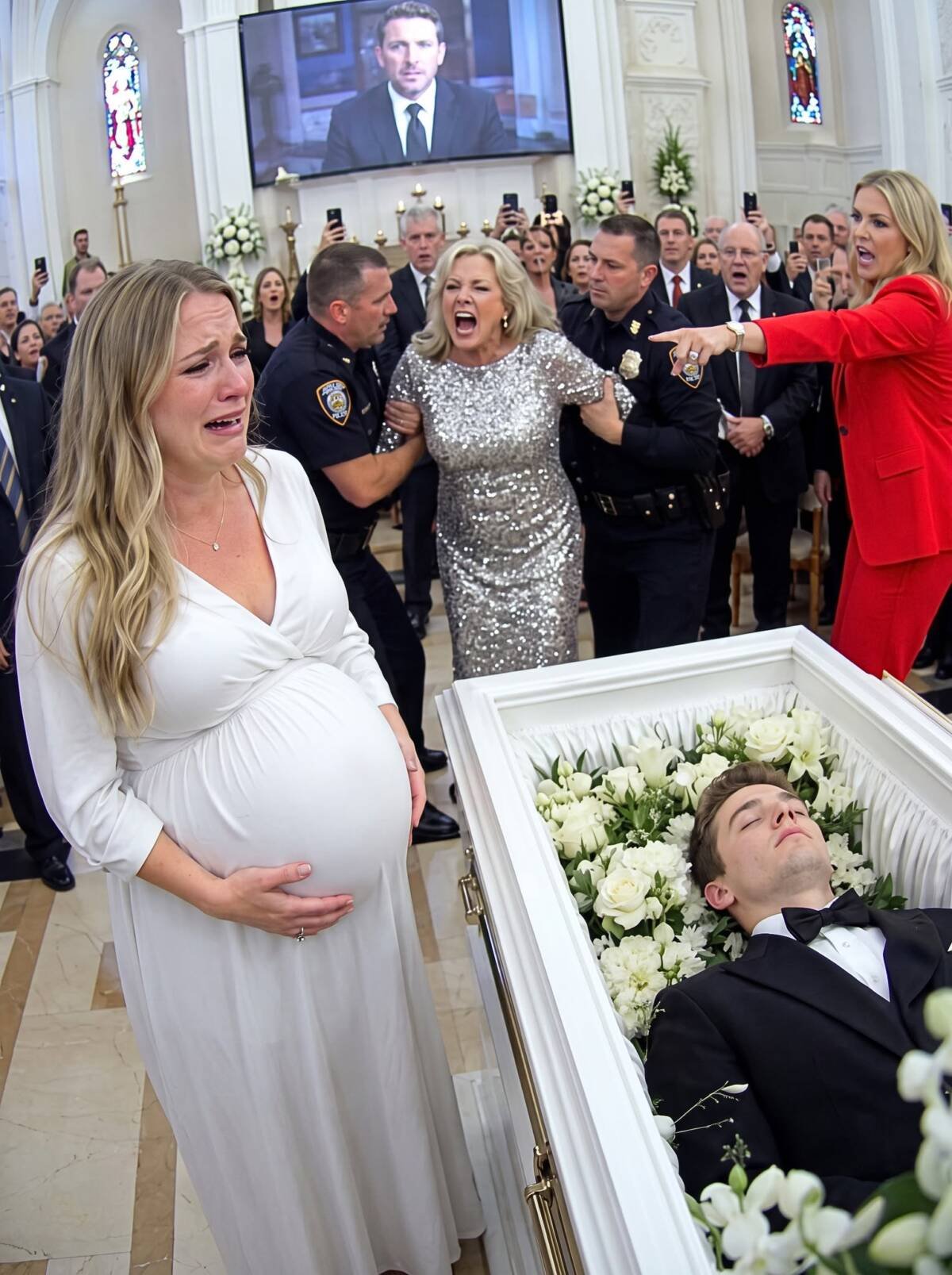
When the attendants reluctantly lifted the polished wooden lid of the coffin, the entire room fell dead silent. Marcos leaned forward to whisper the goodbye he hadn’t been given the chance to say—and froze. Beneath the white fabric draped over her seven-month-pregnant belly, something shifted. Seconds later, Marcos was screaming for everyone to stop, SAMU paramedics and Civil Police were racing through the crematorium doors, and what doctors uncovered at the hospital would shatter the official story of Ana Clara’s death forever.
The Rain on the Imigrantes
Marcos Almeida could never pinpoint the exact second his life broke in half.
If anyone asked him later, all he could recall were isolated, jagged fragments: the relentless drumming of late-afternoon rain against the apartment windows, the harsh vibration of his cell phone skittering across the wooden kitchen table, and a calm, unfamiliar voice mentioning the Rodovia dos Imigrantes before delivering the words no husband is ever prepared to hear.
Ana Clara had left the apartment shortly after two o’clock that afternoon. She had a short list of errands to run—picking up a few last-minute items for the nursery, stopping by the pharmacy for her prenatal vitamins, and dropping off a package for her mother. She was twenty-nine weeks along, carrying their first child, a boy they had already named Miguel.
Back in the apartment, Miguel’s room was still half-finished. The air carried the clean, comforting scent of fresh pine, baby soap, and newly dried paint. A white wooden crib stood unassembled against the far wall, its screws and Allen wrench neatly laid out on a towel where Marcos had promised he would finish putting it together that weekend. On the changing table sat three stacks of tiny cotton onesies that Ana Clara had washed, folded, and refolded twice just to be certain they were soft enough.
When the phone rang just after six, Marcos had been standing in that very doorway, holding a screwdriver and wondering if he should surprise her by finishing the crib before she got home.
Instead, the voice on the other end of the line used careful, clinical phrases—hydroplaning, concrete barrier, severe impact, immediate death. They were words designed to sound orderly and definitive, as if tragedy could be neatly filed away once the right terminology was applied. None of it softened the blow. In the span of thirty seconds, the woman Marcos had loved for eight years—and the son he had never held—were reduced to a case number on a rainy highway.
Marcos and Ana Clara had met in the most ordinary place imaginable: standing in a slow, humid afternoon line at a bank branch in central São Paulo. Marcos always liked to tell friends that he fell in love with her in under thirty seconds. An elderly woman near the front of the queue had stepped aside for a moment to retrieve a dropped folder, and a man in a tailored suit had immediately slid into her spot. Before anyone else could muster the courage to speak up, Ana Clara had stepped forward, tapped the man lightly on the shoulder, and politely—yet firmly—guided the older woman right back to her place.
She had been like that about everything: warm, unassuming, and quietly fierce when it came to fairness.
They hadn’t wanted a grand, expensive wedding. Two years after that afternoon at the bank, they married in a small civil ceremony surrounded by immediate family, followed by a long lunch at a neighborhood restaurant where everyone laughed until their sides hurt.
Ana Clara was also the kind of woman who preserved every piece of a memory. She saved handwritten birthday cards, cinema tickets, dried flowers, and every single medical note from her pregnancy. All of it lived inside a sturdy blue plastic folder she carried to every appointment. Inside that blue folder were Miguel’s black-and-white ultrasound prints, lab results, her obstetrician’s handwritten notes, emergency contact sheets for Hospital das Clínicas, and a lined notebook page titled Before Miguel Arrives, where half the items had already been crossed off in neat blue ink.
There was only one recurring source of tension in their quiet, happy home: Ana Clara’s younger brother, Gustavo.
For years, Gustavo had orbited their lives like a permanent storm cloud. He showed up unannounced at dinnertime, constantly floated between short-lived business ventures, and regularly asked to borrow money—always swearing it was a temporary bridge until a big client paid him. Whenever Marcos hesitated, Gustavo leaned heavily on the same familiar refrain: Family is supposed to support family.
Marcos had never fully trusted him. There was something too rehearsed about Gustavo’s apologies, too quick about the way his eyes darted around a room when money was mentioned. Yet Ana Clara had always defended her brother. She believed in giving people grace, especially the people she had grown up with.
On the evening of the storm, Gustavo called Marcos twice before the highway police ever reached him.
The first call came around four-thirty. Gustavo sounded casual, almost too casual, asking simply if Ana Clara had made it back to the apartment yet. When Marcos said she was still out running errands, Gustavo hung up quickly.
The second call came nearly an hour later. This time, Gustavo’s voice was clipped and unusually agitated. He asked again if Marcos had heard from her, his breathing audibly shallow over the line. Yet when Marcos later called him back in tears after the police delivered the news, Gustavo’s reaction had been oddly muted—heavy sighs, a few mumbled curses about the rain, but none of the raw, breathless shock Marcos had heard from Ana Clara’s mother.
At the time, Marcos noticed none of it. Grief had hollowed him out so completely that there was no room left for suspicion. Everything outside the fact that Ana Clara was gone became distant static as officials processed the accident report, issued the death certificate, and scheduled the cremation for the following afternoon.
The Silence Inside Vila Alpina
The next day dawned gray and heavy over São Paulo.
Inside the Vila Alpina Crematorium, the air smelled faintly of white lilies, polished cedar, and muted incense. Overhead, fluorescent tubes hummed softly against the acoustic ceiling tiles. Marcos stood beside the dark wooden coffin, his palms pressed flat against the cool lacquer as if holding onto the wood could somehow anchor him to the floor.
Inside, Ana Clara lay motionless, dressed in a simple pale dress her mother had chosen. Even beneath the soft white fabric draped across her torso, the gentle curve of her seven-month pregnancy was unmistakably visible.
A few feet away, Ana Clara’s mother, Dona Helena, sat hunched in a folding chair, weeping quietly with a worn wooden rosary twisted tightly around her knuckles. Relatives murmured in low clusters near the back of the room, offering awkward hugs and whispered condolences that Marcos barely heard.
Against the far wall stood Gustavo.
His arms were crossed tightly over his chest, his shoulders hunched, his eyes red-rimmed. To anyone glancing across the viewing room, he looked like a devastated brother trying to hold himself together. Only later—when Marcos replayed every second of that afternoon in his mind—would he realize that Gustavo had barely looked at the coffin at all. Instead, his gaze had kept drifting toward the wall clock, then toward the crematorium staff, as though he were waiting for a train to finally pull out of the station.
At 4:15 p.m., a crematorium attendant in a dark suit stepped quietly to Marcos’s side. He carried a sleek black clipboard holding the final cremation authorization form.
“Senhor Almeida,” the attendant murmured gently, extending a pen. “Whenever you are ready, we just need your final signature to proceed.”
Marcos stared down at the paper. The black letters seemed to blur together. Authorization for Cremation. Final Release.
His fingers closed around the pen, and then stopped dead. A cold, sudden weight settled into his chest—not just grief, but an overwhelming, visceral certainty that he could not sign that line.
“I need to see her one more time,” Marcos said, his voice barely above a whisper.
The attendant hesitated, offering a practiced, compassionate frown. “Senhor, the coffin has already been prepared for the final transfer. We’re on a strict schedule—”
“Please,” Marcos interrupted, louder this time, his eyes locking onto the man’s face. “Just for one minute. I haven’t even said goodbye to her properly. Open it.”
Dona Helena looked up from her rosary, her eyes pleading. After a brief, uncomfortable glance at his supervisor near the doorway, the attendant gave a reluctant nod. Alongside a colleague, he stepped forward, unlatched the brass clasps, and slowly lifted the heavy wooden lid.
The quiet murmur in the room died instantly.
Dona Helena stopped mid-prayer. A cousin near the water dispenser froze with a paper cup halfway to her lips. The hum of the overhead lights suddenly seemed deafening.
Marcos stepped closer and leaned over the edge of the coffin. Looking down at Ana Clara’s pale, peaceful face, a wave of guilt nearly buckled his knees. He wanted to apologize for not taking the afternoon off work to drive her himself. He wanted to beg her forgiveness for not insisting she stay home until the storm passed.
He reached out, letting his fingertips brush the cold linen resting over her stomach—and froze.
Beneath the white fabric, something shifted.
It was barely a flicker—a faint, gentle ripple against the cloth so subtle that anyone standing two feet farther back would never have seen it. Marcos stopped breathing. His heart hammered violently against his ribs. You’re losing your mind, a voice inside his head whispered. Grief is playing tricks on you.
He didn’t blink. He didn’t move a muscle. He stared down at the fabric, counting the seconds.
One. Two. Three.
Then it happened again—stronger this time, an unmistakable rolling push from beneath the linen.
“Stop!” Marcos screamed, his voice tearing through the silence of the viewing room. “Stop everything right now!”
The attendants jumped backward in alarm. Dona Helena gasped, rising unsteadily from her chair.
“Senhor, please, calm down,” the lead attendant said quickly, stepping forward to place a reassuring hand on Marcos’s shoulder. “Sometimes, after passing, natural postmortem muscle reactions or trapped air can cause slight movements. It’s completely normal—”
Marcos violently shook the man’s hand off. He leaned straight over the coffin, gripping the wooden sides with trembling fingers. “Ana! Ana Clara!”
Her chest didn’t rise. Her eyelids didn’t flutter. Her skin was ice-cold.
And then the impossible truth crashed over him like a tidal wave.
“Call an ambulance!” Marcos roared, spinning toward the stunned room. “Call SAMU right now! My son is alive!”
The viewing room exploded into chaos. One attendant bolted toward the front desk to dial 192. Relatives surged forward in panicked disbelief while Dona Helena pressed both hands over her mouth, sobbing out Miguel’s name.
Amid the frantic shouting, Marcos’s eyes caught movement near the back wall.
Gustavo had taken one sharp step forward—and then stopped dead in his tracks.
Even in the middle of the worst panic of his life, that single split-second reaction burned itself permanently into Marcos’s memory. While every other person in the room was staring in horrified awe at Ana Clara’s belly, Gustavo wasn’t looking at his sister at all. His eyes darted rapidly to the double exit doors, then dropped down to the blue plastic folder resting on Dona Helena’s chair, and finally snapped straight to Marcos’s face.
The expression in Gustavo’s eyes wasn’t shock. It wasn’t relief.
It was cold, cornered calculation.
A Heartbeat Against the Clock
Less than six minutes later, the piercing wail of sirens echoed off the concrete walls outside Vila Alpina. The double doors burst open and three SAMU paramedics rushed inside, lugging heavy orange trauma bags and a portable fetal Doppler monitor.
“Everyone back! Clear the coffin immediately!” the lead paramedic barked, taking command of the room in an instant.
Relatives scrambled out of the way as the paramedic knelt beside the wooden casket, pulled back the white linen, applied a streak of cold clear gel to Ana Clara’s abdomen, and pressed the small handheld sensor firmly against her skin.
Silence swallowed the room again.
For five agonizing seconds, the portable speaker hissed with nothing but harsh, empty static. Marcos gripped the back of a folding chair so hard his knuckles turned bone-white, silently praying to a God he hadn’t spoken to in years.
The paramedic shifted the sensor two inches to the left.
Suddenly, cutting faintly through the static, came a rapid, rhythmic thump-thump-thump-thump.
Weak. Frantic. Unmistakably alive.
“We have a heartbeat!” the paramedic shouted, his eyes widening as he looked up at his partner. “The baby is alive! Get the stretcher in here now—code red!”
Marcos’s legs gave out beneath him, and he caught himself on the edge of the coffin as Dona Helena fell to her knees weeping in gratitude. Across the room, Gustavo quietly stepped backward until his shoulders pressed once more against the wall.
Minutes later, Civil Police officers arrived to take control of the scene, alerted by the emergency dispatch. While paramedics carefully lifted Ana Clara onto the gurney and secured her for transport, a senior officer noticed the blue folder lying on the chair and asked Dona Helena for her medical records to send ahead to the hospital.
Flipping quickly through the prenatal charts and the preliminary highway accident report tucked inside, the officer’s brow furrowed. He paused, turning back a page, and compared two timestamps. The time of death logged on the initial paperwork didn’t align cleanly with the final medical note from the emergency response team.
It wasn’t proof of foul play—not yet. But it was the first jagged crack in a story that had been rushed toward a furnace far too quickly.
Marcos climbed straight into the back of the ambulance beside his wife. As the vehicle tore out of Vila Alpina with sirens screaming through the congested late-afternoon traffic of São Paulo, he wrapped both hands around Ana Clara’s cold fingers and leaned close to her stomach.
“Hold on, Miguel,” he whispered over the roar of the engine, tears spilling down his cheeks. “Please, son, hold on. Your dad is right here. Don’t leave me.”
At Hospital das Clínicas, an emergency obstetric and surgical team was already waiting beneath the awning of the ambulance bay. The moment the rear doors flew open, Ana Clara was wheeled at a full run through the sliding glass doors and down the long corridor toward the surgical center.
Marcos sprinted beside the gurney until a surgical nurse stepped smoothly in front of him at the swinging double doors, placing a firm, gentle hand against his chest.
“Senhor Almeida, you cannot come past this line. Let the doctors work.”
“I can’t lose them both,” Marcos choked out, his voice shattering. “I already lost her. Please—I can’t lose him too.”
The doors swung shut with a heavy sigh, leaving him alone beneath the blinding white lights of the hallway.
Time lost all meaning. Five minutes felt like an hour. Marcos paced the linoleum floor until his shoes scuffed, staring at the red digital clock mounted above the nursing station.
6:41 p.m. 6:45 p.m. 6:48 p.m.
At exactly 6:49 p.m., with no doctor having emerged from the operating room, a thin, fragile, unmistakable sound pierced through the sealed glass doors.
A baby’s cry.
Marcos pressed both hands over his face and sobbed.
Moments later, the double doors burst open and a neonatal nurse hurried past carrying a tiny, premature infant wrapped tightly in sterile white linen, rushing him down the hall toward the neonatal intensive care unit. Marcos caught only a three-second glimpse of a tiny, wrinkled face and clenched miniature fists—but it was enough. A part of Ana Clara had refused to let go.
Yet inside the operating room, the relief lasted only minutes.
While completing the emergency procedure, the attending surgeon noticed something on Ana Clara’s upper arm that made him pause—a small, faint puncture-like mark surrounded by an unusual localized skin reaction. It didn’t resemble glass lacerations, seatbelt bruising, or any blunt-force trauma described in the highway crash report.
The surgeon immediately notified the hospital’s legal-medicine liaison, who in turn called the Civil Police officer waiting downstairs.
Within the hour, the cremation order was officially revoked. Ana Clara’s body was placed under strict forensic hold, and investigators ordered a comprehensive toxicology screening alongside a full mechanical and forensic inspection of her wrecked car.
Until 6:49 that evening, everyone had accepted Ana Clara’s death as a senseless highway tragedy.
Now, detectives were asking a far darker question: had someone desperately needed it to look like one?
The Accident That Didn’t Add Up
Saving Miguel should have been the end of the nightmare. Instead, it pried open a door into a betrayal Marcos never could have imagined.
Over the next seventy-two hours, Civil Police detectives began reconstructing Ana Clara’s final afternoon minute by minute. They pulled cell-tower pings, credit card timestamps, pharmacy receipts, and traffic-camera feeds leading toward the Rodovia dos Imigrantes.
The first major breakthrough came from a modest gas station located less than four kilometers before the stretch of highway where Ana Clara’s car had veered into the concrete divider.
The station’s overhead security camera had recorded Ana Clara’s silver sedan pulling up beside the air pump at 4:08 p.m. in the pouring rain. Two minutes later, a dark hatchback pulled in directly behind her.
Stepping out into the downpour—without an umbrella, his posture rigid and aggressive—was Gustavo.
The grainy, silent footage didn’t show him physically striking Ana Clara or tampering with her tires. Instead, it captured him leaning heavily against the driver’s-side window for nearly seven minutes, gesturing sharply while arguing with his seven-month-pregnant sister. At one point, he reached briefly inside the cabin before stepping back as she rolled the window up and pulled away into the storm.
Twelve minutes later, her car slammed into the highway barrier.
When detectives brought Gustavo into the precinct for a formal statement, he didn’t panic. He sat calmly across the metal table, folded his hands, and offered a neat, rehearsed explanation.
“I just wanted to talk to my sister about a private family matter,” Gustavo said evenly. “She was emotional—pregnancy hormones, you know how it is. We had a small disagreement, she got upset, and she drove off. I had no idea she was going to crash.”
If the gas-station video had been the only red flag, his story might have survived.
It wasn’t.
Four days later, the state forensic laboratory delivered the toxicology report. Ana Clara’s bloodstream contained a significant concentration of a fast-acting prescription sedative—a substance completely incompatible with pregnancy and nowhere in her medical files.
When detectives showed Marcos the lab findings, his blood turned to ice. Ana Clara had been extraordinarily cautious throughout her pregnancy. She had given up coffee, checked the ingredients on every herbal tea, and wouldn’t even swallow a basic over-the-counter painkiller without calling her obstetrician first. There was zero chance she had taken a heavy sedative on her own before driving onto a rain-soaked highway.
With that single report, every strange detail from the past week locked violently into place: the mismatched medical timeline, the unexplained mark on her arm, the gas-station argument minutes before the crash, Gustavo’s two frantic phone calls before the police even knew who Marcos was, and the partially wiped call log on Ana Clara’s recovered cell phone.
Then digital-forensics technicians cracked open the deleted messaging archive on her phone—and found the final missing piece.
For years, Gustavo had been drowning in hidden debts to private lenders, keeping himself afloat by bleeding money from relatives while painting every crisis as a temporary setback. Ana Clara had quietly bailed him out again and again—until three days before her death.
In the recovered chat thread, Ana Clara had finally drawn a hard line. She told Gustavo clearly that she was done giving him money. She ordered him to stop approaching Marcos with fabricated stories, and she warned him that once Miguel was born, she was going to sit down with their mother and reveal every single debt he had been hiding.
Prosecutors finally had their motive.
Gustavo hadn’t just been facing the loss of an easy cash flow. He was about to lose the carefully built illusion that kept his family rescuing him. According to the investigators’ reconstruction, he had tracked Ana Clara down in the rain, argued with her, and introduced a sedative that fatally impaired her reflexes minutes before she merged onto the highway—counting on the storm, the crash, and a rushed cremation to turn every piece of evidence into ash.
When officers finally arrived at Gustavo’s apartment and snapped handcuffs around his wrists, Marcos felt no surge of triumph or satisfaction. Watching the news on his phone from the hospital waiting room, he simply closed his eyes and saw the viewing room at Vila Alpina again—and the cold, calculating way Gustavo had stared at the exit doors the exact second a paramedic announced that Miguel was alive.
Fighting for Every Gram
While prosecutors assembled their indictment, Miguel fought a much quieter, fiercer battle inside the neonatal intensive care unit at Hospital das Clínicas.
Delivered two months prematurely, he looked impossibly small inside the clear plastic incubator—a tangle of delicate wires, feeding tubes, and glowing monitors tracking every breath and heartbeat.
Marcos spent nearly every waking hour beside that glass box. In the quiet hum of the NICU, he learned an entirely new language of hope. Ten extra grams on the morning scale mattered. One less tube mattered. Every stronger, louder cry felt like a miracle.
The first afternoon a nurse smiled and told him he could wash his hands, reach through the porthole, and touch Miguel’s tiny fingers without sterile gloves, Marcos stood beside the incubator and wept silently as his son’s miniature hand curled tightly around his thumb.
Dona Helena came almost every day, sitting beside Marcos with her wooden rosary looped loosely around her wrist. Often, they sat for an hour without speaking a single word. Nothing either of them could say would shrink the hole Ana Clara had left behind—yet somehow, their shared silence became a shelter rather than a weight.
They had both lost Ana Clara. They had come within minutes of losing Miguel. Yet the little boy was growing stronger every day because his father had refused to sign one piece of paper.
Months later, the case finally reached the courtroom.
Walking through the heavy wooden doors and seeing Gustavo seated at the defense table pulled Marcos straight back to the scent of lilies and incense at Vila Alpina. Prosecutors methodically laid out the entire chain of evidence: the surgical findings from Hospital das Clínicas, the toxicology panel, the gas-station surveillance video, the recovered text messages, and the timeline inconsistencies that had nearly been erased by a hurried cremation.
The prosecution didn’t need to guess at every whispered word spoken in that rainstorm. The mountain of evidence was more than enough to prove that Ana Clara’s death was not the simple, unavoidable highway accident Gustavo had desperately hoped would vanish in the flames.
When the jury returned a guilty verdict—convicting Gustavo for his role in the events that caused Ana Clara’s death and endangered Miguel’s life—Marcos didn’t smile. There was nothing to celebrate. No prison sentence could bring his wife back to finish assembling the crib, or give Miguel the mother he deserved.
What the verdict did was preserve the truth. A lie would never stand as Ana Clara’s final story.
The Blue Folder
Years passed.
The fragile, premature baby Marcos had first glimpsed wrapped in sterile white linen grew into a bright, energetic boy with his mother’s dark, expressive eyes—and an endless stream of questions about the woman he never got the chance to meet.
Marcos answered every single one with patience and care. He refused to let Ana Clara be remembered only as a tragedy or a court case. Over breakfast and bedtime stories, he told Miguel about the woman who laughed easily, who stood up for an elderly stranger in a bank line, who carefully folded tiny cotton onesies weeks before he was born, and who loved her son fiercely before ever seeing his face.
And tucked safely on the top shelf of Marcos’s bedroom closet, the blue plastic folder remained.
Inside were the slightly faded ultrasound prints Ana Clara had treasured, Miguel’s tiny plastic hospital bracelet from the NICU, and a folded copy of the medical report that had halted the cremation at Vila Alpina. Marcos rarely took it down; he didn’t need to open it to remember what it represented.
Even years later, after Miguel had fallen asleep in the bedroom that had once smelled of fresh pine and paint, Marcos still sometimes remembered the humming fluorescent lights of the crematorium, the cold wood of the coffin, and the faint, impossible ripple beneath the white cloth.
One quiet evening, when Miguel was old enough to understand fragments of how he had entered the world, he looked up from his pillow and asked a simple question.
“Dad… why did you make them open the coffin?”
Marcos sat on the edge of the bed and looked at his son for a long, quiet moment before brushing a lock of hair back from his forehead.
“Because I loved your mother too much to leave without saying goodbye.”
Someday, when Miguel is older, he will learn the rest of what lives inside that answer—the investigation, the trial, the betrayal, and the blue folder waiting on the closet shelf. For now, Marcos lets him simply be a child.
Marcos Almeida had walked into Vila Alpina believing he was burying his entire future. Instead, he walked out having saved his son and uncovered the truth for his wife. Because sometimes, a miracle doesn’t arrive with a grand explanation. Sometimes, it begins with a grieving husband refusing to sign the final line.
What is your reaction to Marcos’s instinct in that crematorium—and the chilling betrayal uncovered afterward? Share your thoughts in the comments below, and pass this story along to someone who believes in the power of a parent’s love.