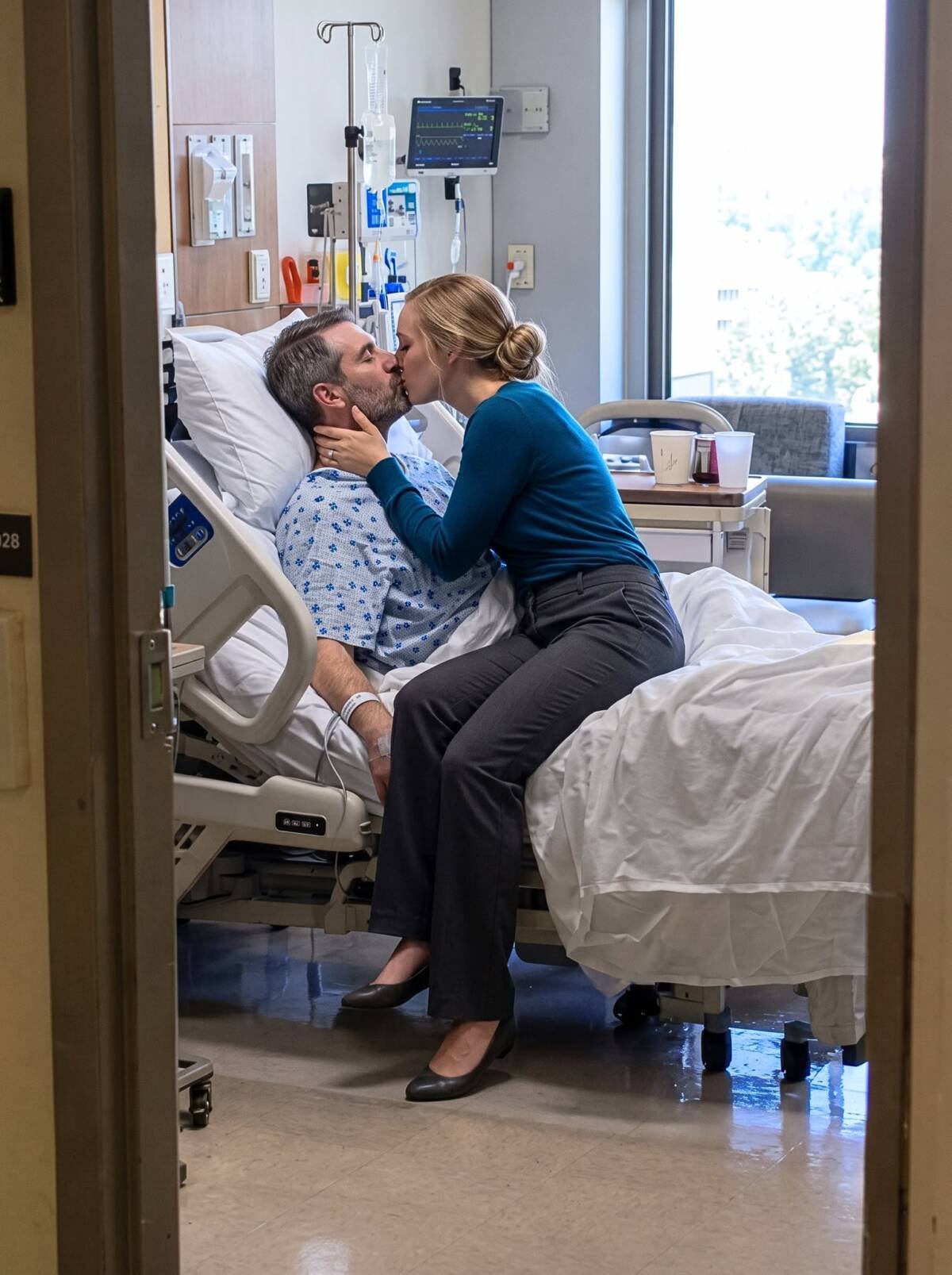
A terrifying discovery inside a respected family’s home led one woman to uncover a hidden archive, years of alleged abuse, and a secret that threatened to destroy everything she thought she knew about her husband’s family.
Fictional dramatic story
Introduction: The Glass That Changed Everything
The first thing I noticed was the white powder clinging to the inside of the glass.
My father-in-law, Arthur Vance, stood in my bedroom doorway holding a glass of orange juice. He wore the same reassuring smile that had made neighbors trust him, former students respect him, and church members praise him for decades.
But that night, something about his expression frightened me.
“Drink it now, Rebecca,” he said. “I want to see you finish it.”
It was almost eleven o’clock. Rain battered the windows of our home in Arlington, Virginia, and my husband, David, was hundreds of miles away on a business trip. My mother-in-law, Evelyn, was in Richmond, leaving me alone in the house with Arthur and his daughter, Chloe.
I had spent two years trying to convince myself that my father-in-law’s behavior was merely inappropriate rather than dangerous. He lingered too long whenever we were alone, made suggestive comments disguised as jokes, and appeared in rooms without warning whenever I tried to avoid him.
Whenever I raised concerns, someone found a reason to dismiss them.
That night, however, the powder inside the glass was impossible to ignore.
I did not know what it was, but I knew I could not safely drink it.
So I pretended to agree.
Then Chloe arrived home unexpectedly, smelling of alcohol and complaining that she was thirsty. When she reached for my glass, I let her take it.
Within minutes, she was barely conscious.
I was horrified by what I had witnessed, but another thought kept repeating in my mind: Arthur believed I had consumed the juice.
And if he returned to my bedroom, he would expect to find me unconscious.
I hid nearby with my phone recording.
What happened next would change my understanding of the Vance family forever. By morning, I would be fleeing the house with Arthur’s laptop, searching for evidence that could explain his behavior.
At a roadside motel, I opened a hidden directory filled with folders bearing women’s names.
Most meant nothing to me.
Then I reached the last two.
CHLOE VANCE.
EVELYN VANCE.
My sister-in-law. My mother-in-law.
That was when I realized the danger I had escaped might have been part of a much older secret—and that I might not have been the first woman Arthur had targeted.
Part 1: The Glass Meant for Me
Arthur Vance had spent decades cultivating the kind of reputation that made people reluctant to question him.
As a retired school principal, he was known for his discipline, his public service, and his insistence that young people needed strong moral guidance. He volunteered at community events, attended church gatherings, and remembered the names of former students long after they had graduated.
People described him as respectable.
I had learned that respectability and kindness were not necessarily the same thing.
My discomfort around Arthur had begun shortly after David and I married. At first, his behavior seemed too minor to explain without sounding unreasonable. He stood unnecessarily close when speaking to me, made comments about my appearance that left me uncomfortable, and found excuses to enter rooms when I was alone.
Whenever I tried to distance myself, he acted offended.
Once, I told David that his father made me uneasy.
David laughed awkwardly and said Arthur had always been old-fashioned. He suggested that I might be interpreting harmless behavior too negatively.
Evelyn was less gentle.
She told me to be careful about how I dressed and warned me against creating misunderstandings within the family.
I left that conversation feeling ashamed of having spoken up.
Afterward, I tried to keep my distance from Arthur without making the tension obvious. I avoided being alone with him whenever possible and made excuses whenever he offered to help me with something.
But living in the same house made complete avoidance difficult.
Then came the night of the orange juice.
Arthur appeared in my bedroom doorway shortly before eleven, carrying the glass as though he were doing me a favor.
“You’ve been working too hard,” he said. “This will help you sleep.”
I looked at the juice.
A thin white residue clung to the inside of the glass. Some of it appeared to have settled near the bottom, while the rest remained visible along the sides.
My stomach tightened.
“What is it?” I asked, trying to keep my voice steady.
“Orange juice.”
“I mean, did you put something in it?”
His smile faltered.
“Why would I do that?”
“I was just asking.”
He stepped farther into the room.
“Drink it, Rebecca.”
I glanced toward the hallway. He was standing close enough to the doorway that passing him would have been difficult.
“Thank you,” I said. “I’ll have it in a minute.”
“No.” His voice became sharper. “Drink it now. In front of me.”
I had never heard him speak to me that way before. The pleasant expression remained on his face, but his eyes had changed.
I understood then that he was not simply offering me a drink.
He wanted to see me consume it.
I lifted the glass slowly, pretending to comply, while trying to decide how to get out of the room without provoking him.
Before I could make another move, the front door slammed downstairs.
“Is anyone awake in this house?” Chloe shouted. “Why is everything so dark?”
Arthur flinched.
He glanced toward the hallway, muttered something about checking on his daughter, and hurried away.
I remained standing in the middle of the room, holding the glass with both hands.
I did not know what the powder was. I did not know whether it was dangerous or what Arthur intended to do. But I knew I had been right not to drink it.
I set the glass down.
A few minutes later, Chloe stumbled into my bedroom. She had been drinking and appeared irritated about something that had happened during her evening.
“Do you have anything to drink?” she asked.
I nodded toward the nightstand.
She picked up the glass of orange juice.
“Is this yours?”
“You can have it.”
She drank it quickly, grimaced at the taste, and placed the empty glass on the table.
“You really need to buy better juice.”
I barely heard her.
I was watching her face.
At first, nothing happened. Chloe complained about her evening and began scrolling through her phone. Then her words became increasingly difficult to follow.
She blinked repeatedly, rubbed her eyes, and leaned back against the bed.
“Why am I so tired?”
She tried to stand but seemed unable to coordinate her movements. A moment later, she collapsed onto the mattress.
I rushed toward her.
“Chloe? Can you hear me?”
She did not respond coherently.
Panic overwhelmed me.
I did not know what she had consumed, how much of it had affected her, or whether she needed emergency medical care. I knew only that something was seriously wrong.
I also knew Arthur had been watching me closely when he handed me the glass.
I was frightened, confused, and suddenly aware that he might return expecting to find me in the same condition.
My first instinct was to leave the house, but I feared encountering him in the hallway. I grabbed my phone and moved to a nearby linen closet, keeping myself close enough to hear movement outside my bedroom.
I called for emergency medical help and explained that Chloe had suddenly become unresponsive after drinking something. I did not want her condition to worsen while I tried to understand what had happened.
Then I began documenting what I could hear.
I did not know whether Arthur would return, but I wanted a record of anything that happened next.
About twenty minutes later, footsteps approached.
Arthur stopped outside my bedroom.
He looked down the hallway, then opened the door and entered.
He did not turn on the light.
From my hiding place, I could hear him moving around the room. I kept my phone recording and tried not to make a sound.
I could not see everything clearly, and I could not know what he intended to do. But his return, after insisting that I drink the juice and leaving me with the impression that he expected me to become incapacitated, frightened me more than anything else that had happened that night.
I remained hidden until the hallway fell silent.
For years, I had questioned my own judgment because the people around me insisted Arthur was harmless.
That night, I stopped treating my fear as an inconvenience.
I had seen enough to know that something was terribly wrong.
Part 2: The Morning I Left Everything Behind
I waited until daylight before leaving the closet.
The house was quiet, but I could hear movement upstairs. I had barely slept, and every unfamiliar sound made me tense.
When I returned to my bedroom, Chloe was beginning to regain consciousness. She appeared confused and frightened, struggling to understand why she could not remember what had happened after drinking the juice.
“What happened?” she asked.
I sat beside her.
“You drank something, and then you became unresponsive. I’ve been worried about you.”
She pressed a hand against her forehead.
“I don’t remember anything.”
Arthur appeared shortly afterward.
His expression changed when he saw that Chloe was awake and that I was standing beside her.
“What happened here?” he asked.
Chloe stared at him.
“Dad, why can’t I remember anything?”
He began offering explanations before either of us had finished asking questions. He said he had been drinking, that he might have misunderstood the situation, and that everyone needed to calm down.
His words came too quickly.
I looked at him.
“You brought me that juice last night.”
He turned toward me.
“And you insisted that I drink it in front of you. Chloe drank it instead, and then you came back to my bedroom.”
Arthur’s expression hardened.
For a moment, I saw the same cold impatience that had appeared when he ordered me to drink the juice.
“Be careful what you say,” he warned.
Chloe began demanding answers.
Arthur reached for her, apparently trying to stop her from shouting, but she pulled away.
“Don’t touch me!”
He looked around the room as though the walls themselves might be listening.
“Keep your voice down. Do you want everyone to hear this? Do you want to destroy this family?”
The words stayed with me.
He seemed more concerned about people finding out than about his daughter’s condition.
I took out my phone.
“I recorded you last night.”
Arthur went still.
I played a brief section of the recording in which he could be heard insisting that I drink the juice. I did not need to explain what the footage meant to me. His reaction was enough to make the atmosphere in the room change.
“Give me the phone,” he said.
“No.”
His voice dropped.
“You have no idea what you’re doing.”
I believed him when he said I did not understand everything. I had no idea how extensive the situation was, whether other people were involved, or what Arthur might do to protect himself.
But I understood that I could not remain in that house.
I collected my identification, purse, charger, and a few clothes. I also made sure the recording was backed up so that I would not lose it if my phone disappeared.
As I passed Arthur’s office, I noticed his personal laptop sitting on the desk.
He had always been unusually protective of it. He closed it whenever someone entered the room and became irritated if anyone touched it.
I remembered a time when Chloe had tried to use it and Arthur had reacted with disproportionate anger.
Now, with everything that had happened, I wondered what he was protecting.
I took the laptop.
I did not know whether it contained evidence, private correspondence, or nothing relevant at all. I only knew that I needed to understand why Arthur had been so determined to make me drink that juice.
Within minutes, I was driving away from the house.
I did not tell David where I was going. He was still in Chicago, and I could not bear the thought of trying to explain the situation only to hear him defend his father again.
I drove until I found a motel outside the neighborhood.
After checking in, I locked the door, closed the curtains, and placed my belongings on the bed. I made sure the recording was safely backed up and contacted an attorney to ask how I should preserve the evidence.
For the first time that morning, I allowed myself to breathe.
Then I opened Arthur’s laptop.
It was password protected, but I remembered a pattern he had used when I once helped him resolve an account problem. After a few attempts, the desktop opened.
At first, everything appeared ordinary.
There were tax documents, photographs, school records, community correspondence, and years of personal files. The contents looked exactly like the records one might expect to find on the computer of a retired principal.
Then I noticed a hidden directory inside a backup folder.
It contained dozens of subfolders.
Each one was labeled with a woman’s name.
I opened one.
Inside were several video files and documents. I quickly realized that some of the material appeared to show women in vulnerable, impaired, or potentially non-consensual situations.
I closed the file.
My hands were shaking.
I returned to the directory and looked at the other names.
There were dozens.
I had no way of knowing how many women were represented, whether they knew the recordings existed, or whether the files had been shared with anyone else. But the folder structure suggested that the material had been organized rather than collected accidentally.
I scrolled farther down.
Then I saw a name I recognized immediately.
CHLOE VANCE.
Directly beneath it was another.
EVELYN VANCE.
My sister-in-law.
My mother-in-law.
I stared at the screen, unable to move.
The two women I had known for years appeared to have their own folders inside Arthur’s private archive. I could not yet establish what every file contained or what either woman knew, but the discovery raised questions that could no longer be dismissed as family misunderstandings.
Had Arthur been targeting women for years?
Had Chloe experienced something similar before that night?
Had Evelyn known more than she had ever admitted?
And how many other people were hidden behind those names?
The laptop had transformed my fear into something larger.
I was no longer looking at an isolated incident.
I was looking at a possible pattern.
Part 3: The Hidden Archive
I sat at the motel desk and stared at Chloe’s folder.
For two years, I had regarded my sister-in-law as difficult, entitled, and sometimes cruel. She took my belongings without asking, mocked my work, and seemed to enjoy making me uncomfortable in front of other relatives.
Whenever she argued with Arthur, however, her behavior changed abruptly. She could be loud and confrontational one moment, then become unusually quiet as soon as he lowered his voice.
I had always assumed their relationship was simply dysfunctional.
Now I wondered whether there was something much more serious beneath it.
I opened the folder.
Several files were labeled with dates, and others contained short notes. Some appeared to document Chloe in circumstances where she was impaired or unable to respond normally.
I closed the videos almost immediately.
I did not want to view more intimate material than was necessary to recognize the nature of the files, and I understood that the recordings might constitute evidence of serious wrongdoing.
A text document contained several brief statements.
One read:
“She knows something happened, but she can’t prove what.”
Another said:
“Fear works better than memory.”
I read the lines repeatedly.
I could not independently establish who had written every note or the precise circumstances surrounding each recording. Still, the language was disturbing, particularly in the context of the material stored alongside it.
I moved to Evelyn’s folder.
The files appeared to extend across a longer period.
I did not watch them. Instead, I examined the associated documents and messages, looking for information that might help investigators understand what I had found.
One archived exchange appeared to show Evelyn confronting Arthur about a recording.
“If you ever do this again, I’m leaving.”
A response attributed to Arthur followed.
“Leave, and everyone sees what I have. Chloe too.”
I sat back from the computer.
Suddenly, I remembered a conversation with Evelyn from months earlier.
I had told her that Arthur made me uncomfortable. I had expected her to listen, perhaps even to help me establish boundaries with him.
Instead, she told me to be more careful about the way I dressed and to avoid creating misunderstandings.
At the time, I had interpreted her response as hostility.
Now I wondered whether she had been frightened into silence.
That possibility did not excuse her treatment of me. If she had recognized the danger Arthur posed and still discouraged me from speaking, her actions had helped leave me vulnerable.
But it offered a possible explanation for the strange mixture of fear, denial, and defensiveness I had witnessed inside the family.
I returned to the main directory.
Other folders contained spreadsheets, dates, usernames, and financial information. Several documents appeared to refer to communications with people outside the family.
Some messages mentioned travel arrangements and locations. Others referred to recordings being transferred or shared.
I could not determine the full meaning of every entry, and I did not want to make assumptions that might compromise an investigation. But there were enough troubling indications to suggest that the archive deserved immediate professional examination.
I stopped opening files.
The laptop needed to be preserved, not explored further by someone with no forensic training.
I called a trusted friend, Sarah, and told her I was safe.
“Where are you?” she asked.
“I’m at a motel. I can’t tell you everything yet, but I found something on Arthur’s computer.”
“What kind of something?”
“Folders with women’s names. Chloe’s name is there. Evelyn’s too.”
Sarah went quiet.
“Rebecca, have you called the police?”
“Not yet.”
“Then do that now. Don’t contact Arthur, and don’t keep opening those files.”
Her advice was direct, and for the first time since leaving the house, I felt that someone was taking me seriously without demanding that I prove my fear was reasonable.
I contacted an attorney, explained the basic circumstances, and then reached out to law enforcement.
When detectives arrived at the motel, I explained what had happened with the juice, described Chloe’s sudden condition, and showed them the recording on my phone.
I also explained how I had obtained Arthur’s laptop and what I had seen while examining the directory.
The detectives listened carefully.
One of them asked whether I had edited any files or copied anything from the laptop.
“No,” I said. “I opened a few documents and briefly viewed enough to understand that something was wrong. Then I stopped.”
They documented the laptop’s condition and took custody of it for examination.
Before leaving, one detective asked whether I recognized any of the names in the archive.
“Yes.”
“Which ones?”
“My sister-in-law and my mother-in-law.”
He wrote down their names.
Then he asked another question.
“Did you see anything suggesting that someone outside the family might be involved?”
I explained that I had noticed references to other people, but I could not determine their significance.
The detective nodded.
“That’s something we’ll examine.”
For the first time, I understood that the investigation might extend far beyond Arthur’s home.
Later that day, the detective called with an update.
Investigators had begun identifying people and examining the communications associated with the files.
“There is another person appearing in several of the records,” he told me.
“Who?”
“Someone who worked with your father-in-law at the school where he was principal.”
I closed my eyes.
Arthur had spent years building a reputation around education, discipline, and public trust.
Now investigators were examining whether someone from that professional world had been connected to the disturbing material on his computer.
I had gone to the motel looking for an explanation for one glass of juice.
Instead, I had uncovered questions about a hidden archive, two women inside my own family, and a possible network of people whose activities needed to be investigated.
Part 4: The Family That Already Knew
Arthur was not arrested immediately.
Detectives needed time to examine the laptop, establish the authenticity and context of the files, and determine whether anyone else might be involved. They also needed to identify potential victims without unnecessarily exposing private material or compromising the investigation.
I remained away from the family home.
David returned from Chicago after learning that I had left and that police were asking questions about his father. He called repeatedly, but I did not answer until I felt prepared to speak.
When I finally picked up, his first question was predictable.
“Rebecca, where are you? Mom says something happened with Dad.”
“Something did happen.”
“What does that mean?”
I took a breath.
“Your father tried to make me drink something that I believe was meant to incapacitate me. Chloe drank it instead, and then she became unresponsive.”
There was a long silence.
“Are you sure?”
The question hurt more than I expected.
I had spent two years telling David that something about his father frightened me. Now, even after I had described what happened, he seemed to be searching for a less disturbing explanation.
“Yes,” I replied. “I’m sure something happened, and the police have my recording.”
“Maybe Dad was drunk. Maybe there was a misunderstanding.”
I looked toward the motel window.
“That is exactly what I’m tired of hearing.”
David asked me to come home so we could talk in person.
I refused.
“I am not coming back until I feel safe.”
He did not argue further, but his silence made it clear that he had not yet accepted the full implications of what I was telling him.
Meanwhile, detectives interviewed Chloe.
At first, she struggled to discuss the night of the juice. She remembered arriving home after drinking, taking the glass from my nightstand, and then losing awareness of what happened afterward.
She also described earlier experiences that had troubled her.
According to her account, there had been occasions when she woke up after drinking at home with gaps in her memory. She had initially blamed alcohol or exhaustion, but at one point she said she discovered a recording on Arthur’s phone that made her question whether something had happened while she was impaired.
When she confronted him, she said, he showed her another file and threatened to distribute the material if she spoke.
The threat changed her behavior.
She became increasingly afraid of challenging him, particularly when he reminded her that other people might see the recordings.
Chloe told investigators that she had kept quiet because she believed disclosure would destroy her reputation and relationships.
The revelation was painful to hear.....