I spent weeks finding the perfect birthday present for my father. A brand-new black Ford F-250 King Ranch, complete with leather seats, custom wheels, and the exact engine he had been talking about for years.
I paid for it in cash.
On his 60th birthday, I watched his face light up when he opened the gift. For one brief moment, I believed I had finally done something that would make him proud of me.
Then, during dinner, he raised his glass, looked directly at me, and announced:
“Here’s to my idiot daughter, always trying to buy love with money.”
Thirty relatives laughed.
My brother laughed the loudest.
My mother stared at her plate.
And I did something nobody at that table expected.
I folded my napkin, smiled at my father, and walked out without saying a single word.
The following morning, my father’s brand-new truck was gone.
By 8:12 a.m., my phone had registered 108 missed calls.
What my family didn’t understand was that I hadn’t stolen anything.
The truck had never legally become his.
And the birthday joke that was supposed to humiliate me would ultimately teach my father a lesson he had spent sixty years avoiding.
Main Story
1. The Perfect Gift I Should Never Have Bought
Six weeks before my father’s 60th birthday, I began looking for something special.
Dad had spent years talking about trucks. Every Thanksgiving, every family barbecue, and practically every time we passed a dealership, he mentioned the same vehicle: a black Ford F-250 King Ranch.
He would describe the engine, the towing capacity, the leather interior, and the way it would look parked in his driveway.
Then he would laugh and say he would never actually spend that much money on a vehicle.
I knew exactly what he wanted.
I also knew something else.
In my family, gifts were rarely allowed to remain gifts.
Spend too little, and you were selfish.
Spend too much, and you were showing off.
Choose something thoughtful, and someone would eventually accuse you of trying to manipulate them.
Still, I convinced myself that this birthday might be different.
I was thirty-six years old, financially independent, and working in procurement and vendor contracts for a large energy services company. I had built a comfortable life through years of hard work, careful decisions, and responsibilities my family rarely understood.
I wasn’t buying the truck because I needed Dad to pay me back.
I wasn’t buying it because I wanted recognition.
At least, that was what I told myself.
Somewhere underneath all that confidence was a daughter who still wanted her father to look at her with genuine pride.
So I contacted the preferred auto broker my company used and arranged the purchase of a black King Ranch F-250.
Leather seats.
Custom wheels.
Towing package.
The exact engine Dad had been discussing for years.
I paid cash.
However, I deliberately left the final title transfer unfinished until the birthday celebration. The truck would be delivered with temporary dealer tags, and the paperwork would be completed once Dad formally accepted and registered the vehicle.
It was a routine arrangement.
At the time, I never imagined that one administrative detail would become the most important part of the entire story.
2. The Birthday Dinner That Changed Everything
The celebration took place at my parents’ house outside Fort Worth, Texas.
My mother had prepared a large dinner, and relatives arrived throughout the afternoon. The long walnut dining table was crowded with family members, conversations, and the familiar competition over who had accomplished the most since the last gathering.
My brother Dean spent much of the evening discussing his latest bonus.
My uncle talked about his fishing trips.
My mother wore the polished smile she always seemed to reserve for family occasions.
I sat quietly, waiting for the right moment.
When dessert was finished, I reached beside my chair and placed a small black gift box in front of Dad.
He looked at it suspiciously.
“What’s this?”
“Your birthday present.”
He opened the box.
Inside was the key.
For a moment, he simply stared at it.
Then he looked up at me.
“This is mine?”
“Happy birthday, Dad.”
The room erupted.
Everyone wanted to see the truck.
We walked outside beneath the driveway lights, where the black F-250 sat with a large red bow stretched across its hood.
Dad approached it slowly.
He ran one hand across the paint, opened the driver’s door, and examined the interior.
My uncle whistled.
Dean looked genuinely impressed.
Dad circled the truck twice, smiling in a way I hadn’t seen in years.
For approximately one hour, I believed everything had gone right.
I thought perhaps this birthday would be different.
Perhaps my father would finally recognize that I had done something meaningful.
Perhaps the gift would become a memory we could share without turning it into another family argument.
I was wrong.
3. The Toast That Made Everyone Laugh
Dinner continued after the truck inspection.
People returned to their seats, conversations grew louder, and the evening settled into its usual rhythm.
Then Dad stood.
He picked up his wineglass and looked around the table.
“Well,” he said, smiling, “I think we should make a toast.”
Everyone quieted.
Dad turned toward me.
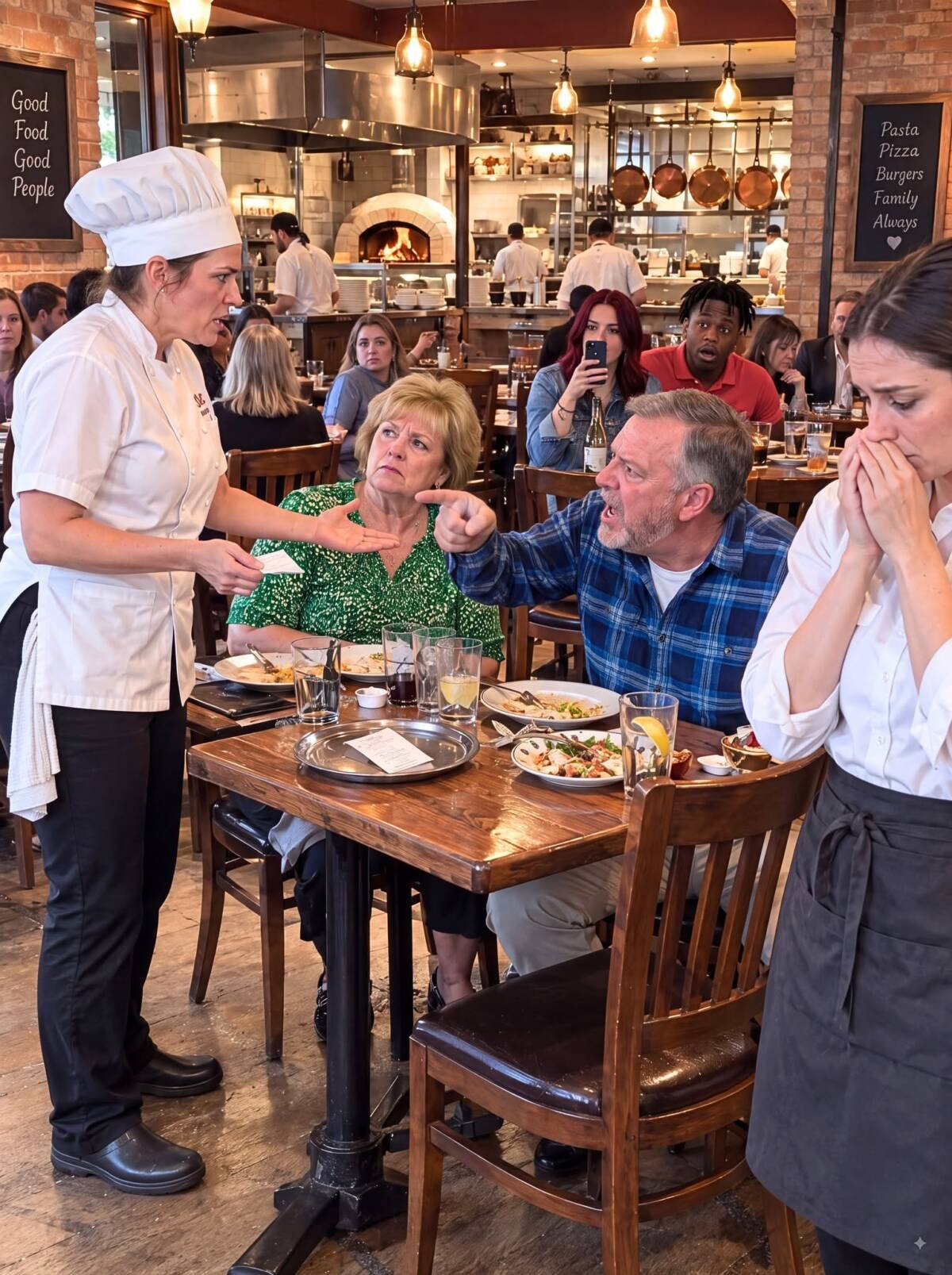
“Here’s to my idiot daughter.”
Several relatives immediately laughed.
I blinked.
Dad raised his glass higher.
“Always trying to buy love with money.”
The laughter grew.
Dean nearly choked on his drink.
My aunt covered her mouth, while my mother looked down at her plate as though she had suddenly discovered something fascinating about the dessert.
Thirty relatives were watching me.
I felt the familiar heat rise in my face, but this time, something inside me refused to move.
I had heard variations of that joke for years.
When I earned a scholarship as a teenager, Dad called me the family calculator.
When I bought my first condo, he joked that I should marry the building.
When I paid his medical bills after back surgery, he told relatives I was auditioning for sainthood.
Every achievement became an opportunity to mock me.
Every generous act became evidence that I was somehow trying to prove I was better than everyone else.
And now, after buying him the exact truck he had wanted for years, he had turned my gift into the punchline of his birthday celebration.
The room continued laughing.
I looked at Dad.
Then I looked at Dean.
Finally, I glanced at my mother.
Nobody stopped him.
Nobody defended me.
Nobody even appeared surprised.
That was the moment I understood something I had spent years refusing to accept.
This wasn’t an isolated joke.
It was a family tradition.
And I was the person everyone expected to tolerate it.
4. I Didn’t Argue. I Just Walked Out.
I slowly picked up my napkin.
I folded it carefully.
Then I placed it beside my plate and stood.
Dad was still holding his glass.
“What’s wrong?” he asked.
I smiled.
“Nothing, Dad. Happy birthday.”
Then I walked toward the front door.
Nobody said anything.
I could hear the laughter fading behind me, followed by the awkward silence that always came when someone refused to play the role they had been assigned.
I didn’t cry.
I didn’t shout.
I didn’t explain why his words hurt.
I didn’t give anyone another dramatic scene they could later rewrite into evidence that I was too sensitive.
I simply left.
The drive home was quiet.
I kept both hands on the steering wheel and watched the lights of Fort Worth pass through the windshield.
For years, I had believed that if I worked hard enough, achieved enough, or gave enough, my family might eventually treat me differently.
That night, I stopped believing it.
I also made a decision.
The truck was coming back.
5. The Empty Driveway
At 6:40 the following morning, I began making calls.
First, I contacted the auto broker.
Then I contacted the dealership’s legal delivery coordinator.
Finally, I called the transport company used for my employer’s fleet accounts.
The arrangement was straightforward.
The truck had been delivered under temporary dealer tags.
The title transfer had not been completed.
Dad had not signed the ownership paperwork.
And the vehicle remained insured under my holding policy.
Legally, the truck was still mine.
I had not stolen it.
I was simply retrieving an asset whose ownership had never been transferred.
By 7:30 a.m., the F-250 was gone from my parents’ driveway.
It was being transported back to the dealership.
At 8:12 a.m., I looked at my phone.
108 missed calls.
I stared at the number for several seconds.
Then I laughed.
Not because the situation was funny.
But because I had spent years trying to get my family to listen to me, and suddenly, everyone had something urgent to say.
The first voicemail was from my mother.
“Call me immediately. What have you done?”
The second was from Dean.
“You took Dad’s truck? Are you serious?”
The third was from Dad.
I didn’t listen to it.
I made coffee, sat at my kitchen island, and waited.
For the first time in years, I wasn’t rushing to repair something I hadn’t broken.
6. “You Took Dad’s Truck!”
Dean finally reached me at 8:21 a.m.
“You took Dad’s truck!”
“No,” I replied. “I took back mine.”
He immediately raised his voice.
“Are you actually insane?”
“Was Dad insane when he called me an idiot in front of thirty people?”
“It was a joke!”
I leaned back in my chair.
“Then he should still be laughing.”
Dean went silent.
Then he changed tactics.
“You embarrassed him.”
I almost smiled.
“Good. Maybe now he remembers what it feels like.”
Dean insisted that I had already given Dad the truck.
I explained that the title transfer had never been completed.
He called the distinction ridiculous.
That was almost amusing.
The dealership’s legal department had agreed with me completely.
My family had always treated my career as some vague office job involving spreadsheets and paperwork. They never understood that procurement meant managing contracts, ownership conditions, asset transfers, and agreements worth millions of dollars.
The same professional skills Dad had spent years dismissing were exactly why his driveway was empty before breakfast.
Dean finally asked what I intended to do.
“Cancel the purchase.”
“You can’t be serious.”
“I’ve never been more serious.”
He hung up.
7. My Mother Wanted to Know How Much It Would Cost
Mom called next.
“Bring the truck back.”
“No.”
“Your father is humiliated.”
I looked out the kitchen window.
“Now he cares?”
She accused me of punishing Dad over one stupid toast.
That sentence brought everything into focus.
The toast wasn’t the problem.
It was simply the latest example of a pattern everyone expected me to tolerate.
When I earned a scholarship, Dad mocked me.
When I bought my condo, Dad mocked me.
When I paid his medical bills, Dad mocked me.
When I bought him the truck, Dad mocked me.
And every time I objected, my mother offered the same explanation.
“You know how your father is.”
For years, that sentence had been used as a shield.
It meant Dad could say whatever he wanted, while everyone else was responsible for keeping the peace.
This time, I refused.
“I’m not responding to one toast, Mom. I’m responding to a lifetime of them.”
She became quiet.
Then her voice changed.
“What do you want?”
Finally, we were no longer discussing whether I was allowed to be hurt.
We were discussing consequences.
“I want Dad to understand that gifts are voluntary. And disrespect has a cost.”
Mom paused.
Then she asked the question that proved she still didn’t understand.
“How much will it take to fix this?”
I almost laughed.
They still thought the problem was money.
8. My Father Came to Get His Truck Back
Dad arrived at my townhouse shortly after noon.
He drove the old SUV he had planned to replace with the F-250.
I saw him pull into the driveway from my office window.
He wore pressed jeans, polished boots, and a starched button-down shirt.
It was the outfit he always chose when he wanted people to take him seriously.
I opened the door.
But I remained in the doorway.
For several seconds, he simply looked at me.
“You made your point.”
“No,” I replied. “You made yours last night.”
His jaw tightened.
“I was drinking.”
“There is always a reason when it’s you.”
He glanced past me toward the living room.
Then he returned his attention to me.
“You really had it taken away.”
“It was still mine.”
“Over a joke?”
I crossed my arms.
“Call it a joke again, and we’re done.”
That stopped him.
For perhaps the first time in my adult life, Dad seemed to realize that I wasn’t standing there waiting to be corrected.
I was thirty-six years old.
I was financially independent.
I owned my home.
And the intimidation that had worked when I was younger no longer had anywhere to land.
He looked away first.
“Your uncle drove past this morning,” he said. “The neighbors saw the truck being loaded. Cheryl is already telling everyone, and your mother is beside herself.”
There it was.
Not regret.
Embarrassment.
“You raised a glass and humiliated me in front of the family,” I said. “Now you get to know what public embarrassment feels like.”
“You always think everything is an attack.”
“No. I finally stopped pretending it isn’t.”
His expression changed.
I could almost see the memories lining themselves up behind his eyes.
The scholarship jokes.
The comments about my career.
The ridicule when I bought my condo.
The times he had transformed something I was proud of into another opportunity to make me smaller.
Dad had spent years calling me oversensitive because that was easier than admitting he enjoyed making me the punchline.
The birthday toast had simply made the pattern too public for me to keep ignoring.
9. “What Do You Want From Me?”
Dad finally asked the question.
“What do you want from me?”
I had expected it.
But when it arrived, I realized I didn’t want the answer I might have given years earlier.
I didn’t need a forced apology.
I didn’t need another family dinner where he publicly corrected himself.
I didn’t need a performance of gratitude designed only to get the truck back.
“Nothing.”
He frowned.
“That’s not true.”
“It is. I don’t want gratitude because you’re embarrassed. I don’t want an apology because the neighbors saw the transport truck. And I’m not spending another decade buying expensive things for people who treat me cheaply.”
His face hardened.
“So that’s it?”
“The truck is going back to the dealer. I’m canceling the purchase.”
Then I gave him one option I knew he would hate.
“If Dean thinks you deserve one that badly, he can buy it for you.”
Dad went quiet.
We both knew Dean couldn’t afford anything close to it.
After a long pause, he finally said something more honest than anything else that day.
“You’re punishing me.”
I shook my head.
“No, Dad. I’m ending the discount.”
For the first time, he seemed to understand.
10. The Family Started Rewriting the Story
By that evening, the family version of events had already begun circulating.
According to relatives, I had overreacted to a harmless joke.
I had ruined Dad’s birthday.
I had created a public spectacle.
I had taken back a gift because I couldn’t handle being teased.
Nobody seemed particularly interested in the public spectacle Dad had created first.
I stopped correcting them.
People who benefit from humiliation often become very concerned with tone and proportion once the person being humiliated refuses to participate.
They wanted me to debate whether Dad’s comment had been bad enough to justify my reaction.
I no longer cared about winning that argument.
The purchase was canceled.
The truck returned to the dealer.
The money went back into my account.
And nothing anyone said could change those facts.
Mom called twice more over the next few days.
The first time, she suggested I reconsider once everyone had calmed down.
The second time, she reminded me how much Dad had loved the truck.
“He keeps talking about it.”
“I’m sure he does.”
“He really did like it.”
“That makes what he said even stranger.”
She sighed.
“You know how your father is.”
I paused.
“Yes, Mom. I know exactly how he is. That’s why I’m changing how I respond.”
After that, the calls slowed.
11. The Six-Word Message
A week after the birthday dinner, Dad finally texted me.
It was only six words.
“Shouldn’t have said that at dinner.”
I stared at the message longer than I expected.
It wasn’t a full apology.
There was no acknowledgment of the years that had preceded that toast.
But from a man who had spent most of his life turning cruelty into humor before accusing everyone else of being too sensitive, those six words were probably the closest thing to an admission I was ever going to receive.
I didn’t answer immediately.
For once, I didn’t feel obligated to reward the smallest amount of accountability with immediate forgiveness.
I simply put my phone down and went back to work.
12. The Real Cost of the Truck
The family drama eventually faded.
Dean stopped calling once he realized I wasn’t going to change my mind.
Mom returned to ordinary conversations without mentioning the truck every five minutes.
Dad and I remained more distant.
At family gatherings, he became noticeably more careful about making me the center of his jokes.
I couldn’t tell whether he had developed genuine respect for my boundaries or simply learned that humiliating me could now cost him something tangible.
But I had stopped needing to know the difference.
What mattered was that the pattern had changed.
For years, I had believed that being generous meant giving without keeping score.
I had paid bills.
Bought thoughtful gifts.
Helped relatives when emergencies appeared.
And rarely asked for acknowledgment because I genuinely liked being able to help.
The problem wasn’t generosity.
The problem was offering generosity to people who treated it as an obligation while treating me as entertainment.
Dad’s birthday forced me to see how deeply I had participated in that arrangement.
Some part of me had still been hoping that if I became successful enough, useful enough, or generous enough, my family would finally stop reducing everything I accomplished to a joke.
The truck was supposed to be proof.
Instead, it became proof of something else.
I didn’t need to purchase a different version of my father.
13. I Finally Stopped Buying Their Approval
The black F-250 went back to the dealership.
The money returned to my account.
I used part of it later for something I had postponed for years.
I upgraded my home office.
I took a vacation without inviting anyone who might turn the expense into commentary about my personality.
Nobody received another extravagant gift from me simply because I felt obligated to prove I cared.
That didn’t mean I became cold.
I still gave birthday presents.
I still paid for dinners.
I still helped people I loved when they needed me.
The difference was that generosity became something I chose freely instead of something I used to negotiate for basic respect.
Months later, I passed a black King Ranch F-250 on the highway.
For a second, I remembered Dad standing in the driveway on his birthday, running his hand across the paint as though he could already imagine himself behind the wheel.
Then I remembered the toast.
The laughter.
And the empty driveway the following morning.
I smiled.
Not because I had taken something away from him.
But because I had finally stopped giving parts of myself away just to keep everyone else comfortable.
Conclusion: The Gift Was Never the Problem
My father had called me an idiot for supposedly trying to buy love with money.
In a strange way, he had accidentally taught me the lesson I should have learned years earlier.
Love that has to be purchased is not love.
And respect that disappears the moment you establish a boundary was never respect.
A gift given freely can also be withdrawn before it becomes another weapon in someone else’s hands.
I never bought Dad another truck.
I never tried to buy his approval again either.
And every time I remembered that empty driveway, I felt the same quiet satisfaction.
For once, I had kept what was mine.
Not just the truck.
My dignity.
My peace.
And the freedom to stop proving that I deserved to be loved.
Sometimes the most expensive lesson in a family isn’t the price of a gift. It’s the moment you realize your generosity has been mistaken for permission to disrespect you.
What Would You Have Done?
Would you have taken the truck back after being publicly humiliated, or would you have let your father keep it and walked away from the relationship?
Share your thoughts in the comments. Sometimes the hardest boundary to establish is the one your family has spent years convincing you that you don’t deserve to have.om reliable sources.