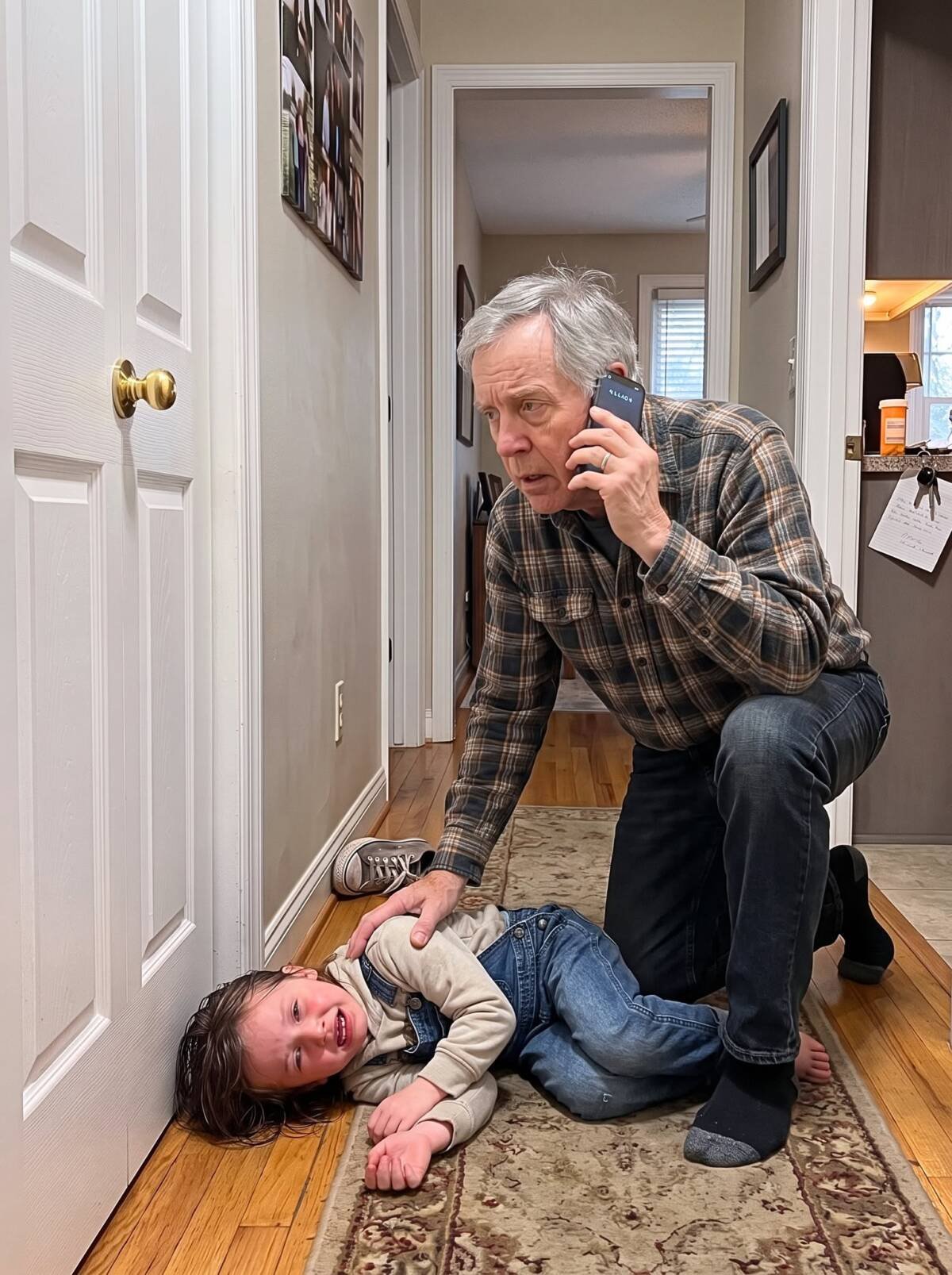
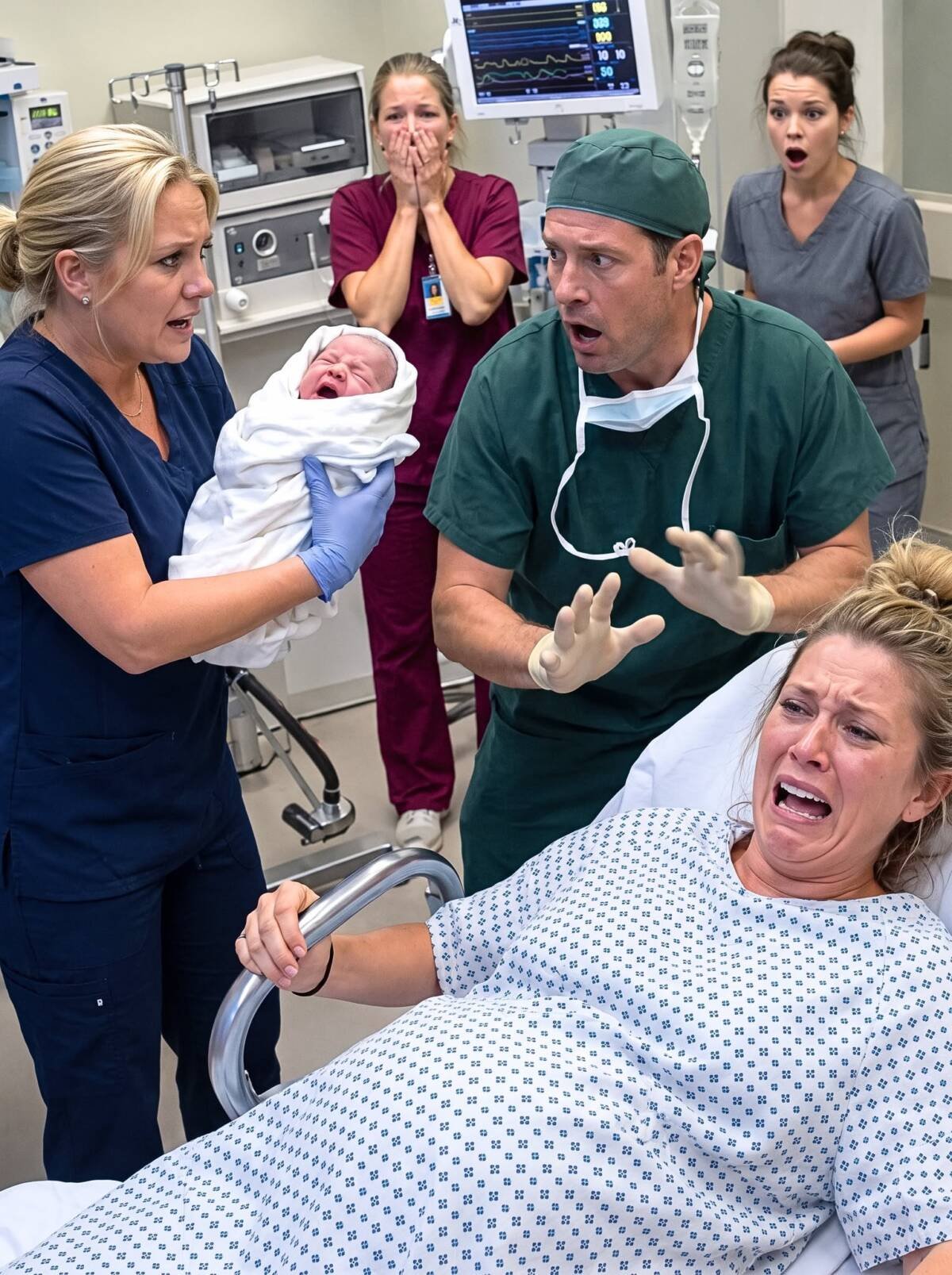
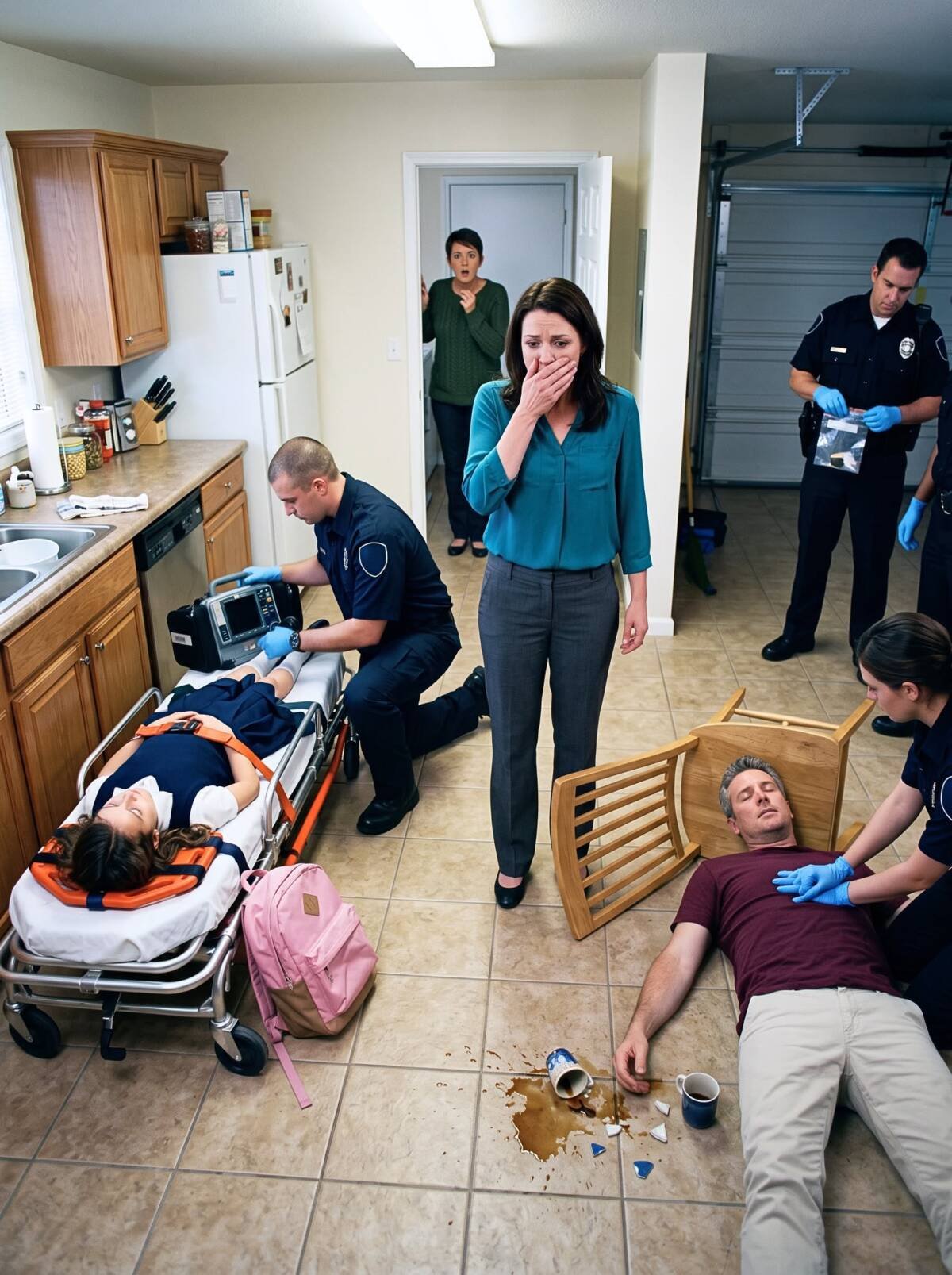
When a pediatrician pulls a mother into a quiet hospital hallway and says her ten-year-old daughter’s pregnancy test has come back positive, the world stops making sense.
Within hours, a family built on five years of trust was fractured. Her biological father rushed into the emergency room, pointed straight at her stepfather, and demanded that he be arrested on the spot. Suspicion filled every corner of the room, and a devoted husband suddenly found himself treated like a suspect in a nightmare he could never have imagined.
Nobody questioned the test. Nobody thought to look beyond the most terrifying explanation. Until an ultrasound came back empty—and a neurologist ordered an urgent brain scan that uncovered a hidden medical crisis no one saw coming.
The Symptoms That Looked Like Nothing
My name is Rachel, and for most of my life as a mother, I believed the worst phone call I could ever receive would come from a police officer or an emergency room nurse. Instead, the call that shattered our lives came from my daughter Sophie’s pediatrician on an ordinary Tuesday afternoon.
For nearly a month, Sophie had not been herself. She was ten years old—usually energetic, loud, and endlessly curious—but lately, she had been waking up exhausted. She complained of dull, persistent headaches that lingered behind her eyes. Several mornings a week, she hurried to the bathroom before breakfast, overcome by sudden waves of nausea and vomiting.
At first, I did what most parents do: I looked for the simplest explanation. A lingering stomach bug. Dehydration from soccer practice. The stress of fifth-grade math tests. I gave her extra fluids, adjusted her bedtime, and kept an eye on her temperature. When the symptoms refused to fade and she began complaining of dizziness during school, I finally scheduled an appointment with her pediatrician.
I walked into the clinic expecting a routine checkup and a lecture about rest and hydration. The doctor listened carefully, asked a series of questions, and ordered standard blood and urine panels to rule out an infection or anemia. We waited in the exam room while Sophie swung her legs against the paper-covered table, complaining that she was missing art class.
When the doctor returned, the warmth had drained from her face. She closed the door softly behind her and looked directly at me.
“Rachel,” she said, her voice steady but unusually serious, “I need to discuss one of Sophie’s test results with you privately.”
My stomach dropped. I stepped into the hallway, my mind racing through every childhood illness I had ever heard of. “Is it an infection?” I asked immediately. “Something in her blood?”
The pediatrician hesitated for a fraction of a second. “Sophie’s blood and urine both show an elevated level of hCG,” she said gently. “Because of that hormone, her pregnancy test came back positive.”
I stared at her, completely unable to process the words. “She’s ten years old.”
“I understand, Rachel,” the doctor replied. “And I want to be very clear: a positive result alone does not tell us what happened. We need to transfer her to the hospital for further evaluation immediately so we can determine why her body is producing this hormone.”
Her tone was calm and clinical, designed to keep me grounded, but the floor beneath my feet felt like it had vanished. I gripped the edge of the hallway counter, desperately searching for any rational explanation—a mixed-up sample, a faulty lab machine, anything that would make what I had just heard impossible.
When Fear Enters a Home
Driving to the hospital, my hands shook so violently on the steering wheel that I could barely stay in my lane. In the backseat, Sophie leaned her head against the window, pale and quiet, unaware that the adults around her were about to enter a tailspin.
My mind immediately went to Daniel.
Daniel had been Sophie’s stepfather for almost five years. He was the man who sat at the kitchen table with her every evening working through fractions, who stood on the sidelines of freezing Saturday morning soccer games holding a thermos of hot chocolate, and who made lopsided pancakes every weekend just to hear her critique them. He had never once given me a single reason to doubt his character or to believe my daughter was anything less than completely safe with him.
Yet as soon as I called Sophie’s biological father, Eric, to tell him what the pediatrician had found, the accusation took shape before I could even finish my sentence.
“Rachel, listen to me,” Eric said, his voice tight with panic and fury. “You need to get Sophie away from him right now. Do not let Daniel near her until we know what happened.”
Hearing him immediately point the finger at my husband made me physically sick. Every instinct in me wanted to defend Daniel, to tell Eric he was out of his mind. But another, louder instinct took over—the primal, unyielding duty of a mother. I did not know what the test meant. And until doctors and specialists gave me answers, Sophie’s safety had to come before my marriage, before Daniel’s feelings, and before my own certainty.
When Daniel arrived at the hospital, I met him outside the entrance before he could walk into Sophie’s room. I told him about the test result, and I told him that until the medical team figured out what was going on, Sophie needed to stay strictly with me.
The color drained from his face. He looked at me as though I had struck him.
“You think I could do something to Sophie?” he asked, his voice barely above a whisper.
“I don’t know what this test means yet, Daniel,” I said, fighting back tears. “I’m not accusing you. I just—until we understand what’s happening, I have to put her first.”
He stared at me for a long, agonizing moment. He didn’t raise his voice. He didn’t get defensive. Instead, his shoulders dropped under the weight of a wound I didn’t yet realize I had inflicted.
“You should put her first,” he said quietly. “I just wish you knew me well enough to know I would never hurt her.”
Minutes later, Eric burst through the automatic doors of the emergency department. His face was flushed, his eyes scanning the waiting area until they locked onto Daniel. Without a word of greeting, Eric marched forward, pointed directly at my husband, and shouted toward the security desk and nurses’ station.
“Arrest him! Get him away from my daughter!”
Hospital staff intervened immediately, stepping between the two men as I pleaded with Eric to lower his voice. I refused to let Sophie’s hospital room become a battleground built on panic and assumptions. Security guided Eric toward the family waiting area while Daniel silently retreated to the far end of the corridor, respecting the distance I had asked him to keep even as every eye in the hallway turned toward him with quiet suspicion.
The Ultrasound That Changed the Question
Inside the examination room, the medical team moved with practiced urgency. Doctors drew more blood to verify the hormone levels and scheduled an abdominal ultrasound. At the same time, a pediatric specialist trained in child advocacy asked to speak with Sophie privately.
Waiting outside that closed door was the longest hour of my life. When the specialist emerged, she told us that Sophie had consistently and calmly denied that anyone had ever touched her or behaved inappropriately toward her. In fact, she seemed genuinely confused by the line of questioning.
Eric wasn’t convinced. “She’s ten,” he argued, pacing the small consultation room. “Kids get scared. They protect people they know.”
I didn’t have the strength to argue with him. I just waited for the ultrasound.
Two hours later, the attending physician called Eric, Daniel, and me into a private conference room. Daniel stood near the door, keeping his distance, while Eric leaned forward in his chair, braced for the worst.
“The ultrasound is complete,” the doctor said, looking at each of us in turn. “There is no pregnancy.”
For a heartbeat, nobody breathed.
Eric was the first to speak. “Are you sure? Could it be too early to see? Then why was the test positive?”
“The repeat bloodwork confirmed that Sophie’s hCG levels are genuinely elevated,” the doctor explained. “This was not a laboratory error. However, there is no gestational sac, no sign of pregnancy whatsoever. That means something else inside Sophie’s body is producing this hormone.”
For the first time since the pediatrician’s phone call, I turned and looked at Daniel. A cold wave of realization washed over me. Fear had driven us straight down a single, devastating path—and we might have been completely wrong.
While Eric continued to question how an ultrasound could be certain, the medical team had already shifted its focus. If Sophie wasn’t pregnant, her symptoms—the headaches, the morning vomiting, the exhaustion—were no longer being viewed through the lens of a pregnancy test. They were clues to something else entirely.
A pediatric specialist returned to Sophie’s bedside for a more thorough neurological exam. As she asked Sophie to follow her finger with her eyes, she noticed something subtle that I had never caught at home. Sophie struggled to look upward. When pressed gently, Sophie admitted something she had been too afraid or too tired to mention before.
“Sometimes I see two of things,” she murmured. “And I haven’t been able to read the whiteboard at school for a couple of weeks.”
The doctor’s expression shifted instantly. Within twenty minutes, a pediatric neurologist was in the room. After conducting his own exam, he turned to me and spoke with quiet urgency.
“We need to get Sophie into an MRI as soon as possible,” he said.
“A brain scan?” I asked, my voice trembling. “Why would she need a brain scan if the problem is a pregnancy hormone?”
“Because pregnancy is not the only reason the human body can produce hCG,” the neurologist replied. “Combined with her headaches, morning vomiting, and changes in her vision, we need to look at her brain immediately.”
Eric’s anger vanished in an instant, replaced by a pale, hollow dread. “What are you looking for?”
The neurologist refused to speculate before seeing the images, explaining only that certain rare medical conditions could trigger hCG production while placing pressure inside the skull.
When the nurse arrived to wheel Sophie toward radiology, my daughter reached out and gripped my hand tightly. She looked up at me with wide, frightened eyes.
“Mom,” she whispered, “am I in trouble?”
The question nearly broke me. I leaned down and kissed her forehead, fighting to keep my voice steady. “No, sweetheart. You are not in trouble. None of this is your fault.”
As the doors to the imaging suite closed behind her, I looked back at the waiting room. Daniel was sitting alone in the far corner, his elbows on his knees, staring at the floor. He hadn’t left. Even after being accused, isolated, and humiliated, he had stayed right where he was needed.
The Truth Hidden Deep Inside
Forty minutes later, the neurologist returned alongside a pediatric radiologist. They led Eric, Daniel, and me into a dimly lit viewing room where a series of black-and-white images glowed on a large monitor.
The neurologist pointed to a distinct, pale shape sitting deep near the center of Sophie’s brain.
“We found a mass,” he said gently. “We will need additional testing and a biopsy to confirm the exact classification, but its location explains everything—the pressure causing her morning vomiting and headaches, the effect on her upward gaze and double vision, and the elevated hCG.”
I stared at the screen, struggling to connect the dots. “A brain tumor can cause a positive pregnancy test?”
“Certain rare intracranial germ cell tumors secrete hCG,” the neurologist explained. “The original test detected something very real. It simply pointed everyone toward the most common explanation instead of the rarest one.”
“So she was never pregnant,” I whispered.
“No,” the doctor confirmed. “Never.”
Shame hit me harder than anything I had ever felt. Only hours earlier, I had looked at the man who had loved and raised my daughter for five years and asked him to step back because I wasn’t sure I could trust him.
Eric was stunned into silence, his suspicion instantly eclipsed by a father’s worst terror. Questions poured out of him—was it malignant, could surgeons remove it, had we waited too long? The doctors assured us that pediatric oncology and neurosurgery were already being brought onto the case, and that we would take this one step at a time.
When we stepped back into the hallway, Daniel hadn’t said a word. He hadn’t demanded an apology. He hadn’t said I told you so. He simply looked at me, his eyes red-rimmed, and asked the only question that mattered to him.
“Is Sophie going to be okay?”
“I don’t know,” I choked out.
“Then we deal with that first,” he said softly.
When I returned to Sophie’s room, I sat beside her and explained, in the simplest and gentlest way I could, that doctors had found something inside her head that didn’t belong there—something that explained why she had been feeling so sick.
She listened quietly, absorbing the news with a maturity no ten-year-old should ever have to summon. “Then why did everyone keep asking me weird questions earlier?” she asked.
I swallowed the lump in my throat. Children notice far more than adults realize. She had felt the tension, seen the frightened faces, and sensed the distance between the people who loved her.
“The first test confused everyone because it usually means something completely different,” I told her honestly. “The doctors had to make sure you were safe while they figured out what was really going on.”
Sophie thought about that for a moment. Then she looked toward the doorway. “Does Daniel know? Can he come in?”
Eric shifted uncomfortably, but the truth had already rewritten the room. Daniel stepped inside cautiously, stopping just past the threshold until Sophie spotted him.
“Why are you standing all the way over there?” she asked, frowning.
“I just wanted to make sure you were comfortable,” Daniel said softly.
“You’re being weird too,” she muttered.
For the first time all day, a genuine smile broke across Daniel’s face. He walked over, pulled a chair beside her bed, and listened as Sophie immediately launched into a detailed complaint about hospital Jell-O and demanded to know when she could have a strawberry milkshake.
Later that evening, I saw Eric ask Daniel to step into the hallway. I stayed close, braced for tension, but the hostility was gone.
“I owe you an apology,” Eric said, his voice rough. “I heard that test result and assumed the worst. I pointed at you in front of everyone.”
Daniel was quiet for a few seconds. “If Sophie were my biological daughter and I heard the same thing, maybe I would have panicked too.”
“That doesn’t make what I did fair.”
“No,” Daniel agreed quietly. “It doesn’t.”
They didn’t walk away as best friends, and Daniel didn’t pretend the accusation hadn’t left a scar. But for the first time since the nightmare began, every adult in Sophie’s life was finally facing the same enemy.
Watching the Number Fall
The next morning, the pediatric oncology team confirmed the diagnosis: Sophie had an hCG-secreting intracranial germ cell tumor. As terrifying as the words sounded, the oncologist offered a perspective that stopped me in my tracks.
“That positive pregnancy test may have actually saved us critical time,” she explained. “On their own, Sophie’s symptoms are easy to misdiagnose. Headaches get blamed on stress, nausea gets treated as a virus, and fatigue gets dismissed as school burnout. Because that hCG level forced everyone to keep digging, we found this much sooner than we otherwise might have.”
She explained something else, too. Moving forward, that exact same hCG level—the number that had detonated inside our family—would become one of the most important tools in Sophie’s care. If her treatment worked, the number would drop.
Treatment began soon after. Our world shrank to hospital corridors, infusion rooms, medication schedules, and quiet nights spent listening to the hum of monitors.
Through all of it, Daniel never wavered. He brought Sophie’s favorite blanket, her drawing pads, and the worn stuffed fox she had slept with since preschool. He memorized her medication dosages, sat beside her through the hardest days of nausea, and somehow always found a way to coax a laugh out of her when nobody else could. Eric was there, too, showing up consistently and setting aside old rivalries so Sophie only ever felt surrounded by love.
Weeks passed. Blood draws became a quiet ritual, and every time the results came back, I found myself staring at the hCG number I had once wished had never existed.
Slowly, it began to fall.
Then came the follow-up MRI. Daniel sat beside me in the consultation room while Eric paced near the window. When the oncologist walked in holding Sophie’s latest scans, the room went completely still.
“The tumor is responding,” she said, smiling.
She pulled up the side-by-side images. The mass had visibly shrunk, and Sophie’s hCG levels had plummeted.
“It’s working?” I whispered, covering my mouth.
“Yes,” the doctor confirmed. “We still have road ahead of us, but this is exactly the response we hoped to see.”
Daniel dropped his head into his hands and cried quietly. Eric turned toward the window, wiping his eyes. And I sat there, overwhelmed by gratitude and by the staggering realization of how close we had come to losing everything—both our daughter’s health and our family’s foundation.
Rebuilding What Fear Almost Destroyed
Months later, after completing her primary rounds of treatment, Sophie was finally strong enough to spend more time at home. She had lost weight, her hair was different, and she tired easily, but her sharp sense of humor had survived completely untouched.
One Saturday morning, I walked into the kitchen to find Daniel flipping pancakes while Sophie sat at the counter sketching. He slid a comically oversized pancake onto her plate.
“That thing is bigger than my head,” Sophie deadpanned.
“You need calories,” Daniel replied.
“I need a normal pancake.”
“You’re getting premium stepdad service.”
Sophie took a single bite, chewed thoughtfully, and looked up at him. “Two stars.”
Daniel looked genuinely offended. “Out of five?”
“Out of ten.”
Hearing laughter bounce off the kitchen walls again felt like a miracle.
Healing our marriage, however, took longer than a single good morning. Trust isn’t a light switch you can flip back on once fear shuts it off. One night, after Sophie was asleep, I sat across from Daniel and gave him the apology he truly deserved—not the rushed, guilt-ridden one from the hospital hallway, but an honest reckoning.
“I need you to know that I understand what happened to you that day,” I told him. “Everyone looked at one test result, and suddenly you had to prove you weren’t a monster.”
Daniel looked down at his hands. “I understand why you protected Sophie.”
“I could have protected her without assuming you were guilty,” I said, my voice breaking.
“Yes,” he answered softly.
It hurt to hear him agree, because it was the truth. Then he reached across the table and took my hand.
“I’m still here.”
We talked, we argued, we went to counseling, and we slowly rebuilt what those terrifying forty-eight hours had damaged. Eric apologized to Daniel again, too—and more importantly, he backed it up with his actions. Over time, the two men built a quiet, steady respect anchored in the one truth neither of them ever doubted: Sophie came first.
The Clue That Saved Her Life
Nearly a year after that first phone call from the pediatrician, I sat beside Sophie in the oncology clinic waiting for her latest lab results. When the doctor walked in, she was smiling before she even sat down.
Sophie caught it immediately. “That’s a good smile, right?”
“It’s a very good smile,” the doctor said.
Sophie’s hCG levels had returned completely to the normal range.
I burst into tears before the doctor could even finish reading the chart. Sophie groaned dramatically and handed me a tissue box.
“Mom, you cry at literally everything now.”
“I’m allowed,” I sniffled.
“Is that a medical rule?” she asked, turning to the doctor. “Is she lying?”
The doctor laughed. “Probably.”
We know there will still be follow-up scans, routine bloodwork, and the quiet anxiety that lingers long after any serious illness. None of us pretend the past year didn’t happen. But Sophie is thriving, and for the first time in a long time, our future feels much bigger than the next hospital appointment.
Every now and then, my mind drifts back to that Tuesday afternoon—to the shock of the positive test, the shouting in the emergency room, and the devastation in my husband’s eyes. That single result nearly tore my marriage apart because we all jumped to the most terrifying conclusion imaginable.
Yet without it, Sophie’s tumor might have stayed hidden for months longer.
The test I once wished had never existed turned out to be the warning that saved my daughter’s life. Sometimes, the most frightening answer in front of us isn’t the truth at all—it’s simply the clue that forces us to keep looking until we find it.
Have you or someone you love ever faced a medical mystery where the first answer wasn’t the real story? Share your thoughts in the comments below—and if Sophie’s story moved you, pass it along to remind another parent never to ignore the signs.