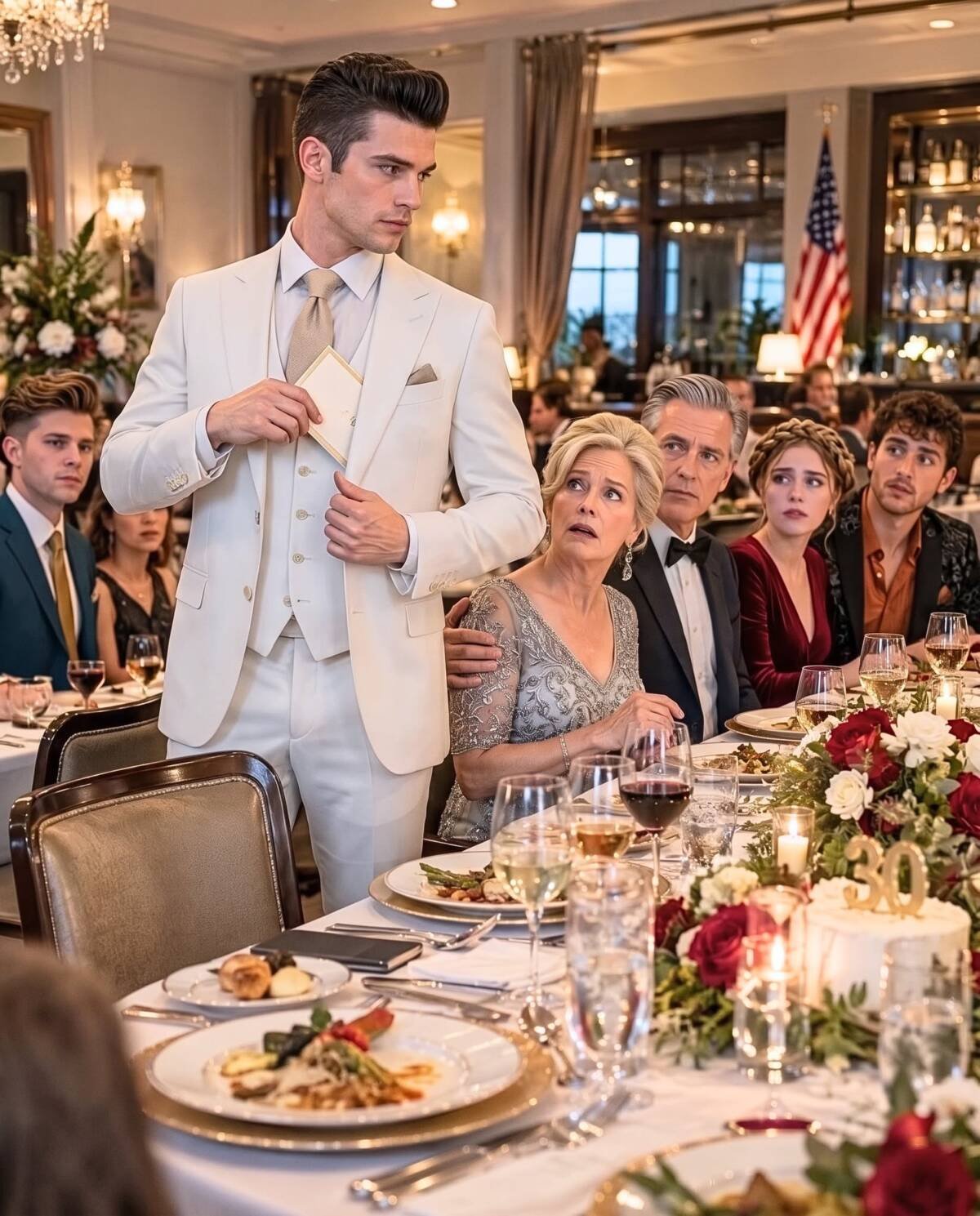
She Was Ordered to Drink the Juice in Front of Him — Ten Minutes Later, Her Sister-in-Law Collapsed
A disturbing family secret begins to unravel after a young woman notices white powder around the rim of a glass of orange juice and quietly decides not to drink it
Editor’s Note: This is a fictional dramatic story presented in a journalistic storytelling style. The names, events, and locations are part of the story and are not presented as a report of a verified real-world incident.
Hannah Anderson knew something was wrong the moment her father-in-law told her to drink the orange juice.
It was nearly 11 p.m. during a violent thunderstorm, and Hannah was standing inside her bedroom when Walter Anderson appeared at the door carrying a glass.
At first, his request sounded almost ordinary.
Then Hannah noticed something unusual.
There were faint traces of white powder around the rim of the glass.
Walter insisted that she drink it immediately — and, more importantly, that she drink it in front of him.
That demand changed everything.
Hannah did not know what was inside the glass. She did not know what Walter intended to do after she drank it. But she knew that something about the situation was deeply wrong.
Instead of confronting him, she pretended to cooperate.
Then an unexpected interruption gave her a chance to act.
Her sister-in-law, Kimberly, stumbled into the room after returning home intoxicated. Hannah quietly handed her the glass.
Kimberly drank it.
Within minutes, she was unconscious.
What happened next would expose a secret that Hannah believed had been hidden inside the Anderson family for years — and reveal that the greatest danger was not simply what Walter had allegedly planned that night, but how many people had learned to remain silent whenever his behavior threatened the family’s carefully protected reputation.
A Family That Looked Perfect From the Outside
For two years, Hannah had been married to Nathan Anderson.
To outsiders, the Anderson family appeared almost flawless.
Walter was a respected retired superintendent who frequently spoke about discipline, morality, responsibility, and family values. Joyce, his wife, carefully maintained the image of an elegant woman devoted to her family and community.
Nathan worked in logistics management and generally avoided conflict.
Kimberly, Nathan’s sister, had grown accustomed to receiving whatever she wanted from her parents and often treated Hannah as though she were an unwanted addition to the household rather than a member of the family.
But Hannah had gradually discovered that the Anderson family’s public image did not match what happened behind closed doors.
Her discomfort centered primarily on Walter.
His behavior toward her had repeatedly crossed boundaries.
Sometimes it was an inappropriate comment disguised as humor. Other times, it was a touch that lasted longer than it should have. On other occasions, Walter seemed to make a point of finding Hannah alone in the house so he could initiate uncomfortable conversations.
Hannah initially tried to convince herself that perhaps she was interpreting his behavior incorrectly.
Eventually, however, she spoke to Nathan.
She expected her husband to take her concerns seriously.
Instead, Nathan dismissed them.
His explanation was simple: Walter was old-fashioned and socially awkward.
Hannah tried again.
She approached Joyce and carefully explained that some of Walter’s behavior made her uncomfortable.
Joyce’s response was even more troubling.
Rather than asking Hannah what had happened, Joyce suggested that Hannah should be more careful about how she dressed so there would be no misunderstandings.
For Hannah, that conversation became a turning point.
She realized that the family’s priority was not necessarily protecting her.
It was protecting the family’s reputation.
After that, she stopped expecting anyone in the Anderson household to intervene on her behalf.
Instead, she began paying closer attention.
She documented incidents.
She saved messages.
She kept notes about dates and conversations.
She did not yet know exactly what she was building.
She simply knew that if the day ever came when she needed to defend herself, she did not want the entire case to depend on whether someone was willing to believe her.
The Glass of Orange Juice
The night everything changed, Nathan was away in St. Louis attending a business conference.
Joyce was also away, visiting friends in another town.
That left only Hannah, Walter, and Kimberly inside the house.
Outside, rain hammered against the windows.
The house was unusually quiet.
Then Walter appeared at Hannah’s bedroom door.
He was holding a glass of orange juice.
Hannah immediately noticed the smell of alcohol on his breath.
Walter smiled and encouraged her to drink.
He claimed the juice would help her relax and sleep despite the storm.
But Hannah was distracted by something else.
White powder appeared to cling faintly to the edge of the glass.
She could not identify it.
She did not know whether it was harmless, whether it was a medication, or whether it was something much more dangerous.
What she did know was that the powder did not look normal.
Her instincts told her not to drink.
But refusing Walter directly could escalate the situation.
He was standing near the doorway, partially blocking it.
So Hannah forced herself to remain calm.
She smiled.
She told him she would drink the juice later.
Walter’s expression changed immediately.
The friendly appearance disappeared.
“No. Drink it now. Right in front of me.”
Hannah’s heart began pounding.
She lifted the glass toward her mouth and pretended to obey.
Then the front door slammed downstairs.
Kimberly’s voice echoed through the house.
She had returned home.
Walter suddenly appeared nervous.
He stepped away from Hannah’s doorway and adjusted his shirt.
“I’ll check on you later,” he said.
Then he disappeared down the hallway.
Hannah waited until she was certain he was gone.
She did not drink the juice.
She placed the glass down and remained alert.
A few minutes later, Kimberly entered the bedroom.
She was visibly intoxicated and complaining about her evening. She dropped her purse onto the couch and demanded water.
Hannah looked at the glass.
Then she looked at Kimberly.
The decision was made almost immediately.
She handed Kimberly the orange juice.
Kimberly drank it.
She complained briefly about the taste.
Then she stretched across Hannah’s bed.
Within approximately ten minutes, Kimberly was deeply unconscious.
Hannah’s fear intensified.
She did not know exactly what had been put into the drink.
But now she knew that whatever had been in the glass had affected Kimberly dramatically.
Hannah did not confront Walter.
Instead, she took her phone and laptop and quietly moved into a linen closet farther down the hallway.
From a narrow opening, she could see the partially open door to her bedroom.
Then she waited.
Walter Returned
Approximately twenty minutes later, Hannah heard footsteps.
They were slow.
Deliberate.
Someone was approaching her bedroom.
Walter appeared in the hallway.
He looked different from the man who had brought the juice.
There was no confusion in his movements.
He appeared to believe that the unconscious woman beneath the blankets was Hannah.
He opened the door and entered.
Hannah remained hidden.
She raised her phone.
Then she began recording.
She did not know exactly what would happen.
She only knew that she wanted evidence.
The story later claimed that Walter’s actions inside the bedroom became the beginning of a much larger confrontation.
The recording, however, would become even more important than Hannah initially realized.
Because the following morning, the Anderson family would attempt to construct an entirely different version of events.
The Morning After
The screaming began around 6:30 the following morning.
Kimberly had awakened frightened and confused.
She was sitting on Hannah’s bed, wrapped in a sheet, struggling to understand how she had ended up there.
She could not remember entering the bedroom.
She could not remember falling asleep.
And she could not explain why Walter had been inside the room.
Walter immediately attempted to provide an explanation.
He claimed that alcohol and confusion had caused him to enter the wrong bedroom.
He insisted that everything had been a misunderstanding.
But his explanation quickly became more difficult to believe.
Hannah told Kimberly about the orange juice.
She explained that Walter had brought it to her the previous night.
She explained that she had noticed white powder around the rim.
And then she told Kimberly the most important detail.
Kimberly had been the person who drank it.
Kimberly stared at her.
“What are you saying?”
“You drank that juice.”
The realization was immediate.
Kimberly’s confusion turned into horror.
Then anger.
She confronted Walter.
She demanded to know what had been inside the drink and what he had intended to do after Hannah became unconscious.
Walter denied wrongdoing.
But his reaction created another disturbing moment.
Rather than focusing on Kimberly’s condition, he repeatedly worried about whether the neighbors might hear them.
Then he said something that changed the atmosphere completely.
“Your mother cannot find out about this.”
Kimberly stared at him.
For her, the meaning was unmistakable.
Walter appeared to be more afraid of exposure than concerned about what had happened.
Joyce Returns Home
The front door suddenly opened.
Joyce had returned earlier than expected.
She immediately sensed that something was wrong.
Voices were coming from upstairs.
The family began moving quickly to control the situation.
Kimberly locked herself in the bathroom and cried.
Walter tried to present himself as calm.
Hannah, however, decided not to participate in another cover story.
She told Joyce that something had happened during the night.
Joyce went upstairs.
Instead of demanding a complete explanation, she listened as Walter offered a vague story involving Kimberly and a missing piece of jewelry.
The explanation made little sense.
Joyce appeared to know that something was wrong.
But she did not immediately demand the truth.
Her silence became significant.
Hannah had seen that silence before.
It was the same silence she had encountered whenever she had complained about Walter.
The same silence that had allowed uncomfortable behavior to be dismissed.
The same silence that protected the family from embarrassment.
The Family Tribunal
By afternoon, Nathan had been contacted and was returning from St. Louis.
When he arrived, Hannah expected him to finally ask questions.
Instead, she found herself facing a united family.
That evening, everyone gathered in the living room.
Joyce spoke first.
She accused Hannah of deliberately drugging Kimberly and creating a situation designed to destroy the family.
Hannah looked at Nathan.
She expected hesitation.
There was none.
Nathan supported his parents.
He said Walter had already explained what happened.
Hannah asked him what exactly Walter had explained.
Nathan answered that Walter claimed Hannah had set him up.
The accusation was almost surreal.
Hannah had been the person who refused to drink the suspicious juice.
Kimberly had consumed it.
Yet the family had somehow constructed a version in which Hannah was responsible.
Joyce then delivered the sentence that revealed the family’s thinking.
“Nobody is going to believe one outsider over four members of the same family.”
Hannah understood then that arguing would accomplish nothing.
So she reached into her pocket.
She removed her phone.
Nathan asked what she was doing.
Hannah pressed play.
The room went silent.
The recording captured Walter approaching the bedroom.
It captured the door opening.
Then his voice could be heard.
“Hannah, you’re finally asleep. I knew that juice would work.”
Nathan’s face changed immediately.
Joyce stepped backward.
Kimberly covered her face.
Walter froze.
The carefully constructed story had collapsed in seconds.
The Recording Changed Everything
For the first time, Walter appeared unable to control the conversation.
He attempted to explain that the recording did not mean what everyone believed it meant.
But Hannah stopped him.
“It sounds exactly like what happened.”
Nathan stared at his wife.
“How long have you had that?”
“Since last night.”
“Why didn’t you tell me?”
Hannah’s answer was simple.
“I tried telling you about your father long before last night.”
Nathan had no immediate response.
The recording had proved something else beyond the events of that night.
It showed the consequences of years of refusing to listen.
Nathan had been given opportunities to take Hannah seriously.
He had chosen not to.
Now he was hearing his father’s voice directly.
There was no longer room for convenient explanations.
But Hannah had more evidence.
She reached into her bag and placed a thick folder on the table.
Screenshots.
Financial records.
Messages.
Dates.
Notes.
The documents represented months of quiet documentation.
Hannah looked at Walter.
“The recording proves what happened last night.”
Then she opened the folder.
“But last night wasn’t where this started.”
The Secret Joyce Had Tried to Hide
The documents did not only concern Walter.
They also raised questions about Joyce.
Hannah reminded her of an incident several months earlier when Walter had cornered Hannah in an upstairs hallway.
Joyce had been nearby.
She had seen enough to understand that Hannah was uncomfortable.
Yet she had done nothing.
That was the moment Hannah asked the question that Joyce had spent years avoiding.
“Did you know?”
Joyce began to cry.
She eventually admitted that she knew Walter could behave inappropriately.
She claimed she had hoped the problem would disappear if everyone remained calm.
Hannah disagreed.
“You didn’t think it would stop. You hoped nobody would force you to acknowledge it.”
Nathan turned toward his mother.
“Mom, did you know?”
Joyce could not answer immediately.
Her silence said more than words could.
Kimberly was also listening.
For years, she had believed that her family was protected by loyalty.
Now she was beginning to understand that loyalty could also become a weapon when it demanded silence.
She looked at her mother.
“You knew something was wrong with him?”
Joyce began crying.
“I didn’t know this would happen.”
Kimberly’s response was devastating.
“You knew enough.”
A Family Built Around Silence
The Anderson family’s image began collapsing in front of them.
Walter was no longer simply a respected retired educator.
Joyce was no longer simply a protective mother.
Nathan was no longer simply an uninvolved husband.
Kimberly was no longer simply the spoiled daughter who had treated Hannah badly.
Each person had to confront a different part of the same problem.
Walter faced the allegations and the evidence.
Joyce faced years of silence.
Nathan faced the consequences of refusing to believe his wife.
Kimberly faced the painful realization that she had been part of a family culture that protected appearances.
Hannah, meanwhile, faced a different decision.
Nathan approached her.
He was crying.
He asked her to leave with him.
He promised that the two of them could start over somewhere else.
For a moment, Hannah considered it.
Then she remembered every time she had told Nathan she was uncomfortable around his father.
Every time she had hoped her husband would protect her.
Every time he had chosen the easier explanation.
“I need a life away from this family,” she told him.
Nathan tried to argue.
Hannah shook her head.
“That includes you.”
Kimberly Finally Speaks
Kimberly had spent years treating Hannah poorly.
She had mocked her.
Borrowed her clothes without permission.
Criticized her career.
Repeated family gossip.
She had often behaved as though Hannah had to earn the right to belong.
But the events of that night changed her perspective.
Kimberly eventually stood and told her mother that she would not participate in another cover-up.
Joyce begged her to remain quiet.
Kimberly refused.
“You think telling the truth will destroy me? You already did that when you decided his reputation mattered more than your own daughter.”
The room fell silent.
For years, the Anderson family had survived by moving uncomfortable truths behind closed doors.
Kimberly was now refusing to close another door.
She wanted medical documentation.
She wanted the incident properly investigated.
And she wanted the truth preserved outside the control of her family.
Hannah agreed to accompany her.
Their relationship did not magically become perfect.
The years of hostility between them did not disappear overnight.
But Hannah understood that what had happened to Kimberly was larger than their personal history.
Kimberly needed someone to believe her.
Hannah knew exactly what that felt like.
The Investigation
In the story, authorities eventually became involved.
The evidence included Hannah’s recording, documentation concerning the drink, Kimberly’s account of the events, and the material Hannah had collected over the previous months.
Walter continued to deny wrongdoing.
He argued that alcohol, confusion, and misunderstanding had contributed to the situation.
But the family’s ability to privately control the narrative was gone.
The evidence was no longer confined to the living room of the Anderson home.
The allegations could now be examined independently.
Walter was ultimately arrested in the story.
The respected image he had spent decades building could no longer shield him from scrutiny.
Joyce withdrew from public life.
For someone who had spent years worrying about what neighbors thought, the collapse of her public image became its own form of punishment.
But Hannah did not consider public humiliation justice.
Justice, in her view, meant that the truth could finally be examined without the Anderson family deciding what others were allowed to know.
Nathan Finally Admits What He Should Have Done
Nathan continued contacting Hannah for weeks.
At first, his messages were filled with apologies and explanations.
He said he was struggling to accept what his father had done.
He said he had never imagined Walter was capable of such behavior.
Eventually, however, Nathan stopped defending himself.
One message was different.
“I should have believed you.”
Hannah read it several times.
She finally responded.
“Yes. You should have.”
Those words represented something Hannah had been waiting years to hear.
But they came too late.
Nathan eventually signed the divorce papers.
Hannah understood that regret could not erase years of dismissal.
An apology could acknowledge the past, but it could not automatically rebuild trust.
She chose to leave.
A New Beginning
Hannah eventually moved into a small apartment on the other side of the city.
It was not luxurious.
It was not large.
But it was hers.
For the first time in years, she could close her bedroom door without worrying about who might enter.
She could sleep without wondering whether someone was watching her.
She could live without constantly calculating how her choices might affect another family’s reputation.
The silence in her new apartment felt completely different from the silence inside the Anderson home.
The Anderson family’s silence had been built around fear.
Hannah’s silence was peace.
Kimberly’s Final Message
Months later, Kimberly contacted Hannah.
The message was long.
She apologized for how she had treated Hannah during the marriage.
She thanked her for staying with her when everything collapsed.
Kimberly admitted that Hannah would have been justified in walking away.
“I know I made your life miserable for years,” she wrote. “You still helped me when you had every reason to leave.”
Hannah thought carefully before responding.
Then she wrote:
“You deserved to be believed too.”
It was not a complete reconciliation.
It did not erase the past.
But it represented something important.
Two women who had spent years divided by the Anderson family were now able to see the larger problem that had existed around them.
The family had taught them to compete for approval.
The truth had forced them to recognize what they had in common.
What the Story Ultimately Reveals
The most disturbing part of the story is not simply the glass of juice.
It is the culture of silence surrounding it.
Walter’s alleged actions represent one part of the family’s collapse.
Joyce’s willingness to look away represents another.
Nathan’s refusal to believe Hannah represents another.
And Kimberly’s transformation represents the moment when that system finally begins to break.
The story raises a difficult question:
How long can a family protect its reputation before the silence becomes more damaging than the truth?
Hannah eventually understands that speaking out did not destroy the Anderson family.
The behavior inside the family had already caused the damage.
Joyce’s silence protected it.
Nathan’s denial allowed it to continue.
The family’s obsession with appearances kept the truth hidden.
Hannah’s decision to document what happened simply removed the walls that had concealed it.
The truth did not create the problem.
It exposed it.
Final Thoughts
Hannah’s story is ultimately about more than one frightening night.
It is about what happens when people repeatedly dismiss warning signs because acknowledging them would be inconvenient.
It is about the danger of confusing family loyalty with silence.
It is about believing someone when they say they feel unsafe.
And it is about understanding that protecting a reputation should never come before protecting a person.
The Anderson family spent years trying to preserve the appearance of perfection.
But perfection was never what existed inside that house.
There was fear.
There was denial.
There was silence.
And eventually, there was evidence.
Hannah’s decision to remain calm when she saw the white powder around the glass changed the course of the entire story. Instead of confronting a potentially dangerous situation without protection, she waited, documented what happened, and refused to let the family rewrite the events afterward.
In the end, the most powerful evidence was not her accusation.
It was the recording.
Because once the truth had been captured, the family could no longer vote on which version of reality everyone else was expected to believe.
And perhaps that is the central lesson of the story:
A family does not fall apart because someone finally tells the truth. It begins falling apart when protecting appearances becomes more important than protecting the people living inside the lie.
If you enjoyed this story, share it with the people you love or pass it along so others can read it too. Sometimes a story is worth sharing simply because its message may help someone recognize the importance of speaking up when something does not feel right.