The air inside the funeral home was heavy with the scent of white lilies and the quiet, suffocating weight of grief. At the front of the room rested two small white coffins, surrounded by floral arrangements that looked far too large for the tiny lives they were meant to honor.
I stood beside them, barely upright after forty-eight hours without sleep, trying to process a reality that still refused to make sense. My twin sons had gone to sleep in their cribs two nights earlier and simply never woken up.
Then, my mother-in-law stepped beside me. She didn’t offer a hand, a tissue, or a word of comfort. Instead, Miriam looked straight at me and hissed a sentence so cruel it seemed to pull the oxygen out of the room:
“God took them because He knew what kind of mother they had.”
For years, I had swallowed her insults to keep the peace in my marriage. That morning, standing beside my children, something inside me finally broke. When I told her to stay quiet for just one day, she struck me across the face, seized my hair, and shoved my forehead against the edge of one of the coffins, whispering a threat meant only for me.
What Miriam didn’t realize was that my four-year-old daughter, Emma, was watching every second of it. Moments later, Emma broke away from the crowd, ran straight to the pastor, and asked a single question that turned a quiet funeral into a criminal investigation.
Years of Quiet Hostility
My name is Clara, and until that morning, grief had reduced my existence to its most basic functions: breathe, remain standing, and stay present for my four-year-old daughter, Emma. Every time I closed my eyes, I was back in the nursery, staring at two pale blue blankets and remembering the unnatural, terrifying silence that had greeted me when I realized my boys were no longer breathing.
Long before the twins were born, Miriam had made it clear that I was not the woman she had envisioned for her son, Trevor. To her, I was too ordinary, too outspoken, and far too independent for a family she treated less like a home and more like a dynasty she alone had the right to govern.
When the twins arrived, her hostility sharpened. She criticized the way I held them, questioned my feeding schedules, and spoke over me whenever relatives visited.
For years, I absorbed it because Trevor promised me that things would change. He swore he would set firm boundaries with his mother—just not today, not during the holidays, not when she was stressed. Whenever she crossed a line, he reached for the same familiar excuses:
“That’s just how she is, Clara.”
“I just tune her out. It’s easier.”
“She does it because she cares in her own way.”
At first, I mistook his calm tone for patience. Eventually, I understood what those excuses actually were. Trevor wasn’t asking me to be understanding; he was asking me to absorb his mother’s cruelty so he wouldn’t have to face the discomfort of confronting her himself.
The Breaking Point Beside the Coffins
Standing beside my sons’ coffins, I reached the absolute end of that patience. My eyes burned with tears, and my hands were shaking, but I looked directly at Miriam and refused to play the quiet, accommodating daughter-in-law one more time.
“Can you at least shut up today?” I said, my voice cracking.
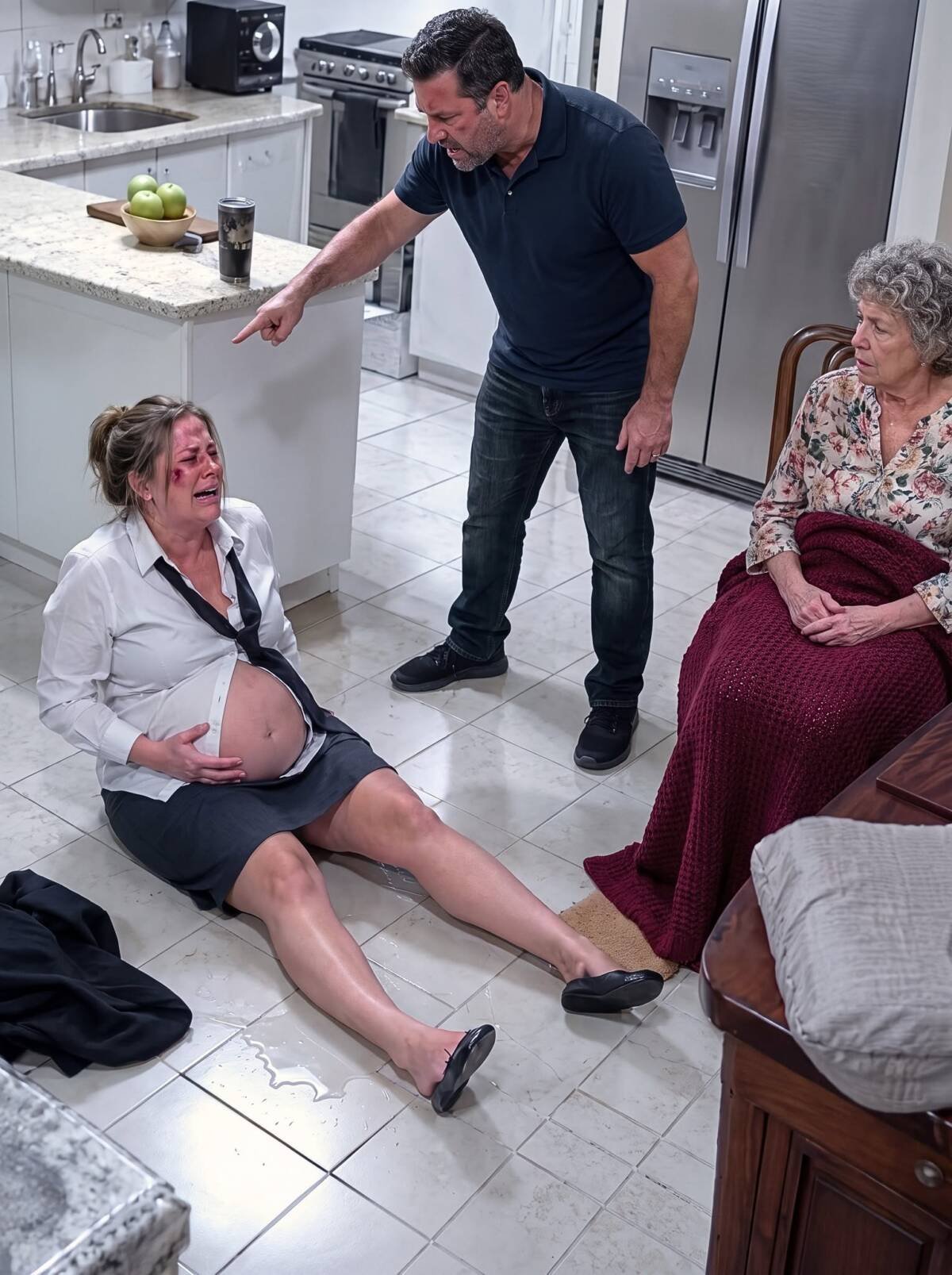
Miriam closed the distance between us before I could even brace myself. The sharp sting of her palm across my cheek stunned me, and before I could recover, her fingers tangled in my hair. With frightening strength, she forced my head downward until my forehead struck the polished wood edge of the nearest coffin.
A dull flash of pain radiated across my skull. As I struggled to keep my footing, Miriam leaned in so close her breath brushed my ear.
“Shut up,” she whispered, “or you’ll end up in there.”
Before I could pull away, a pair of strong hands gripped my arms from behind. For one brief, desperate second, I felt a surge of relief—someone had finally stepped in to protect me.
Then I turned my head and saw that the person holding me back was Trevor.
My husband hadn’t stepped between his mother and me. He hadn’t pulled Miriam away from the coffin or demanded that she leave. Instead, he gripped my shoulders and hissed at me to stop making a scene, treating my reaction as the disturbance while his mother stood inches away, smoothing her black coat as though nothing had happened.
In that instant, something inside our marriage fractured beyond repair. Trevor wasn’t simply paralyzed by grief. When forced to choose between confronting his mother and blaming his wife, he had made his choice without hesitation.
The Secret Emma Carried
A few feet away, Emma had watched the entire confrontation without making a sound. She stood in her navy-blue coat, white tights, and a slightly crooked headband, her wide eyes darting from the blood beginning to bead on my forehead to the adults who were doing nothing to help me.
Then, suddenly, she moved.
She didn’t run to me, and she didn’t run to Trevor. Instead, she darted across the room, weaving between floral stands and startled mourners until she reached the pastor near the podium. She grabbed the sleeve of his jacket and tugged hard.
Miriam froze the moment she saw where Emma was heading. For the first time all morning, the composure slipped from her face. It was as if she realized before anyone else that the most dangerous person in the room was no longer me.
Emma looked up at the pastor, her voice trembling but loud enough to carry across the quiet hall.
“Pastor,” she shouted, “do I have to tell everyone what Grandma put in the babies’ bottles?”
The funeral home went completely dead silent.
My father-in-law’s rosary slipped from his fingers and clattered against the floor. Several relatives turned sharply in their pews. The pastor knelt immediately to meet Emma at eye level, while all the color drained from Miriam’s face.
“Emma, sweetheart,” the pastor said gently, “what are you talking about?”
Tears were already spilling down Emma’s cheeks, but she didn’t back down. She lifted a shaking finger and pointed straight at Miriam.
“I saw her that night in her kitchen,” Emma cried. “She was on the phone talking about the babies. She said she was going to fix everything.”
A wave of dizziness hit me as fragments of that night suddenly rearranged themselves in my mind: Miriam insisting that I looked exhausted and needed to lie down; her eagerness to prepare the twins’ nighttime bottles herself; the faint, unfamiliar odor near the bottle warmer that I had brushed off because I could barely keep my eyes open.
I wanted to run to Emma and wrap my arms around her, but I stayed rooted to the floor, terrified that interrupting her might make her stop.
Trevor finally stepped forward, his voice tight with panic. “Emma, no. Stop.”
Emma ignored him. Through her sobs, she delivered the detail that shifted the atmosphere in the room from shock to genuine dread.
“She put white powder in them,” Emma said. “From little jars. She said the babies would be better off in heaven because Mommy couldn’t handle it all.”
Nausea rose in my throat. The pastor kept his hand steady on Emma’s shoulder. “What else did you see, honey?”
That was when Miriam snapped.
“She’s making it up!” Miriam barked, her voice shrill. “She’s four years old! She doesn’t even know what she’s talking about!”
Miriam lunged forward, as if she intended to grab Emma by the arm, but the pastor rose to his full height and stepped squarely between them.
“Do not take another step,” he said firmly.
Miriam halted, her chest heaving. Emma wiped her eyes with the sleeve of her coat and spoke again, revealing how her grandmother had kept her quiet for two days.
“I didn’t know it was bad,” Emma whispered, looking toward me with heartbreaking guilt. “She gave me cookies and told me it was a secret. She said Mommy and Daddy needed help with the babies.”
That realization cut deeper than anything else. Miriam hadn’t just let a four-year-old witness what she was doing—she had used sweets and the promise of a harmless secret to make a child feel complicit in something monstrous.
Trevor took a slow step toward his daughter, holding out his hand. “Emma, look at me, please. Tell Daddy exactly what you saw.”
Emma instinctively stepped backward, moving closer to the pastor. That tiny retreat broke my heart all over again. Even at four years old, my daughter was already deciding which adults around her were safe.
“I don’t want Grandma to get mad,” she whimpered.
The pastor didn’t hesitate. He turned toward one of the funeral directors standing near the aisle. For the first time that morning, someone chose the truth over protecting the family’s reputation.
“Call the police,” the pastor ordered. “Right now.”
The Mask Finally Falls
The entire room shifted in an instant. We were no longer simply mourning an unexplained loss; Emma’s words had forced everyone to confront a terrifying possibility.
Miriam’s eyes darted toward the double doors at the back of the hall. “This is insane! You’re all out of your minds!”
I touched my forehead and saw bright red blood on my fingertips, but the pain barely registered. All that mattered was keeping Emma calm and making sure no one intimidated her before investigators arrived.
I took a slow breath and forced my voice to stay steady. “Emma, baby, when did you see Grandma in the kitchen?”
She looked at the cut on my forehead and cried harder. “The night we stayed at her house. When you tucked me in with the pink blanket. I was thirsty, so I went downstairs.”
The pink blanket anchored the memory instantly. It had been our last night at Miriam’s house—the exact night she had insisted on taking over the evening feeding because, as she put it, “helping exhausted mothers is what grandmothers are for.”
I had thanked her. I had trusted her.
“Grandma was on the phone,” Emma continued, catching her breath between sobs. “She said after that, everything would be okay. And she said, ‘When Trevor sees everything clearly, he’s going to thank me.’”
Beside me, Trevor made a hollow, choking sound. The color vanished from his face as the full weight of those words hit him. His mother hadn’t just resented me; she had convinced herself that removing our children would somehow hand her son his old life back.
Nobody in the room was dismissing Emma anymore. Her memory was too specific, and Miriam’s rising panic was confirming every word.
Suddenly, Miriam spun around and bolted for the exit.
The pastor and two funeral attendants intercepted her before she reached the hallway. As they blocked her path, the last remnant of Miriam’s carefully curated dignity collapsed, and years of bottled-up rage poured out in front of dozens of witnesses.
“They were ruining everything!” she shrieked, pointing a trembling finger at me. “Trevor was wasting his entire life on her and those babies! He became a slave the day that woman walked into this family!”
Relatives stared in horrified silence as she kept screaming, unable to stop herself.
“It was always about the babies! The house, the money, his time, his future—all of it wasted on diapers and exhaustion while you all sat around applauding her like fools!”
Trevor walked slowly toward his mother. For the first time in our marriage, he wasn’t making excuses for her. He looked at her as though she were a complete stranger.
“What did you do?” he asked, his voice barely above a whisper.
Miriam stared back at him, her eyes wild, still expecting him to understand.
“I did what you were never strong enough to do,” she said. “I freed you.”
In that moment, every shred of doubt in the funeral home vanished.
The Evidence That Confirmed Everything
Police arrived minutes later, before the chaos could escalate further. Officers quickly separated everyone in the hall. A paramedic guided Emma into a quiet side room away from the shouting, while another tended to the laceration on my forehead.
Trevor tried to approach me as they walked me toward the ambulance, but I turned away. I couldn’t look at him. When his mother had slammed my head against our children’s coffin, his first instinct had been to restrain me. Grief didn’t erase that.
Inside the side room, detectives spoke with Emma carefully, wrapping her in a soft blanket and setting a juice box beside her. She looked impossibly small sitting in that oversized chair, answering questions no four-year-old should ever have to understand.
Meanwhile, investigators began piecing together the timeline of the twins’ final night—who had been in the kitchen, who had prepared the bottles, and who had been awake.
At first, my father-in-law tried to defend Miriam, claiming she must have accidentally mixed in a harmless herbal supplement or vitamin. With every question detectives asked, however, his explanations grew weaker. Even the relatives who had spent years excusing Miriam’s controlling behavior began to realize that what they had called “being difficult” had masked something far darker.
The pastor refused to let anyone downplay what had happened. “What I heard from that little girl was not confusion,” he told the lead detective. “It was memory.”
At the hospital, once the adrenaline faded, the details of that night came rushing back with sickening clarity: how unusually deep the twins’ sleep had been, how quiet the house had felt, and how quickly our lives had ended after what I thought was an ordinary family visit.
Investigators moved fast. Forensic testing detected traces of a powerful sedative in residue recovered from one of the twins’ bottles. Shortly afterward, a search of the trash outside Miriam’s home turned up physical evidence directly linking her to the substance.
What Emma had spoken aloud beside two small coffins was no longer just a child’s testimony. It was backed by hard forensic proof.
That night, Trevor sat outside my hospital room for hours. Through the glass pane in the door, I could see him slumped in a plastic chair, still wearing his rumpled funeral suit, his tie loosened around his neck.
A week earlier, the sight of him like that would have made me rush to comfort him. That night, I felt nothing but exhaustion.
When I finally let him in, he closed the door and broke down before he could even get a word out.
“I didn’t know,” he sobbed.
I looked at him in silence. Part of me believed him—I didn’t think he had known what his mother planned to do. But standing over two tiny graves had taught me that ignorance isn’t a defense when you spend years deliberately refusing to look.
“I didn’t know,” Trevor repeated, his voice breaking, “but I should have. Clara, I let her do this to you. I let her get away with everything.”
For the first time, he stopped calling his mother “opinionated” or “set in her ways.” He began telling me what growing up under Miriam’s roof had actually been like—the humiliation, the silent treatments, the rigid control designed to make him terrified of ever defying her.
Listening to him helped me understand where Miriam’s obsession with control came from, but it didn’t make me want to forgive him. It only confirmed that the cruelty I had endured wasn’t new; it had been the foundation of his family for decades.
A Pattern Hidden in the Past
Word of what happened at the funeral spread quickly. There had been too many witnesses for the family to bury the story.
Two days later, a distant relative posted a short video clip online that had been filmed before the confrontation—just a quiet pan of the flowers and the two small coffins. Most of the comments were condolences.
Then, one comment from an unfamiliar account made my blood run cold:
“Check Miriam’s extended family. This isn’t the first time she’s used ‘calming powders’ on babies.”
I took a screenshot immediately and sent it to the lead detective. Until that moment, I had believed we were uncovering a singular, horrific crime. That anonymous comment suggested something far more chilling.
Investigators began digging into decades-old family records. They uncovered two poorly explained infant deaths from the 1990s, an incident involving one of Miriam’s nephews that had long been dismissed as a crib accident, and another baby in the family who had mysteriously spent weeks in the hospital without a clear diagnosis.
Not every older case had enough surviving evidence to bring formal charges, and detectives had to separate family rumors from provable facts. Still, the pattern was unmistakable. For decades, Miriam had operated in a world where no one dared to question her—even when children suffered.
While the legal case built, Emma started seeing a child trauma therapist. At first, her drawings were filled with baby bottles beneath heavy black clouds. Later, she drew a towering figure looming over a house while two tiny stars floated high above the roof.
Then, one afternoon, she drew the funeral.
In the crayon sketch, I stood beside two white boxes with a red mark on my forehead, while a tiny stick figure of Emma stood across the room with her mouth wide open. Looking at that page forced me to face a painful truth: on the worst day of our lives, my four-year-old daughter had felt forced to step up because every adult in the room had failed to do it first.
The Trial and the Weight of the Truth
As the criminal case moved toward trial, some members of Trevor’s family still tried to soften the reality. They called Miriam “confused” or “unwell.” Others insisted the whole ordeal was simply an unimaginable “family tragedy.”....