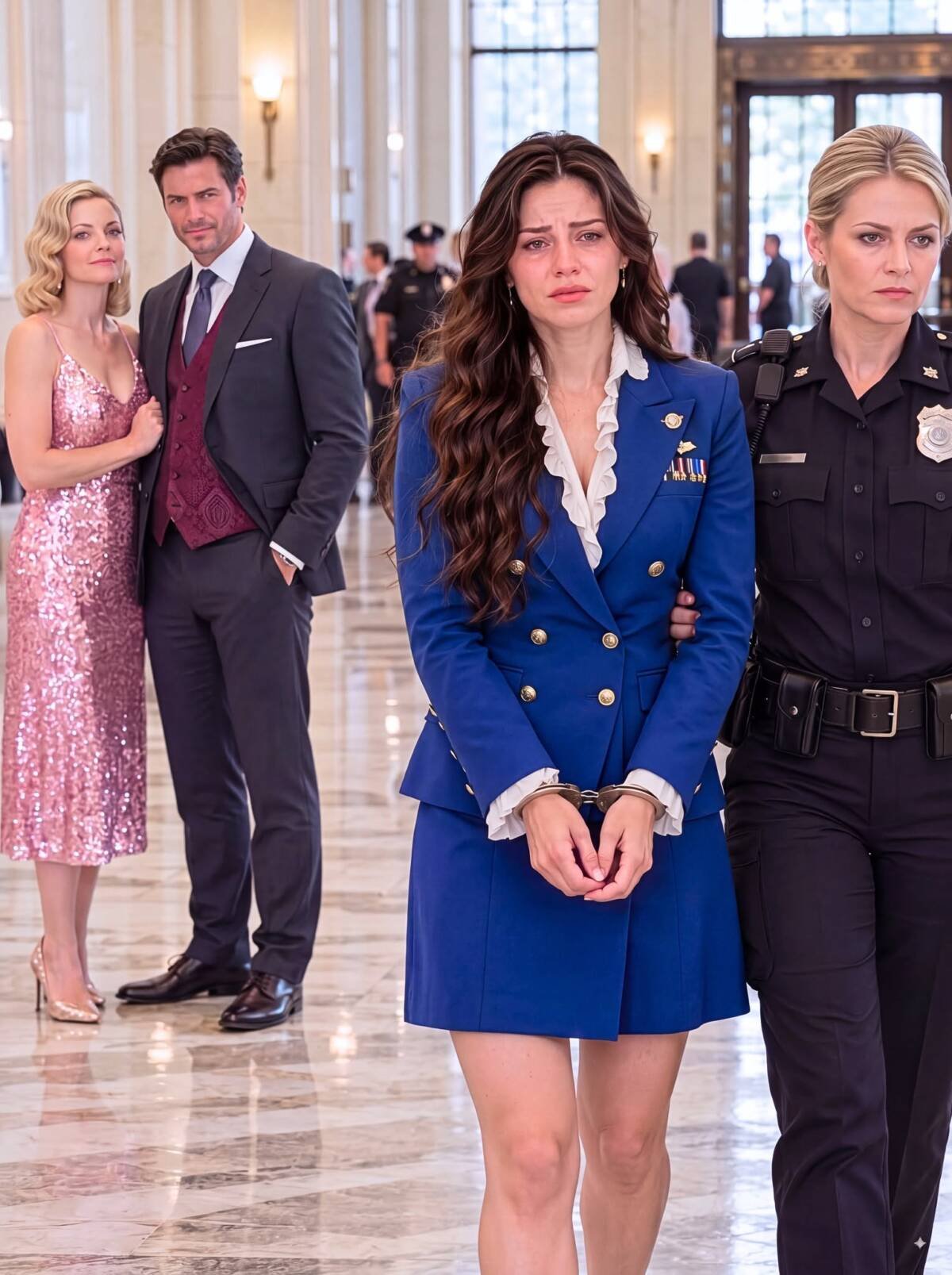
At 1:47 in the morning, two police officers broke down my front door, entered my home with an arrest warrant, and accused me of stealing millions of dollars from my own grandmother’s estate. Behind them stood my parents, smiling as if they had been waiting years for that exact moment. My sister was already livestreaming, broadcasting my arrest to more than a million people.
They thought they were watching the end of my life as I knew it.
I didn’t scream. I didn’t fight the officers. I didn’t even ask my parents why they had done it.
I simply told my sister to keep recording.
Fifteen minutes after I arrived at the police station, an officer opened my case file, went pale, and hurried out of the room. Moments later, the police chief walked through the door looking visibly shaken.
“Ma’am,” he said, “there’s something in your file we need to discuss. You are…”
What my family didn’t know was that the six million dollars they accused me of stealing was connected to an investigation that could expose everyone involved in their scheme. And the evidence they had presented to secure my arrest might become the very thing that destroyed them.
The Arrest My Family Wanted the World to See
At exactly 1:47 a.m., the sound of splintering wood shattered the silence inside my home.
I had been asleep on the living-room sofa, surrounded by probate documents and financial reports I had been reviewing earlier that evening. For several seconds, I couldn’t understand what was happening.
Then I heard shouting.
“Police! Search warrant! Nobody move!”
Two uniformed officers entered through what remained of my front door. One carried a flashlight, while the other held a document in his hand.
“Claire Morgan?”
I slowly sat upright.
“Yes?”
“Stand up and keep your hands where we can see them. You’re under arrest for estate fraud and the alleged misappropriation of six million dollars.”
I stared at him, trying to process what I had just heard.
But the officers weren’t what shocked me most.
Standing behind them were my parents.
My father, Richard Morgan, wore his expensive camel-colored coat. My mother, Patricia, stood beside him with her pearl necklace resting perfectly against her collar. Both looked remarkably calm.
Almost pleased.
And then I noticed my younger sister, Vanessa.
She was holding her phone horizontally, pointing it directly at me. A bright red LIVE notification flashed across the screen.
“Everyone, we’re here,” she announced excitedly. “This is finally happening. My sister is being arrested for stealing our grandmother’s fortune.”
I looked at her.
She smiled.
“More than a million people are watching, Claire. You might as well say hello.”
My father folded his arms.
“We warned you this would happen. You thought you could steal everything and get away with it.”
My mother shook her head theatrically.
“Your grandmother would be heartbroken if she knew what you had done.”
For a moment, I couldn’t believe what I was hearing.
Three months earlier, our grandmother, Evelyn Morgan, had passed away at the age of eighty-four. She had built a substantial fortune through decades of careful investments, commercial property acquisitions, and her ownership stake in a regional construction company.
Her estate was valued at approximately $42 million.
For years, my parents had openly discussed how the money would eventually be distributed. My father assumed he would control the family business, while my mother believed Vanessa deserved the largest share because she was, in her words, the daughter who understood how to maintain the family’s social standing.
I had never been particularly interested in their arguments.
I had my own career, my own home, and my own responsibilities.
But six weeks before her death, Grandma changed everything.
She revised her trust documents, removed my father as trustee, restricted my mother’s access to the family holding company, and appointed me to oversee the administration of her estate.
Her decision caused an immediate family crisis.
My parents accused me of manipulating an elderly woman. Vanessa claimed I had taken advantage of Grandma’s declining health. They repeatedly demanded that I surrender control of the estate.
I refused.
Grandma had made her decision legally, deliberately, and with the assistance of independent attorneys.
She had also left a handwritten explanation.
“Claire understands that money is a responsibility, not a reward. She is the only person I trust to protect what I spent my life building.”
Those words had changed the way my family treated me.
And apparently, they had now decided to make me pay for it.
“Ask her about the missing six million dollars!” my father shouted toward the officers.
One officer approached me.
“Ma’am, please stand up and turn around.”
I looked directly at my father.
“Is this really what you wanted?”
He didn’t answer.
Vanessa moved closer, adjusting the angle of her phone.
“Say something, Claire. Tell everyone how you stole Grandma’s money.”
I turned toward her camera.
“Keep recording.”
Her smile briefly disappeared.
The officers placed handcuffs around my wrists and escorted me outside.
My front door hung crookedly from its damaged frame. Police lights illuminated the driveway, and several neighbors had already turned on their porch lights.
Vanessa continued broadcasting.
“Look at her. She isn’t even denying it.”
I remained silent.
My family believed my silence meant I had nothing to say.
They had no idea that I was already thinking about the evidence.
More importantly, I was thinking about the six-million-dollar account mentioned in the warrant.
Because I knew something they apparently didn’t.
That account did not belong to my grandmother’s estate.
And it was never supposed to be discovered by anyone outside a very small investigative team.
The Police Station Discovery That Changed Everything
The drive to the station lasted approximately twenty minutes.
I answered the officers’ basic questions, provided my identification, and requested permission to contact my attorney.
I didn’t demand special treatment.
I didn’t threaten to call influential people.
I simply waited.
At approximately 2:12 a.m., an officer escorted me into an interview room. The room was small, with a metal table, four chairs, and a camera mounted in the upper corner.
A younger officer entered a few minutes later carrying a tablet.
He opened my electronic case file.
At first, he appeared completely ordinary.
He reviewed the arrest report, checked my identification, and scrolled through several pages of financial documentation.
Then he stopped.
He moved closer to the screen.
He read something again.
His expression changed.
“Excuse me,” he said quietly.
He stood up, stepped outside, and approached another officer.
I could see them speaking through the glass partition. The second officer took the tablet, examined the screen, and immediately reached for a telephone.
Neither man looked comfortable.
Approximately fifteen minutes later, the interview-room door opened.
A tall man in his early fifties entered wearing a dark suit and a police department identification badge.
It was Police Chief Raymond Holt.
He looked at me, then at the documents in his hand.
“Ms. Morgan?”
“Yes.”
He pulled out the chair opposite me but didn’t sit immediately.
“Do you understand why you’re here?”
“I understand what the warrant says. I don’t understand how anyone obtained the information used to create it.”
He studied me for several seconds.
Then he asked a question I hadn’t expected.
“Are you currently assigned to the State Probate Integrity Task Force?”
I looked at him.
“Yes.”
He exhaled slowly.
“And your position?”
“Special prosecutor.”
Chief Holt finally sat down.
For a moment, the room was completely silent.
Then he turned the tablet toward me.
“There’s a problem with the financial exhibit attached to your arrest warrant.”
I examined the document.
It contained a bank account number, a transaction reference, and a statement claiming that I had transferred $6 million from my grandmother’s trust into an unauthorized account.
The account number was familiar.
The transaction reference was familiar, too.
But the alleged transfer had never occurred.
I looked up.
“Chief, that account is part of an active investigation.”
His expression hardened.
“What kind of investigation?”
“An investigation into fraudulent probate transactions, compromised court records, and individuals attempting to redirect estate assets through fabricated beneficiary documents.”
He glanced at the document again.
“Are you telling me the account doesn’t belong to your grandmother?”
“That’s exactly what I’m telling you.”
He leaned back.
“Then why would someone use it as evidence against you?”
I looked directly at him.
“Because someone has access to confidential investigative information. And whoever prepared that document knew enough to make it look authentic.”
Chief Holt went completely still.
I continued.
“The six million dollars was never stolen. The account was established as part of a controlled investigative operation. If someone has used its details to obtain an arrest warrant, you may have a much bigger problem than an estate dispute.”
He closed the folder.
“Ms. Morgan, please don’t discuss this with anyone else until we’ve contacted the appropriate authorities.”
I nodded.
Then I added one more thing.
“There’s something else you should know. My family has been trying to gain control of my grandmother’s estate since the day she died.”
He stood up.
“Who has access to your grandmother’s financial records?”
“My father, his attorney, and several former estate administrators. But they should not have access to the task force’s confidential account information.”
Chief Holt walked toward the door.
Before leaving, he turned around.
“Don’t go anywhere. We’re bringing someone in.”
I watched him disappear into the corridor.
For the first time that night, I realized that my arrest might have exposed something far more serious than my family’s greed.
The Six-Million-Dollar Account Was Never Part of the Estate
Four months before my arrest, the State Probate Integrity Task Force had identified a disturbing pattern.
Several wealthy estates had experienced suspicious financial transfers shortly after the deaths of their owners.
In each case, the transactions involved questionable court orders, altered beneficiary information, and companies that existed primarily on paper.
Investigators suspected that an organized network was exploiting probate proceedings to redirect money and property away from legitimate beneficiaries.
The operation was designed to identify the people responsible.
A cooperating financial institution maintained a controlled account containing six million dollars. Investigators used it to monitor suspicious transactions and trace attempts to access confidential estate funds.
Only twelve individuals were authorized to know the account existed.
I was one of them.
My responsibility involved reviewing financial documentation, identifying irregularities, and helping prosecutors understand how fraudulent transactions moved through the probate system.
The account was not part of my grandmother’s estate.
It was not money I could personally withdraw.
It was not an inheritance.
It was an investigative tool.
Two weeks after Grandma died, investigators identified an attempted transfer involving shares in her construction company.
The paperwork appeared to have originated from a shell corporation.
When I recognized the name of my father’s longtime attorney on one of the documents, I immediately disclosed the potential conflict.
I removed myself from the investigation involving my family.
Deputy Attorney General Sofia Ruiz assumed responsibility for the case.
I had done everything required to avoid compromising the investigation.
Unfortunately, my family apparently interpreted my professional silence as an opportunity.
They had no idea that their actions were being examined.
And now, someone had attempted to use confidential investigative material to have me arrested.
My Father Made One Mistake in Front of the Cameras
At approximately 2:25 a.m., I heard familiar voices coming from the police station lobby.
My father was speaking loudly.
“Everything is already submitted. The judge saw the documents. There is nothing she can do.”
My mother responded.
“She should have thought about that before stealing from her own grandmother.”
Then Vanessa spoke.
“People online are asking whether she’s going to prison.”
I couldn’t hear my father’s complete response, but one sentence came through clearly.
“We gave them everything. The ledger, the bank screenshots, even Claire’s authorization code.”
I immediately looked toward the interview-room door.
My authorization code had never appeared in any public probate filing.
It was associated with restricted investigative records.
If my father possessed it, there were only a few possibilities.
Someone had stolen it.
Someone had sold it.
Or someone inside the investigative system had disclosed it.
I turned toward the officer standing near the door.
“Please make sure the lobby recording is preserved.”
He looked confused.
“Why?”
“Because my father just admitted that he has access to confidential information that should never have been available to him.”
The officer immediately contacted his supervisor.
Outside, Vanessa continued livestreaming.
She had no idea that her father’s comments had changed the direction of the investigation.
A few minutes later, Chief Holt returned.
This time, he wasn’t alone.
Deputy Attorney General Sofia Ruiz entered with two state investigators.
She carried a thick folder and looked directly at me.
“Claire, effective immediately, you are a witness in this matter. You will have no involvement in charging decisions or investigative supervision.”
“Understood.”
She nodded.
“Good. That’s exactly how it needs to be.”
Ruiz examined the arrest warrant, the financial exhibits, and the supporting affidavit.
Within minutes, she identified several serious irregularities.
The affidavit contained language taken almost word for word from sealed task-force records.
The bank compliance officer’s signature was also suspicious.
Ruiz made a telephone call.
She listened for several seconds before speaking.
“Thank you. Please send that confirmation directly to our office.”
She ended the call and looked at Chief Holt.
“The bank officer never signed this document.”
Holt frowned.
“You’re certain?”
“Absolutely. She has already confirmed that the signature is forged.”
Ruiz placed the affidavit on the table.
“This warrant appears to have been obtained using fabricated evidence and confidential investigative information.”
Chief Holt looked toward me.
“Then we need to determine who submitted it.”
Ruiz closed the folder.
“I believe we’re about to find out.”
The Arrest Turned Into a Criminal Investigation
At approximately 2:46 a.m., the officers removed my handcuffs.
I was not charged, and the authorities began reviewing the circumstances surrounding the warrant.
However, Ruiz made it clear that my release did not mean the investigation was finished.
“We need to establish exactly how the confidential information reached your family,” she explained.
“I agree.”
“And we need to preserve every piece of evidence connected to the arrest.”
“Especially the livestream.”
Ruiz looked at me.
“Your sister recorded everything?”
“From the moment the officers entered my home.”
She paused.
“Then we need that recording.”
Investigators immediately contacted the platform and began preserving the broadcast.
Vanessa had already told her viewers that the police were protecting me because of my professional position.
She also claimed that I had manipulated the legal system to take Grandma’s inheritance.
But the recording contained something much more important.
It captured my father discussing the bank screenshots, the financial ledger, and my authorization code.
It also captured my mother celebrating the arrest before anyone had verified the allegations.
At approximately 3:05 a.m., Ruiz and two investigators walked into the lobby.
My father was standing beside the reception desk.
Vanessa held her phone.
My mother was speaking to someone about how the family would finally regain control of the estate.
Ruiz approached them.
“Mr. Morgan, we need to speak with you.”
My father turned.
“About what?”
“About the documents you submitted in support of your daughter’s arrest warrant.”
He looked toward the officers.
“Everything was provided legally.”
“Then you should have no difficulty explaining how you obtained confidential investigative information.”
For the first time that night, my father’s expression changed.
Vanessa lowered her phone.
My mother stopped talking.
And the investigation moved in a direction none of them had anticipated.
The Messages That Revealed the Real Plan
Over the following days, investigators examined the financial documents, electronic communications, and records connected to my grandmother’s estate.
They discovered that the forged bank exhibit had been prepared using information taken from a restricted investigative file.
The document had been routed through my father’s longtime attorney, who had allegedly worked with an estate clerk to obtain confidential probate information.
Investigators also recovered communications from Vanessa’s cloud account.
Those messages revealed a plan that went far beyond accusing me of financial misconduct.
My family had discussed creating the appearance of a six-million-dollar transfer, presenting fabricated financial evidence to the court, and using the resulting arrest to convince the probate judge that I was unfit to administer Grandma’s estate.
If the court removed me, my father believed he could regain control of the family holding company.
Once he had access to the estate’s assets, he intended to challenge the revised trust and restore the inheritance arrangements he had expected before Grandma changed her documents.
The messages also revealed that Vanessa had been planning the livestream for days.
She wanted the arrest to be public.
She wanted the video to spread.
She believed that if enough people saw me in handcuffs, the allegations would become difficult to challenge.
My mother had encouraged the plan.
She believed public pressure would make it easier to convince the court that I had betrayed the family.
But they had overlooked one important detail.
A criminal accusation is not proof of guilt.
And a livestream cannot turn fabricated evidence into legitimate evidence.
The Livestream That Became the Most Important Evidence
By sunrise, Vanessa’s broadcast had been copied and preserved by investigators.
More than a million people had watched the arrest.
But prosecutors were not interested in the comments, the dramatic music, or the number of views.
They were interested in what the participants had said.
The recording captured my father’s statement about submitting confidential financial documents.
It captured Vanessa warning him not to reveal too much.
It showed my mother celebrating the arrest before any proper examination of the allegations.
And it established the timeline of events surrounding the warrant.
Investigators compared the recording with the electronic communications recovered from the family’s accounts.
The evidence began to connect.
A probate clerk eventually admitted that he had accepted money in exchange for photographing sealed court filings.
The photographs had been provided to my father’s attorney.
The attorney had allegedly used the information to prepare documents that appeared to support the fraudulent financial allegations.
Investigators also identified inconsistencies between the bank’s actual records and the documents submitted to the court.
The supposed transfer had never occurred.
The authorization code had been taken from confidential records.
The bank signature was forged.
And the financial exhibit contained information that should never have been available to my family.
What they had presented as proof of my guilt was becoming evidence of their own involvement.
The Courtroom Where My Family’s Story Collapsed
Six weeks after the arrest, I appeared at an evidentiary hearing.
I was not there to make speeches or accuse my relatives.
I was there to answer questions about the financial documents and explain the controlled account.
My father sat across the courtroom in a navy suit.
My mother sat beside him.
Vanessa remained several seats behind their attorney, avoiding eye contact.
The hearing began with a review of the arrest warrant.
The judge examined the affidavit, the financial exhibits, and the bank’s confirmation that the signature had been forged.
Then my father’s attorney attempted to challenge my credibility.
“Ms. Morgan, you helped establish the six-million-dollar controlled account used in this investigation, correct?”
“Yes.”....