The Salute That Changed Everything
Evelyn Monroe stood in her dress uniform at her grandfather’s funeral, the rain drying on her shoulders, as her father, Richard Monroe, delivered his first words to her in years.
“Still pretending the Army needs another doctor?” he sneered, ensuring everyone in the Army Navy Country Club’s reception hall heard him. The room was filled with retired generals, government officials, and defense contractors—all part of the Monroe family’s carefully cultivated image.
Evelyn had returned not for her father, brother Caleb, or stepmother Diane, but to honor her grandfather, General Arthur Monroe. Yet, the moment was quickly overshadowed by Richard’s cruelty. “The family doctor finally came home,” he mocked. “Should we all line up for aspirin?”
A defense contractor chuckled uncomfortably, while Caleb, ever the sycophant, raised his whiskey glass. “Evie, I didn’t know they let Army doctors leave base for family events.”
“They do for funerals,” Evelyn replied, a small victory in a lifetime of battles.
The Room’s Atmosphere Shifts
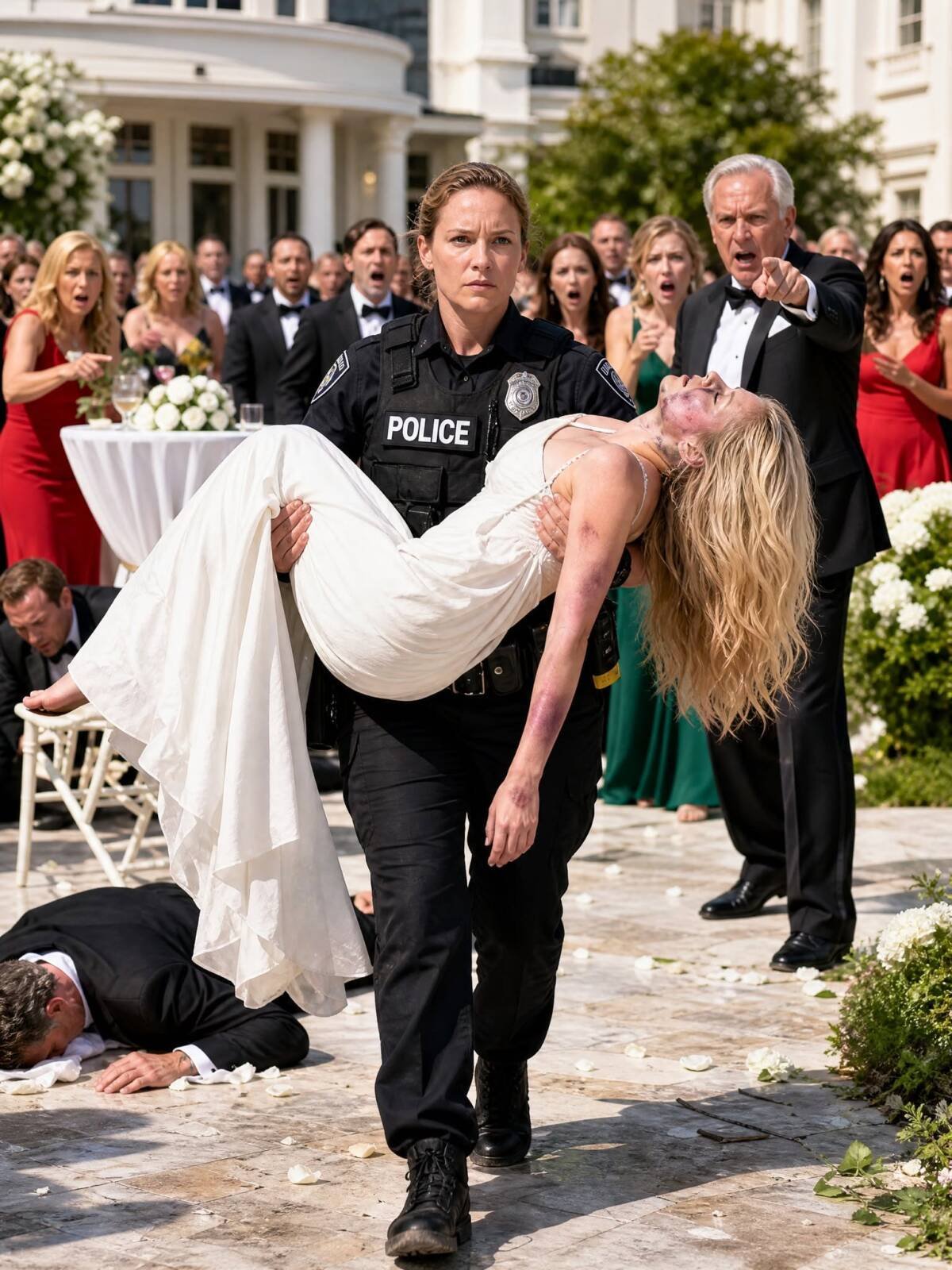
The gathering was a display of the Monroe family’s power—polished crystal, political connections, and wealthy guests. But the mood shifted when Thomas Whitmore, Deputy Assistant Secretary of Defense, entered with three federal security agents. The room fell silent as Whitmore walked directly toward Evelyn.
He saluted. “Colonel Monroe. It’s an honor to see you again.”
Caleb froze, his drink halfway to his lips. Whitmore continued, his voice carrying, “The men from Kandahar still ask about you.”
Richard’s expression darkened. He examined Evelyn’s uniform as if seeing it for the first time. Whitmore shook her hand. “I came to pay respects to your grandfather. He spoke of you near the end.”
The words struck Evelyn deeply. Her grandfather had barely communicated with her in years, yet he had followed her career closely. The revelation was bittersweet.
The Blue Folder’s Revelation
Later, Richard cornered Evelyn. “How do you know Thomas Whitmore?”
“You meet certain people,” she replied, “on the worst day of somebody’s life.”
Outside, Whitmore handed her a silver lighter—her grandfather’s. Taped beneath it was a note in his handwriting: Do not let Richard touch the blue folder.
Back inside the Monroe estate, Evelyn found the blue folder in the den. Inside were documents exposing Monroe Defense Systems’ approval of defective battlefield medical supplies, including trauma kits that had failed under extreme conditions. One batch, 17-D, had been linked to casualties in Kandahar.
Evelyn remembered a young soldier, Tyler Mercer, who had died while she fought to save him. The trauma kit had failed. At the time, she had blamed the chaos of combat. Now, she realized the truth was far darker.
Confronting the Truth
Diane entered the den, staring at the documents. “You shouldn’t be in here.”
“Did you know?” Evelyn asked.
Diane’s silence was answer enough. She defended the company, citing “impossible deadlines” and “difficult decisions.” Evelyn cut her off. “I stood over soldiers whose parents were still waiting for them to come home. Don’t lecture me about pressure.”
Richard entered, his composure unshaken. “Evelyn, put that down before you embarrass yourself.”
She refused. “It contains battlefield failure reports.”
Richard’s hand tightened into a fist. “That folder contains private company material.”
“It contains the truth,” Evelyn replied.
The Investigation Begins
Evelyn’s phone rang. It was Mara Quinn, a trauma nurse who had served with her in Kandahar. “Do you remember the failed tourniquet on Tyler Mercer?” Mara asked. She read the batch number: 17-D-438-K. It matched the documents in Evelyn’s hands.
Evelyn confronted Richard. “The dead just got a witness.”
Whitmore arrived, and Evelyn handed him the folder. He reviewed the documents, his expression hardening. “Richard, I strongly suggest you stop characterizing your father.”
Richard’s confidence cracked as Whitmore revealed that General Monroe had already provided the original documents to investigators. Federal agents seized the company’s servers, and Caleb, pale with shock, realized he had signed the approvals under his father’s direction.
The Aftermath
By midnight, the funeral reception had dissolved. Washington’s elite distanced themselves from the Monroe family as their influence crumbled. In the sitting room, Richard sat in silence, Diane stared into the fireplace, and Caleb looked years older.
“You’ve been waiting for this,” Richard said to Evelyn. “The daughter who ran away to war finally returns to judge the family that raised her.”
“No,” she replied. “You wrote that story. I simply read the documents.”
Whitmore entered with federal agents. “We can prove your company concealed known defects,” he said.
Caleb, devastated, turned to his father. “You’re really leaving me to take the blame?”
Richard didn’t answer. Evelyn picked up her coat and walked out. “If you leave now, don’t ever come back,” Richard called after her.
“That’s the first honest thing you’ve said all night,” she replied, stepping into the rain.
Rebuilding and Moving Forward
The following months were a blur of hospital shifts, legal battles, and investigations. The Monroe Foundation was separated from Monroe Defense Systems, and years of financial manipulation were uncovered. The foundation had genuinely helped wounded veterans, a bitter irony given its role in hiding corruption.
Evelyn received her grandfather’s journals, revealing his quiet pride in her career and his regret for not defending her sooner. One entry read: Evelyn accepted an Army scholarship. Richard is furious. I said nothing. Coward.
Months later, Richard appeared outside Evelyn’s apartment. “They’re going to indict me. I’m asking you not to testify if they call you.”
“If they call me,” she said, “I’ll tell the truth.”
“Then you’re no daughter of mine.”
“You’re right,” she replied. “Not anymore.”
At Arlington National Cemetery, Evelyn placed flowers on her grandfather’s grave. “You were late,” she whispered. “But at least you weren’t silent in the end.”
Monroe Defense Systems collapsed, Richard was removed from the board, and Caleb testified under a cooperation agreement. The foundation was rebuilt with independent leadership, dedicated solely to wounded service members.
Evelyn received a letter from Tyler Mercer’s mother, thanking her for remembering her son’s name. The truth couldn’t erase the loss, but it provided closure.
As Evelyn prepared for another overseas assignment, a young Army medic approached her. “Ma’am, are you Colonel Monroe? Were you in Kandahar?”
“I was.”
“My brother says your team saved his life.”
Evelyn smiled. “I’m glad he got to live it.”
The medic asked for advice. Evelyn thought for a moment. “Take care of your people. And keep your paperwork.”
As she boarded the aircraft, her grandfather’s silver lighter rested in her pocket. It no longer served as proof of his love, but as a reminder of the cost of silence—and the value of truth.