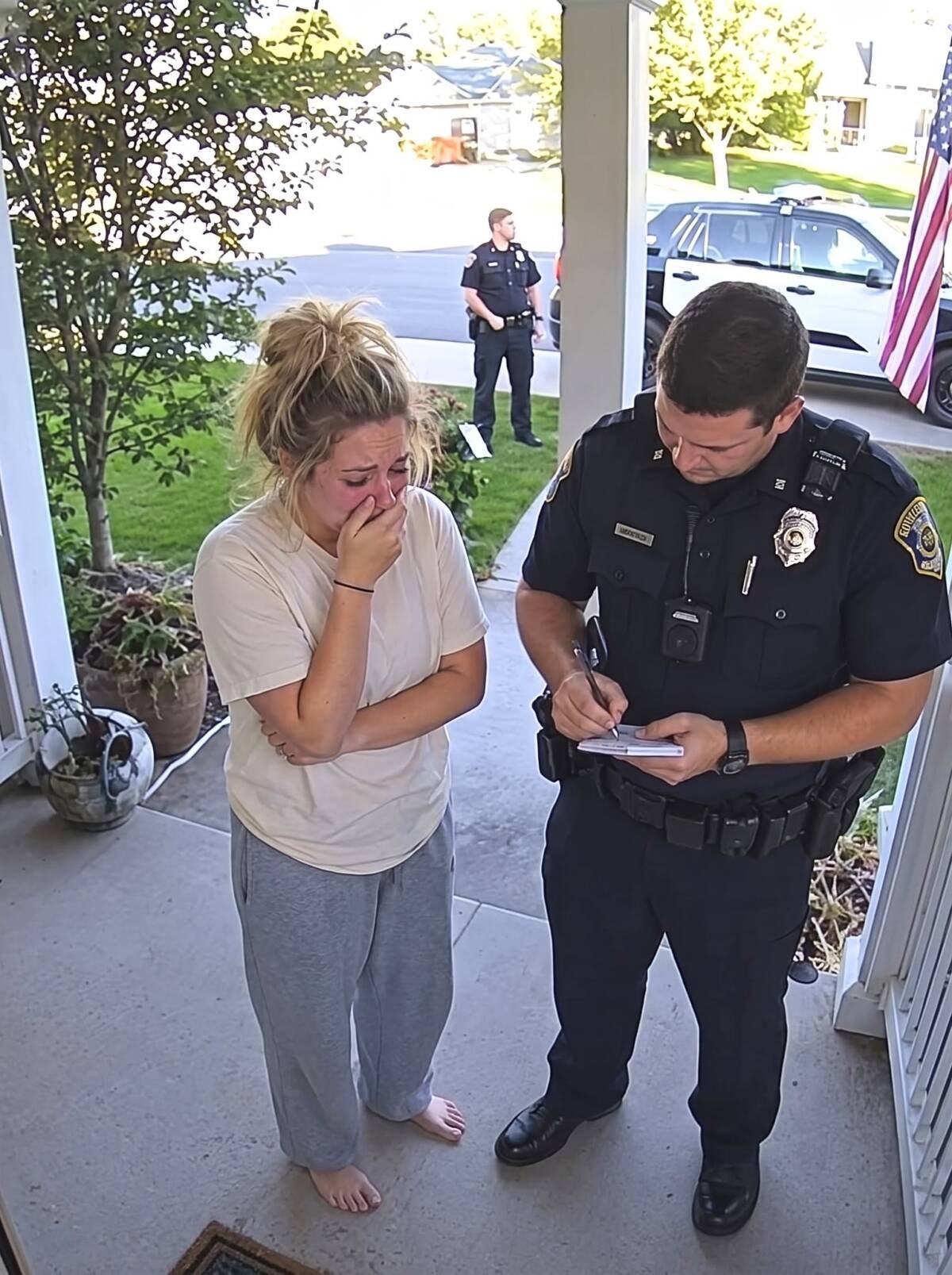
When he returned from a six-month deployment, he expected his wife to run into his arms. Instead, she flinched at his touch while his mother and younger brother whispered that she had lost her mind. Convinced she was hiding a betrayal, he lifted the blanket while she slept—only to uncover a dark secret that turned a Friday night “victory dinner” into a federal takedown.
The Coldest Homecoming
After six months overseas on active duty, I had spent the last forty-eight hours of transit picturing one simple moment: dropping my duffel bag in the foyer, pulling my wife, Elena, into my arms, and finally breathing in the quiet safety of home.
Instead, when I pushed open the front door, Elena stood five feet back in the hallway, looking at me with the guarded, hollow expression of someone greeting a complete stranger.
She was noticeably thinner. Dark shadows bruised the skin beneath her eyes, and even though the house was warm, she wore a heavy oversized knit sweater with both hands pulled completely inside the sleeves. She didn’t run to me. She didn’t even meet my gaze.
Before I could ask what was wrong, the click of heels echoed down the marble hallway. My mother appeared wearing a diamond tennis bracelet and pearl drop earrings I had never seen before—jewelry I knew for a fact my father’s pension couldn’t have bought. Right behind her strolled my younger brother, Ricardo, wearing a tailored blazer and carrying himself with the easy, territorial swagger of a man who had grown far too comfortable in my absence.
Neither of them looked particularly glad that my flight had landed on time.
“Welcome home, sweetheart,” my mother said smoothly, air-kissing my cheek before glancing sympathetically toward Elena. “You’ll have to be patient with her. Being alone for six months made her terribly emotional. She hasn’t been herself.”
Ricardo let out a low, dismissive chuckle, sliding his hands into his pockets. “Too much time in an empty house messes with a person’s head. We’ve been doing our best to keep things from falling apart while you were gone.”
Elena didn’t argue. She didn’t roll her eyes, didn’t defend herself, didn’t even shift her weight. She simply stared at the floorboards and stayed completely silent. Something about that stillness—so unlike the sharp, fiercely independent woman I had married—unsettled me far more than anything my mother or brother had just said.
That night, Elena stayed pressed to the far edge of our mattress, the heavy duvet pulled tightly up to her chin. Lying in the dark, I reached across the space between us and gently brushed my fingers against her shoulder.
She recoiled so violently she nearly fell off the bed.
I pulled my hand back instantly, my chest tightening. For the first time since stepping off the transport plane, a cold, ugly suspicion crept into my mind. I hated myself for even entertaining it, yet I couldn’t shake the feeling that six months apart wasn’t the only thing standing between us.
The Paper Trail and the Truth Beneath the Blanket
The next afternoon, while my mother and Ricardo were out running “errands” and Elena was resting upstairs, I went into my home office to catch up on six months of mail. Tucked inside the bottom drawer of Elena’s desk was an old spare cell phone she rarely used.
I powered it on. Most of the text threads had been hastily wiped, yet the cloud-synced email app was still logged in. As I scrolled through the archived folders, my stomach dropped.
There were records of wire transfers, scheduled appointments with corporate attorneys, and scanned PDFs of legal deeds—every single one bearing Elena’s cramped, shaky signature. Worse, three of the property transfer documents carried my signature as well.
I stared at the screen, my pulse hammering. I had been in a secure communications zone overseas on the dates stamped across those pages. I had never signed them.
Digging deeper, I traced the paper trail: the deed to our family home, our joint investment portfolio, and even the small logistics business Elena and I had built from scratch before my deployment. Every single asset had been transferred out of our names and funneled into one destination—a private holding company controlled entirely by Ricardo.
I closed the laptop slowly. Part of me wanted to march straight into the living room and demand answers, yet I held back. I still didn’t understand Elena’s role in it. Had she been working with him? Or was there another reason she couldn’t look me in the eye?
That night, I lay awake beside her in the dark, listening to her shallow, uneven breathing. Around two in the morning, once I was certain she was asleep, I reached over and carefully lifted the edge of the blanket. I wasn’t sure what I expected to find—a hidden phone, a secret, something to explain why my wife was acting like a ghost.
What I saw stopped the air in my lungs.
Dark, mottled bruises wrapped across her ribs. Purple finger-shaped marks encircled her upper arms, and older, yellowing welts faded down the curve of her back.
Every suspicion I had harbored about my wife evaporated in a single, sickening instant.
Elena gasped awake as the cool air hit her skin. The moment she saw my face—and realized what I had uncovered—pure terror flashed in her eyes. She scrambled to pull the blanket back up, trembling so hard the mattress shook.
“Who did this to you?” I asked, my voice barely a whisper.
Tears spilled silently down her cheeks. For several agonizing seconds, she couldn’t force the words out. Finally, she broke.
“Your mother and your brother,” she choked out. “They forced me to sign everything over.”
Every piece of the puzzle snapped into place with brutal clarity. Elena hadn’t betrayed me while I was serving overseas. She had been trapped inside her own home, isolated and intimidated by the two people I had trusted to look after her.
Through the cracked bedroom window, the faint sound of clinking glasses drifted up from the back patio. My mother and Ricardo were sitting in the garden drinking champagne, laughing softly in the dark as though they were untouchable. They believed the transfers were finalized, that Elena was too broken to speak up, and that I had come home too late to undo it.
I gently pulled the blanket back over Elena’s shoulders and pressed a soft kiss to her forehead. Whatever rage was boiling inside me could wait. For the first time in six months, she needed to know she wasn’t facing them alone.
“Then they didn’t just steal from my wife,” I murmured quietly into the dark. “They picked a fight with the wrong man.”
Patience in Places Where Panic Kills
I didn’t storm down to the patio that night. I stayed beside Elena until her shaking stopped and she finally told me everything.
During the first two months of my deployment, she had tried to reach me through the family liaison. My mother and Ricardo intercepted her, convincing her that causing a “domestic distraction” would jeopardize my mission and destroy my military career. When fear for my career stopped working, they threatened to frame her for embezzlement, telling her no judge would ever believe a “stressed, lonely wife” over two respected members of my family. And when she still refused to sign the deeds, Ricardo had stopped using words.
Listening to her stripped away every excuse I had ever made for my family. My mother had always hidden her cruelty behind pearls and polite concern; Ricardo had spent his entire life mistaking my patience for weakness.
At six o’clock the next morning, before anyone else was awake, I stepped into the garage and made three phone calls.
First, I called Lieutenant Harris, my commanding officer, to confirm the exact dates I had been overseas and unreachable. Second, I called Grace Lin, an old college friend who now worked as a federal prosecutor specializing in financial fraud. Third, I called Dr. Patel, a forensic physician Grace recommended, and arranged a quiet appointment that afternoon to document every single injury on Elena’s body before the bruises could fade.
By eight o’clock, I was calm enough to sit at the breakfast table across from my mother without letting a flicker of anger show on my face.
She poured coffee with effortless grace, casually suggesting that Elena might benefit from an inpatient psychological evaluation. Ricardo leaned back in his chair, buttering his toast, and went even further—suggesting gently that divorce might be the “kindest option” for everyone involved.
Elena sat rigid beside me, staring at her plate. Beneath the tablecloth, however, her hand was locked tightly around mine.
I nodded slowly, thanking Ricardo for his concern, and let him talk. The more comfortable he felt, the more rope he handed me. He proudly explained how he and my mother had stepped in to “restructure” the business and protect the family’s assets while I was away, insisting that Elena had signed every transfer willingly.
“Did she really sign willingly?” I asked, keeping my tone neutral.
For a split second, Ricardo’s easy smile faltered. My mother jumped in immediately, insisting everything had been notarized and completely legal, while Ricardo reminded me smugly that signed contracts carried legal weight and couldn’t simply be undone on a whim.
What neither of them realized was that Grace Lin’s investigators were already pulling those notarized signatures apart.
Their next mistake was driven purely by ego. My mother and Ricardo decided to host a formal celebration dinner on Friday night—inviting extended relatives, business associates, investors, and family attorneys to officially announce the “company restructuring” and Ricardo’s new role as CEO.
Ricardo wanted an audience for his victory. I made sure he had no reason to cancel. I approved the catering menu, signed off on the wine list, and listened without a word as he casually talked about moving his furniture into my home office.
On Thursday afternoon, he caught me in the hallway and clapped a hand on my shoulder. “Honestly, man, you’re handling this way better than I expected.”
I met his eyes calmly. “I learned patience in places where panic gets people killed.”
Ricardo laughed, assuming it was just another dry military line. He never heard the warning buried inside it.
The Audience They Asked For
On Friday morning, Grace Lin called with the news I had been waiting for. Forensic document examiners had confirmed my signatures were forged, and Dr. Patel’s medical report—paired with the timeline of the signings—provided overwhelming grounds for an emergency freeze on all asset transfers.
Better yet, Grace had uncovered something much bigger. Tracing Ricardo’s holding company had led federal auditors straight to a web of offshore accounts stretching back nearly four years. What he had done to Elena wasn’t an isolated crime; it was a desperate attempt to cover massive financial fraud.
As Grace spoke, I looked through the glass doors of my study into the living room. My mother was snapping her fingers at Elena, ordering her to rearrange the floral centerpieces. Across the room, Ricardo had opened my display case, pulled out my Bronze Star, and pinned it to the lapel of his tuxedo jacket as a joke, smirking at his own reflection in the mirror.
“Bring everything tonight, Grace,” I said quietly.
She paused on the line. “Are you sure you want to do this in front of all those people?”
I watched my brother admire a medal he had never earned.
“Yes,” I said. “They wanted an audience. Let’s give them one.”
By seven o’clock that evening, the house was packed. Investors, attorneys, and relatives milled around the dining room holding crystal flutes of champagne. Ricardo stood proudly beneath our grandfather’s oil portrait, soaking in the attention.
My mother tapped a silver spoon against her glass to quiet the room. Resting a theatrical hand on Elena’s shoulder, she gave a practiced, somber speech about how difficult the past six months had been for her “emotionally fragile” daughter-in-law, before beaming brightly and introducing Ricardo as the brilliant new leader of the family’s future.
Polite applause filled the room. Ricardo raised his glass, flashing a victorious grin.
“Thank you, everyone,” he said smoothly. “I’ve always believed that in this world, some men are meant to follow orders… and others are born to command.”
A few guests chuckled awkwardly, unaware of the storm standing right outside the front door.
I waited until the last clap faded. Then I stepped forward into the center of the room.
“Before we toast,” I said, my voice carrying effortlessly across the silence, “there’s a small correction we need to make.”
My mother’s smile vanished instantly. “Not now, sweetheart, we’re—”
Almost on cue, the heavy front doors swung open behind the crowd.
Grace Lin stepped inside first, flanked by two federal agents in dark suits and a county court officer. Right behind them walked Dr. Patel carrying a thick, sealed evidence binder. Within three seconds, the room went dead silent.
Ricardo’s glass froze halfway to his lips. “What the hell is this?”
I stepped beside my wife and wrapped my arm securely around her waist. “This is the part where Elena finally gets to tell the truth.”
For the first time since I had come home, Elena lifted her chin and looked straight at my family without flinching. Grace stepped up to the dining table, laying out the stamped federal court orders freezing every account and property transfer tied to Ricardo’s holding company—followed by warrants covering forgery, coercion, assault, extortion, and wire fraud.
My mother recovered first, her voice turning shrill. “This is absurd! Elena signed those papers of her own free will! You’re turning a private family matter into a disgusting circus!”
I didn’t raise my voice. I didn’t argue.
I simply picked up the remote from the sideboard and pressed play.
The large flat-screen television mounted above the fireplace flickered to life. Instantly, crystal-clear security footage filled the screen—high-definition video showing Ricardo shoving legal folders across the kitchen table, grabbing Elena’s wrist, and twisting it until she picked up the pen. The next clip showed my mother cornering Elena in the upstairs hallway, hissing that I would come home to nothing if she didn’t cooperate.
A collective gasp swept through the room. Two investors immediately set their champagne glasses down and backed toward the doorway.
Ricardo lunged toward the television, his face drained of all color, only to be intercepted cleanly by a federal agent who pinned his arm behind his back. Only then did the realization hit him: our smart-home security system automatically backed up every clip to an encrypted cloud account registered solely in my name. The very house he thought he had stolen had quietly recorded every crime he committed inside it.
My mother stared at me, her polished mask finally shattering into raw panic. “You can’t do this! We’re family!”
I looked down at Elena, then back at the woman who had raised me.
“Family doesn’t leave bruises on the woman I love.”
The metallic click of handcuffs echoed through the silent dining room. Ricardo shouted about lawyers and misunderstandings, looking wildly around the room for help, yet not a single relative or investor met his eyes. Minutes later, my mother was escorted out right behind him, still desperately trying to salvage her reputation as the blue and red lights strobed across the front lawn.
At the threshold, Ricardo twisted back to glare at me one last time. “You ruined us.”
I shook my head calmly. “No, Ricardo. You created the evidence. I just stopped protecting you.”
A Different Kind of Home
Six months later, Elena and I were living in a quiet lakeside house forty miles away from the old estate. The court had overseen the sale of the original property to recover the funds Ricardo had siphoned off, and facing decades in federal prison over his offshore accounts, my brother had quickly accepted a plea deal.
My mother learned a quieter, colder lesson. The wealthy friends and socialites she had spent her whole life trying to impress vanished the moment the indictments hit the local news.
Elena’s physical bruises faded within weeks, though rebuilding her sense of safety took far longer. She eventually relaunched our logistics company entirely under her own name—and I learned that supporting her didn’t mean trying to fix everything myself. Some days it meant reviewing contracts side by side; other days it simply meant bringing her a warm cup of coffee and waiting until she was ready to reach for my hand.
One quiet evening, we sat together on the wooden porch watching the sun sink behind the pines across the lake. Elena leaned her head gently against my shoulder.
“I was so afraid you’d come home too late to save anything,” she admitted softly.
I lifted her hand and kissed her knuckles. “No. I came home right in time to remind you that you never had to face them alone.”
For a long time, I thought my biggest job was winning back the house and the business they stole from us. Eventually, I realized that buildings and bank accounts can always be rebuilt. What mattered was making sure the woman I loved felt safe in her own skin again.
Ricardo had wanted that Friday night dinner to prove he had conquered my life, and my mother had wanted an audience to applaud him. In the end, they got the exact crowd they invited—just not the celebration they expected.
They mistook my silence for surrender. They never understood that I wasn’t staying quiet because I had nothing to say.
I was just waiting until the evidence could speak for me.
Do you think he handled his mother and brother the right way by exposing them in front of their entire social circle, or should he have kept it private? Share your thoughts in the comments below—and if this story of loyalty and justice moved you, pass it along to someone who believes karma always finds its way home!
#KarmaStory #JusticeServed #MilitaryHomecoming #FamilyDrama