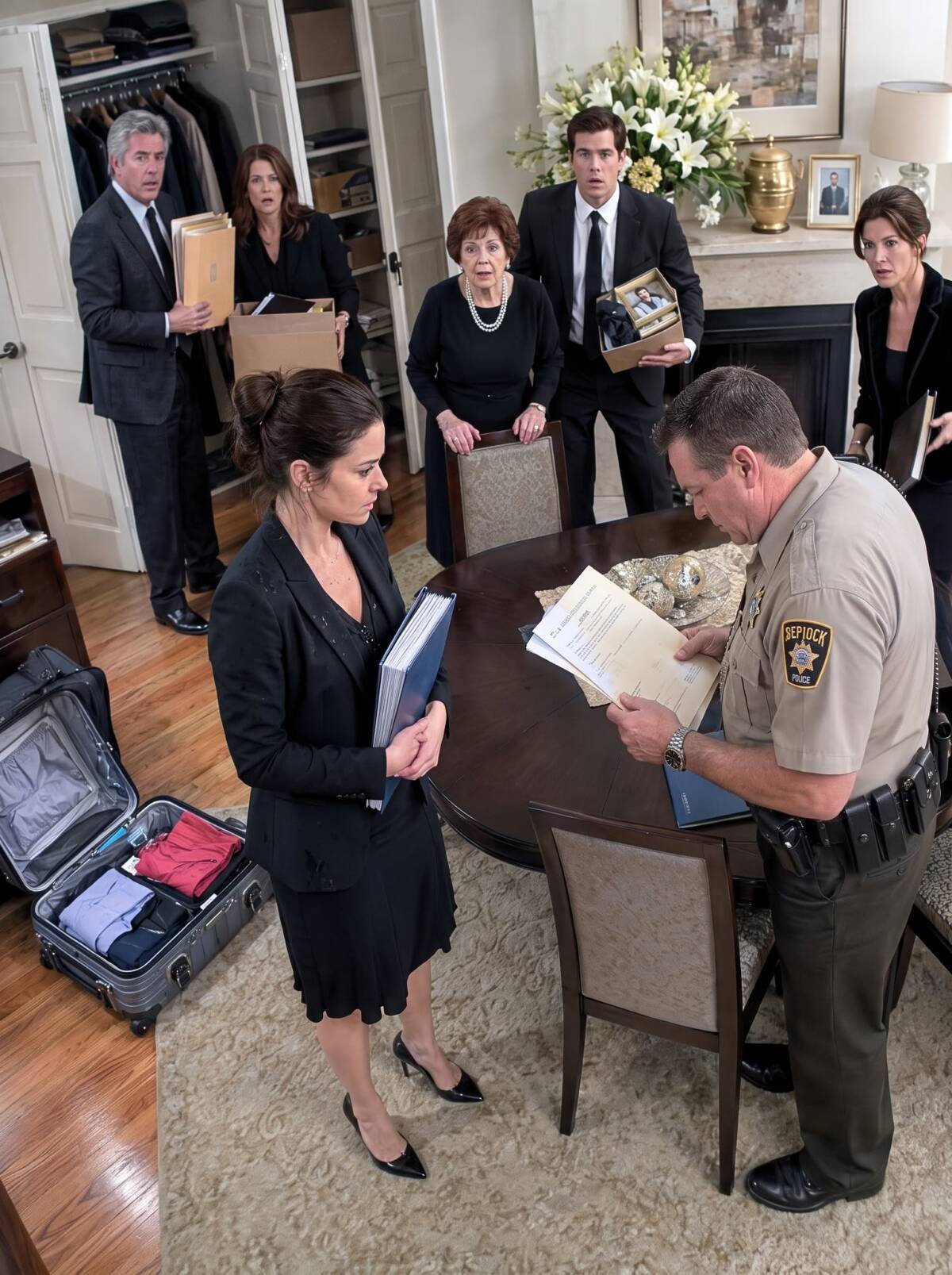
At my father’s funeral, in front of nearly forty relatives and lifelong family friends, my brother stood behind the chapel podium and announced that our childhood home on Maple Street would be sold immediately. He framed the decision as a noble, practical necessity to settle “family obligations” and secure our mother’s future.
What he didn’t mention—and what he was desperately trying to bury alongside our father—was that those “obligations” were $340,000 in unpaid gambling debts.
Before the whispers had even settled in the pews, my mother stood up, turned directly toward me, and delivered the final blow with chilling composure. “Your sister is independent,” she told the room. “She has her own life in the city. She’ll need to find another place to live.”
Dozens of eyes shifted to me, waiting for a scene, an argument, or tears. I didn’t give them any of it. I sat in complete silence, my hands folded in my lap, until the scrape of a chair echoed from the back of the chapel.
Our family attorney, a man who had managed my father’s affairs for thirty years, rose slowly to his feet. “I’m afraid neither of you understood Mr. Henderson’s final wishes,” he said calmly.
In an instant, the air left the room—and the practiced confidence vanished from my brother’s face.
The Performance of Grief
To understand how we arrived at that moment in the chapel, you have to understand the architecture of the Henderson family.
I was sitting four rows back from the polished mahogany casket, watching my older brother, Marcus, perform grief with the effortless charisma he had relied on his entire life. Just minutes earlier, he had delivered a sweeping, sentimental eulogy packed with stories of weekend fishing trips, backyard baseball games, and late-night father-son talks. They were touching stories, delivered with just the right tremor in his voice. The only problem was that half of them were so heavily polished they barely resembled the quiet, reserved man I had actually grown up with.
When Marcus finished his eulogy, he didn’t step down. Instead, he gripped the edges of the wooden podium, leaned toward the microphone, and adopted a solemn, businesslike tone.
“As many of you know, Dad’s passing has left us with some heavy logistical burdens,” Marcus said, his eyes sweeping across the rows of aunts, uncles, and neighbors. “After talking it over with Mom, we’ve decided the best way to honor his memory and make sure she’s taken care of is to sell the house on Maple Street right away. To cover… family obligations.”
A low ripple of murmurs moved through the chapel. Everyone knew the Maple Street house was the centerpiece of my parents’ lives—a sturdy, two-story colonial my father had maintained with meticulous pride for more than three decades. Selling it before the dirt had even settled on his grave seemed abrupt, even alarming.
What almost no one in that room knew was that my mother, Eleanor, had been quietly draining her own accounts for years to keep Marcus afloat. Now, with his creditors closing in and $340,000 on the line, the house was the last chip left on the table.
Eleanor rose from the front pew. She didn’t look at the casket. She didn’t look at the floral arrangements I had spent two sleepless nights coordinating. She looked straight at me.
“Your father would understand,” she said smoothly, her voice carrying clearly to the back walls. “Marcus needs the support right now. Briana is independent; she has her own career in the city. Your sister can find somewhere else to live.”
The silence that followed was heavy and suffocating. A few cousins stared awkwardly at their folded funeral programs. Aunt Dorothy’s hand flew to her mouth. Others simply watched with detached curiosity, as if publicly erasing a daughter from her own family before her father was buried were just another item on the afternoon itinerary.
I didn’t flinch. I didn’t argue. Being treated as an afterthought in the Henderson family wasn’t a shock—it was the baseline I had lived with for thirty-two years.
The Daughter Who Was Only a Guest
In our house, there had always been two sets of rules: one for Marcus, and one for me. Marcus was the investment, the heir, the name that mattered. I was the temporary resident.
I learned that lesson permanently at eighteen. I had just graduated near the top of my high school class with a 3.9 GPA, and I remember spreading my college acceptance letters across the dining room table like trophies—Penn State, Temple, and Drexel. My heart had been racing with pride, waiting for my parents to finally see how hard I had worked.
My mother barely glanced at the Temple letter before sliding it back across the wood.
“Why would we spend that kind of money on you?” she asked, her tone completely matter-of-fact. “You’re a girl, Briana. You’ll get married one day. You’ll be a guest in someone else’s house. Marcus, on the other hand, needs an education that reflects his potential.”
I remember turning to my father, desperate for him to step in. I waited for him to tell her she was wrong, to say that my future mattered just as much as my brother’s. Instead, Richard Henderson stared down into his coffee mug and said nothing.
For years, his silence hurt far more than my mother’s cruelty. I interpreted his refusal to speak as quiet agreement.
So I left. I worked two jobs, took out student loans that made my stomach knot every time a statement arrived, and pushed through accounting school on sheer stubbornness. I earned my CPA license, built a steady, respected career in Philadelphia, and carved out a life entirely on my own terms. Ironically, the independence I had been forced to build became the exact excuse my mother used whenever Marcus needed another bailout.
For two years after college, I barely spoke to them. It wasn’t about punishment; it was about survival. Every visit home reminded me of the small, shrinking box they expected me to fit into. Eventually, I allowed brief phone calls and the occasional holiday dinner back into my schedule, though I never again mistook those visits for belonging.
The 2:00 AM Call and a House Already Claimed
The phone rang at two in the morning on a Tuesday. My father had collapsed at home.
I drove through the empty Philadelphia streets with my hands shaking on the steering wheel, praying I would make it in time to say something—anything—that bridged the quiet distance between us. When I pulled into the parking lot at Jefferson Memorial, Marcus’s silver Mercedes was already parked near the entrance. By the time I reached the ICU room, my father was gone.
Our last conversation had taken place three months earlier. It had lasted barely ninety seconds. He had called to ask if I was doing all right. I had told him I was busy with work, asked how his back was feeling, and neither of us had found the courage to say what was actually sitting between us. Now, there would never be another chance.
The next morning, I drove to Maple Street expecting to find a house suspended in grief. Instead, it looked like an estate sale in progress.
Marcus had been unemployed for eight months, yet the living room was cluttered with his designer luggage, a brand-new set of golf clubs, and unopened boxes of high-end electronics. He moved through the house with the restless energy of a man already spending the proceeds of a sale.
When I walked upstairs to my old bedroom, I stopped in the doorway. My twin bed was gone. My bookshelves had been cleared. The room had been converted into a storage vault for Marcus’s overflow—garment bags, shoe boxes, and stacks of luxury goods he had no business owning.
I closed the door quietly and went back downstairs. Somebody had to handle the actual work of burying Richard Henderson, and it clearly wasn’t going to be Marcus. Over the next three days, I coordinated with the funeral home, drafted the obituary, selected the flowers, and organized the reception. Marcus focused his energy on greeting neighbors at the front door with red-rimmed eyes and a well-rehearsed sigh.
Behind closed doors, however, the urgency was impossible to miss. Late one evening, I walked past the kitchen and heard Marcus speaking in a low, frantic hiss into his cell phone.
“I know, I know! Just give me until after this week,” he snapped. “I’ll have the money. The house is as good as sold.”
He spotted me in the hallway and ended the call immediately, forcing a tight smile. “Work stuff,” he muttered, brushing past me.
Marcus hadn’t held a job in two-thirds of a year. I didn’t bother calling him out. Instead, I turned around and walked down the narrow wooden stairs to my father’s basement office.
The Folder in the Basement
Years as a CPA had taught me a simple truth: people lie, especially when they are desperate, but paperwork almost always tells the truth. Sorting through my father’s files also gave me a quiet place to breathe away from the tension upstairs.
The basement smelled faintly of cedar and old paper. One metal filing cabinet held neatly labeled manila folders of tax returns dating back to the 1990s. The second cabinet held a thicker, worn folder labeled IMPORTANT DOCUMENTS.
Inside were the usual artifacts of a life: marriage certificates, faded family photographs, my birth certificate, and property tax receipts. Tucked near the very back, however, was a crisp, heavy legal document bearing a name I had never heard before: Farwell Family Holdings LLC.
The filing was dated 2009. Curious, I flipped through the pages—and froze when I saw my own name printed in the operating agreement. On the final page, above a typed line, sat a signature that was unmistakably mine.
Slowly, a buried memory surfaced. Just after I graduated from college, my father had asked me to stop by the house on a Saturday afternoon. He had slid a stack of papers across the kitchen table, tapping the bottom line with a pen.
“Just some administrative business stuff,” he had said casually. “Sign here.”
I had trusted him enough not to question it, signed my name, and forgotten about it entirely. Yet here it was, preserved carefully in his private files nearly fifteen years later.
I slipped the document into my purse. Just as I closed the filing cabinet, the basement door creaked open at the top of the stairs.
“Briana?” my mother’s voice echoed down. “What are you doing in your father’s files?”
“Looking for his life insurance policy,” I replied evenly. “The funeral home asked for verification.”
She didn’t press further, but the next morning over coffee, I tested the waters. I casually mentioned Farwell Family Holdings LLC and watched her face.
For a split second, her composed mask slipped—a flicker of irritation, maybe even alarm—before she waved a hand dismissively.....