When a pediatrician pulls a mother into a quiet hospital hallway and says her ten-year-old daughter’s pregnancy test has come back positive, the world stops making sense.
Within hours, a family built on five years of trust was fractured. Her biological father rushed into the emergency room, pointed straight at her stepfather, and demanded that he be arrested on the spot. Suspicion filled every corner of the room, and a devoted husband suddenly found himself treated like a suspect in a nightmare he could never have imagined.
Nobody questioned the test. Nobody thought to look beyond the most terrifying explanation. Until an ultrasound came back empty—and a neurologist ordered an urgent brain scan that uncovered a hidden medical crisis no one saw coming.
The Symptoms That Looked Like Nothing
My name is Rachel, and for most of my life as a mother, I believed the worst phone call I could ever receive would come from a police officer or an emergency room nurse. Instead, the call that shattered our lives came from my daughter Sophie’s pediatrician on an ordinary Tuesday afternoon.
For nearly a month, Sophie had not been herself. She was ten years old—usually energetic, loud, and endlessly curious—but lately, she had been waking up exhausted. She complained of dull, persistent headaches that lingered behind her eyes. Several mornings a week, she hurried to the bathroom before breakfast, overcome by sudden waves of nausea and vomiting.
At first, I did what most parents do: I looked for the simplest explanation. A lingering stomach bug. Dehydration from soccer practice. The stress of fifth-grade math tests. I gave her extra fluids, adjusted her bedtime, and kept an eye on her temperature. When the symptoms refused to fade and she began complaining of dizziness during school, I finally scheduled an appointment with her pediatrician.
I walked into the clinic expecting a routine checkup and a lecture about rest and hydration. The doctor listened carefully, asked a series of questions, and ordered standard blood and urine panels to rule out an infection or anemia. We waited in the exam room while Sophie swung her legs against the paper-covered table, complaining that she was missing art class.
When the doctor returned, the warmth had drained from her face. She closed the door softly behind her and looked directly at me.
“Rachel,” she said, her voice steady but unusually serious, “I need to discuss one of Sophie’s test results with you privately.”
My stomach dropped. I stepped into the hallway, my mind racing through every childhood illness I had ever heard of. “Is it an infection?” I asked immediately. “Something in her blood?”
The pediatrician hesitated for a fraction of a second. “Sophie’s blood and urine both show an elevated level of hCG,” she said gently. “Because of that hormone, her pregnancy test came back positive.”
I stared at her, completely unable to process the words. “She’s ten years old.”
“I understand, Rachel,” the doctor replied. “And I want to be very clear: a positive result alone does not tell us what happened. We need to transfer her to the hospital for further evaluation immediately so we can determine why her body is producing this hormone.”
Her tone was calm and clinical, designed to keep me grounded, but the floor beneath my feet felt like it had vanished. I gripped the edge of the hallway counter, desperately searching for any rational explanation—a mixed-up sample, a faulty lab machine, anything that would make what I had just heard impossible.
When Fear Enters a Home
Driving to the hospital, my hands shook so violently on the steering wheel that I could barely stay in my lane. In the backseat, Sophie leaned her head against the window, pale and quiet, unaware that the adults around her were about to enter a tailspin.
My mind immediately went to Daniel.
Daniel had been Sophie’s stepfather for almost five years. He was the man who sat at the kitchen table with her every evening working through fractions, who stood on the sidelines of freezing Saturday morning soccer games holding a thermos of hot chocolate, and who made lopsided pancakes every weekend just to hear her critique them. He had never once given me a single reason to doubt his character or to believe my daughter was anything less than completely safe with him.
Yet as soon as I called Sophie’s biological father, Eric, to tell him what the pediatrician had found, the accusation took shape before I could even finish my sentence.
“Rachel, listen to me,” Eric said, his voice tight with panic and fury. “You need to get Sophie away from him right now. Do not let Daniel near her until we know what happened.”
Hearing him immediately point the finger at my husband made me physically sick. Every instinct in me wanted to defend Daniel, to tell Eric he was out of his mind. But another, louder instinct took over—the primal, unyielding duty of a mother. I did not know what the test meant. And until doctors and specialists gave me answers, Sophie’s safety had to come before my marriage, before Daniel’s feelings, and before my own certainty.
When Daniel arrived at the hospital, I met him outside the entrance before he could walk into Sophie’s room. I told him about the test result, and I told him that until the medical team figured out what was going on, Sophie needed to stay strictly with me.
The color drained from his face. He looked at me as though I had struck him.
“You think I could do something to Sophie?” he asked, his voice barely above a whisper.
“I don’t know what this test means yet, Daniel,” I said, fighting back tears. “I’m not accusing you. I just—until we understand what’s happening, I have to put her first.”
He stared at me for a long, agonizing moment. He didn’t raise his voice. He didn’t get defensive. Instead, his shoulders dropped under the weight of a wound I didn’t yet realize I had inflicted.
“You should put her first,” he said quietly. “I just wish you knew me well enough to know I would never hurt her.”
Minutes later, Eric burst through the automatic doors of the emergency department. His face was flushed, his eyes scanning the waiting area until they locked onto Daniel. Without a word of greeting, Eric marched forward, pointed directly at my husband, and shouted toward the security desk and nurses’ station.
“Arrest him! Get him away from my daughter!”
Hospital staff intervened immediately, stepping between the two men as I pleaded with Eric to lower his voice. I refused to let Sophie’s hospital room become a battleground built on panic and assumptions. Security guided Eric toward the family waiting area while Daniel silently retreated to the far end of the corridor, respecting the distance I had asked him to keep even as every eye in the hallway turned toward him with quiet suspicion.
The Ultrasound That Changed the Question
Inside the examination room, the medical team moved with practiced urgency. Doctors drew more blood to verify the hormone levels and scheduled an abdominal ultrasound. At the same time, a pediatric specialist trained in child advocacy asked to speak with Sophie privately.
Waiting outside that closed door was the longest hour of my life. When the specialist emerged, she told us that Sophie had consistently and calmly denied that anyone had ever touched her or behaved inappropriately toward her. In fact, she seemed genuinely confused by the line of questioning.
Eric wasn’t convinced. “She’s ten,” he argued, pacing the small consultation room. “Kids get scared. They protect people they know.”
I didn’t have the strength to argue with him. I just waited for the ultrasound.
Two hours later, the attending physician called Eric, Daniel, and me into a private conference room. Daniel stood near the door, keeping his distance, while Eric leaned forward in his chair, braced for the worst.
“The ultrasound is complete,” the doctor said, looking at each of us in turn. “There is no pregnancy.”
For a heartbeat, nobody breathed.
Eric was the first to speak. “Are you sure? Could it be too early to see? Then why was the test positive?”
“The repeat bloodwork confirmed that Sophie’s hCG levels are genuinely elevated,” the doctor explained. “This was not a laboratory error. However, there is no gestational sac, no sign of pregnancy whatsoever. That means something else inside Sophie’s body is producing this hormone.”
For the first time since the pediatrician’s phone call, I turned and looked at Daniel. A cold wave of realization washed over me. Fear had driven us straight down a single, devastating path—and we might have been completely wrong.
While Eric continued to question how an ultrasound could be certain, the medical team had already shifted its focus. If Sophie wasn’t pregnant, her symptoms—the headaches, the morning vomiting, the exhaustion—were no longer being viewed through the lens of a pregnancy test. They were clues to something else entirely.
A pediatric specialist returned to Sophie’s bedside for a more thorough neurological exam. As she asked Sophie to follow her finger with her eyes, she noticed something subtle that I had never caught at home. Sophie struggled to look upward. When pressed gently, Sophie admitted something she had been too afraid or too tired to mention before.
“Sometimes I see two of things,” she murmured. “And I haven’t been able to read the whiteboard at school for a couple of weeks.”
The doctor’s expression shifted instantly. Within twenty minutes, a pediatric neurologist was in the room. After conducting his own exam, he turned to me and spoke with quiet urgency.....
Related Posts
For Six Years, I Secretly Paid My 84-Year-Old Neighbor’s $29 Water Bill. The Morning After Her Funeral, Her Son Showed Up With a Lawyer—Until I Handed Him the Envelope She Left Behind
For six years, I quietly paid a twenty-nine-dollar monthly water bill for my elderly neighbor, Ada Holloway, convinced she had no idea. It was a…
Read more
I Arrived Late to My Only Son’s Funeral and Refused to Let Them Bury Him—One Look at My Daughter-in-Law’s Face Revealed a Betrayal Worse Than Death
Clara Vance arrived at Oakridge Memorial Cemetery ten minutes after the graveside service had already begun, bracing herself for the hardest hour of her life….
Read more
My 8-Year-Old Begged for a Short Haircut All Week—Then the Stylist Lifted Her Hair and Whispered One Question That Started a Police Investigation
There are moments in life that quietly divide your existence into a clear before and after. You rarely see them coming. They don’t arrive with…
Read more
My Doctor Husband Refused My Emergency C-Section to Punish Me—He Never Knew I Recorded Every Word
In the high-stakes world of Manhattan medicine, a physician’s word is law—until the day a doctor uses his authority to silence his own wife on…
Read more
“Mom, Please Help!” My 10-Year-Old Called Me Shaking—When I Raced Home to Find Her and My Husband Unconscious, an Officer Pulled Me Aside and Whispered, “Ma’am, You May Not Believe Why This Happened”
It started at 3:17 p.m. on an ordinary Tuesday afternoon, the kind of quiet weekday when nothing is supposed to go wrong. I was sitting…
Read more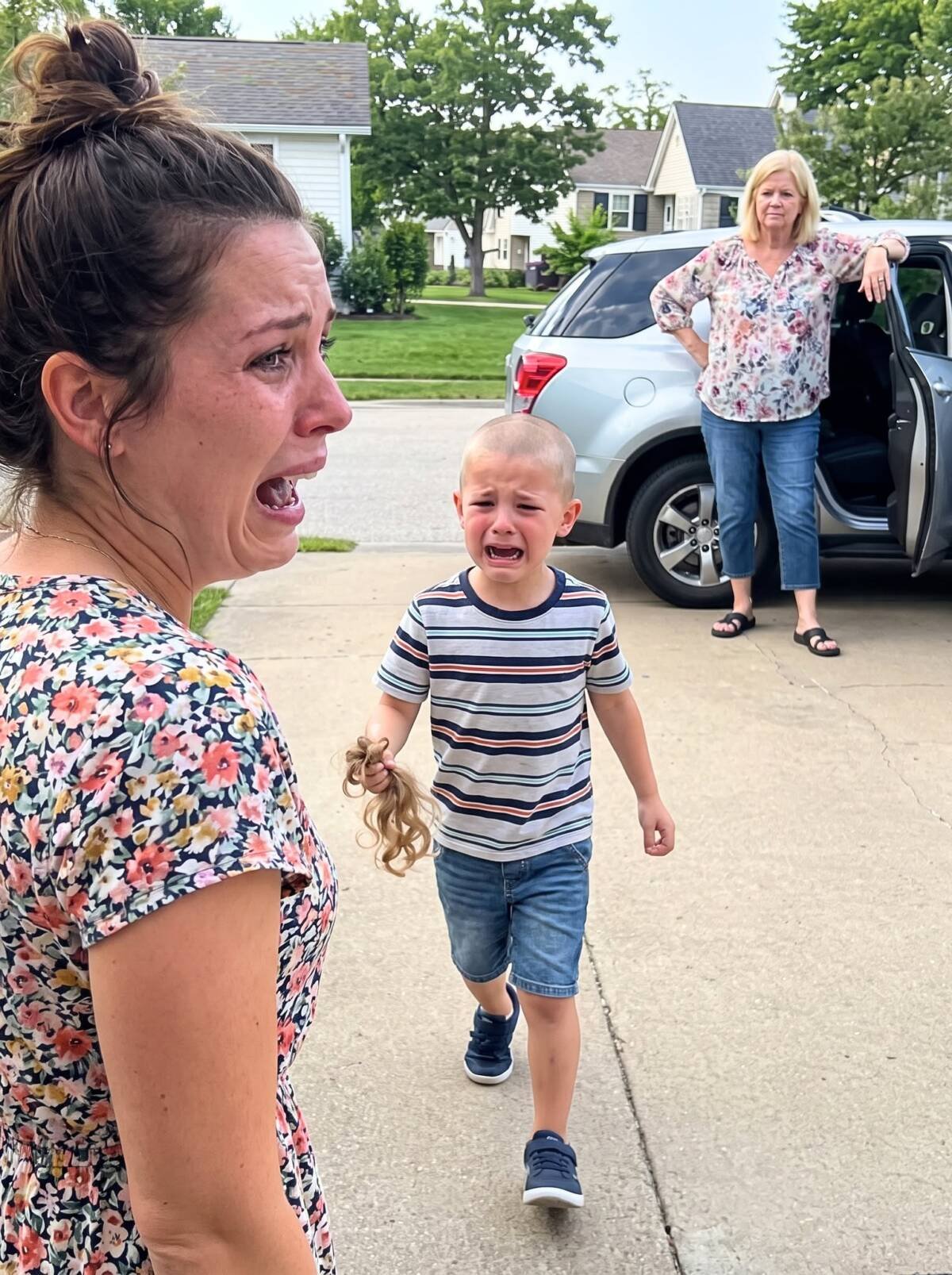
My Mother-in-Law Secretly Picked Up My 5-Year-Old Son From School and Shaved Off His Golden Curls—Then My Husband Served Her a Sealed Envelope at Sunday Dinner
When five-year-old Leo stepped out of his grandmother’s car on a Thursday afternoon, his eyes were swollen from crying, his head was covered in a…
Read more