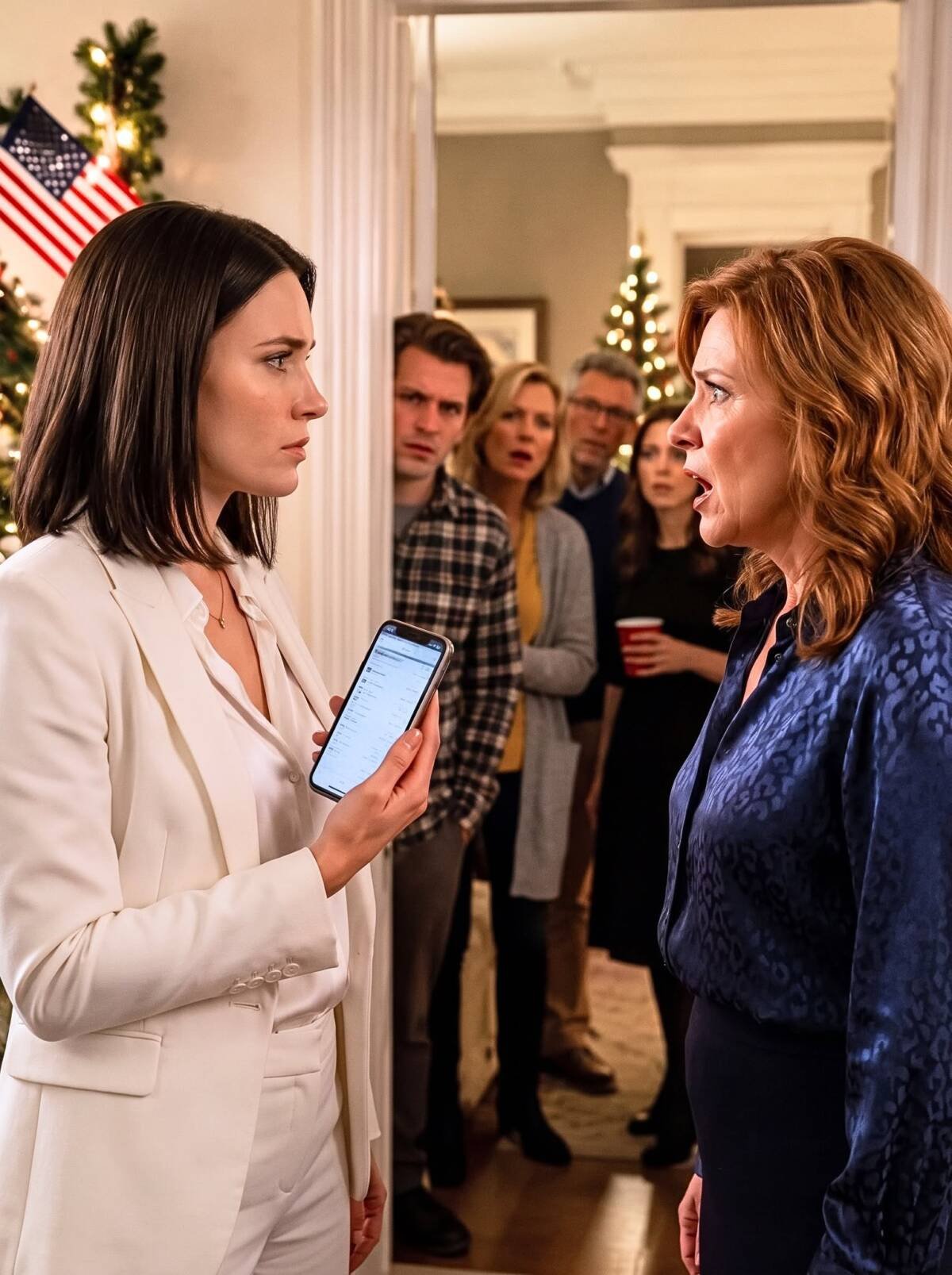
When my biological father returned after 14 years with a brand-new car, he thought one expensive gift would prove he was the man who mattered most. He even turned to my stepdad and declared, “Now he knows who his real father is.” But he had no idea what the man he was trying to humiliate had already sacrificed for me.
For a moment, I wanted to embarrass him in front of everyone. I wanted to wipe that smug smile off his face and make him understand exactly what he had missed.
Then I realized I had a better way to respond.
I didn’t need to shout, insult him, or turn my seventeenth birthday into a public argument. All I needed was a small wooden box, a stack of bank statements, and the truth he had never bothered to learn.
By the end of that afternoon, the expensive car would be driving away without me, and the man who had spent years proving he was my father would finally hear something I had wanted to say for a very long time.
A Childhood Defined by Absence
For most of my childhood, my biological father was little more than a face in old photographs and a name attached to questions nobody seemed able to answer.
I hadn’t seen him since I was three years old. I was too young to remember much about him, and as I grew older, the empty space he had left became something I learned to live with rather than something I expected to change.
My mother did her best to make sure I never felt that absence too deeply. She worked hard, kept our household running, and found ways to make a limited budget stretch further than it reasonably should have.
Still, children notice more than adults sometimes realize.
I noticed when the bills piled up on the kitchen counter. I noticed when Mom put something back on a store shelf after checking the price. I noticed when she bought groceries for us but went another week without replacing something she needed herself.
Whenever I needed new shoes for school, a piece of equipment for football, or something my friends seemed to get without thinking twice, Mom tried to find a way to make it happen.
But there were limits.
By the time I was thirteen, I had become careful about asking for things. I learned to distinguish between what I wanted and what I genuinely needed, and I often kept my wishes to myself because I knew every extra expense meant another decision for Mom to make.
I didn’t resent her for any of it. If anything, watching her work so hard made me want to ask for even less.
What I didn’t understand then was that our lives were about to change in a way that had nothing to do with money.
It started when I was fifteen and Mom met a man named Ray.
The Man Who Never Needed to Call Himself My Father
Ray had two children of his own, Danny and Cara, who stayed with us every other weekend. When he and Mom began building a life together, our small house became louder, busier, and occasionally more chaotic.
There were more shoes by the front door, more arguments over television shows, more dishes in the sink, and more people competing for space at the kitchen table.
But there was also something else.
For the first time in years, our home began to feel like a place where we were building something together.
Ray never treated me as an obligation that came with dating my mother. He didn’t act as though I was someone else’s responsibility, and he never made me feel that his biological children deserved more attention than I did.
He simply included me.
One of the first things I noticed was that Ray showed up to my football games.
Every single one.
It didn’t matter whether the game was important, whether the weather was miserable, or whether I was likely to spend most of the afternoon sitting on the bench.
He was there.
After one particularly uneventful game, I found him waiting near the fence. I had barely played, and I couldn’t understand why he had bothered to stay for the entire afternoon.
“You know I was barely on the field, right?” I asked.
“I know,” he replied.
“You stayed for the whole game.”
“Yep.”
“Why?”
Ray looked at me as though I had asked him why the sky was blue.
“Because you were here.”
That was it.
He didn’t turn the moment into a lecture about commitment or make a grand speech about how much I meant to him. He simply acted as though being there was the most natural thing in the world.
At the time, I didn’t fully understand how unusual that kind of consistency could be.
I would later realize that it was one of the most important things anyone had ever given me.
He Stayed When Things Got Difficult
The following year, I nearly failed chemistry.
It wasn’t because I wasn’t trying. I was struggling to understand the material, and the more frustrated I became, the harder it was to concentrate. Every poor grade made the next assignment feel even more intimidating.
Ray noticed.
One evening, he pulled up a chair beside me at the kitchen table and asked to see my homework.
He wasn’t a chemistry expert, and he certainly didn’t have all the answers. Sometimes we spent twenty minutes trying to understand a single problem. Other nights, we worked through equations until the clock approached midnight.
There were evenings when neither of us wanted to look at another textbook.
Still, Ray kept coming back.
One night, after staring at a page full of calculations, I finally put my pencil down.
“You realize you’re making this harder, right?” I told him.
“Probably.”
“Then why are you still helping?”
He leaned back in his chair and gave me a small shrug.
“Parents don’t quit before their kids do.”
He said it casually, without pausing to consider how those words might sound.
But I noticed.
He had called himself a parent.
And for the first time, I understood that he might already see me as his son, even though we shared no biological connection.
I never told him how much that moment meant to me. I was fifteen, and expressing feelings like that wasn’t something I knew how to do comfortably.
Instead, I went back to my homework.
Ray stayed beside me.
A few months later, he and Mom got married.
By then, I had stopped thinking of him as simply the man my mother was dating. He had become part of my everyday life, someone I could count on when things went wrong, when I needed advice, or when I simply needed an adult to show up.
What I didn’t know was how much he was doing behind the scenes to help secure my future.
The Birthday Present I Never Expected
After Ray and Mom married, they opened a college savings account in my name.
It wasn’t a decision made with a large inheritance or a comfortable financial cushion behind it. Our family still had bills to pay, Danny and Cara still needed things, and Ray’s aging truck seemed to require another repair every few months.
Some months, they managed to put a little money into my account.
Other months, there was nothing left.
I never expected much from it. I knew Ray and Mom were trying, and I understood that saving for college was difficult when everyday expenses already demanded so much of their income.
Still, the account continued to grow, one small contribution at a time.
Then came my seventeenth birthday.
That morning, Ray knocked on my bedroom door carrying a small wooden box.
He had made it himself.
One corner was slightly uneven, and the wood showed a few marks where he had corrected mistakes. It wasn’t the kind of gift you would see displayed in a store window, but my initials, J.M., had been carefully burned into the lid.
I ran my fingers over the letters.
“You made this?”
“Took me about six weeks,” he said.
I opened it.
Inside were statements from my college savings account, neatly arranged in chronological order.
At first, I didn’t understand why he had given me bank statements for my birthday. Then I began turning the pages and noticed handwritten notes beside many of the deposits.
Boots can wait — $40.
Brought lunch all week — $25.
Truck service next month — $60.
I stopped at the first page and read the notes again.
Then I turned to the next statement.
The pattern continued.
Every few weeks, Ray had found a little money to put toward my future. But the notes revealed something I had never considered: those deposits weren’t simply coming from whatever happened to be left over at the end of the month.
They came from choices.
Ray had delayed buying new work boots. He had brought lunch from home instead of buying it during the workday. He had postponed repairs on his truck so that a little more money could go into my account.
Then I reached a month when there was no deposit at all.
Beside the empty space, Ray had written:
Danny needed new glasses. Tight month — $0.
I stared at the note for a long time.
Danny was his son. Of course Ray was going to make sure his child could see properly. That wasn’t something I questioned.
But what happened next surprised me even more.
On the following statement, I found another handwritten note.
Made it up this month — $80.
Ray had returned to the account and contributed more than usual, trying to make up for the month when the family couldn’t spare anything.
I slowly turned through the remaining pages.
Five dollars here. Twenty dollars there. Sometimes forty. Sometimes eighty.
The amounts were modest, but the sacrifices behind them were not.
For the first time, I understood what the account really represented.
It wasn’t just money.
It was time, patience, planning, and a thousand small decisions made by a man who wanted me to have opportunities he couldn’t simply afford to hand me.
When I finally looked up, Ray seemed almost embarrassed.
“I just wanted you to know we were still making progress,” he explained. “Even when it doesn’t look like much.”
At the bottom of the box, beneath the statements, was a folded note.
I opened it and read the words inside.
Kid,
It isn’t enough yet.
We’ll keep going.
Ray.
I read it twice.
The wooden box was probably the least expensive birthday present I received that year. Yet it immediately became the most meaningful one.
It represented everything Ray had done without asking for recognition.
I put the note back in the box and closed the lid carefully.
I had no idea that within a few hours, someone else would arrive with a gift designed to make Ray look insignificant.
A Knock at the Door Changed Everything
About three hours later, someone knocked on our front door.
Mom went to answer it.
I heard a man’s voice from the hallway, followed by a sentence that made me freeze.
“I came to see my son.”
I stepped out of my room and walked toward the front door.
Standing there was a man I recognized from the few photographs Mom had kept over the years.
My biological father.
He looked older than I remembered from the pictures, with gray beginning to show near his temples. He wore an expensive jacket and a watch that caught the light whenever he moved his hand.
He smiled at me as though the fourteen years between us had been a brief misunderstanding.
“Happy birthday, son.”
I didn’t know what to say.
There had been no birthday cards. No phone calls. No visits. No messages asking how school was going or whether I had made the football team.
He had missed years of my life, including the ordinary moments that had shaped the person standing in front of him.
Yet here he was, speaking as though we could pick up where we had left off.
He briefly acknowledged that he owed me answers. But before I could ask any of the questions that had followed me throughout childhood, he said my birthday wasn’t the right time to discuss the past.
Instead, he asked me to come outside.
He had brought me something.
I followed him onto the porch.
Parked in front of our house was a brand-new black car with a giant red bow stretched across the hood.
For a moment, I couldn’t believe what I was seeing.
I had wanted a car for years. I imagined the freedom of driving myself to school, getting to football practice without arranging a ride, and no longer depending on other people whenever I needed to go somewhere.
The car was far beyond anything I could have expected to receive.
My biological father held up the keys.
“Happy birthday.”....