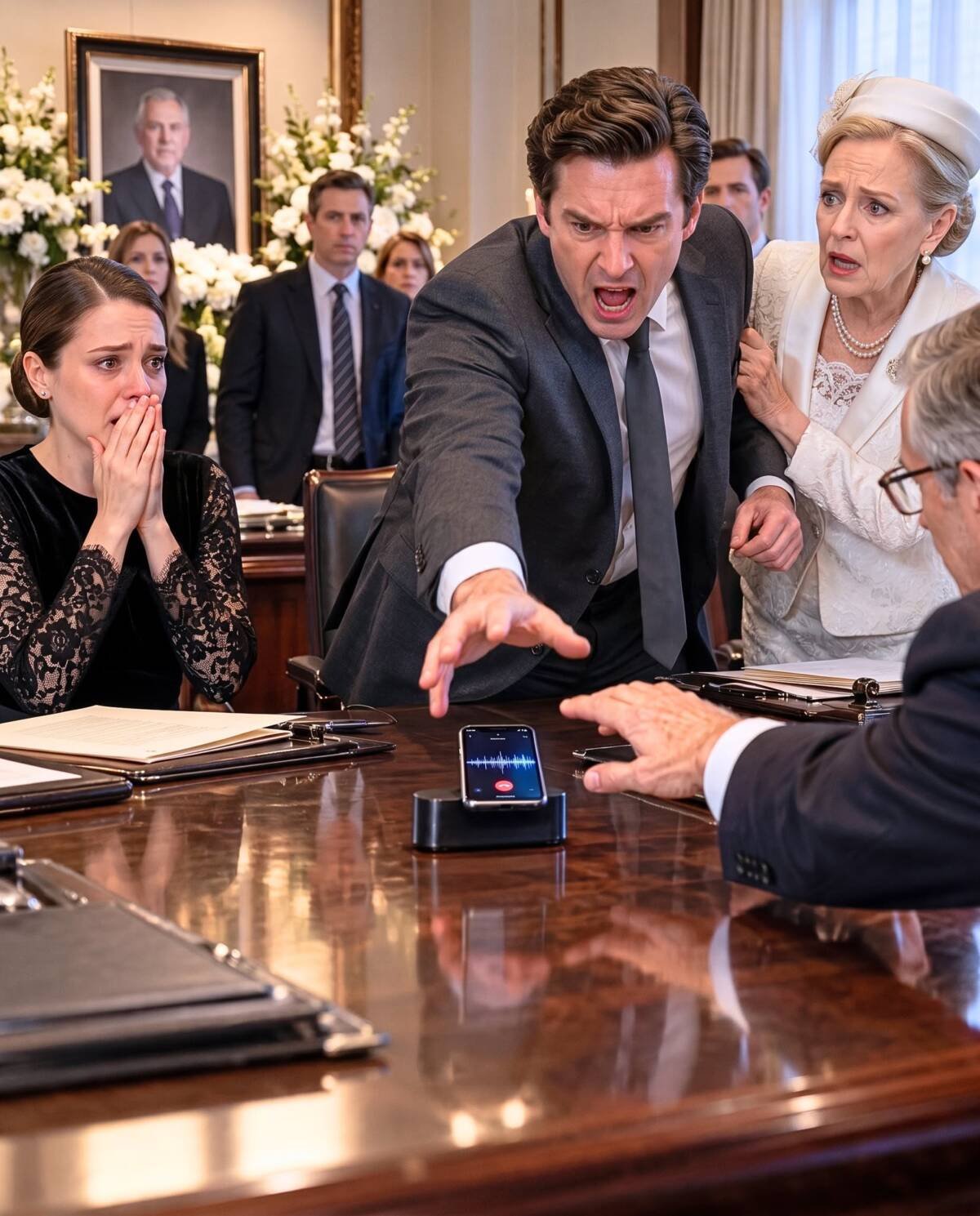
For eight years, my parents sent me away whenever my older brother’s wealthy future in-laws came to visit. They said my history of depression was embarrassing and that I might damage his future. I obeyed until the night I discovered the truth: my family had told everyone I was dead. Four years later, I returned to the one place they never expected to see me again—and everything they had carefully hidden began to unravel.
Introduction: The Daughter Who Was Never Supposed to Exist
For eight years, I learned how to disappear without leaving a trace.
Whenever my older brother, Julian, invited his fiancée, Clara, and her wealthy family to our home, my mother found a reason for me to leave. Sometimes she gave me money for a motel. Other times, she told me to spend the weekend with a friend, even though she knew I had nowhere to go.
Her explanation never changed.
“They’re respectable people, Anastasia. Please don’t make things uncomfortable for us.”
My father, Arthur, rarely bothered to offer an explanation. He would lower his newspaper, glance at me over his glasses, and tell me to find somewhere else to stay until the guests had gone.
I was their daughter, but inside our house, I had become an inconvenience.
The reason was something I had spent years trying to overcome: when I was eighteen, I received psychiatric treatment for severe depression. It was one of the most difficult periods of my life, but instead of helping me rebuild my confidence, my parents treated my illness as a permanent stain on our family’s reputation.
My mother worried about appearances. My father preferred silence. And Julian, the son whose future seemed to matter more than anything else, never questioned why his sister kept disappearing.
So I left whenever they asked.
I slept in inexpensive motels, sat through long nights in twenty-four-hour diners, and sometimes stayed in my car until morning. I told myself that my parents were simply protecting Julian’s future and that one day they might finally understand how much their behavior hurt me.
I was wrong.
The truth was far worse than anything I had imagined.
One evening, I returned to my childhood home to retrieve medication I had forgotten. I expected to slip inside, collect it, and leave before anyone noticed.
Instead, I overheard my mother comforting Clara’s mother, Victoria, outside my bedroom.
“Oh, Victoria,” my mother whispered, pressing a lace handkerchief to her face. “Some days I still can’t bring myself to open this door.”
Victoria placed a hand on her shoulder.
“You’ve been so strong, Eleanor.”
My mother looked toward the closed bedroom door.
“It’s exactly the way she left it.”
Then Victoria said the words that changed my life.
“Anastasia is watching over Julian and Clara. I truly believe that.”
For a moment, I couldn’t breathe.
They weren’t telling people I lived in Atlanta. They weren’t merely hiding my psychiatric history or pretending I had moved away.
My parents had told everyone that I was dead.
And inside the bedroom I had once called my own, they had built a memorial to a daughter who was still alive.
What happened next would take me four years, hundreds of miles from home, and a life I had never imagined possible. But first, I had to understand how the people who were supposed to love me had managed to erase me.
Chapter 1: The Family Secret That Started With Shame
My name is Anastasia Dunaway, and I grew up in a comfortable New Jersey home where appearances were treated almost like a family religion.
My mother, Eleanor, believed that a respectable family should always look composed. Our lawn had to be immaculate, our clothes appropriate, our holidays photographed, and our private problems kept firmly behind closed doors.
My father, Arthur, rarely challenged her. He worked, paid the bills, and avoided arguments whenever possible. In our home, his silence often carried the same weight as my mother’s criticism.
My older brother, Julian, fit neatly into the life they wanted to present to the world. He was charming, ambitious, and successful in the way our parents understood success. When he became engaged to Clara, whose family had money, influence, and connections in prominent charitable organizations, my mother treated the engagement as the crowning achievement of her social life.
Clara’s father served on hospital boards, and her mother was involved with the church and several community charities. My parents admired them enormously.
They wanted the Dunaway family to look equally polished.
Unfortunately, I did not fit the picture.
At eighteen, I had experienced a period of severe depression that required professional psychiatric treatment. I had struggled, sought help, and begun the difficult work of recovering. I hoped that my family would understand that treatment was not a moral failure and that needing support did not make me less deserving of love.
My mother saw things differently.
“You know how Clara’s family is,” she told me one afternoon. “They don’t need to hear complicated stories about our family.”
I remember standing at the kitchen counter while she counted several bills and slid them toward me.
“Take this. Find somewhere to stay until Sunday.”
I stared at the money.
“Why do I have to leave? This is my home, too.”
Her expression hardened.
“Please don’t start this again. Julian has worked very hard to build a future for himself. We are not going to jeopardize that because you insist on making everything about you.”
I wanted to tell her that I wasn’t trying to make anything about myself. I wanted to sit at my own family’s dinner table without feeling as though my existence were an accusation.
Instead, I took the money.
My father sat in the living room, reading his newspaper. He heard every word but offered no objection.
“Your mother is trying to keep the peace,” he said when I passed him. “Just cooperate for once.”
That became the pattern.
Whenever Clara and her relatives visited, I disappeared. I learned to pack quickly, avoid questions, and return only after the house had been restored to its usual order.
Sometimes I stayed in a cheap motel. Sometimes I spent the evening in a diner, nursing a cup of coffee until the staff changed shifts. When money was tight, I slept in my car and drove somewhere else before sunrise.
I kept working, saving what I could, and trying to build a life that did not depend on my parents’ approval.
Eventually, I found work at Green Valley Nursery, where I cared for trees, shrubs, and flowers.
The work suited me. Plants did not care about family reputations. A damaged branch could be pruned, a struggling tree could be given better soil, and a neglected plant could recover with patience.
No one asked me to explain the worst period of my life before allowing me to do my job.
For the first time in years, I felt useful without having to prove that I was worthy of being present.
I believed that keeping my distance from my family was the price I had to pay for peace.
I had no idea they were preparing an entirely different story about my absence.
Chapter 2: The Woman Who Bought My Memorial Tree
Six months before I discovered the truth, Clara walked into Green Valley Nursery.
It was a pleasant morning, and sunlight filtered through the greenhouse windows, illuminating rows of flowering plants. I was checking a delivery of young trees when I noticed a woman in a white linen dress approaching the counter.
She wore a silk scarf and carried herself with the effortless confidence of someone accustomed to being welcomed wherever she went.
“Excuse me,” she said. “Could you help me choose a dogwood tree?”
“Of course. Are you looking for a particular variety?”
“Something with white blossoms. It’s for a memorial garden at our church.”
I began explaining the varieties we had available.
Then she added something that made me pause.
“My fiancé’s family lost a young girl years ago. We’d like the garden to be a peaceful place where people can remember loved ones.”
I felt a small tightening in my chest, but I assumed she was talking about a relative I had never met.
I showed her a healthy white dogwood and explained how to plant it, how much sunlight it needed, and how to protect its roots during the first winter.
Clara listened carefully.
“This one is beautiful,” she said. “I think it would be perfect.”
I helped prepare the tree for transport, secured the root ball, and watched as she loaded it into her Mercedes.
Before leaving, she thanked me for taking the time to explain everything.
“You’ve been very helpful.”
I smiled.
“I’m glad I could help.”
She drove away, and I returned to work.
Only later would I understand the cruel irony of that ordinary transaction.
The young girl Clara wanted to remember was me.
My family had apparently turned my disappearance into a story of tragedy, allowing other people to mourn a daughter who was still working, paying her bills, and trying to recover from years of emotional rejection.
I had unknowingly sold the tree that would become part of my own memorial.
At the time, I knew none of this.
I continued living as I always had, leaving my parents’ house whenever they demanded it and telling myself that I could eventually move beyond the humiliation.
Then came another family dinner.
And another demand that I leave.
This time, I returned home after dark to retrieve medication I had forgotten on my nightstand.
I entered through the mudroom, moving quietly out of habit. The hallway was dim, and the house seemed unusually still.
Then I heard voices near my bedroom.
I stopped.
My mother’s voice was unmistakable.
“Oh, Victoria. Some days I still can’t bring myself to open this door.”
I stood motionless, trying to understand why she would say that about my room.
Victoria answered gently.
“You’ve been so strong.”
My mother sniffled.
“It’s exactly the way she left it.”
Then came the sentence that made my stomach drop.
“Anastasia is watching over Julian and Clara,” Victoria said. “I truly believe that.”
For several seconds, my mind refused to put the words together.
I was alive. I was standing in the hallway. My medication was waiting inside the bedroom.
Yet two women were discussing me as if I had been buried years earlier.
I waited until their footsteps faded, then approached the door.
My hand trembled as I turned the handle.
Chapter 3: The Memorial Inside My Bedroom
The room looked like a photograph of my childhood frozen in time.
My bed was neatly made. The curtains were exactly where I remembered them. My books remained on the shelves, and the small decorative objects I had collected as a teenager sat untouched on the dresser.
It was not a bedroom anymore.
It was a shrine.
In the center of the display stood a framed photograph, a white dogwood tree, and a black granite plaque.
I moved closer.
The inscription read:
IN LOVING MEMORY OF ANASTASIA DUNAWAY, 1995–2014.
AN ANGEL TAKEN TOO SOON.
I read the words once.
Then again.
The year 2014 was the year I had received psychiatric treatment. It was the year my life had become difficult, the year I had needed help, and the year my mother had begun treating me as a source of shame.
Apparently, it was also the year my family had decided I was easier to explain as dead.
Everything suddenly made sense.
The weekends away. The insistence that I avoid Clara’s family. The untouched bedroom. My mother’s carefully performed grief.
My parents had not simply been telling people that I was living elsewhere.
They had created an entirely fictional version of my life.
I imagined my mother discussing her tragic loss at church gatherings. I pictured her accepting condolences from people who believed she had endured the death of a child. I wondered how many people had hugged her, offered sympathy, or praised her strength while I was sleeping in my car.
The thought made me feel physically ill.
Then I noticed the dogwood tree.
I recognized it immediately.
It was the same kind I had sold Clara at the nursery.
For months, I had believed I was simply helping a customer choose a tree for a charitable project. In reality, I had helped supply the centerpiece of a memorial built around a lie.
I expected tears to come, but they did not.
Instead, something inside me became unusually still.
I looked at the plaque and realized that my parents had constructed a permanent monument to the version of me they found easiest to accept: a daughter who could never contradict them, never embarrass them, and never ask why they had abandoned her emotionally when she needed them most.
A dead daughter was convenient.
A living one could speak.
I opened my closet and removed a small lockbox I had kept hidden for years. Inside were my birth certificate, passport, Social Security card, bank records, and other documents I had protected because I had always known that I might eventually need to leave for good.
I packed the essentials.
Then I stood in the doorway and looked at the room one last time.
I switched on every light and left the door wide open.
If my mother wanted to preserve the room as a memorial, she could explain why it was suddenly empty.
That night, I drove north.
I did not leave a note.
I did not call Julian.
I did not tell my parents where I was going.
For the first time in eight years, I was not leaving because they had ordered me to go.
I was leaving because I had finally chosen myself.
Chapter 4: Starting Over in Vermont
By the following evening, I had reached Philadelphia.
I stopped at a gas station, removed the SIM card from my phone, and destroyed it. I wanted distance from my family, and I knew that answering their calls would make it harder to maintain it.
For years, I had been conditioned to respond whenever my mother demanded something. Even when I was hundreds of miles away, I could still hear her voice telling me that I was making things difficult.
I needed silence long enough to discover what I wanted without hearing her judgment in my head.
For the next two weeks, I slept in my car and used public-library computers to search for employment.
Eventually, I found an opening at Green Mountain Botanicals, an orchard and landscaping farm outside Burlington, Vermont.
The owner, Martha Vance, was an older woman with a practical manner and little patience for unnecessary explanations.
During the interview, she reviewed my nursery experience and asked whether I knew how to prune fruit trees.
“Yes.”
“Can you work outside in difficult weather?”
“Yes.”
“Do you show up when you say you will?”
“I do.”
She looked at me for a moment, then closed the folder.
“Good. There’s a caretaker’s cabin near the north orchard. Rent comes out of your paycheck. Work starts at five in the morning.”
She slid a set of keys across the desk.....