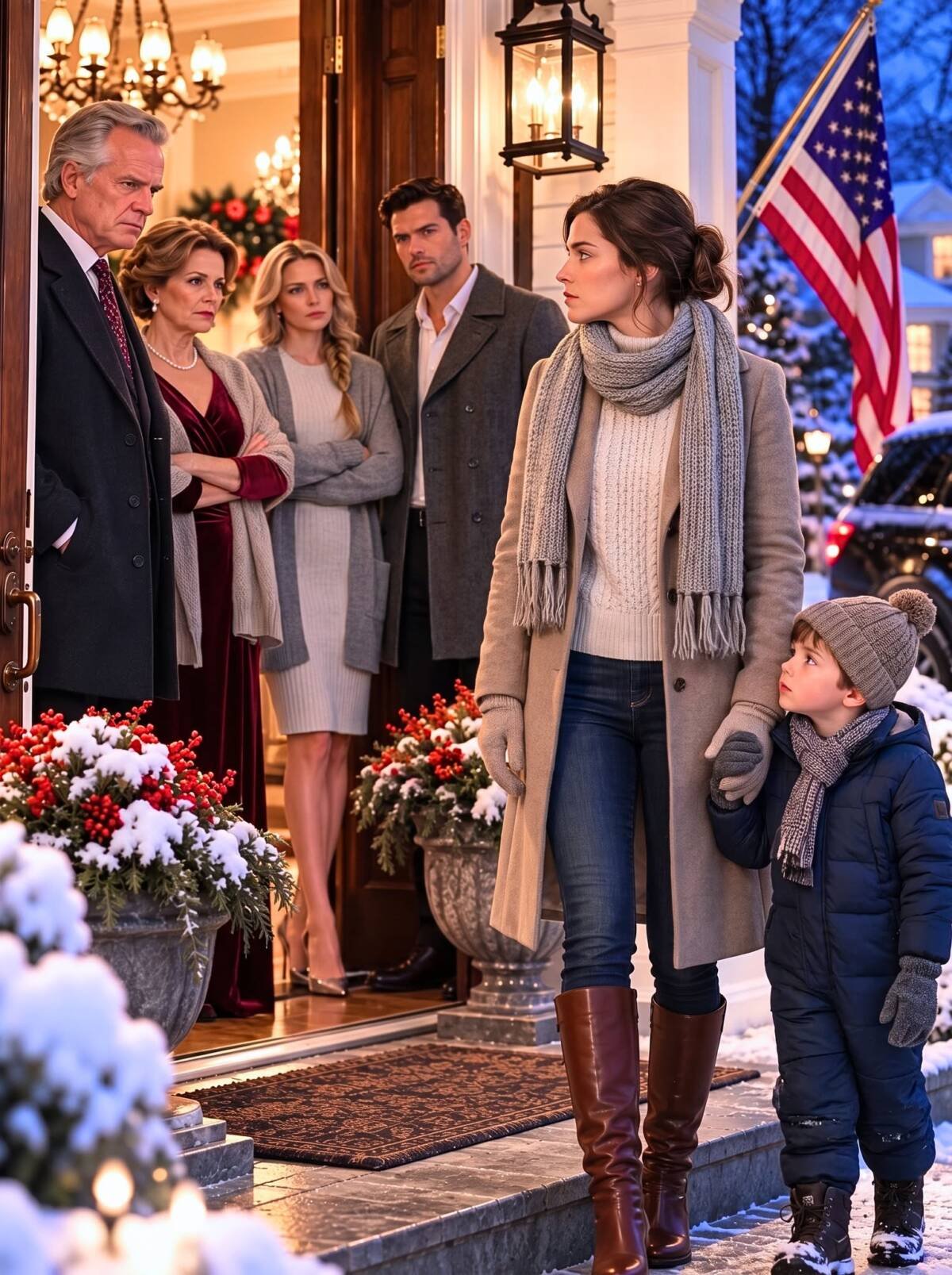
After nine years of financially supporting her parents, Naomi believed she was helping her struggling family stay afloat. But when a devastating car accident left her hospitalized with a newborn at home, her mother refused to help because she was looking after her younger sister’s cat. Naomi canceled every payment. The next morning, her grandfather arrived with a folder that exposed a family secret—and an inheritance that could change everything.
Introduction: The Phone Call That Changed Everything
The first time my mother called after my car accident, she didn’t ask whether I could breathe.
She didn’t ask whether my broken ribs were healing, whether my punctured lung was getting better, or whether my six-week-old daughter, Nia, was safe at home.
Instead, she opened the conversation by shouting.
“Naomi, what did you do to our money?”
I lay in a hospital bed with one arm immobilized in a cast, every breath sending pain through my chest. My daughter rested against me, small and warm beneath her blanket. My husband, Marcus, stood nearby, exhausted after spending hours trying to get home.
Across the room, my grandfather sat quietly with a thick manila folder resting on his lap.
At the time, I had no idea what was inside it.
I also had no idea that the woman demanding an explanation for her missing money had spent years hiding the truth about my family’s finances.
For nine years, I had helped my parents pay their bills. I had covered what I believed were mortgage payments, medical expenses, household costs, and occasional financial emergencies involving my younger sister, Kendra.
The monthly transfers totaled $4,500.
Over the years, my contributions had reached approximately $486,000.
I had never considered that money a burden. I thought I was doing what a responsible daughter should do when her family needed help.
But three days before that phone call, a delivery truck had run a red light and struck my car on King Street. I suffered three fractured ribs, a punctured lung, and a broken arm.
My mother had known I was seriously injured.
She had also known that my infant daughter needed someone to care for her while my husband tried to get home.
She had refused to help.
Her reason?
My sister was on a Caribbean cruise, and Mom had promised to look after her cat.
That decision changed the way I saw my entire family.
I canceled every automatic payment.
For the first time in nine years, I stopped feeling responsible for keeping everyone else financially comfortable.
I thought that would be the end of it.
I was wrong.
The following morning, my grandfather walked into my hospital room, placed the folder on my bedside table, and looked directly at me.
“Naomi, there’s something you need to know about where your money has really been going.”
Then he opened the folder.
The first document showed that my parents’ mortgage had been paid off six years earlier.
And that was only the beginning.
Part 1: The Emergency My Mother Refused to Answer
Three days earlier, my life had changed in a matter of seconds.
I was driving through an intersection on King Street when a delivery truck ran a red light. I remembered the sudden blast of a horn, the headlights filling my field of vision, and the terrible sound of metal collapsing.
Then everything went dark.
When I regained consciousness, I was in a hospital room surrounded by monitors, medical equipment, and the quiet movements of nurses.
My chest hurt whenever I breathed. My arm was in a cast, and the doctors were monitoring my punctured lung.
But my first thought wasn’t about myself.
It was Nia.
My daughter was only six weeks old. She needed regular feedings, clean diapers, and the kind of constant attention that only a very young infant requires.
Marcus had been traveling for work when the accident happened. He was stranded at an airport approximately six hours away and desperately trying to find another flight home.
Our babysitter had already stayed beyond her scheduled hours.
Marcus needed someone he could trust to take over until he returned.
Naturally, he called my mother.
Valerie lived only twenty minutes away. She had a reliable car, was retired, and regularly complained that Marcus and I didn’t bring Nia over often enough.
We assumed she would help.
Instead, she refused.
Kendra was away on a Caribbean cruise and had asked our mother to look after her cat. Valerie had agreed to take care of the animal and wasn’t willing to change her plans.
Marcus explained the situation carefully.
“Naomi has been seriously hurt. I don’t know how long it will take me to get home. Nia needs someone to take care of her.”
My mother remained unmoved.
“Kendra is counting on me,” she reportedly told him.
“Mom, this isn’t about Kendra. Naomi was in an accident.”
“She has a sitter, doesn’t she?”
“The sitter can’t stay indefinitely.”
There was a pause.
Then my mother said something Marcus would remember long after the conversation ended.
“Naomi always figures things out.”
He tried one more time.
“She has broken ribs and a punctured lung. She’s in the hospital.”
But Valerie had already made her decision.
She was staying home with Kendra’s cat.
When Marcus later told me what had happened, I felt something inside me go quiet.
I didn’t scream. I didn’t argue. I didn’t call my mother to demand an explanation.
I simply accepted that I could no longer count on her to show up when it mattered.
I contacted Bright Harbor Care, an emergency infant-care agency we had researched before Nia was born.
Within forty-two minutes, a caregiver named Marisol sent me a photograph of my daughter sleeping peacefully in her bassinet.
Only then did I open my banking app.
I wanted to understand how much financial support I had been providing and how quickly I could stop it.
Four recurring transfers appeared on my screen.
Mortgage Support. Medical. Household. Loan K.
Together, they totaled $4,500 each month.
I had been making those payments for nine years.
I opened a calculator and entered the figures.
$4,500 multiplied by twelve months.
Then multiplied by nine years.
The result was $486,000.
I stared at the number.
Nearly half a million dollars.
I had paid it because I believed my parents were struggling. I had convinced myself that their security was partly my responsibility and that my sister occasionally needed help getting back on her feet.
Meanwhile, Marcus and I had been careful with our own money.
We bought secondhand nursery furniture. We delayed purchases we didn’t urgently need. We discussed major expenses before committing to them.
I had even postponed vacations because I worried that my parents might need another payment.
And now, while I lay in a hospital bed recovering from a serious accident, my mother had refused to help with her own granddaughter because of a cat.
I canceled every transfer.
One by one, the scheduled payments disappeared from my screen.
For the first time, I didn’t feel guilty.
I felt free.
The First Person Who Showed Up
Marcus finally made it home the following morning.
When he entered my hospital room carrying Nia, I began to cry.
He placed her gently against my chest, supporting her carefully so she wouldn’t put pressure on my injuries.
“She’s okay,” he whispered. “We’ve got her.”
I looked at my daughter’s face and felt the fear that had been sitting in my chest since the accident begin to loosen.
For the first time in days, I believed someone meant what they said.
A few minutes later, there was a knock at the door.
My grandfather stepped inside.
He looked older than I remembered, his shoulders slightly hunched and his expression unusually serious. He carried a thick manila folder.
“I heard what happened,” he said.
“I don’t want to talk about Mom.”
“I understand.”
He placed the folder on the bedside table.
“But you need to see this.”
He opened it and removed a document.
It was a mortgage satisfaction statement connected to my parents’ home.
I recognized the address immediately.
Then I noticed the date.
Six years earlier.
I looked at Grandpa.
“What am I looking at?”
He took a slow breath.
“Your parents paid off their mortgage six years ago.”
I stared at him, waiting for him to explain that I had misunderstood.
“That can’t be right. I’ve been sending Mom mortgage money every month.”
“I know.”
“Then why was she still asking me to pay it?”
Grandpa looked down at the folder.
“That’s what we need to find out.”
For the first time, I wondered whether the financial emergencies I had spent nine years solving were real at all.
Part 2: Where Nearly Half a Million Dollars Really Went
Grandpa turned to the next section of the folder.
The documents included financial statements, account summaries, and records connected to expenses my mother had repeatedly described as urgent.
I had expected to see evidence that my parents had struggled more than I realized.
Instead, the records suggested that their financial situation was considerably more stable than I had been led to believe.
Their mortgage had been paid off years earlier.
Several outstanding medical debts had already been settled.
My father’s prescriptions were covered by insurance, according to the records Grandpa showed me.
And one of their savings accounts held more than $300,000.
I looked at the documents, trying to make sense of the figures.
“Then why did she keep asking me for money?”
Grandpa didn’t answer immediately.
He opened another section of the folder.
This time, Kendra’s name appeared repeatedly.
There were records connected to a condominium, a vehicle, credit-card payments, and personal expenses.
Marcus leaned over to examine the pages.
“Are you saying Naomi’s money paid for all of this?”
“Some of the records suggest that money Naomi sent to her parents was used to cover expenses connected to Kendra,” Grandpa replied. “But we need a complete accounting to determine exactly where every dollar went.”
I felt sick.
I thought about the secondhand crib Marcus and I had bought because we wanted to save money.
I thought about the vacations we had postponed, the household repairs we had delayed, and the times I had transferred money to my parents even when my own budget was tight.
Then I thought about Kendra on a Caribbean cruise.
I had believed my family needed my help to survive.
The records suggested that some of the money I had provided might have helped finance a lifestyle I could never have justified for myself.
But Grandpa had not brought the folder merely to show me financial statements.
There was another document.
And this one changed everything.
The Inheritance My Grandmother Left Behind
“Your grandmother left you something,” Grandpa said.
I looked up.
“What do you mean?”
“Your grandmother wanted you to have financial security. Your mother was supposed to explain everything when you turned twenty-five.”
I was thirty-four.
Nine years had passed since that birthday.
Grandpa placed an older legal document in front of me.
At the top was my full legal name: Naomi Evelyn Brooks.
Beneath it was a list of assets that included a twelve-unit apartment building, an investment account, and a house on Willow Lane.
I recognized the address before I finished reading it.
It was my parents’ home.
I looked at Grandpa.
“Why is their house listed here?”
“Because your grandmother placed it in a trust for you.”
I couldn’t speak.
For years, my mother had described the house as a financial burden that I was helping her and Dad carry. She had told me about mortgage payments, rising household expenses, and the possibility that they might lose their home if I stopped helping.
Now I was learning that the property had apparently been included in an inheritance intended for me.
Grandpa explained that my grandmother had established a trust to provide long-term financial security for me. Valerie had been appointed to manage it until I turned twenty-five.
At that point, my mother was supposed to explain the arrangement and help transfer control according to the trust’s terms.
“What happened when I turned twenty-five?” I asked.
Grandpa showed me another document.
It appeared to extend my mother’s authority over the trust.
At the bottom was a signature that looked similar to mine.
I examined it closely.
Then I shook my head.
“I never signed this.”
Grandpa closed his eyes.
“I suspected you hadn’t.”
Marcus picked up the document.
“Are you saying someone forged her signature?”
“That’s what the attorney needs to determine,” Grandpa said. “The signature appears questionable, and the circumstances require a formal investigation.”
The words landed harder than the accident itself.
For nine years, I had worked overtime, managed expenses carefully, and sent money to people I believed were struggling.
I had sacrificed my own comfort because I thought I was helping my family remain financially secure.
Meanwhile, my grandmother had apparently established an inheritance that could have provided security for me long before I became a mother.
I looked at Grandpa.
“Why are you telling me now?”
He explained that he had questioned Valerie about the trust several times over the years.
Each time, she insisted that I had chosen to let her continue managing everything because I supposedly didn’t understand investments.
When Grandpa asked for documentation, she showed him the paper containing the disputed signature.
He admitted that he had accepted her explanation for too long.
“I wanted to believe she was telling the truth,” he said. “I thought I was protecting the family by avoiding a confrontation.”
I looked at him.
“And what did that protect me from?”
He had no answer.
The Question That Made My Mother Go Silent
Two months earlier, Grandpa had learned that Valerie was discussing a possible sale of the apartment building.
That raised questions because he remembered my grandmother’s original intentions for the property.
He contacted an attorney familiar with the trust and began asking for records.
The preliminary review uncovered unexplained transfers, missing distributions, and documents that required further examination.
Then my accident happened.
Grandpa called my mother to ask whether she was helping with Nia.
Valerie told him she couldn’t leave Kendra’s cat.
He asked why she couldn’t arrange for someone else to look after the animal.
Her response was revealing.
“Naomi can afford to hire someone.”
Grandpa said that was the moment he stopped accepting her explanations.
Later that afternoon, my mother called again.
“Naomi! I’ve been trying to reach you.”
“I’m in the hospital, Mom.”
“I know that. But we have a serious problem.”
“What problem?”
“The transfers. You canceled everything.”
“Yes.”
Her voice rose.
“You can’t just stop supporting your family without warning.”
I looked at Nia, who was sleeping peacefully beside me.
“Apparently, I can.”....